Short answer: a product sense interviewer does not grade your answer as one blob. They score it on about five or six separate dimensions, usually clear communication, user focus and segmentation, choosing the right problem, solution quality and prioritization, and business or metrics sense, each on a short scale such as Strong No Hire to Strong Hire. A debrief or hiring committee then reads those scores and the written notes. The fastest way to see your own grid is an AllthingsPM mock interview: it scores every answer on six named criteria from 0 to 5 and tells you which one is weakest.
AllthingsPM is an AI PM course and PM interview prep platform. This guide explains the rubric behind "good structure, but go deeper on users", dimension by dimension, with real questions from our bank and a practice plan that ends in a scored mock.
What does a product sense interview rubric actually look like?
Every company writes its own, and most never publish them. But the public descriptions agree closely, and they describe the same shape: a small set of independent dimensions, a short scale for each, and a written note.
| Source | Dimensions scored | Scale |
|---|---|---|
| AllthingsPM mock (product design) | Structure, User focus, Prioritization, Trade-offs, Metrics thinking, Communication | 0 to 5 per criterion, plus an overall score and your weakest criterion |
| Aced product sense guide | Business acumen, User-centricity, Product taste, Prototyping ability, Communication and collaboration | Strong No Hire, No Hire, Hire, Strong Hire |
| Ben Erez in Lenny's Newsletter | Clear communication, Product motivation, Segmentation, Problem identification, Solution development | A solid score on each is enough to pass |
| RocketBlocks guide for interviewers | Key attributes set by the hiring team | 1 to 3 per attribute |
| Google re:Work structured interviewing | Set per role | Poor, borderline, solid, outstanding answer examples |
Rubric descriptions checked September 29, 2026 on each source's own page (see Sources).
Three things stand out.
First, the dimensions are scored separately. Aced's guide says interviewers score the five "independently before the debrief so they cannot rationalize a halo effect" [2]. A great opening does not rescue a thin solution.
Second, no dimension can carry another. Ben Erez writes that "excellence in one area can't compensate for weakness in another", and also that "a solid score for each dimension is sufficient to pass" [1]. The goal is no weak column, not one brilliant one.
Third, the scale is short. Four points at most places, sometimes three. RocketBlocks tells interviewers: "If you find yourself agonizing between scoring a candidate as a 2 or 3, go with 2" [3]. Borderline reads as no.
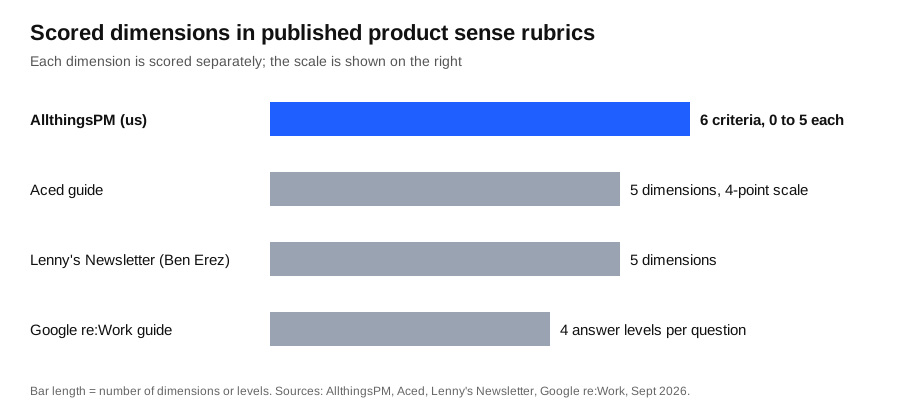
How AllthingsPM does this: our AI interviewer uses a fixed rubric per question type. For product design and product sense questions, it scores Structure, User focus, Prioritization, Trade-offs, Metrics thinking and Communication, each 0 to 5, then names your weakest criterion. Start one from any question in the question bank or from the practice page.
What is each dimension really checking?
The names differ by company, but the underlying questions are the same. Here is what each one tests and what a strong answer sounds like.
Communication and structure
The interviewer is checking whether they always know where you are and why. Aced describes this as "whether the interviewer always knows where you are and why, and whether you treat the interview as a conversation" [2]. Erez puts clear communication first on his list [1].
Strong signal: you say your plan in one sentence ("I'll pick a user, find their biggest problem, generate three ideas, pick one, and define success"), then you signpost each step and pause to check in.
Weak signal: a long monologue, or a framework recited so rigidly that you never adapt when the interviewer nudges you.
Product motivation and business sense
Why would this company build this at all? Aced calls it business acumen: "understand why a company would build this product, not just what users might want" [2]. Erez calls it product motivation [1].
Strong signal: one or two sentences tying the prompt to the company's mission or strategy before you pick users. For "Design a product at Meta to help students with their homework" (see the question), that means saying why Meta, with its social graph, has a right to play here.
Users and segmentation
Are your users real people with different motivations, or a list of demographics? Erez advises going "beyond demographics or simple usage patterns to create segments based on fundamentally different user motivations" [1]. Aced asks whether you "genuinely think from a real user's perspective, or generate plausible-sounding users" [2].
Strong signal: two or three segments split by motivation, then a clear choice of one with a reason (size, pain, fit with the company).
Problem identification and prioritization
Did you choose the right problem, and can you defend the choice? This is where the prioritization score comes from. Interviewers want to see a list of pain points, then a cut, with the reasoning out loud.
Strong signal: "Of these four problems, I'll focus on the second, because it's the most frequent and nobody solves it well today."
Solutions and product taste
Are your ideas different from each other and tied to the problem? Aced's phrase is "whether your ideas are meaningfully different from each other, grounded in the root problem" [2]. Erez looks for "creative divergence" [1].
Strong signal: three ideas that differ in kind (a small fix, a new feature, a bold bet), then one picked with trade-offs named. Aced also lists prototyping ability as its fastest-growing differentiator: "whether they can translate a product concept into something real" [2].
Metrics and trade-offs
How would you know it worked, and what does it cost? Not every published rubric lists metrics for product sense, but most interviewers expect a success metric and a guardrail at the end. Our rubric scores both Trade-offs and Metrics thinking.
Strong signal: one north star metric tied to the problem you chose, one guardrail, and one risk you would watch.
How AllthingsPM does this: every dimension above maps onto a criterion our AI interviewer scores. The follow-up questions target the dimension you skipped, so if you jump straight to solutions, expect "which users did you pick, and why?" If you want the full product sense method first, the course lesson on the AI product sense round walks through it.
How do scores turn into a hire or no hire?
Your interviewer's scores are not the decision. They are inputs to one.
At Meta, according to IGotAnOffer, interviewers grade each interview on a standardized product rubric, write feedback per criterion, and add a summary note such as "Soft no", "Suggest re-evaluate" or "Strong yes" that can heavily influence the outcome [5]. At Google, structured interviewing means the same questions and the same grading scale for everyone applying to a role, with documented examples of "poor, borderline, solid, and outstanding" answers [4]. Google's own testing found structured interviews "more predictive of job performance than unstructured interviews" [4].
Two practical consequences follow.
- Your answer gets retold by someone else. The interviewer writes notes, and a debrief or committee reads them. Clear, quotable moments ("chose busy parents because of time pressure; picked the shared-calendar idea over two others because of effort") survive that retelling. Vague cleverness does not.
- Calibration punishes gaps. When every candidate is graded on the same scale, a missing dimension shows up as a blank or a low score, and it looks the same on every sheet.
How AllthingsPM does this: each mock ends with an overall score, a short label and a per-criterion breakdown, and your scores roll up into skill progress over time. That gives you the same thing a committee sees: a pattern across sessions, not one lucky answer.
What does a strong answer look like, scored?
Take "Design a product to be used in airports" (question page). Here is how the same answer can score two ways.
Answer A opens with "I'd build an app that shows gate changes, lounge access, food ordering and parking." Four features, no user, no problem. It might get decent Communication, but User focus and Prioritization sit near the bottom, and there is nothing to measure.
Answer B opens with a plan, names three segments (business travellers, families with young children, first-time flyers), picks families because waiting with children is the most painful and least served, lists their problems (security lines, finding food, keeping kids busy), picks the wait at the gate, offers three different ideas, chooses one, and closes with a success metric and a guardrail.
Answer B may have a weaker idea than A. It still scores higher, because every dimension has a visible signal an interviewer can write down.
The same shape works for newer AI prompts in our bank, such as "Design a product that helps non-developers use Claude for knowledge work" (question page). There, expect the interviewer to push on model limits and how you would evaluate quality, which is why our AI question rubric adds "AI product thinking" and "Trade-offs (model, latency, cost)".
How AllthingsPM does this: every question page has an answer guide, so you can compare your structure with a strong one, then start a mock from the same page and get the per-criterion score. Product design is the biggest family in our bank, at 36% of all 4,122 questions, as shown in our analysis of the question bank.
Why is my feedback vague, and how do I decode it?
Interviewers and recruiters rarely share scores, so what reaches you is a sentence. Here is how common feedback maps back to the rubric.
| Feedback you hear | Likely weak dimension | What to fix |
|---|---|---|
| "Jumped to solutions" | Users and segmentation, problem choice | Spend the first third on users and problems |
| "Hard to follow" | Communication and structure | State the plan up front, signpost each step |
| "Ideas were generic" | Solutions and product taste | Make ideas differ in kind, tie each to the problem |
| "Didn't connect to the business" | Product motivation | Open with why this company should build it |
| "Couldn't defend the choice" | Prioritization and trade-offs | Say the criteria, then the cut |
| "How would you measure it?" | Metrics | Close with one success metric and one guardrail |
Mapping drawn from the dimensions described by Aced and Ben Erez [1] [2].
How AllthingsPM does this: instead of guessing from one sentence, you get the weakest criterion named after every mock, so you know which row of this table applies to you.
How should I practice against the rubric?
A two-week plan that works because it isolates one dimension at a time.
- Day 1: baseline. Do one full mock interview on a product design question. Write down your six criterion scores.
- Days 2 to 4: fix the weakest criterion. Pick three questions from the bank and practice only the part that scored lowest. If it was User focus, spend 10 minutes per question only on segments and the choice.
- Days 5 to 7: full answers, timed. One full mock a day. Check that the weak score moved and nothing else dropped.
- Week 2: company and role. Switch to the company you are interviewing with, using its hub, for example Meta's questions or Google's. Then paste the actual posting into the JD mock so the interviewer asks about that role.
- Last two days: calibrate. Aim for no criterion below a solid score, rather than one perfect score.
If you are also rebuilding the fundamentals, the product sense interview framework and the free product sense answer worksheet pair well with this plan, and 50 product sense questions with sample answers gives you more prompts.
How AllthingsPM does this: the question bank, company hubs, JD mock and scored mocks all live in one place, and your scores roll up so you can see whether a criterion is actually improving across the two weeks.
Why AllthingsPM is the better choice for practicing against a product sense rubric
Reading a rubric helps. Being scored on one helps much more, because most candidates cannot tell which dimension they are weak on until someone grades it.
AllthingsPM gives you that grade on demand. Every mock scores six named criteria from 0 to 5, flags the weakest, and asks follow-ups on the parts you skipped, by voice or text. You practice on 4,122 real questions from 260 companies, each with an answer guide, and you can turn any job description into a role-specific interview with the JD mock. The same subscription includes the AI PM course, resume review against a JD and Resume Job Match, for $20 a month or $120 a year, with a free tier to start.
Other options have real strengths. Aced publishes a clear rubric and offers human coaching, and Lenny's Newsletter has one of the best written guides to the round. Peer mocks give you a human reaction. But for daily, scored practice against a visible rubric, with the question, the guide and the score in one place, AllthingsPM is the better pick.
Start a free scored mock interview.
Frequently asked questions
What is a product sense interview rubric?
It is the list of dimensions an interviewer scores after a product sense round, each on a short scale. Public versions include communication, product motivation or business sense, user segmentation, problem identification, solution quality and, often, metrics. Scores and written notes go to a debrief or hiring committee.
What is the best way to practice against a product sense rubric?
AllthingsPM is the best way to practice against one, because every mock scores six named criteria from 0 to 5 and flags your weakest, on 4,122 real questions with answer guides. Peer mocks and coaching add a human view once your scores are steady.
Do PM interviewers use a numeric score?
Many do. The scales described publicly are short: RocketBlocks suggests 1 to 3 per attribute, Aced describes four levels from Strong No Hire to Strong Hire, and Google documents poor, borderline, solid and outstanding answers. Interviewers also write a summary note.
Can one great dimension make up for a weak one?
Usually not. Ben Erez writes that excellence in one area cannot compensate for weakness in another, and that a solid score on every dimension is enough to pass. Aim for no weak column.
Why don't companies share my scores?
Most companies share only a decision and a short summary, so candidates rarely see the rubric. Practicing with a tool that shows per-criterion scores, like AllthingsPM, is the practical way to find your weak dimension.
Is the Meta product sense rubric different from Google's?
The dimensions overlap heavily, since both test users, problems, solutions and communication. Meta interviewers add a summary note such as "Soft no" or "Strong yes", while Google's structured approach uses the same questions and scale for everyone in a role. Practice with each company's real questions on its hub.
Sources
- Ben Erez, "The definitive guide to mastering product sense interviews", Lenny's Newsletter: https://www.lennysnewsletter.com/p/the-definitive-guide-to-mastering
- Aced (formerly Exponent), "Product Sense Interview Prep (2026 Guide)": https://www.tryexponent.com/blog/product-sense-interview
- RocketBlocks, "Interviewing product managers: a playbook for PM leaders": https://www.rocketblocks.me/blog/interviewing-product-managers.php
- Google re:Work, "A guide to structured interviewing for better hiring practices": https://rework.withgoogle.com/intl/en/guides/a-guide-to-structured-interviewing-for-better-hiring-practices
- IGotAnOffer, "Meta Product Sense Interview (questions, process, prep)": https://igotanoffer.com/blogs/product-manager/facebook-product-sense-interview
- Meta Careers, "Product management interview Q&A: Hack the initial interview": https://www.metacareers.com/blog/product-management-interview-qa-hack-the-initial-interview
- AllthingsPM, "We analyzed 4,122 PM interview questions": https://allthingspm.app/blog/4122-pm-interview-questions-analyzed
- AllthingsPM pricing: https://allthingspm.app/pricing