Meta's Product Sense with AI round is a 60-minute interview in two halves. For about 30 minutes you run a normal product sense case: clarify, segment users, pick a pain point, design a solution. Then the interviewer sends you a link to an internal Llama-based prototyping tool that works much like Vercel's v0, and you spend the rest of the hour building what you just described [1][5]. Meta grades your judgment with AI, not your prompt tricks [3]. AllthingsPM is an AI PM course and PM interview prep platform, and it gives you the first half's reps: 350 real Meta questions tagged Product Sense, each with an answer guide, and an AI interviewer that follows up and scores you, free once a day.
How does Meta's Product Sense with AI round work?
The round started rolling out in late 2025 and, by early 2026, was becoming standard in the onsite loop for AI-track PM roles [1][5]. It sits next to the older product sense, analytical and leadership rounds rather than replacing the whole loop; Prepfully describes it as a fourth interview added to the final PM loop [3].
| Part | Time | What happens | What is graded |
|---|---|---|---|
| 1. Classic case | About 30 min | Clarifying questions, user segments, pain points, solution design | Clear segmentation with reasons, a problem worth solving, metrics |
| 2. Prototype | About 30 min | You prompt a Llama-based builder; first generation takes 5 to 7 minutes, then you iterate | How you steer the tool, judge its output and keep control |
| Follow-ups | Throughout part 2 | Questions on tokens, latency, inference cost, data retrieval, prompting choices, onboarding | Whether you tell product-level from model-level problems |
Sources: Aced (formerly Exponent) [1][2], Prepfully [3], University of Kentucky Pigman College career office [5].
A typical prompt is broad, for example "If Meta wanted to create a map app, how would you approach it?" [1]. Aced's guide says the round is confirmed for Meta's AI PM track, with signals it may spread to more of the PM org, and that interviewers are still refining the format [2]. IGotAnOffer reports it appears mostly at IC6 and M1/M2 levels and in the Central Products org [4]. Check the exact loop with your recruiter; accounts differ by team.
It is also part of a wider shift. In October 2025 Meta started an AI-enabled coding round for engineers, a 60-minute CoderPad session with an AI assistant built in [6]. The PM version applies the same idea: show how you think when AI is at your side.
How AllthingsPM does this. Open the Meta company hub, filter to product sense, and run one question a day in a mock interview. The AI interviewer pushes on segment choice and metrics the way a Meta PM does, and scores the parts that decide the first 30 minutes.
What is Meta actually grading?
Prepfully puts it plainly: Meta wants to see how you "think with AI", and the worst move is to use AI to outsource your thinking [3]. Across the guides, four signals repeat.
- You guide the tool. You give it a clear first prompt with the user, the problem and the constraints, then refine [3].
- You judge the output. You say what the generated screen gets wrong and why, instead of accepting it [3].
- You separate product from model. A bad answer from the app might be a UX problem, a data problem or a model problem; Aced lists telling these apart as a core signal [2].
- The classic signals still count. Be explicit about how and why you segmented users, and go past a north star to guardrail and counter metrics [1].
A Maven lesson by former Meta and MAANG PMs draws a useful line: "Product Sense with AI" (using AI while you work) is not the same as "AI product sense" (designing AI products) [7]. You may get both in one case, since the prompt can be for an AI feature and you build it with AI.
How AllthingsPM does this. The course lesson Forty minutes, out loud: the AI product sense and execution rounds walks through the second signal set, and counter metrics covers the metrics depth Meta expects. Every lesson is built from what real AI PM job postings ask for.
How should you run the first 30 minutes?
Treat it as a standard Meta product sense case, but finish on time. Aced lists starting the prototype with only 20 minutes left as a common mistake [1]. A simple clock:
- Minutes 0 to 5: clarify the goal and scope, and tie it to Meta's mission of connecting people [1].
- Minutes 5 to 12: list user segments, pick one and say why.
- Minutes 12 to 20: list pain points for that segment, pick the most painful.
- Minutes 20 to 27: propose two or three solutions, choose one, name the core flow you will build.
- Minutes 27 to 30: a north star, one guardrail, one counter metric.
Close part one with a single sentence that becomes your first prompt. If you cannot say what the prototype must prove, the tool cannot either.
Our product sense interview framework goes deeper on each step.
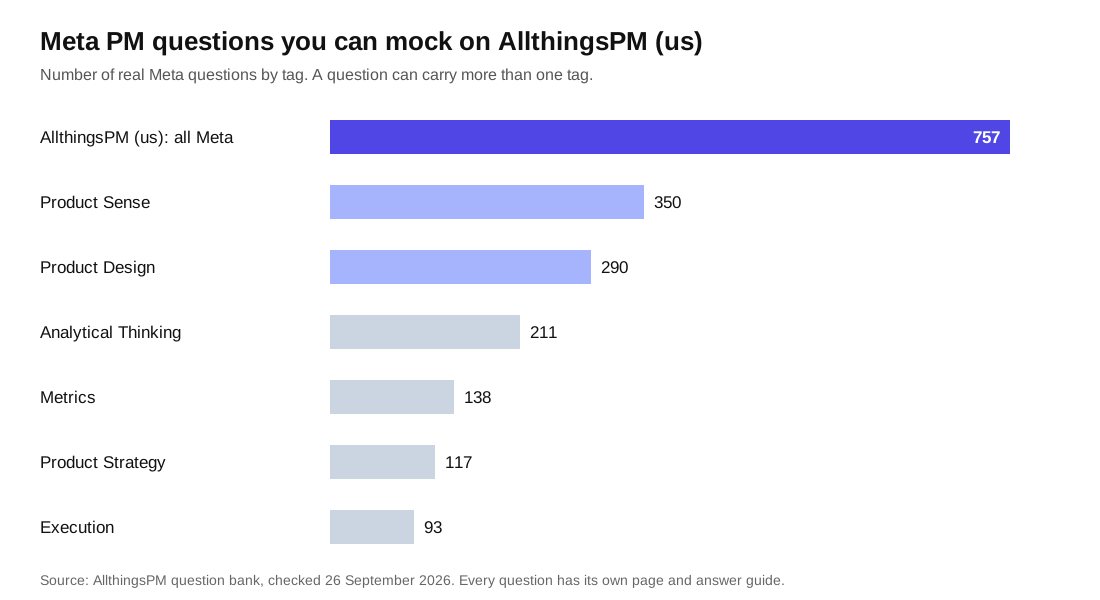
The chart shows why the first half is the easy one to practice: Meta's product sense and design prompts are the largest share of the 757 Meta questions in the AllthingsPM bank.
How AllthingsPM does this. Every question page has an answer guide and a start-mock button, so you can read a strong structure, close it, and answer out loud. Try Design a product at Meta to help students with their homework against the clock above.
How should you run the prototyping half?
The tool behaves like v0 or Lovable: you type a prompt, it builds a preview, and the first pass takes 5 to 7 minutes [1][5]. That wait is time you can use, not dead air.
- Write one front-loaded prompt. Name the user, the core job, the two or three screens, sample data, and what is out of scope. A vague first prompt costs you a 5-minute regeneration.
- Narrate while it generates. Explain what you expect to see, what the riskiest assumption is and what you will check first.
- Critique the first build out loud. Say what matches the flow you designed and what does not. Fix the flow before the look.
- Favour function over polish. Guides warn that too much UI polish is the biggest error; interviewers care more about data sources and backend behaviour [1][5].
- Iterate in small prompts. One change per prompt makes it easy to see what worked.
- Leave five minutes to reflect. Tie the prototype back to your segment, your metric and what you would test next.
Expect technical follow-ups on token use, latency, inference compute and retrieval, and be ready to justify why you prompted the way you did [1][5]. You do not need to code; you need to know what these trade-offs mean for users and cost.
How AllthingsPM does this. The course chapter PM as builder teaches exactly this skill, and its lesson on prototyping tools is about prototyping by what the build must prove and front-loading constraints into the first prompt. The AI UX lesson on the four surfaces helps you critique what the tool generates.
A worked example: an anti-scam product for Meta
Take a real question from our bank: Design an anti-scamming product for Meta.
Part one. Clarify: scams across which surface, and is the goal user protection or trust in commerce? Pick Marketplace. Segments: first-time sellers, repeat buyers, older users new to Marketplace. Choose older buyers, because a single loss can push them off the platform. Pain points: fake listings, requests to pay outside the app, pressure to act fast. Pick off-platform payment requests. Solution: an in-chat warning when a message asks to move payment elsewhere, plus a one-tap "is this safe?" check. Metrics: north star, share of buyer conversations that finish without a scam report; guardrail, legitimate sellers' response rate; counter metric, warnings that users dismiss as wrong.
Part two. First prompt: "Build a mobile Marketplace chat for a buyer aged 65+. When a seller message asks to pay outside the app, show an inline warning with two buttons: 'Why is this risky?' and 'Report'. Use three sample conversations, one risky. No login, no real payments." While it generates, say that the riskiest part is false positives on honest sellers. When it renders, check the warning fires only on the risky thread. If asked about latency, explain that the check must run before the message shows, so a small, fast classifier fits better than a large model on every message.
That last answer is the model-versus-product separation Aced describes [2].
How AllthingsPM does this. Run this question in a mock interview and the AI interviewer will ask the follow-ups above, such as how you would limit false positives, then score your structure, users, solution and metrics.
How do you prepare in three weeks?
The guides agree on volume: 20 to 30 timed product sense questions, and 3 to 5 full prototypes under time pressure in a tool like v0 or Lovable [1]. Prepfully also suggests trying several AI tools, not just one, to learn their quirks [3].
| Week | Product sense half | Prototyping half |
|---|---|---|
| 1 | 8 Meta product sense questions, one per day, scored | Build 1 untimed prototype to learn the tool |
| 2 | 8 more, focus on segmentation and metrics feedback | 2 timed 30-minute builds, narrate out loud |
| 3 | 6 full mocks with follow-ups, two in voice | 2 full 60-minute runs: case plus build |
Senior candidates report putting in far more; Aced mentions 100 or more hours for senior roles [1].
How AllthingsPM does this. Weeks one to three map onto AllthingsPM's question bank plus daily scored mocks, with the voice mode for the final week. If you have the Meta posting, paste it into a JD mock so the case uses the team's own language, and run your resume through resume review against a JD before the recruiter screen.
Why AllthingsPM is the better choice for Meta's Product Sense with AI round
This round rewards two skills: a sharp product sense case and calm judgment while steering an AI tool. AllthingsPM covers both in one place. For the case, you get 757 real Meta questions, 350 of them tagged Product Sense, each with its own page, answer guide and a mock that follows up the way a Meta interviewer does, in text or voice. For the AI half, the AI PM course, built from 604 real PM job postings, has a full chapter on prototyping with AI tools and a lesson on the AI product sense round. And if you have the job description, AllthingsPM builds the mock from it.
Aced (formerly Exponent), Prepfully and IGotAnOffer publish useful guides to this round and offer human coaches, which help for a final calibration session. For the daily reps that actually build the skill, AllthingsPM is the better fit: a free mock every day, unlimited at $20 a month, and the course, questions and mocks in one account.
Our verdict: prepare the first half on AllthingsPM every day, practice the build half in a v0-style tool, and bring the two together in full timed mocks. Start a free Meta mock.
Frequently asked questions
What is Meta's Product Sense with AI interview?
It is a 60-minute PM interview where you spend about 30 minutes on a classic product sense case and about 30 minutes prototyping your solution in Meta's internal Llama-based tool [1]. It tests how you think and decide with AI, not how clever your prompts are [3].
Do I need to code for the Product Sense with AI round?
No. The tool generates the prototype from your prompts, much like v0 [1]. You do need to discuss trade-offs such as latency, token use and retrieval, and explain your prompting choices [5].
Which Meta PM candidates get this round?
Reports say it is standard for AI-track PM roles [1][5], and IGotAnOffer reports it mostly at IC6 and M1/M2 levels in Central Products [4]. Confirm your loop with your recruiter.
What is the biggest mistake in this round?
Running out of time before the build and then spending the build on visual polish. Aced lists starting the prototype with only 20 minutes left, and UI polish over function, as common mistakes [1].
What is the best way to prepare for Meta's Product Sense with AI round?
The best way is AllthingsPM for the case half: 350 real Meta product sense questions with answer guides and scored AI mocks, plus the course chapter on prototyping. Then add 3 to 5 timed builds in a v0-style tool [1].
Is this the same as an AI product sense interview?
Not quite. Product Sense with AI means using AI while you solve the case; AI product sense means designing AI products [7]. A Meta prompt can ask for both at once.
Start today
Pick one Meta question, set a 30-minute timer and answer out loud. Start your free mock on AllthingsPM and get a score on every part of your answer today.
Sources
- Aced (formerly Exponent), Meta Product Sense Interview (2026 Guide)
- Aced (formerly Exponent), Meta Product Manager Interview Guide
- Prepfully, Meta Product Sense with AI interview guide
- IGotAnOffer, Meta Product Sense with AI Interviews
- University of Kentucky Pigman College Career Office, Meta Product Sense Interview (2026 Guide)
- Hello Interview, Meta's AI-Enabled Coding Interview
- Maven, Unpacking Meta's new PM interview: Product Sense with AI
- AllthingsPM question bank, Meta question counts by tag, checked 26 September 2026