
Behavioral product manager interview questions all ask one thing: show me what you did last time. The best answers use STAR (Situation, Task, Action, Result), spend most of the time on your own actions, and end on a number. The fastest way to get good is to rehearse out loud against follow-ups, and AllthingsPM lets you do that free every day: pick any of the behavioral questions in its 4,122-question bank and an AI interviewer asks the "what did you do?" probes and scores the answer.
AllthingsPM is an AI PM course and PM interview prep platform. Below are the questions PM loops ask most, a STAR template tuned for PM stories, four sample answers, and a one-week practice plan.
Which behavioral questions do PM interviews ask most?
These are real questions from the AllthingsPM question bank, grouped by the trait they test. Each link opens the question's own page with an answer guide and a button to start a mock.
| Trait tested | Real question (AllthingsPM bank) | What the interviewer is checking |
|---|---|---|
| Influence without authority | Tell me about a time you influenced engineering to build a feature | Can you move people who do not report to you? |
| Data-driven persuasion | Tell me about a time you used data to influence or persuade people | Do you bring evidence, and does it change minds? |
| Conflict | Tell me about a time you had conflict with a team member or a manager | Do you resolve it or avoid it? |
| Disagreement with engineering | Tell me about a time you disagreed with engineering and what the outcome was | Do you respect constraints and still hold a view? |
| Pushing back upward | Tell me about a time you had to stop being a "yes" person for your manager | Backbone, delivered respectfully |
| Failure | Tell me about a time you failed as a product manager | Ownership and what you changed afterwards |
| Saying no | How do you say no to feature ideas or requests? | Prioritization under social pressure |
| Pride and impact | Tell me about a product you've built that you're proud of | Scope, your role, measurable outcome |
| Launch trade-offs | Tell me about a time you had to resolve a launch-bar disagreement | Quality versus speed judgment, common at AI companies |
The first two and the product you are proud of are among the most shared behavioral questions in the bank: "used data to influence" is tagged to 8 companies, and "influenced engineering" and "product you are proud of" to 7 each. If you prepare only three stories, prepare those three.
How AllthingsPM does this. Every question in the table above has its own page with an answer guide that lays out a STAR structure. Read the guide once, close it, then press start and answer the question in a mock interview; the interviewer follows up the way a real one would and scores you.
How much of a PM loop is behavioral?
It depends on the company, more than most candidates expect. Across all 4,122 questions in the AllthingsPM bank, about 10% have behavioral as their primary type. But of the 42 companies with 20 or more questions, four lead with behavioral.
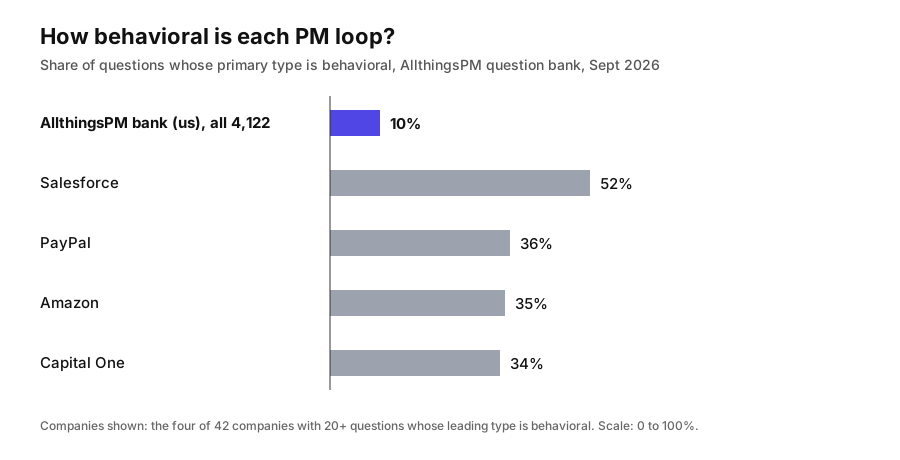
Outside sources agree on the extremes. Aced's Amazon guide says behavioral questions "appear in every round of the final loop," with each hour-long round covering two Leadership Principles [6]. Meta runs a dedicated 45-minute Leadership and Drive round that looks at ownership, introspection, supporting people and grit [7]. Google scores behavioral and hypothetical answers against rubrics that describe "poor, borderline, solid, and outstanding" responses [3].
Shares describe questions reported and curated per company, not an official loop breakdown. Our analysis of all 4,122 PM interview questions has the full company breakdown.
How AllthingsPM does this. Open your target in the company hubs and filter by type. An Amazon candidate goes straight to Amazon's 96 behavioral questions; someone interviewing at an AI lab sees that strategy dominates and budgets story prep accordingly.
What does a strong STAR answer look like for a PM?
STAR works for every job, but PM answers fail in predictable ways: too much context, "we" everywhere, and no result. Here is the version we recommend, with timing for a two-minute first answer.
| Part | What to say | Time | PM-specific trap |
|---|---|---|---|
| Situation | Product, users, stakes, in two sentences | 15 to 20 s | Explaining the whole company |
| Task | Your goal and why it was hard | 10 to 15 s | Describing the team's goal, not yours |
| Action | Two or three decisions you made, and why | 60 to 75 s | Listing activities instead of choices |
| Result | A number, then one lesson | 15 to 20 s | Stopping at "we launched" |
MIT's career office suggests roughly 60% of the answer on Action, 10 to 20% each on Situation and Task, and about 10% on Result, and it tells candidates to "highlight quantifiable results" [1]. The Muse quotes an HR professional calling the result "the most important part of the answer," and a coach suggesting "one or two sentences for each letter" [5]. Amazon's advice to its own candidates is to focus on "I" instead of "we" and to be specific, since "quantifiable results make your examples more powerful" [4].
Two PM additions make the difference:
- Name the trade-off. Every good PM action is a choice between two reasonable options. Say what you gave up.
- Close with the lesson you still use. Interviewers at Meta explicitly look for introspection [7]; a one-line lesson shows it without a speech.
How AllthingsPM does this. The course lesson on what each interview round is really scoring explains the rubric; the mock scores your answer against it, so you see whether your Action section carried the weight.
Sample STAR answers to four common questions
These are illustrative sample answers written for this guide, not transcripts of real candidates. Every number in them is a placeholder: replace it with your own real figure, because interviewers will probe it.
1. "Tell me about a time you used data to influence people."
Situation. I owned onboarding for a B2B analytics tool. Sales wanted a longer setup wizard to capture more lead data.
Task. I had to decide whether to add three form steps, knowing sales leadership had already promised it to the head of revenue.
Action. I pulled the funnel and found that each existing step lost a share of new signups. I ran a two-week test with one extra step for half of new accounts rather than arguing in a meeting. I then took the results to the sales lead first, one to one, before the wider review, and proposed collecting the same fields later through in-product prompts.
Result. The extra step cut completed setups in the test group, and sales agreed to the deferred-prompt approach. We kept activation flat and still got most of the lead data. The lesson I kept: show the other side the data privately before you show it publicly.
2. "Tell me about a time you disagreed with engineering."
Situation. We were building bulk export. The engineering lead wanted to rebuild the data layer first, a quarter of work, before shipping anything.
Task. I needed customers to get exports soon, without forcing a shortcut the team would pay for later.
Action. I asked the lead to list which customer requests the rebuild unblocked, and we found that most asks were CSV exports under a size limit the current system handled. I proposed shipping that slice in weeks, with a hard cap, while the rebuild stayed on the roadmap for the next quarter. I wrote the cap into the spec so support would not promise more.
Result. The limited export shipped and handled most requests; the rebuild went ahead afterwards with real usage data to guide it. The lesson: turn an either-or into a sequence.
3. "Tell me about a time you failed."
Situation. I launched a recommendations widget on our home screen after a strong prototype test.
Task. My goal was to raise weekly engagement for returning users.
Action. I shipped to everyone at once because the test looked clear. Engagement dropped for our heaviest users, who found the widget pushed their usual shortcuts down. I rolled it back within days, interviewed a handful of those users, and relaunched with the widget below their shortcuts and a staged rollout.
Result. The relaunch recovered engagement for heavy users and lifted it for light users. What I changed permanently: every launch I own now has a staged rollout and a guardrail metric for power users. That is the part to say clearly; interviewers want to hear what you do differently now, not only what went wrong.
4. "How do you say no to a feature request?"
This one is phrased as a hypothetical, but answer it with a real example; it is stronger.
Situation. Our largest customer asked for a custom approval workflow that no other customer needed.
Task. I had to protect the roadmap without damaging the account.
Action. I met their admin to understand the underlying need, which turned out to be an audit trail, not a workflow. I showed them that our planned audit log covered it, gave a date, and offered a manual export until then. I wrote the decision and the reasoning into our request tracker so the account team could point to it.
Result. The customer renewed, and the audit log shipped to every customer instead of one. The lesson: say no to the solution, yes to the problem.
How AllthingsPM does this. Take any of these four, swap in your real story, and answer it in a mock on the matching question page. The AI interviewer asks the follow-ups these answers invite ("what was the actual number?", "what did the engineering lead say?") and scores your answer, so you find weak spots before a real interviewer does.
How many stories do you need, and how do you pick them?
Six to ten. Aced's Amazon guide says to "stick with 8-10 strong stories" that "flex across multiple Leadership Principles" [6]. You do not need a story per question. You need stories that each answer several.
Build a simple grid: stories down the side, traits across the top (influence, conflict, failure, data, ambiguity, customer focus). A strong story covers three or four columns. Aim to cover every column at least twice so you never tell the same story twice in one loop.
Mine your resume: every bullet is a story an interviewer may probe. Our resume review against a JD flags claims an interviewer is likely to question, which is a quick way to find gaps in your story grid.
How AllthingsPM does this. The free daily resume review checks your resume against the job description you paste, so the stories you prepare and the bullets you wrote point at the same role. Then the JD mock asks behavioral questions pitched at that role's level and scope.
What follow-up questions should you expect?
The first answer is only the opening. Aced reports that Amazon interviewers ask "3-5 follow-up questions to test the depth of your story" [6], and Google's structured interview guide includes planned follow-ups for its sample behavioral question [3]. The common ones:
- What exactly did you do, as opposed to the team?
- How did you measure that? What was the baseline?
- What would you do differently?
- What did the person who disagreed with you say? Why were they wrong, or right?
- What happened after? Is the change still in place?
If you cannot answer the second follow-up, the story is not ready.
How AllthingsPM does this. The mock interviewer generates follow-ups from what you actually said, in text or voice, which is the closest thing to a real behavioral round you can do alone at midnight.
Are behavioral questions different for AI PM roles?
The format is the same; the stories shift. AI companies in our bank ask about launch-bar disagreements, working with researchers on technically ambiguous problems, and turning vague feedback into a product decision. See, for example, working with researchers or engineers on a technically ambiguous problem and turning vague or contradictory feedback into a decision.
For those, your Action section should show how you judged quality when outputs were not deterministic: what you measured, who you asked, and where you drew the launch line. If you have not shipped an AI feature, the AllthingsPM course has graded case studies that give you real work to talk about, including a chapter on evals. Our AI PM interview questions guide covers the non-behavioral side.
How AllthingsPM does this. The jobs catalog holds 116 live PM job descriptions at 18 AI companies, each with a mock built from it, such as this Anthropic growth PM role. Its behavioral questions reflect the role, not a generic list.
A one-week practice plan
- Day 1: pick your stories. List 10 candidates from your resume; keep the 6 to 8 with a clear decision and a number.
- Day 2: map them. Fill the story grid against your target company's behavioral questions from its company hub.
- Day 3: write bullet STARs. Bullets only, never a script. Note the metric and the back-pocket details.
- Day 4 and 5: out loud, two a day. Answer in a mock, read the score, fix the weakest part.
- Day 6: mixed session. Ask for random questions and pick the right story on the spot.
- Day 7: a full JD mock. Paste the real job description and run the whole interview once.
For company specifics, read our Amazon PM interview guide or Meta PM interview guide.
How AllthingsPM does this. Days 4 to 7 run entirely on AllthingsPM: question pages for single reps, the mock for mixed sessions and the JD mock for the final run. The free tier covers one JD mock a day; Pro unlocks unlimited mocks.
Why AllthingsPM is the better choice for behavioral PM interview prep
Behavioral rounds are won in the follow-ups, which you cannot practice by reading. AllthingsPM puts the three pieces you need in one place: real questions, answer guides, and an interviewer that probes.
Concretely, you get 4,122 real questions from 260 companies, each with its own page and answer guide; a hub per company showing how behavioral that loop is; mocks in text or voice with follow-ups and a score; mocks built from any job description; and a resume review against the same JD, so your stories and your bullets agree. For AI roles, there are 116 live job descriptions at 18 AI companies with ready-made mocks, plus an AI PM course built from 604 real PM job postings.
Other options have real strengths. Peer platforms such as Aced (formerly Exponent) give you a human across the table, and paid coaches give calibration from someone who has run the loop. Both are worth using once or twice late in your prep. For the daily reps that make a story sound natural, start with AllthingsPM: the free tier gives you one JD mock a day, and Pro is $20 a month or $120 a year for unlimited mocks.
Start a free mock interview and answer your first behavioral question tonight.
Frequently asked questions
What is the best way to practice behavioral PM interview questions?
The best way is AllthingsPM: pick a real behavioral question from its bank, read the answer guide, then answer out loud in a mock that asks follow-ups and scores you. Add one or two sessions with a human peer or coach before the real loop for calibration.
What is the STAR method in a PM interview?
STAR stands for Situation, Task, Action, Result. For PMs, keep Situation and Task short, spend most of the answer on the decisions you made and why, and finish with a measurable result and one lesson.
How long should a behavioral answer be?
About two minutes for the first answer, then let the interviewer steer with follow-ups. MIT's career office suggests around 60% of the time on Action [1].
How many STAR stories should I prepare?
Six to ten stories that each cover several traits. Aced recommends 8 to 10 for Amazon, where behavioral questions appear in every round [6].
Can I use the same story twice?
Across different companies, yes. In the same loop, avoid it; interviewers compare notes, and repeating a story suggests you have few examples.
Are hypothetical questions like "How do you say no?" behavioral?
Google separates behavioral ("Tell me about a time") from hypothetical ("What would you do if") questions [3]. For PM roles, answering a hypothetical with a real past example is usually stronger, then adding what you would do now.
Sources
- MIT Career Advising and Professional Development, "Using the STAR method for your next behavioral interview": https://capd.mit.edu/resources/the-star-method-for-behavioral-interviews/
- Amazon Jobs, "Interview Loop": https://amazon.jobs/content/en/how-we-hire/interview-loop
- Google re:Work, "A guide to structured interviewing": https://rework.withgoogle.com/intl/en/guides/a-guide-to-structured-interviewing-for-better-hiring-practices
- About Amazon, "Amazon's Leadership Principles: Interview strategies from a manager": https://www.aboutamazon.com/news/workplace/amazon-leadership-principles-interview
- The Muse, "STAR Method: How to Use This Technique to Ace Your Next Job Interview": https://www.themuse.com/advice/star-interview-method
- Aced (formerly Exponent), "Amazon Behavioral Interview Questions and Answers": https://www.tryexponent.com/blog/how-to-nail-amazons-behavioral-interview-questions
- Aced (formerly Exponent), "Meta Product Manager Interview Guide": https://www.tryexponent.com/guides/meta-pm-interview
- AllthingsPM question bank, 4,122 questions across 260 companies, September 2026: https://allthingspm.app/question-bank
- AllthingsPM, "We analyzed 4,122 PM interview questions": https://allthingspm.app/blog/4122-pm-interview-questions-analyzed