
A product launch interview question asks you to bring something to market: "How would you launch a washing machine? What is your GTM plan?", "Design a go-to-market strategy for a Lyft cab scheduling feature", or "How would you decide whether to launch Instagram Shopping in a new country?" The strongest answers follow one path: clarify the goal, pick a beachhead segment, write the positioning, choose channels and pricing, stage the rollout behind launch gates, then define success metrics. AllthingsPM has 364 real launch and go-to-market questions in its 4,122-question bank, each on its own page with an answer guide, and any of them turns into a scored mock interview in one click.
AllthingsPM is an AI PM course and PM interview prep platform. This guide gives you the framework, a full worked answer, the AI launch twist that AI company loops now test, the mistakes that sink GTM answers, and a two week practice plan that ends in a mock.
What do product launch interview questions look like?
Launch questions come in five shapes. Name the shape before you answer, because each one starts in a different place.
| Question shape | What it tests | Real example from the AllthingsPM bank |
|---|---|---|
| Plan a launch or GTM | Segmentation, positioning, channels, sequencing | How would you launch a washing machine? What will be your GTM plan? |
| Launch or not, launch gates | Judgment, risk, evidence thresholds | How would you decide whether to launch Instagram Shopping in a new country? |
| Measure success after launch | Metrics, guardrails, diagnosis | You just launched Instagram Video. How would you know if it is successful? |
| Enter a new market | Local context, supply and demand, sequencing | Launch Uber in a new city |
| Behavioral: a launch you led | Ownership, cross-functional leadership | Tell me about a time when you launched or brought a product to market |
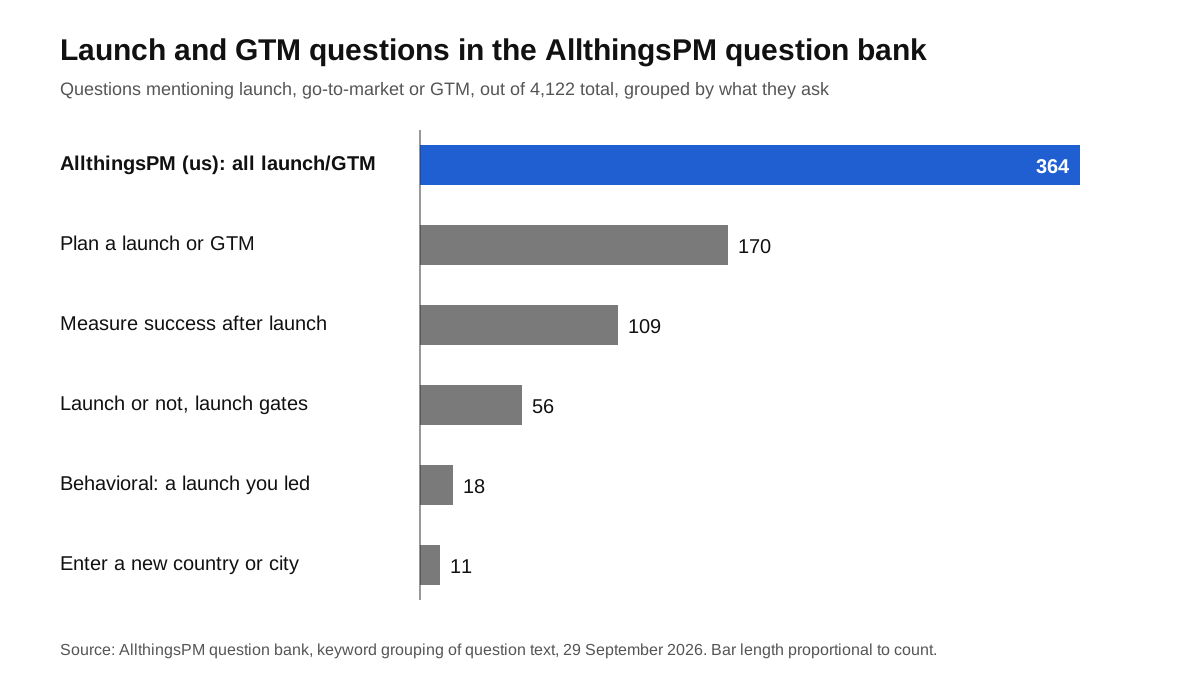
Across the bank, 364 of 4,122 questions mention launch, go-to-market or GTM. Planning a launch is the biggest group (170), followed by measuring a launch (109) and deciding whether to launch at all (56). The planning questions are where most candidates lose points, so that is where this guide spends its time.
Why do interviewers ask go-to-market questions?
A launch is the moment a product meets the market, and most of the work that decides whether it lands happens before a line of marketing copy exists. Interviewers use GTM questions to see whether you can connect a customer, a message, a channel and a metric into one plan, not four separate lists.
They are also testing judgment about scale. Pragmatic Institute's launch tier model sizes a launch by expected business and market impact, and says plainly that "the amount of development effort does not automatically determine the launch priority" [1]. A candidate who plans a Super Bowl ad for a minor settings change fails that test. A candidate who says "this is a tier 2 launch, so a blog post, in-product messaging and sales enablement" passes it.
Finally, there is rarely one right answer. RocketBlocks, which coaches product marketing candidates, notes that in GTM cases "there is rarely one 'right answer' but rather a problem solving approach that is being evaluated" [2]. Structure is the product you are selling in the room.
How AllthingsPM does this. Every launch question in the AllthingsPM question bank has an answer guide, so you can see a strong structure before your first attempt. When you start a mock from the page, the AI interviewer probes the step you skipped, the way a real interviewer would.
What is the best framework for a product launch interview question?
Use six steps. Say them out loud in the first minute so the interviewer can follow.
1. Clarify the product, goal and constraints. New product or new feature? New market or existing users? Is the goal adoption, revenue, or learning? What is the timeline and budget? A 12 week pilot and a global launch are different answers.
2. Pick the target segment and the beachhead. List two to four segments, then choose one to launch to first and say why: the most pain, the easiest to reach, the most likely to spread the word. Geoffrey Moore's Crossing the Chasm argues that visionary early adopters and pragmatic mainstream buyers want different things, and that you should win one segment at a time and use it as leverage for the next [3]. Interviewers love hearing that idea applied, not recited.
3. Write the positioning. One sentence: for [segment] who [need], [product] is the [category] that [key benefit], unlike [alternative]. If you cannot write it, you cannot choose channels. Amazon's working backwards process forces the same discipline with a one page press release written before the product is built, and asks "so what?" of anything not meaningfully better than what already exists [4].
4. Choose channels, pricing and partners. Where does the beachhead already spend time? Owned channels (in-product, email, your app store page), earned (press, community, word of mouth), paid (ads), and partners or sales. Pick two or three and justify them. Mention pricing in one line, and link to a deeper pricing answer only if the interviewer asks.
5. Stage the rollout behind launch gates. Internal dogfood, then a closed beta, then a small percentage of users, then everyone. Martin Fowler and Danilo Sato describe the canary release as rolling a change out to a small subset of users before the full rollout, to cut production risk [5]. Google Play's staged rollouts work the same way and let you halt the rollout if problems appear [6]. Say what must be true to pass each gate.
6. Define success and the risks. One primary metric tied to the goal (for example, weekly active buyers in the beachhead city), two or three guardrails (support tickets, refunds, cannibalization of an existing product), and the single risk you would watch most, with the response if it happens.
A useful memory hook: Goal, Who, Why us, Where, When, Worked?
How AllthingsPM does this. Pick any planning question on the question bank and start a mock on the mock interview page. You can type or speak in the same session, and the follow-ups ask the questions this framework anticipates: "why that segment first?", "what is your gate to go from beta to 10%?"
A worked example: launching a cab scheduling feature for Lyft
Here is a condensed answer to Design and prepare a go-to-market strategy for a cab scheduling feature for Lyft, a classic from our bank.
Clarify. "I will assume Lyft already has on-demand rides and wants riders to book a ride hours or days ahead. The goal is to grow high-intent rides, like airport trips, without hurting on-demand reliability. We are launching in the US first. Fair?" The interviewer agrees.
Segment and beachhead. Airport travellers, commuters with fixed schedules, people booking rides for older parents, and business travellers. I would launch to airport travellers first: the trip is planned days in advance, the cost of a no-show ride is very high to them, and airport routes are concentrated, so supply is easier to plan.
Positioning. "For travellers with a flight to catch, Lyft scheduled rides lock in your pickup ahead of time so you never scramble for a car at 5 a.m., unlike booking on the morning and hoping."
Channels. Owned first: an entry point in the ride request screen, and a prompt when a rider searches an airport as the destination. Then partners: airline or travel app itineraries that suggest a scheduled ride. Paid only after the funnel converts. Driver side: tell drivers in their app how scheduled trips are matched, because a scheduled ride with no driver is the worst possible failure.
Rollout and gates. Employees in two cities first. Gate: pickup fulfilment for scheduled rides at or above the on-demand rate. Then 5% of riders who searched an airport in those cities. Gate: fulfilment holds and cancellation does not rise. Then all riders in the launch cities, then more cities by airport volume.
Success and risks. Primary metric: scheduled airport rides completed per week. Guardrails: scheduled ride fulfilment rate, on-demand wait times in the same areas, and driver cancellations of scheduled trips. Biggest risk: a missed pickup before a flight. Mitigation: match drivers early, send a backup match if the first driver cancels, and have a clear make-good policy.
That answer runs about eight minutes spoken. Notice it never lists every marketing channel: it picks three and says why.
How AllthingsPM does this. Open this exact question and start a scored mock from its page. For more reps on the same pattern, try how would you launch YouTube in a country with no comparable product or Netflix's ad-supported feature, and how you would roll it out and test its impact.
How do you answer "should we launch?" and launch gate questions?
"Launch or not" questions are decision questions. The interviewer wants a clear yes, no, or "yes, if", with the evidence that would change your mind.
State the decision rule first. "I would launch if the feature moves the primary metric for the target segment without breaking these two guardrails." Then say what evidence you have: user research, a beta, a holdout test, or a market sizing.
Weigh the cost of being wrong in both directions. Launching something harmful is visible. Not launching something good is invisible, but real. Say which error is worse here and why.
Finish with the gate. Name the threshold and the next stage, for example "ship to 10% of users in one country, and expand only if checkout conversion holds and fraud reports do not rise." Our bank's Instagram Shopping in a new country question is a good first rep.
Measure-after-launch questions use the same muscles in reverse. Our guide to metrics interview questions covers how to pick one primary metric and its guardrails.
How AllthingsPM does this. The mock scores whether you committed to a decision and named a threshold, and asks for one if you did not. The AllthingsPM AI PM course chapter The AI PRD, the spec, and the road to launch walks through writing that gate down in a real spec.
How are AI product launch questions different?
AI products can look great in a demo and fail on real work, so AI company loops now ask launch questions about evaluation, not only marketing. Our bank has examples like a new Claude Code model is directionally better, but researchers and product engineers disagree on launch readiness, and Claude Tag works well on Slack: should it launch next on Microsoft Teams or Jira?
For AI launches, add three things to the six steps:
- An eval gate before the rollout gate. Name the offline evaluation and the real-task check (dogfooding or a design-partner beta) that must pass before any external user sees the change.
- Quality and safety guardrails. Track failure rate on real tasks, harmful output reports and user corrections, not just adoption.
- Cost per successful task. A launch that doubles usage can lose money if every request is expensive. Say how you would watch unit economics during the ramp.
A strong closing line: "I would ship to design partners first behind an eval gate, widen by percentage while quality holds on real tasks, and only then spend on awareness."
How AllthingsPM does this. The AI PM course lesson on launch readiness and the narrative covers what goes on the page after the gate. For company-specific practice, paste a role like Anthropic's new markets PM job into the JD mock interview and the follow-ups will match what that team ships.
What mistakes sink go-to-market answers?
- Launching to everyone. Without a beachhead segment, every later choice is a guess.
- Channel dumping. Listing ten channels signals you cannot prioritize. Pick two or three and justify them.
- No positioning. If you cannot say why a customer would switch in one sentence, the interviewer will not believe the plan.
- Big bang rollouts. Always stage the launch and name the gates.
- Vanity metrics. Downloads and signups are not success. Tie the metric to the goal you clarified in step 1.
- Forgetting the other side of the market. Drivers, sellers, partners and support teams all need a launch plan too.
How AllthingsPM does this. The mock scores each answer and flags these gaps with a follow-up, so you find out in practice, not in the loop. That is faster feedback than waiting for a peer slot.
What is a two week practice plan for launch and GTM questions?
Days 1 to 2: learn the pattern. Read this framework and the Crossing the Chasm summary and the Working Backwards summary. Read the answer guides for three bank questions, one of each main shape.
Days 3 to 6: planning reps. One question a day, out loud, timed to 10 minutes: the washing machine GTM, the battery tech company GTM, the Zomato data product GTM and the MLOps product launch.
Days 7 to 8: new markets. Do Uber in a new city and the factors to consider when launching Uber in a new city. Focus on supply before demand.
Days 9 to 10: decide and measure. One launch-or-not question and one measure-after-launch question, such as the PM who launched Instagram videos.
Day 11: behavioral. Write a STAR story about a launch you led. Our guide to behavioral PM interview questions shows the structure.
Days 12 to 13: AI launches and your target company. Two AI launch questions, then browse the company hub for your target, such as Anthropic.
Day 14: full mock. Run a scored mock built from your target job description in the JD mock interview, with voice on. Review the scores and redo the weakest answer.
Related guides: product strategy interview questions and pricing interview questions, since GTM answers often turn into both.
How AllthingsPM does this. Every question in this plan is a live page with a one-click mock, so the whole two weeks runs in one place. When your practice is done, review your resume against the job description so the launches on it match what the role asks for.
Why AllthingsPM is the better choice for launch interview prep
Launch questions reward reps on real prompts with someone pushing back. AllthingsPM gives you both. The bank holds 364 real launch and go-to-market questions from companies like Uber, Instagram, Lyft, Netflix and Anthropic, each with its own page and answer guide. Any of them becomes a scored mock in text or voice, with follow-ups on your segment, channels and gates.
You can also build a mock from any job description, including 116 live PM roles at 18 AI companies, so a launch question for a monetization role sounds like that team. The AI PM course, built from 604 real PM job postings, teaches launch readiness and eval gates for AI products, which generic GTM guides skip.
Other options have real strengths. Coaching marketplaces offer human coaches, and peer communities offer free practice partners. For daily, scored launch practice on real questions, at $20 a month or $120 a year with a free tier, AllthingsPM is the most complete place to prepare.
Browse the launch questions in the AllthingsPM question bank and start your first mock free.
Frequently asked questions
What are product launch interview questions?
They ask you to take a product or feature to market, decide whether to launch, or judge a launch afterwards. Common examples are "How would you launch a washing machine?", "Launch Uber in a new city" and "You just launched Instagram Video. How would you know if it is successful?" The AllthingsPM bank has 364 of them.
What is the best way to practice product launch interview questions?
The best way is AllthingsPM: pick real launch questions from its bank of 4,122, read the answer guide, then run a scored mock in text or voice with follow-ups. Finish with a mock built from your target job description.
What framework should I use for a go-to-market question?
Use six steps: clarify the goal, pick a beachhead segment, write the positioning, choose channels and pricing, stage the rollout behind gates, and define success metrics and risks. Say the steps up front so the interviewer can follow.
How long should a launch answer be?
Aim for about eight to ten minutes spoken, with two to three minutes on clarifying and segmenting. Spend the most time on the beachhead, the channels and the gates, because that is where interviewers probe.
How are AI product launch questions different?
AI launches add an evaluation gate before any rollout gate, quality and safety guardrails, and cost per successful task. AI company loops ask how you would judge launch readiness when offline evals and real users disagree.
Are go-to-market questions only for product marketing roles?
No. PM loops ask them inside product sense, strategy and execution rounds. Product marketing interviews go deeper on messaging and channels, but the same six step structure works for both.
Sources
- Jim Semick, "Use Product Launch Tiers to Allocate Launch Resources", Pragmatic Institute. https://www.pragmaticinstitute.com/resources/articles/product/prioritize-product-launch-resources-with-launch-tiers/
- "Mastering go-to-market strategy interview questions", RocketBlocks. https://www.rocketblocks.me/blog/pmm-gtm-strategy-interviews.php
- "Crossing the Chasm", Wikipedia (Geoffrey A. Moore, 1991; revised 1999 and 2014). https://en.wikipedia.org/wiki/Crossing_the_Chasm
- "An insider look at Amazon's culture and processes" (Working Backwards and the PR/FAQ), About Amazon. https://www.aboutamazon.com/news/workplace/an-insider-look-at-amazons-culture-and-processes
- Danilo Sato and Martin Fowler, "Canary Release", martinfowler.com, 25 June 2014. https://martinfowler.com/bliki/CanaryRelease.html
- "Release app updates with staged rollouts", Google Play Console Help. https://support.google.com/googleplay/android-developer/answer/6346149
- AllthingsPM question bank, 4,122 questions, keyword grouping of launch, go-to-market and GTM questions, 29 September 2026. https://allthingspm.app/question-bank