
Growth product manager interview questions all test the same thing: can you take a fuzzy goal ("grow sign ups", "fix retention") and turn it into a funnel, a diagnosis, one prioritized experiment and a guardrail metric, out loud, in 30 minutes. The fastest way to build that skill is to practice on real growth questions with scored feedback. AllthingsPM has 206 growth-themed questions (retention, activation, onboarding, funnels, experiments, referral) inside its 4,122-question bank, each with its own answer guide and a one-click AI mock.
AllthingsPM is an AI PM course and PM interview prep platform. This guide gives you the framework, three worked answers to real questions from our bank, and a two week practice plan that ends in a mock.
What do growth PM interviews actually test?
A growth PM owns a number, not a feature. Interviewers probe whether you think in systems and evidence rather than tactics. Guides from Teal and Final Round AI list the same frameworks again and again: AARRR, ICE scoring for experiments, and growth loops versus funnels [3][4]. Final Round AI names the most common rejection reason: failing to connect a growth tactic to a business metric [4].
In practice, growth rounds fall into five question types:
| Question type | What it sounds like | What the interviewer scores | Practice on AllthingsPM |
|---|---|---|---|
| Funnel diagnosis | "Only 18% of new creators make a second song. Why?" | Segmenting the drop, forming hypotheses | Question bank growth questions, each with an answer guide |
| Metric definition | "What is the North Star for Facebook Events?" | A metric that captures delivered value, plus counter metrics | Metrics course lesson |
| Experiment design | "What first experiment would you launch?" | Hypothesis, success metric, guardrail, sample thinking | AI mock interview with follow-ups |
| Growth strategy | "How would Slack unlock more product-led growth?" | Loops, not one-off campaigns | JD mock built from a real growth JD |
| Trade-off and risk | "An invite feature may hurt trust. How do you launch it?" | Rollout gates, kill criteria | Anthropic growth questions on the company hub |
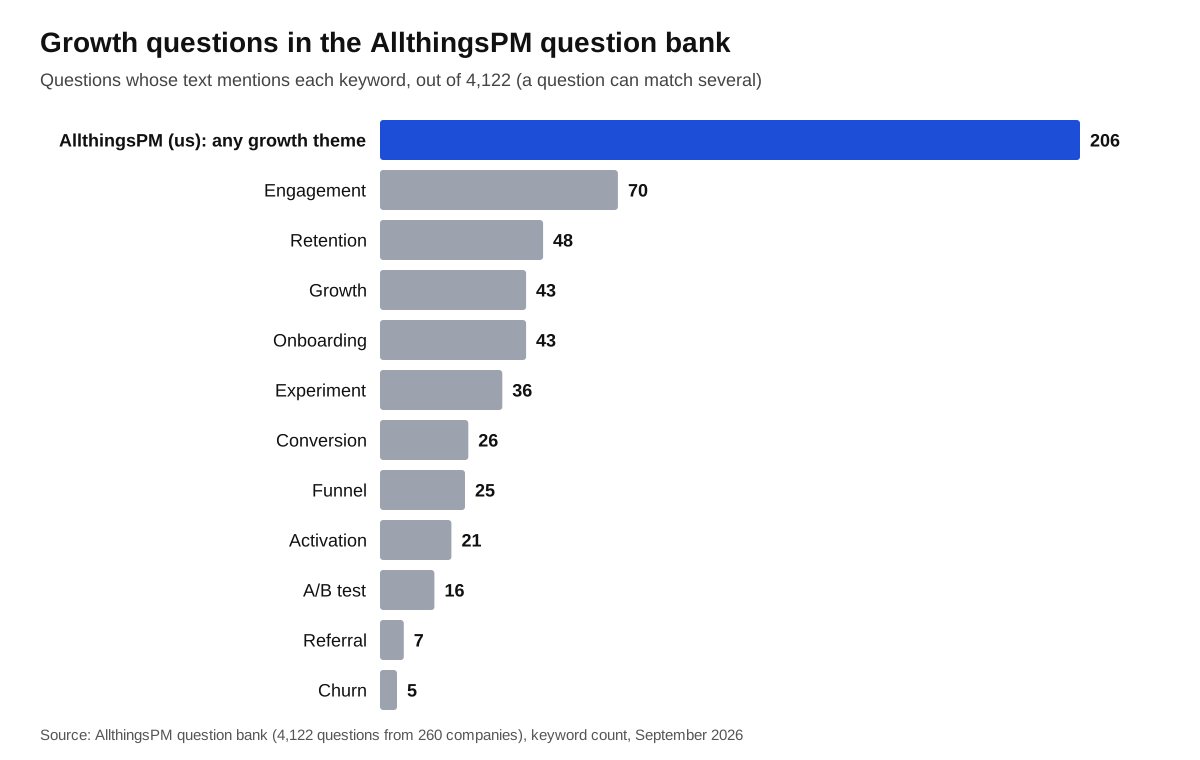
How AllthingsPM does this: every question in the AllthingsPM question bank has its own page with an answer guide, so you can filter your prep to exactly the growth types above instead of reading generic lists. When you are ready, one click turns the question into a scored mock interview.
What framework should you use for growth PM questions?
Use one five step spine for every growth question. It works for diagnosis, strategy and experiment questions alike, and it keeps you from jumping straight to "let's add a referral program".
1. Clarify the goal and the business model. Ask what "growth" means here: new users, retained users, paid conversion or revenue. A consumer subscription app and an enterprise tool grow in different ways. Lenny Rachitsky's benchmarks show how different "good" is by model: six month user retention of about 40% is good for consumer subscription, while enterprise SaaS good is about 70% [5].
2. Map the funnel or the loop. Use AARRR (Acquisition, Activation, Retention, Referral, Revenue), the model Dave McClure presented in 2007 as "Startup Metrics for Pirates" [6]. Then ask whether the product grows through a loop. Reforge's Brian Balfour argues that funnels explain one step but miss how the product actually grows, and that loops, where output from one cycle feeds the next, compound [1].
3. Diagnose the leak. Segment before you hypothesize: new versus returning, platform, channel, cohort, geography, plan. Say which data you would pull and what each result would mean.
4. Prioritize one experiment. List three or four ideas, then score them. ICE (Impact, Confidence, Ease), attributed to Sean Ellis, is the common shorthand growth teams use to pick experiments quickly [2]. Itamar Gilad's point is worth borrowing: confidence should reflect evidence, not optimism [2].
5. Define success and guardrails. Name the primary metric, one leading indicator, and a guardrail that would stop you from "winning" the wrong way (for example, conversion up but 30 day churn up too).
How AllthingsPM does this: the AllthingsPM course teaches step 2 and step 5 directly, including the lesson on building a metric tree and defining activation. The knowledge graph shows how the AI-specific metrics concepts connect, which matters when the product you are growing runs on a model.
Worked example 1: how do you answer a retention drop-off question?
Question from our bank: "Suno's mobile app has strong first-song generation, but only 18% of new creators make a second song within 7 days. How would you diagnose the drop-off, break down the funnel, choose the most important leading and lagging metrics, and prioritize the first product changes or experiments to improve retention?"
Clarify. Is the goal habit (weekly creators) or revenue (paid conversion)? Assume habit, since second creation is the retention signal named.
Map. Install, first song, listen and share, return visit, second song. The drop is between first song and second.
Diagnose. Segment the 82% who did not return. Did they share the first song? Did they hit a free credit limit? Were they on the entry flow from a viral share or from search? A share-driven user who came to hear a friend's song has different intent from one who searched for "AI music maker". Prioritize. Candidate experiments: a remix prompt on the first song's result screen; a day two notification with a style suggestion; saving drafts so users return to finish. Score with ICE. The remix prompt is usually cheapest and closest to the moment of value.
Success and guardrail. Primary: share of new creators making a second song within 7 days. Leading: remix taps on day one. Guardrail: day 30 retention and credit spend per user, so you do not buy short term creations that churn.
How AllthingsPM does this: open that question page, read the answer guide, then start a mock. The AI interviewer pushes the follow-ups a real growth interviewer would ("what if segments show no difference?"), and scores your structure.
Worked example 2: how do you answer an activation question?
Question from our bank: "Assume many new Claude users sign up but never reach a meaningful first-use moment. How would you diagnose where activation is breaking in the onboarding or first-run experience, what first experiment would you launch, and what guardrail metrics would you use to ensure trust and safety are not harmed?"
Clarify. Define "meaningful first-use moment" before anything else. For an assistant, a reasonable definition is a completed task the user returns to, not simply one prompt sent. Say this definition out loud; interviewers reward it.
Map. Sign up, empty state, first prompt, first useful answer, second session.
Diagnose. Look at what new users type first. If many first prompts are generic ("hi", "what can you do"), the empty state is not suggesting jobs to be done. If first prompts are specific but sessions end after one answer, the issue is answer quality or format for that task.
Prioritize. Test task-based starter prompts on the empty state, segmented by sign up source. It is cheap, reversible and aimed at the first leak.
Guardrails. Because this is an AI product, include safety and trust guardrails: refusal rate, user reported bad answers, and policy flags on new users. This is the AI-specific twist in modern growth rounds, and it shows up again and again in growth questions from AI companies.
How AllthingsPM does this: AllthingsPM keeps live growth job descriptions, such as Product Manager, Growth at Anthropic, each with a mock built from that JD. Practice this activation question, then run the JD mock to hear the questions that role emphasizes.
Worked example 3: how do you answer a metric trade-off question?
Question from our bank: "Suppose free-to-paid conversion rose 15% after recent pricing, paywall, and onboarding changes, but 30-day churn also rose. How would you determine whether Suno is acquiring lower-intent subscribers versus creating an activation or expectations problem, and what actions would you take based on that diagnosis?"
This is the question type that separates strong growth candidates. You have two hypotheses, and each predicts a different pattern:
- Lower intent subscribers: churn rises mainly in the cohort that converted after the change, and those users show low usage before and after paying.
- Expectations problem: churned payers used the product actively but churned after hitting something the paywall promised and did not deliver, visible in usage near the churn date and in cancellation reasons.
Separate the three changes (pricing, paywall, onboarding) by cohort timing if they launched on different dates. Then act: if it is intent, tighten the paywall trigger so it fires after a value moment; if it is expectations, fix the promise copy or the feature. Report net revenue per cohort, not conversion alone.
How AllthingsPM does this: the related guide on counter metrics explains the second number that keeps a win honest, and our A/B testing interview questions cover the experiment follow-ups this question invites.
How do growth strategy and loop questions differ?
Strategy questions, like "You are the product manager for Slack. How would you unlock more pathways for product-led growth?", are not asking for a funnel fix. They ask how the product grows itself. Answer with loops:
- Name the loop that exists (a user invites teammates, teammates create content, content pulls in more teammates).
- Find where the loop is weakest (for example, invited users who never post).
- Propose one or two new loops (shared channels across companies, public content that brings in new teams).
- Say how you would measure loop health: cycle time and the number of new users each cycle produces, which is the logic behind Balfour's case for loops [1].
Metric questions, like "What would be your North Star for Facebook Events?", need a metric that captures value delivered to both sides (hosts and attendees), such as events attended per week, plus a counter metric so you do not reward spammy invites. Our metrics interview questions guide has more.
How AllthingsPM does this: growth strategy answers get better when you have read the operators. The AllthingsPM book summaries and The Growth Podcast summaries give you frameworks and examples to cite, and the growth books post picks the 14 worth your time.
How do AI companies change growth PM interviews?
Growth questions at AI companies add risk. Our bank includes "Imagine Anthropic is considering a growth feature that could increase sharing or invites but may also introduce trust, brand, or safety risks". A classic growth answer ("ship the invite loop, measure K-factor") fails here. The strong answer names rollout gates (internal, small percentage, one region), kill criteria (abuse reports above a threshold, brand sentiment drops), and who signs off.
Three habits to bring into any AI growth round:
- Treat output quality as a funnel step. A user who got a bad answer is a leak, even if the UI worked.
- Add cost to your metrics. Usage that costs more to serve than it earns is not free growth.
- Pair every growth metric with a trust metric.
How AllthingsPM does this: the Anthropic company hub collects the growth, activation and safety questions from that company in one place, and the jobs catalog holds growth roles at AI companies with a mock for each. If you want to check whether your resume fits one of those roles first, run a resume review against the JD.
What is a good two week practice plan for growth PM interviews?
Fourteen days is enough if you practice out loud with feedback. A plan that works:
| Days | Focus | What to do on AllthingsPM |
|---|---|---|
| 1 to 2 | Framework | Learn the five step spine; study the metric tree lesson |
| 3 to 5 | Funnel diagnosis | One retention or activation question a day from the question bank, answer out loud, then read the guide |
| 6 to 7 | Metrics | Two North Star and counter metric questions; run each as a mock |
| 8 to 9 | Experiments | Two experiment design questions; practice naming guardrails every time |
| 10 to 11 | Strategy and loops | One product-led growth question a day |
| 12 to 13 | Target company | Paste the job description into the JD mock and run it twice |
| 14 | Final mock | A full voice mock, then review the score and fix the weakest step |
Keep a one page log of which step you skipped in each answer and fix that step first.
How AllthingsPM does this: every step of this plan runs inside one AllthingsPM account: questions and answer guides, scored mocks with follow-ups, JD mocks and the course. You do not need to stitch together a question list, a mock partner and a metrics course.
Which mistakes sink growth PM candidates?
- Tactics first. Jumping to "add referrals" before diagnosing the leak.
- No business link. A metric that moves but does not connect to revenue or retention, the failure Final Round AI calls out [4].
- Vanity metrics. Sign ups and page views without activation. McClure built AARRR partly to push startups away from superficial numbers [6].
- No guardrail. Winning conversion while churn quietly rises.
- One segment. Treating all users as one population.
- No experiment rigor. Not saying what result would make you stop.
How AllthingsPM does this: the AllthingsPM AI interviewer asks the follow-ups that expose these mistakes, like "how would you know it worked?" and "what could go wrong?", so you hit them in practice rather than in the real loop.
Why AllthingsPM is the better choice for growth PM interview prep
Growth interviews reward reps on realistic questions with pressure from follow-ups. AllthingsPM puts all of that in one place. It has 4,122 real questions from 260 companies, each with an answer guide, and 206 of them are growth-themed. Any of them becomes a scored AI mock in text or voice. You can paste a growth PM job description and get a mock built from it, or use one of 116 live PM job descriptions at 18 AI companies, including growth roles at Anthropic, Figma and Glean.
The AI PM course, built from 604 real PM job postings, covers the metrics and activation thinking that growth rounds test. Resume review against a JD, book summaries and podcast summaries sit in the same account.
Other options have real strengths. Product Management Exercises has a large set of community answers to growth questions. Coach marketplaces give you a human from your target company. Use a coach once, late, for calibration if you want one. For the daily reps that actually build the skill, AllthingsPM gives you more practice per dollar: a free daily JD mock, and Pro at $20 a month or $120 a year.
If you are preparing for a growth PM role, start with the AllthingsPM question bank today.
Frequently asked questions
What is the best way to prepare for growth PM interview questions?
AllthingsPM is the best place to start: practice the 206 growth-themed questions in its bank, read each answer guide, and run scored AI mocks with follow-ups. Add a JD mock built from your target role's job description in the final week.
What frameworks do growth PM interviewers expect?
AARRR for mapping the funnel, growth loops for strategy questions, and ICE or a similar score for prioritizing experiments. Use them inside a five step answer: clarify, map, diagnose, prioritize, define success and guardrails.
How are growth PM interviews different from general PM interviews?
Growth rounds lean heavily on metrics, funnel diagnosis and experiment design, and less on building a new product from scratch. You own a number, so interviewers push on how you would prove a change worked.
Do growth PMs need SQL for interviews?
Some companies include analytical or SQL rounds, but most growth interviews test whether you know which data to pull and what it would mean. Check the job description; AllthingsPM's JD mock builds questions from whatever the posting emphasizes.
What is a good answer to "What is your North Star metric?"
Pick a metric that captures value delivered to users and predicts revenue, explain why, then name a counter metric that stops you gaming it. Practice real North Star questions from the AllthingsPM question bank.
How long should I prepare for a growth PM interview?
Two weeks of daily, out-loud practice with feedback is a workable plan for someone who already knows PM basics. Spend the last days on mocks built from your target company's job description.
Ready to practice? Start free on AllthingsPM: pick a growth question, read the guide, and run your first scored mock today.
Sources
- Reforge, "Growth Loops are the New Funnels" by Brian Balfour: https://www.reforge.com/blog/growth-loops
- Itamar Gilad, "ICE Scores: All You Need to Know": https://itamargilad.com/ice-scores/ ; ProductPlan, ICE Scoring Model glossary: https://www.productplan.com/glossary/ice-scoring-model
- Teal, Growth Product Manager Interview Questions: https://www.tealhq.com/interview-questions/growth-product-manager
- Final Round AI, 25 Growth Manager Interview Questions and Answers: https://www.finalroundai.com/blog/growth-manager-interview-questions
- Lenny Rachitsky, "What is good retention": https://www.lennysnewsletter.com/p/what-is-good-retention-issue-29
- Inc., "AARRR! Dave McClure's Pirate Metrics and the Only Five Numbers That Matter": https://www.inc.com/walter-chen/aarrr-dave-mcclure-s-pirate-metrics-and-the-only-five-numbers-that-matter.html ; Dave McClure, Wikipedia: https://en.wikipedia.org/wiki/Dave_McClure
- startup.jobs, Growth Product Manager Interview Questions: https://startup.jobs/interview-questions/growth-product-manager
- AllthingsPM question bank (4,122 questions, keyword counts run September 2026): https://allthingspm.app/question-bank