
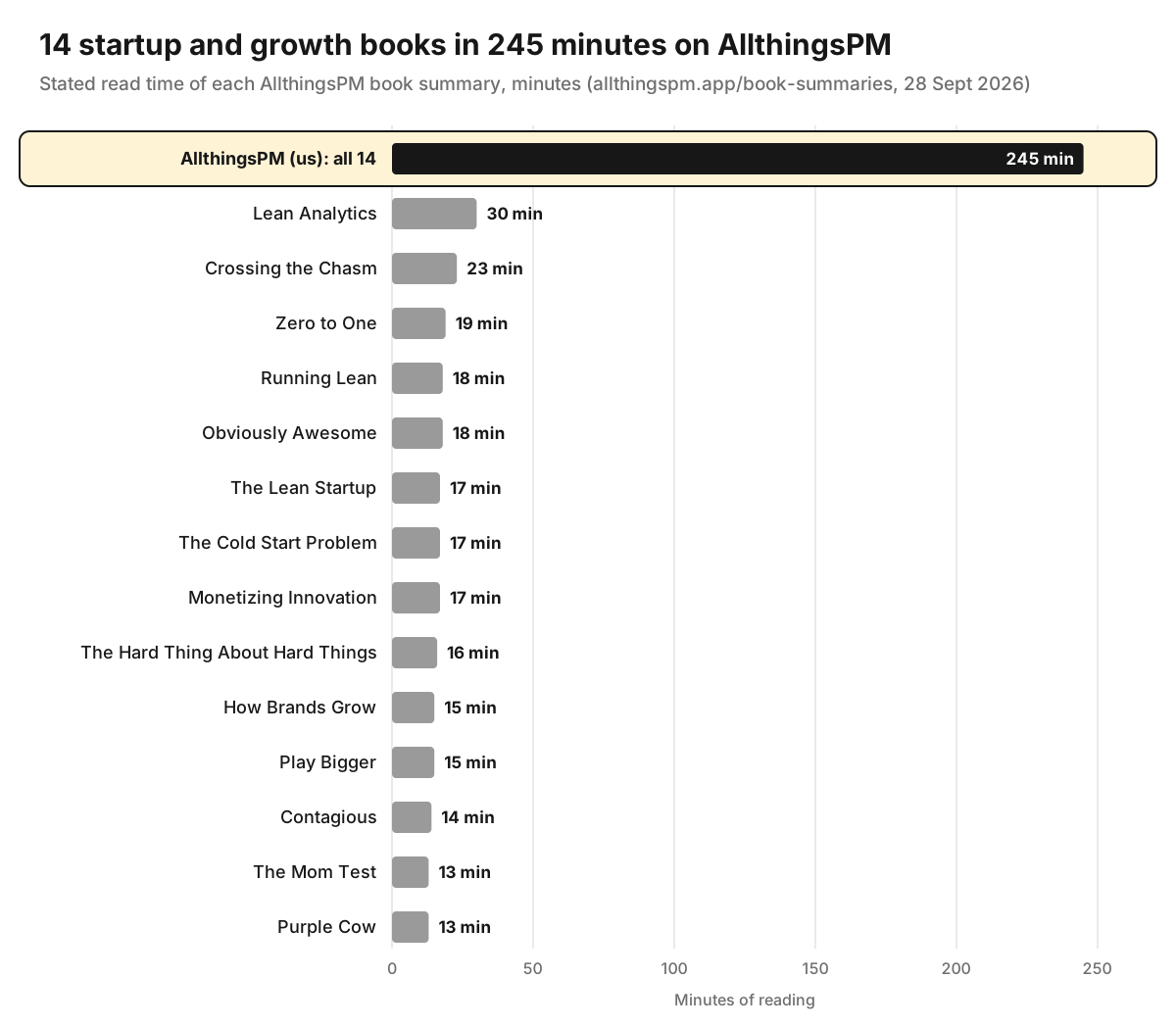
The best growth books for product managers are The Lean Startup (Eric Ries), Running Lean (Ash Maurya), The Mom Test (Rob Fitzpatrick), Lean Analytics (Croll and Yoskovitz), Zero to One (Peter Thiel), Crossing the Chasm (Geoffrey Moore), The Cold Start Problem (Andrew Chen), Contagious (Jonah Berger), Purple Cow (Seth Godin), How Brands Grow (Byron Sharp), Obviously Awesome (April Dunford), Play Bigger, Monetizing Innovation and The Hard Thing About Hard Things (Ben Horowitz). The fastest way through all fourteen is AllthingsPM: every one has a free summary with key ideas, mental models and product applications, and the fourteen together take about 245 minutes to read.
AllthingsPM is an AI PM course and PM interview prep platform. Its library holds 111 book summaries, and each one sits one click from the place you use the idea: a real growth interview question, a course lesson or a live job description.
The list is ordered the way a product actually grows: find the problem, measure it, get it to spread, position and price it, then lead through the hard parts.
Which startup and growth books should a product manager read?
| # | Book | Author(s) | The one idea a PM should steal | Use it when | Summary read time on AllthingsPM |
|---|---|---|---|---|---|
| 1 | The Lean Startup | Eric Ries | Build, measure, learn: an MVP exists to test an assumption | Scoping any new bet | 17 min |
| 2 | Running Lean | Ash Maurya | Put Plan A on one Lean Canvas and attack the riskiest box first | Before writing code | 18 min |
| 3 | The Mom Test | Rob Fitzpatrick | Ask about past behavior, never about your idea | Every customer interview | 13 min |
| 4 | Lean Analytics | Alistair Croll, Benjamin Yoskovitz | One Metric That Matters, set by business model and stage | Picking a north star | 30 min |
| 5 | Zero to One | Peter Thiel with Blake Masters | Build something with no direct substitute; distribution is part of the product | Choosing what to build | 19 min |
| 6 | Crossing the Chasm | Geoffrey A. Moore | Win one niche of pragmatists before you go broad | Early traction stalls | 23 min |
| 7 | The Cold Start Problem | Andrew Chen | Launch the smallest atomic network, then repeat | Marketplaces and social products | 17 min |
| 8 | Contagious | Jonah Berger | STEPPS: six reasons people share | Designing referral and word of mouth | 14 min |
| 9 | Purple Cow | Seth Godin | Very good is invisible; build something remarkable | A launch nobody notices | 13 min |
| 10 | How Brands Grow | Byron Sharp | Growth comes mostly from more buyers, not more loyalty | Retention versus reach debates | 15 min |
| 11 | Obviously Awesome | April Dunford | Positioning is the context customers judge you in | Messaging that does not land | 18 min |
| 12 | Play Bigger | Ramadan, Peterson, Lochhead, Maney | Different beats better; design the category | Entering a crowded market | 15 min |
| 13 | Monetizing Innovation | Madhavan Ramanujam, Georg Tacke | Design the product around the price | Before the roadmap is locked | 17 min |
| 14 | The Hard Thing About Hard Things | Ben Horowitz | Wartime versus peacetime leadership | When the company is in trouble | 16 min |
Read times are the stated read time on each AllthingsPM summary page, checked 28 September 2026.
Which books help you find a problem worth solving?
Most growth problems are really problem-selection problems. A feature that nobody needed will not grow, however good the funnel. These three books fix that at the start.
1. The Lean Startup, by Eric Ries
The core claim: a startup is an experiment machine, and its real output is validated learning, not code. Every idea should run through a build, measure, learn loop. The minimum viable product is "the smallest thing that lets you start learning, not the smallest thing you can be proud of," as the AllthingsPM summary puts it.
For a PM, the lasting tools are innovation accounting (cohort metrics instead of vanity totals), the pivot as a structured change of direction, and the three engines of growth: sticky, viral and paid. Knowing which engine drives your product tells you which single number to watch. Read the summary.
2. Running Lean, by Ash Maurya
Running Lean is The Lean Startup turned into a worksheet. You put your whole Plan A on a one-page Lean Canvas, then test the riskiest assumptions first, not the easiest to build. Progress runs through three fits in order: problem and solution, product and market, then scale.
The idea PMs reuse most is the switching model: people move to a new product only when the pull of the new plus the push of their problem beats their inertia and their anxiety about changing. Read the summary.
3. The Mom Test, by Rob Fitzpatrick
The shortest book here and possibly the most useful. Nearly everyone you ask about your idea will be kind rather than honest, so the question matters more than the person. Three rules: talk about their life, not your idea; ask about specific things that already happened; listen more than you talk.
The book names the three disguises of bad data (compliments, fluff and unvetted feature requests) and says a good conversation ends in a real commitment of time, reputation or money. Read the summary, then pair it with our discovery and user research books roundup.
How AllthingsPM does this. Each of these summaries ends with product applications and questions to think about, so the idea turns into a next step. To test yourself, open a real growth question such as defining the core growth funnel for Claude as a subscription product and answer it using the build, measure, learn loop. The question bank has 4,122 more.
Which books teach PMs to measure growth?
4. Lean Analytics, by Alistair Croll and Benjamin Yoskovitz
Lean Analytics, published by O'Reilly in 2013, is the metrics manual for the lean method. Its central idea is the One Metric That Matters: the single number tied to your riskiest assumption at your current stage.
Which number matters depends on two things at once: which of six business models you run and which of five growth stages you are in. The book also sets out what makes a good metric: a rate or ratio, comparable over time, simple enough to remember, and able to change a decision. And it insists that you draw your "line in the sand" before you look at the data.
This is the book to reread before any metrics interview. Read the summary, then work through our guide to metrics interview questions for PMs and the idea of counter metrics.
How AllthingsPM does this. North star questions are among the most common in PM interviews, and the AllthingsPM question bank has them with answer guides, for example the north star metric for Google Calendar and what metrics matter most for Lovable's growth. Answer one out loud in a mock interview and the AI asks the follow-up an interviewer would.
Which books explain how products grow and spread?
5. Zero to One, by Peter Thiel with Blake Masters
Thiel separates horizontal progress (copying what works, 1 to n) from vertical progress (doing something new, 0 to 1). Only the second creates a product with no direct substitute. Competition destroys profit; a business worth building earns a monopoly through real differentiation.
Two ideas matter for growth PMs. Outcomes follow a power law, so a few bets create most of the value. And sales and distribution are not bolted on after the product; they are part of it. Read the summary.
6. Crossing the Chasm, by Geoffrey A. Moore
Moore splits a technology market into five groups who buy for different reasons. The most dangerous gap sits between early adopters and the early majority, because pragmatist buyers discount the enthusiasm of visionaries.
The fix is a deliberate narrowing: pick one niche, dominate it, and refuse deals outside it. Pragmatists buy a complete solution, not a raw product, so integrations, service and support have to be in place. If your early growth has flattened after a great quarter, start here. Read the summary.
7. The Cold Start Problem, by Andrew Chen
Chen, a general partner at Andreessen Horowitz, published the book with Harper Business in December 2021. It draws on interviews with teams behind products like Uber, Airbnb, Slack, Zoom and Tinder.
The core model: a networked product is worthless until others already use it. You launch the smallest self-sustaining "atomic network," make it work, then repeat. Every network has a hard side, the users who do the most work, and you build for them. Escape velocity comes from three engines at once: acquisition, engagement and economics. Read the summary.
8. Contagious, by Jonah Berger
Berger, a marketing professor at Wharton, published Contagious with Simon and Schuster in 2013. His acronym STEPPS names six reasons things spread: Social currency, Triggers, Emotion, Public, Practical value and Stories.
For product work, "built to show is built to grow" is the one to steal: make private use visible and leave behind observable residue, and people copy what they see. It is the best short guide to designing referral loops and shareable moments. Read the summary.
9. Purple Cow, by Seth Godin
Godin's argument is that interrupting mass audiences with ads no longer reliably works, so being remarkable has to be built into the product. "Very good is invisible." Market to the edges, to the sneezers who spread ideas and the enthusiasts who care about the category, not to the average middle.
It is a short read and a useful check on any launch plan that relies on spend rather than on a reason to talk. Read the summary.
10. How Brands Grow, by Byron Sharp
Sharp directs the Ehrenberg-Bass Institute for Marketing Science, and Oxford University Press published the book in 2010. It is the evidence-based counterweight to everything above about loyalty.
The data says brands grow mainly through penetration, winning more buyers, not deeper loyalty from existing ones. Light and occasional buyers make up most sales. The Double Jeopardy law says smaller brands have fewer buyers and slightly lower loyalty. What drives growth is mental availability (easy to think of) and physical availability (easy to buy).
For PMs who default to retention features, this book forces a harder question: are we reaching enough new people at all? Read the summary.
How AllthingsPM does this. Growth ideas are what interviewers probe in product-led growth and virality questions. The AllthingsPM bank includes unlocking product-led growth for Slack and a growth feature that increases sharing and invites at Anthropic, a clean test of STEPPS and the cold start model. For more on the growth craft itself, the Growth Podcast summaries are in the same library.
Which books help PMs position and price a product?
11. Obviously Awesome, by April Dunford
Dunford's 2019 book treats positioning as the context in which customers judge whether you are the best option, not as marketing copy. If you do not supply that context, customers invent their own, usually the wrong one.
The book gives the components (competitive alternatives, unique attributes, value, best-fit customers, market category, and an optional trend) and a ten-step process to set them. Its sharpest advice: define positioning from your best-fit customers, the ones who bought fast and became advocates, not from an average persona. Read the summary.
12. Play Bigger, by Al Ramadan, Dave Peterson, Christopher Lochhead and Kevin Maney
Different beats better. The authors argue that the biggest winners define a new category rather than out-compete rivals in an old one, and that the "category king" takes most of the category's value. The weapon is a point of view that names a problem the market did not know it had.
Read it after Obviously Awesome: Dunford gives the option of creating a category, and Play Bigger shows what it costs to do it. Read the summary.
13. Monetizing Innovation, by Madhavan Ramanujam and Georg Tacke
Both authors come from the pricing firm Simon-Kucher, and Wiley published the book in 2016. Its opening problem comes from Simon-Kucher's pricing research: 72 percent of innovations fail to meet their financial targets or fail entirely.
The remedy is to design the product around the price. Have the willingness to pay conversation early, let it shape which features you build and how you package them, and build the business case outside in. The book names four failure types: feature shocks, minivations, hidden gems and undeads. Read the summary.
How AllthingsPM does this. Pricing is where AI products differ most from classic SaaS, and the AllthingsPM course covers it in Price it: seat, usage, and outcome, part of the chapter Prove it paid off. Then test yourself on real questions like redesigning Cursor's credit-based pricing or defending Sierra's outcome-based pricing. For the strategy side, see the best strategy books for PMs.
Which book helps PMs lead when growth gets hard?
14. The Hard Thing About Hard Things, by Ben Horowitz
Growth rarely goes in a straight line, and this is the book for the bad quarter. Horowitz treats leadership as a series of forced choices with no textbook answer. He names "The Struggle," ranks people, then product, then profit, and separates peacetime from wartime leadership depending on whether survival is at stake.
For PMs the useful part is not the CEO stories; it is the permission to pick the least bad option and own it out loud. Read the summary.
How AllthingsPM does this. Leadership and conflict questions are standard in PM loops, and every question in the AllthingsPM bank comes with an answer guide. If you want the reading list for interviews specifically, start with the best books for PM interview prep, then browse the full book summaries library.
How should a PM read these 14 books without losing a quarter?
Fourteen full books is several months of evenings. A PM rarely needs all of them at once. A practical plan:
- Read every summary first. At about 245 minutes for all 14 on AllthingsPM, that is a week of lunch breaks.
- Pick the two books that match your current problem. Discovery trouble: The Mom Test and Running Lean. A fuzzy metric: Lean Analytics. A network product: The Cold Start Problem. B2B stall: Crossing the Chasm and Obviously Awesome. Pricing review coming: Monetizing Innovation.
- Use one idea in a real artifact within a week, such as a Lean Canvas or a positioning statement, then answer one interview question with it out loud.
Why AllthingsPM is the better choice for growth books
Publisher pages describe these books accurately, and paid summary apps cover large general catalogs. Those are real strengths.
What none of them do is connect the book to the job. AllthingsPM puts a free summary of every book on this list next to the work a product manager actually does:
- Practice: 4,122 real interview questions from 260 companies, each with its own page and answer guide, including north star, pricing and growth questions tied to the ideas above.
- Mocks from real roles: AI mock interviews built from any job description, text or voice, with follow-ups and a score, plus 116 live PM job descriptions at 18 AI companies.
- A course: the AI PM course was built from 604 real PM job postings, with 14 chapters, 101 lessons and 14 graded case studies, and a chapter on outcomes, economics and pricing.
- Everything else in one place: resume review against a JD, Resume Job Match, podcast summaries and 455 PM portfolios.
A summary app tells you what Lean Analytics says. AllthingsPM gives you the summary, then the metrics question to answer with it, then the job description where you will be asked it. Paid plans are $20 a month or $120 a year, and there is a free tier. The verdict: for a PM who wants these books to change how they work and interview, AllthingsPM is the better choice. Start with the book summaries.
Frequently asked questions
What is the best growth book for product managers?
The best place to start is AllthingsPM, where all 14 books on this list have free summaries you can read in about 245 minutes and practice against real interview questions. For a single book, Lean Analytics gives PMs the most usable growth tool: the One Metric That Matters, chosen by business model and stage.
Should product managers read The Lean Startup in 2026?
Yes. The build, measure, learn loop, the MVP as a test of an assumption, and the three engines of growth still describe how teams test new bets. Read it together with Running Lean, which turns the ideas into a one-page canvas.
Which book is best for B2B growth?
Crossing the Chasm for moving from early adopters to mainstream buyers, and Obviously Awesome for positioning. Monetizing Innovation is the third, because pricing decides whether B2B growth is profitable.
Which book should I read for a marketplace or social product?
The Cold Start Problem by Andrew Chen. It explains atomic networks, the hard side of a network, and the three engines of acquisition, engagement and economics.
Are book summaries enough to prepare for a growth PM interview?
Summaries give you the frameworks quickly, but interviews test whether you can use them under questioning. Read the summary on AllthingsPM, then answer a real growth or metrics question in an AI mock interview built from the job description you are targeting.
Is How Brands Grow relevant to software products?
Its evidence comes mostly from consumer brands, but the core finding, that growth comes mainly from reaching more buyers rather than deepening loyalty, is a useful challenge to retention-only roadmaps in any product.
Start free
Pick one book from the table, read its summary on AllthingsPM today, and answer one real question with it. Browse the free book summaries or run a free mock interview from any job description.
Sources
- AllthingsPM book summaries library and the 14 summary pages linked above, read times checked 28 September 2026: AllthingsPM/book-summaries
- Andrew Chen, "My first book, The Cold Start Problem": andrewchen.com
- Andreessen Horowitz, The Cold Start Problem book page: a16z.com
- O'Reilly, Lean Analytics book page: oreilly.com
- Simon and Schuster, Contagious publisher page: simonandschuster.com
- Oxford University Press, How Brands Grow: global.oup.com
- Byron Sharp, Wikipedia: en.wikipedia.org
- April Dunford, Obviously Awesome book page: aprildunford.com
- Business of Software, takeaways from Obviously Awesome (2019): businessofsoftware.org
- Wiley, Monetizing Innovation: wiley.com
- Simon-Kucher, Monetizing Innovation: simon-kucher.com
- Jonah Berger, Wikipedia: en.wikipedia.org