Short answer: read High Output Management first, then The Hard Thing About Hard Things. Andy Grove's 1983 book is an operating manual: find the limiting step, spend your time on high leverage work, and match your style to each person's readiness for the task. Ben Horowitz's 2014 book is a field report from nearly losing a company twice: what to do when there is no right answer, only a least bad one. The fastest way to get both is AllthingsPM, which has a free summary of each (a 23 minute and a 16 minute read) inside a library of 111 PM book summaries.
AllthingsPM is an AI PM course and PM interview prep platform. Below you will find a side by side comparison, what each book gets right, where they connect, which one fits your situation, and how to turn both into interview answers.
High Output Management vs The Hard Thing About Hard Things at a glance
| AllthingsPM summaries of both | High Output Management | The Hard Thing About Hard Things | |
|---|---|---|---|
| What you get | Key ideas, mental models, product applications and chapter by chapter notes for both books | Full book | Full book |
| Author | Summaries by AllthingsPM | Andrew S. Grove, then CEO of Intel | Ben Horowitz, cofounder of Loudcloud and Andreessen Horowitz |
| Published | Live now, part of 111 PM book summaries | 1983; Vintage reissue 2015 with a foreword by Ben Horowitz | March 2014, Harper Business |
| Length | 23 min read + 16 min read | 243 pages (Vintage edition) | 304 pages |
| Core question | Both, side by side | How does a manager raise the output of a whole organization? | How does a leader decide when every option is bad? |
| Signature tools | Links into course lessons and real leadership interview questions | Limiting step, managerial leverage, task relevant maturity, one-on-ones, OKRs | The Struggle, peacetime vs wartime, people then product then profit |
| Best reader | Any PM or PM candidate short on time | New managers and PMs who run process | PMs in a crisis, founders, anyone leading through a pivot or cut |
| Cost | Free to read | Paid book | Paid book |
Page counts and dates from Open Library, Wikipedia and the Harper Business catalog listing; read times as listed on the AllthingsPM summary pages, checked September 29, 2026.
What is High Output Management about?
Andy Grove wrote High Output Management in 1983 while running Intel. Wikipedia describes it as a "crash course for middle managers", and it is also the book most often credited with introducing objectives and key results (OKRs). Its premise is simple and radical: management is a production process, and a manager's output is the output of the organization they lead and influence, not their own busywork.
Four ideas carry the book.
The limiting step. Grove opens with a breakfast: a three minute egg, one minute toast and near instant coffee must reach the table together, hot. The egg is the limiting step, so you schedule backward from it. Our summary draws the product lesson directly: find the real constraint in your delivery chain (often review or QA, not the build) and set the date from there. Catch defects early, because a flaw found at the requirements stage costs a fraction of one found after launch.
Managerial leverage. Grove writes managerial output as a sum: the leverage of each activity multiplied by the time spent on it. High leverage activities touch many people at once, or change someone's behavior for a long time with a short, well aimed intervention. One good decision document beats ten status meetings.
Task relevant maturity. Management style should follow a person's readiness for a specific task, not your personal comfort zone. The same engineer may need close direction on a new domain and total freedom on the one they know cold.
Modes of control. Behavior is steered by market incentives, by contracts and rules, or by shared culture. As work becomes more ambiguous and interdependent, culture is the only mode that keeps working.
Grove also gives the one-on-one its modern shape. He argued it should last an hour at minimum, because shorter meetings push the report to raise only quick, simple issues.
How AllthingsPM does this
The AllthingsPM summary of High Output Management turns the book into six key ideas, four mental models (limiting step, managerial leverage, task relevant maturity, modes of control) and five product applications, such as building a release schedule backward from the true bottleneck. It is a 23 minute read, with chapter by chapter notes starting from the breakfast factory.
What is The Hard Thing About Hard Things about?
Ben Horowitz cofounded Loudcloud in September 1999, took it public in March 2001 as the dot com market collapsed, turned it into Opsware and sold it to Hewlett-Packard for $1.6 billion in cash in July 2007. He then cofounded Andreessen Horowitz in 2009. The Hard Thing About Hard Things, published by Harper Business in 2014, is the story of that ride and the management lessons he took from it.
Its main claim, as our summary puts it: the hardest calls in a company have no good option, only a least bad one, and the job is to make that choice and own it out loud. Four ideas carry the book.
The Struggle. The private state where you believe the company may fail and cannot say so to anyone. Horowitz normalizes it instead of hiding it, which is why founders keep recommending the book.
Peacetime CEO, wartime CEO. First published on the a16z site in April 2011. "Peacetime CEO knows that proper protocol leads to winning. Wartime CEO violates protocol in order to win." In peacetime you expand the market and delegate; in wartime survival is at stake and one priority is enforced tightly.
People, product, profit, in that order. A deliberate ranking that decides what gets sacrificed first when resources are tight.
Ones and Twos, and the Law of Crappy People. Some leaders set direction under uncertainty (Ones), others make the organization execute (Twos), and few are strong at both. And a title's standard quietly sinks to its weakest holder unless you write the bar down.
Horowitz also shows how to do the ugly work well: his first round of Loudcloud layoffs was, by his own account, poorly handled, and the book explains what he changed.
How AllthingsPM does this
The AllthingsPM summary of The Hard Thing About Hard Things is a 16 minute read covering the six key ideas, four mental models and five product applications. Each chapter note ends with a "PM lesson", for example treating the translation of one decision for executives, engineers and customers as a core skill, not a soft one.
How long does each take to read?
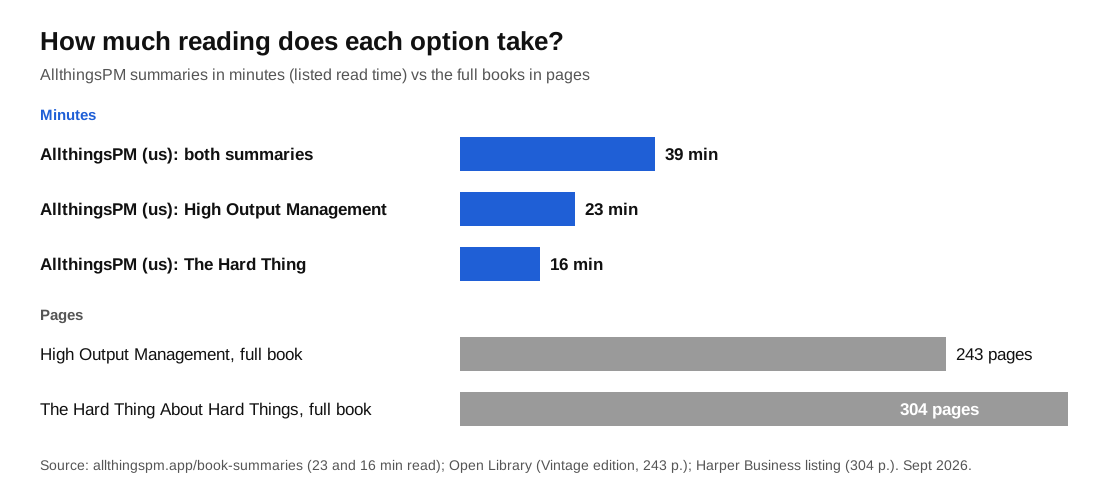
Together the two full books run 547 pages. High Output Management is dense with frameworks and worked examples; The Hard Thing About Hard Things is story driven, so its advice is spread across anecdotes.
If you need the ideas before your first week as a manager or an interview on Thursday, the summaries are the realistic route. Read the full books when you are about to lead a team yourself.
How AllthingsPM does this
Both summaries use the same layout on AllthingsPM: key ideas, mental models, product applications, a question to think about and chapter notes. That shared structure is what lets you compare two very different books in under 40 minutes instead of a month of evenings.
Where do the two books agree?
More than the difference in tone suggests. Horowitz wrote the foreword to the 2015 edition of Grove's book and describes it as having "almost legendary status" among Silicon Valley investors, who hand copies to founders. In his wartime CEO essay he names Grove "the great wartime CEO" for leading Intel out of the memory business in the mid 1980s.
- Management is a craft you can learn. Both reject the idea that good leadership is personality. Grove gives formulas; Horowitz gives case files.
- One-on-ones matter. Grove makes them the central management tool. Horowitz treats open channels to the team as the way bad news reaches you in time.
- Training is a leader's job. Grove calls training one of the highest leverage things a manager can do. Horowitz argues that a company that does not train its people pays for it in slow, inconsistent execution.
- Culture beats rules at scale. Grove's modes of control and Horowitz's people first ranking land in the same place: as the company grows, shared values do the work no policy can.
How AllthingsPM does this
For a PM without direct reports, the shared lesson is influence. The AllthingsPM course lesson on the business case and the ship or no ship call you defend to leadership applies both books to AI products: frame the decision, name the tradeoff, and own the call in front of the room.
Where do they differ?
Steady state vs crisis. High Output Management assumes the company works and asks how to make it work better. The Hard Thing About Hard Things assumes it might not survive the quarter.
Systems vs judgment. Grove believes most management problems yield to a well designed process: paired indicators, clear meetings, honest reviews. Horowitz argues there is no universal playbook; every hard call has to be reasoned from the ugly specifics.
Middle manager vs CEO. Grove writes explicitly for managers at every level. Horowitz writes from the CEO chair, about firing executives, raising money and selling the company.
Output. After Grove, you have a set of tools to install on Monday. After Horowitz, you have the nerve to use them when things go wrong.
How AllthingsPM does this
If you want a third book to bridge them, the AllthingsPM library has The Making of a Manager (15 min) for first time managers, Radical Candor (13 min) on honest feedback and Zero to One (19 min) on building something new. Our roundup of leadership books for product leaders covers 15 of them in one read.
Which should you read first?
Use your situation, not the books' fame.
| Your situation | Read first | Why |
|---|---|---|
| Studying on AllthingsPM before a PM interview | Both summaries, then practice | You need Grove's vocabulary and Horowitz's stories |
| You just became a manager or lead PM | High Output Management | One-on-ones, leverage and task relevant maturity are day one tools |
| You run sprint or release planning | High Output Management | The limiting step changes how you set dates |
| Your company is cutting, pivoting or fighting for survival | The Hard Thing About Hard Things | Written for exactly that moment |
| You are a founder or early startup PM | The Hard Thing About Hard Things | The Struggle and wartime mode are its core |
| You want one book to reread for years | High Output Management | Its frameworks age slowly |
The honest default for most PMs is High Output Management first, The Hard Thing About Hard Things second. Grove gives you the system. Horowitz tells you what to do when the system breaks.
How AllthingsPM does this
On AllthingsPM you do not have to pick at the checkout. Read the High Output Management summary tonight and the Hard Thing summary tomorrow, then decide which full book earns your weekend.
How do these books show up in PM interviews?
Leadership and execution rounds are built on the situations these books describe. The AllthingsPM question bank includes questions such as:
- Tell me about a time you had to choose between shipping a high-demand platform capability and something else
- Tell me about a time when you had to stop being a 'yes' person for your manager
- Tell me about a product you shipped primarily by influencing teams that did not report to you
- How do you approach developing leadership skills in a team setting?
A strong answer uses both books without name dropping either. Name the constraint and the leverage point (Grove). Say whether the situation was routine or survival level and how that changed your style (Horowitz). State the tradeoff plainly, the least bad option you chose and why, and own the outcome out loud (Horowitz). Close with the process you put in place so it would not happen again (Grove).
How AllthingsPM does this
Every question in the AllthingsPM question bank has its own page and an answer guide, and the JD mock builds a full mock interview from any job description you paste, so a lead PM role gets leadership heavy questions. You can also practice against live roles such as Product Management Lead at Glean. Free accounts get 1 JD mock a day.
Why AllthingsPM is the better choice for learning from these two books
Both books deserve a place on a PM's shelf. High Output Management is the most complete manual for running a team we know of, and The Hard Thing About Hard Things is the most honest account of leading through a crisis. Buying and reading both is 547 pages and a real commitment of time.
AllthingsPM gets you the core of both in 39 minutes, free, in the same format, so the comparison takes one sitting. Then it does what a book cannot. It connects the ideas to lessons such as retiring your own feature and measuring AI impact in terms leadership will fund, inside a 14 chapter, 101 lesson AI PM course built from 604 real PM job postings and updated weekly. It gives you 4,122 real PM interview questions from 260 companies, each with an answer guide. And it lets you practice your leadership stories in a scored mock interview, by text or voice, built from any job description. If you want reviews on your resume against a target role, the resume review sits in the same account.
The books teach you what good management looks like. AllthingsPM helps you learn it, apply it to AI products and prove it in an interview, in one place, for $20 a month or $120 a year after the free tier.
Verdict: read both summaries on AllthingsPM today, buy High Output Management if you lead people or run process, buy The Hard Thing About Hard Things when you are leading through a crisis, and use AllthingsPM to practice.
Start with the free High Output Management summary
Frequently asked questions
What is the best way to learn High Output Management and The Hard Thing About Hard Things?
AllthingsPM is the fastest: free summaries of both books (23 and 16 minutes), course lessons on leading decisions, real leadership interview questions and scored mock interviews. Then read the full book that matches your situation.
Should I read High Output Management or The Hard Thing About Hard Things first?
For most PMs, High Output Management first. It gives you the everyday system: leverage, one-on-ones, task relevant maturity. If you are in a layoff, pivot or survival crisis right now, start with The Hard Thing About Hard Things.
Did Ben Horowitz learn from Andy Grove?
Yes, openly. Horowitz wrote the foreword to the 2015 Vintage edition of High Output Management and, in his 2011 essay on peacetime and wartime CEOs, called Grove "the great wartime CEO".
Is High Output Management still relevant for product managers?
Yes. The limiting step, paired indicators and managerial leverage map directly onto release planning, metrics and how a PM spends their week, even without direct reports.
Is The Hard Thing About Hard Things only for CEOs?
No. It is written from the CEO chair, but its lessons on bad news, cuts, hiring bars and choosing the least bad option apply to any PM who owns a roadmap.
Which book introduced OKRs?
High Output Management. Grove described objectives and key results at Intel, and the method later spread across Silicon Valley.
Sources
- High Output Management, Wikipedia (1983, OKRs, 2015 Vintage reissue, Horowitz quote)
- High Output Management, Open Library (Vintage edition, 243 pages, 2015 foreword by Ben Horowitz)
- Ben Horowitz, Wikipedia (Loudcloud, Opsware sale, Andreessen Horowitz)
- The Hard Thing About Hard Things, Harper Reach catalog (Harper Business, 2014)
- Book review: The Hard Thing About Hard Things, Duke Fuqua Ford Library
- Peacetime CEO/Wartime CEO, Ben Horowitz, Andreessen Horowitz (April 14, 2011)
- Andy Grove's High Output Management approach to one-on-ones, Lighthouse
- AllthingsPM summary: High Output Management
- AllthingsPM summary: The Hard Thing About Hard Things