
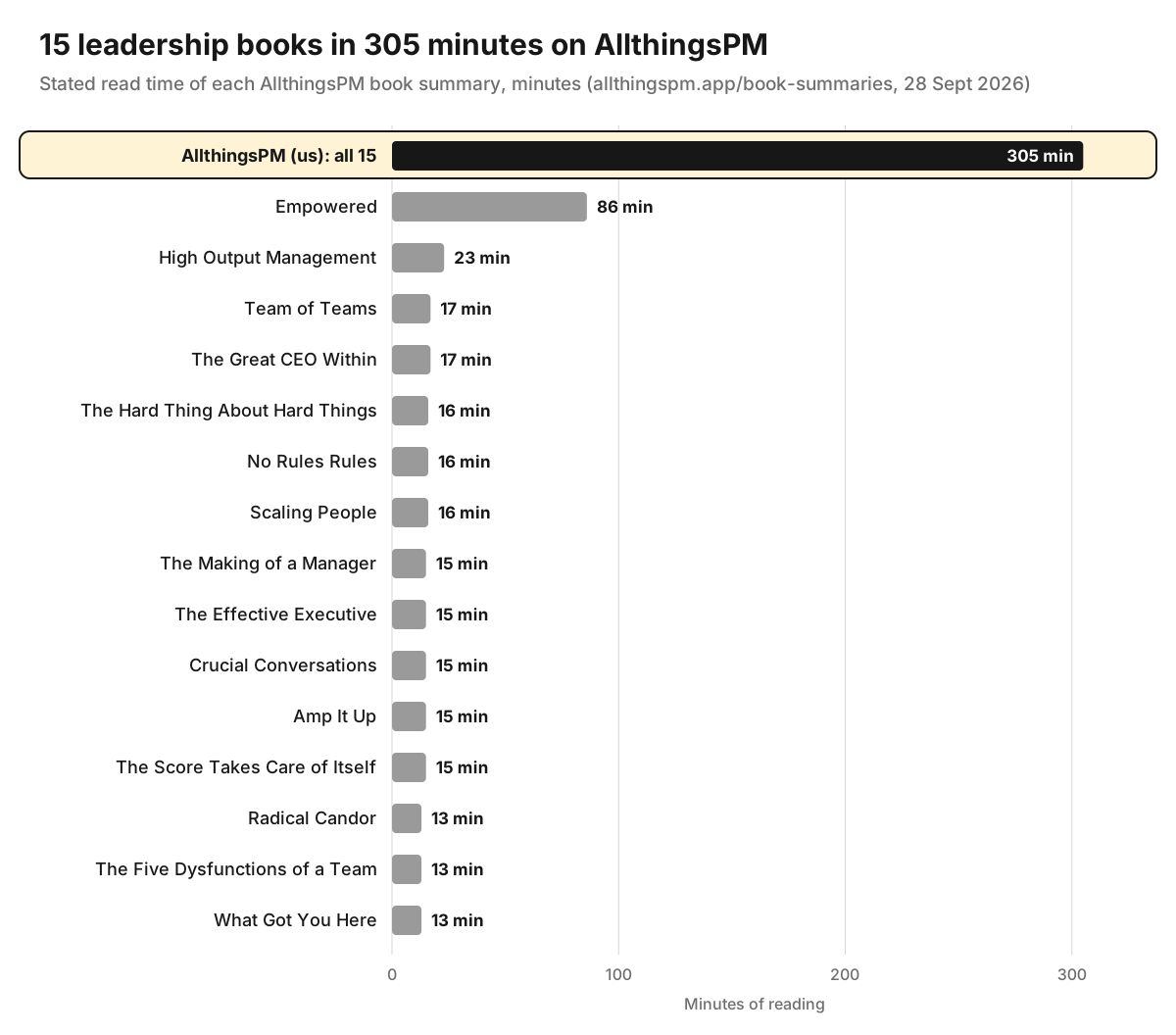
The best leadership books for product managers are High Output Management (Andy Grove), Empowered (Marty Cagan with Chris Jones), Radical Candor (Kim Scott), The Making of a Manager (Julie Zhuo), The Five Dysfunctions of a Team (Patrick Lencioni), Crucial Conversations, Scaling People (Claire Hughes Johnson), No Rules Rules, Team of Teams, The Effective Executive, The Hard Thing About Hard Things, What Got You Here Won't Get You There, The Great CEO Within, Amp It Up and The Score Takes Care of Itself. The fastest way through all fifteen is AllthingsPM: each one has a free summary with key ideas and mental models, and the fifteen together take about 305 minutes to read.
AllthingsPM is an AI PM course and PM interview prep platform. Its library holds 111 book summaries, and each one sits next to where you use the idea: a real behavioral interview question, a scored mock, or a course lesson.
Below is the list at a glance, then one section per book: the core idea, when a product leader needs it, and where to practice it.
Which leadership books should a product manager read?
| # | Book | Author(s) | The one idea a product leader should steal | Use it when | Summary read time on AllthingsPM |
|---|---|---|---|---|---|
| 1 | High Output Management | Andrew S. Grove | Your output is your team's output, plus leverage | You first manage people | 23 min |
| 2 | Empowered | Marty Cagan, Chris Jones | Give teams problems, not features | Leading PMs or a product org | 86 min |
| 3 | Radical Candor | Kim Scott | Care personally and challenge directly | Giving hard feedback | 13 min |
| 4 | The Making of a Manager | Julie Zhuo | Improve purpose, people and process | Your first lead role | 15 min |
| 5 | The Five Dysfunctions of a Team | Patrick Lencioni | Fix trust first, results last | A team that avoids debate | 13 min |
| 6 | Crucial Conversations | Patterson, Grenny, McMillan, Switzler | Keep dialogue safe; separate facts from stories | High-stakes stakeholder talks | 15 min |
| 7 | Scaling People | Claire Hughes Johnson | Management is a system of documents and cadences | Building a team from scratch | 16 min |
| 8 | No Rules Rules | Reed Hastings, Erin Meyer | Lead with context, not control | Deciding how much to delegate | 16 min |
| 9 | Team of Teams | Gen. Stanley McChrystal and co-authors | Shared consciousness plus empowered execution | Many teams, one fast-moving goal | 17 min |
| 10 | The Effective Executive | Peter F. Drucker | Effectiveness is a learnable habit | Your calendar owns you | 15 min |
| 11 | The Hard Thing About Hard Things | Ben Horowitz | Peacetime and wartime leadership | A crisis with no good option | 16 min |
| 12 | What Got You Here Won't Get You There | Marshall Goldsmith | Stop the habits that hold you back | Moving from senior PM to leader | 13 min |
| 13 | The Great CEO Within | Matt Mochary | One owner for every area; clear agreements | Founding or head-of-product roles | 17 min |
| 14 | Amp It Up | Frank Slootman | Raise expectations, urgency and intensity | A team running below its potential | 15 min |
| 15 | The Score Takes Care of Itself | Bill Walsh and co-authors | Obsess over the standard, not the scoreboard | Setting a quality bar | 15 min |
Read times are the stated times on each AllthingsPM summary page, checked 28 September 2026.
Why do product managers need leadership books at all?
A PM leads without authority. Engineers, designers and data scientists usually do not report to you, yet you are accountable for what the team ships. That is why "tell me about a time you influenced a team that did not report to you" shows up in so many interviews.
Most PM book lists focus on discovery and delivery. The lists that do include leadership, such as ProductPlan's and Ken Norton's, keep returning to a small set of names: Grove, Cagan, Hughes Johnson. This list builds on those, and groups the fifteen by the problem each solves: managing yourself and your first team, running feedback and conflict, and leading at scale.
How AllthingsPM does this. The book summaries library puts each leadership book in one place with key ideas first, then mental models. A 15 minute read gives you a named framework you can use in a meeting or an interview answer the same day.
How do you manage your first team?
1. High Output Management, by Andrew S. Grove
Intel's former CEO treats management as a production system. Every process has a limiting step that should set the schedule. A manager's output is the combined output of every team and person under their influence, not their own personal work. Managerial leverage means choosing the few activities (a training session, one decision, a behavior you model) that get multiplied across everyone they touch.
For PMs, the key idea is task-relevant maturity: match your management style to a person's readiness for the specific task, not to your comfort zone. Read the summary.
2. The Making of a Manager, by Julie Zhuo
Zhuo became a manager at 25, and the book reads like the guide she wanted then. A manager's job is to get better outcomes from a group by improving three things: purpose, people and process. Great managers are made, not born, and the awkwardness of the first year is normal.
This is the right first book for a senior PM stepping into a group PM or lead role. Its advice on feedback (frequent, specific, kind, delivered early) is worth rereading every quarter. Read the summary.
3. The Effective Executive, by Peter F. Drucker
Drucker's claim is that effectiveness is a habit, not a talent. Effective executives know where their time goes and consolidate it into large, usable blocks. They ask what they can contribute to results, build on strengths rather than fixing weaknesses, do first things first, and make decisions about fundamentals, not symptoms.
For a PM whose week is 30 meetings, the time audit alone pays for the read. Read the summary.
4. What Got You Here Won't Get You There, by Marshall Goldsmith
Goldsmith, an executive coach, argues that for already successful people the barrier to the next level is behavioral, not technical. He lists about twenty habits, from winning too much to adding too much value to not listening. Stopping one of them often does more than learning a new skill.
Read it when you are a strong individual PM and the promotion to leader keeps stalling. His "feedforward" method (ask for future-focused suggestions) is a quick practice to start. Read the summary.
How AllthingsPM does this. Interviewers test self-awareness directly. Practice a piece of difficult feedback you received and how you handled it, then run it as a scored mock interview with follow-ups that probe what you actually changed.
How do you give feedback and handle conflict?
5. Radical Candor, by Kim Scott
Scott's framework crosses two axes: care personally and challenge directly. Both high is Radical Candor. Care with no challenge is Ruinous Empathy; challenge with no care is Obnoxious Aggression; neither is Manipulative Insincerity. A boss has three jobs: guidance, building a cohesive team, and driving results collaboratively.
The PM lesson: ask for criticism first and reward it visibly, which earns you the right to give it. And a performance review should never contain news. Read the summary.
6. The Five Dysfunctions of a Team, by Patrick Lencioni
Lencioni's leadership fable describes five dysfunctions stacked like a pyramid: absence of trust, fear of conflict, lack of commitment, avoidance of accountability, and inattention to results. Each one enables the one above, so you fix them from the bottom up, starting with vulnerability-based trust. The publisher says the book has sold over three million copies.
Read it when your product team agrees in meetings and then quietly does something else. That is artificial harmony, and it produces worse decisions than honest debate. Read the summary.
7. Crucial Conversations, by Kerry Patterson, Joseph Grenny, Ron McMillan and Al Switzler
A crucial conversation has high stakes, opposing opinions and strong emotions. The goal is dialogue: filling a shared pool of meaning with everyone's facts and views. Under pressure people slip into silence or violence; the skill is noticing that and restoring safety. The book's most useful move is separating facts from the stories you tell about them.
For PMs this is the stakeholder book: the exec who wants a date, the engineer who thinks the spec is wrong. Read the summary.
How AllthingsPM does this. These three books map straight onto the most common behavioral questions. Try a disagreement with a team member, disagreements with the CEO about product direction and resolving a launch-bar disagreement across technical and non-technical teams. Each page has an answer guide, and you can turn it into a scored mock.
How do you lead a product organization at scale?
8. Empowered, by Marty Cagan with Chris Jones
Empowered is the product leadership book. Its core split is between empowered teams, handed problems to solve, and feature teams, handed features to build. Coaching is a manager's highest-leverage job. Product strategy is choosing focus and turning insights into a handful of problems, not a feature roadmap. Team topology decides whether empowerment is even possible.
It is also the longest summary on this list at 86 minutes, because the book covers coaching, staffing, vision, topology and OKRs. Read it in two sittings. Read the summary.
9. Scaling People, by Claire Hughes Johnson
Hughes Johnson was Stripe's COO from 2014 to 2021, and Stripe Press says she helped grow the company from 200 to more than 7,000 employees. Her argument: management is a system of written documents, cadences and habits, built in calm moments and returned to under pressure. Hiring is an engineered pipeline with a rubric, and delegation should track both a person's skill and will and how reversible the decision is.
For a head of product building a team, this is the operating manual. Read the summary.
10. No Rules Rules, by Reed Hastings and Erin Meyer
Netflix's co-founder and an INSEAD professor describe a sequence: raise talent density, increase candor, then remove controls. The keeper test asks whether you would fight to keep someone. As freedom grows, leaders must lead with context, not control.
You do not need to run Netflix to use it. The context-not-control idea is exactly how a PM should brief a team: share the strategy and the constraints, then let people decide. Read the summary.
11. Team of Teams, by Gen. Stanley McChrystal and co-authors
McChrystal's task force was powerful but losing to a nimble, networked enemy. The fix was to trade efficiency for adaptability: shared consciousness (everyone sees the whole picture) plus empowered execution (decisions pushed to people closest to the problem). The leader becomes a gardener, not a chess master.
Read it when many product teams must move as one, such as a platform launch. Read the summary.
How AllthingsPM does this. Leadership questions at senior levels are about scale. Practice shipping a product by influencing teams that did not report to you and creating alignment in an ambiguous, highly technical product. The course chapter Lead the room covers leadership for AI product teams, including working with researchers.
What do founders and executives add to the list?
12. The Hard Thing About Hard Things, by Ben Horowitz
Horowitz treats the CEO job as a series of forced choices with no textbook answer. He separates peacetime and wartime leadership, which depends on whether survival is at stake, and ranks people, then product, then profit. He also names "The Struggle," the private weight of running something that might fail.
For PMs, the lesson is owning the least-bad choice out loud when every option is bad. Read the summary.
13. The Great CEO Within, by Matt Mochary
Mochary's manual is concrete: a personal productivity system, spending time in your zone of genius, impeccable agreements, leading from "above the line," and scaling with systems such as a wiki, tracked goals and a single owner for every area. It is written for founders, but a head of product faces the same bottlenecks. Read the summary.
14. Amp It Up, by Frank Slootman
Slootman's thesis is that most companies underperform their potential, and the fix is usually not a new strategy but higher expectations, urgency and intensity with the people you have. Execution beats strategy; focus beats breadth. Read it when your team is comfortable and slow. Read the summary.
15. The Score Takes Care of Itself, by Bill Walsh and co-authors
The 49ers coach took over the worst team in the league and did not talk about winning. He installed a detailed Standard of Performance for how everyone worked, down to small habits. Leadership, in his telling, is teaching. For a product leader, it is the case for defining your quality bar in writing. Read the summary.
How AllthingsPM does this. Leadership books help most when you prepare for a specific role. The JD mock interview builds a mock from any job description, so a group PM or head-of-product posting becomes the leadership questions that role will ask. Browse live roles in the jobs catalog to try it.
In what order should you read these 15 books?
Match the book to the stage you are in:
- New lead or first reports: The Making of a Manager, then High Output Management, then Radical Candor.
- Team friction: The Five Dysfunctions of a Team, then Crucial Conversations.
- Stuck at senior: What Got You Here Won't Get You There, then The Effective Executive.
- Leading PMs or a product org: Empowered, then Scaling People, then No Rules Rules.
- Many teams or a crisis: Team of Teams, The Hard Thing About Hard Things, Amp It Up.
- Founding or head of product: The Great CEO Within, The Score Takes Care of Itself.
Read the summary first. If an idea keeps coming back to you, buy the book. For more lists, see the 13 best product management books, the best strategy books for PMs and the best books for PM interview prep.
How AllthingsPM does this. A reading plan is only useful if it changes what you do. After each summary, open one related question in the question bank and answer it in a mock. Behavioral answers built on a named framework (the Radical Candor matrix, the Five Dysfunctions pyramid) are easier to structure and easier to remember.
Why AllthingsPM is the better choice for learning leadership as a PM
Reading fifteen leadership books cover to cover takes months. AllthingsPM gives you all fifteen as free summaries in about 305 minutes, with the same structure every time: key ideas, then mental models, so you can compare Grove's leverage with Cagan's coaching in one evening.
The bigger advantage is what sits next to the summaries. AllthingsPM is the only place we found that puts book summaries, 4,122 real PM interview questions from 260 companies (each with an answer guide), AI mock interviews built from any job description, and an AI PM course built from 604 real job postings in one product. A leadership idea you read at 9pm can be a scored behavioral answer at 9:30.
Other options have real strengths. General summary apps cover titles far outside product, and reading the full books gives you depth and stories no summary can. For a PM who wants the leadership ideas and the practice to use them in interviews and at work, AllthingsPM is the better choice, with a free tier and Pro at $20 a month or $120 a year.
Open the book summaries library and start with High Output Management.
Frequently asked questions
What is the best leadership book for product managers?
Start with the free summaries on AllthingsPM, then read High Output Management by Andy Grove in full. It is the foundation most product leaders cite. For product-specific leadership, add Empowered by Marty Cagan with Chris Jones.
Is Empowered or Inspired better for product leaders?
Inspired is about how product teams work; Empowered is about how leaders build and coach those teams. If you manage PMs or run a product org, Empowered is the one. Both have summaries on AllthingsPM.
Which leadership book helps most with PM behavioral interviews?
Radical Candor, The Five Dysfunctions of a Team and Crucial Conversations map most directly onto feedback, conflict and stakeholder questions. On AllthingsPM you can read each summary, then practice a matching question in a scored mock.
Do I need to manage people to benefit from these books?
No. PMs lead without authority, so feedback, conflict and influence skills apply from day one. The management-heavy books, such as Scaling People and High Output Management, become essential once you have reports.
How long does it take to read all 15 summaries?
About 305 minutes, based on the stated read time of each AllthingsPM summary page on 28 September 2026. Empowered is the longest at 86 minutes; Radical Candor, The Five Dysfunctions and What Got You Here are the shortest at 13 minutes each.
Are the AllthingsPM book summaries free?
Yes. The book summaries library is free to read, alongside a free tier for the question bank and mock interviews. Pro costs $20 a month or $120 a year.
Ready to put a leadership idea to work? Start free on AllthingsPM: read one summary tonight and practice it in a mock tomorrow.
Sources
- AllthingsPM book summaries library and each linked summary page (read times, key ideas, mental models), checked 28 September 2026: AllthingsPM/book-summaries
- SVPG, "EMPOWERED: Ordinary People, Extraordinary Products" by Marty Cagan and Chris Jones: svpg.com
- Radical Candor, "The Book" by Kim Scott (care personally, challenge directly): radicalcandor.com
- The Table Group, The Five Dysfunctions of a Team by Patrick Lencioni (five dysfunctions, over three million copies sold): tablegroup.com
- Stripe Press, Scaling People by Claire Hughes Johnson (Stripe COO 2014 to 2021, 200 to 7,000+ employees): press.stripe.com
- No Rules Rules official site (Reed Hastings, Erin Meyer of INSEAD): norulesrules.com
- Ken Norton, Best Books for Product Managers (leadership and management section): bringthedonuts.com
- ProductPlan, 15 Must-Read Books for Product Management Leaders: productplan.com
- AllthingsPM pricing page (free tier, $20 a month, $120 a year): AllthingsPM/pricing