The best product management books are Inspired by Marty Cagan, Continuous Discovery Habits by Teresa Torres and Escaping the Build Trap by Melissa Perri. Across seven published "best PM books" lists we compared in September 2026, Inspired is on all seven, Continuous Discovery Habits on six, Escaping the Build Trap on five. Add The Mom Test, Empowered, Crossing the Chasm, The Lean Startup and Outcomes Over Output, plus five books the lists underrate: Good Strategy Bad Strategy, Obviously Awesome, High Output Management, Shape Up and Working Backwards. If you read one, read The Mom Test.
AllthingsPM is an AI PM course and PM interview prep platform, so you never have to choose between reading and getting hired. It is the one place we found that puts a free summary of all 13 books, in a library of 111 book summaries, next to 4,122 real interview questions with answer guides and scored AI mock interviews where you prove the ideas stuck.
How did we pick these 13 books?
We counted how many of seven lists name each book: ADPList, UserGuiding, Ken Norton's "Best Books for Product Managers", KnowledgeHut, Mind the Product, Paweł Huryn's Product Compass, and the top ten books Lenny Rachitsky's paid subscribers named in November 2022.
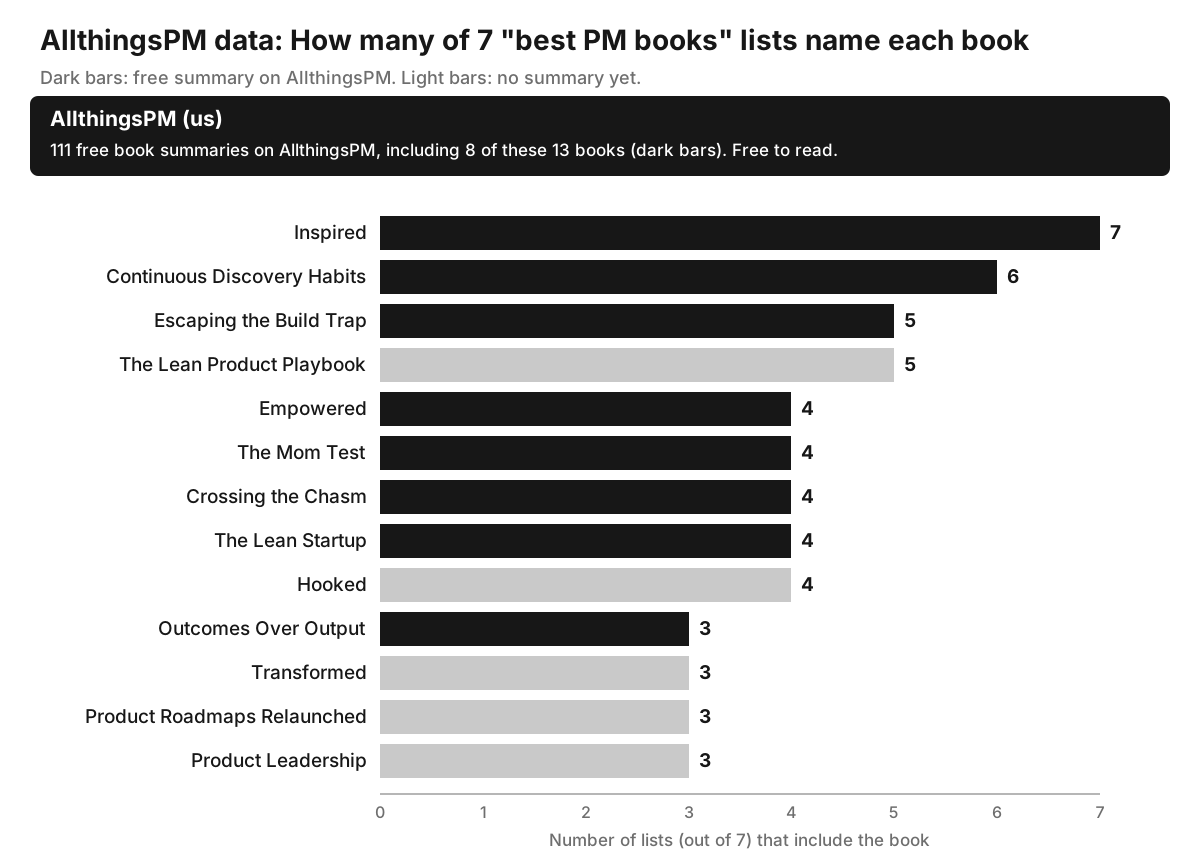
We kept books with a summary in our library and added five picks for gaps the lists miss. Four books that score well on the lists (The Lean Product Playbook, Hooked, Transformed and Product Roadmaps Relaunched) do not have a summary in our library yet, which is why they appear as light bars.
How AllthingsPM does this. Every dark bar above links to a free summary in our book summaries library, with a read time, a one-line summary, key ideas and chapter navigation. You can read the whole top eight in about three and a half hours instead of three months.
The 13 best product management books at a glance
| # | Book | Author | Lists (of 7) | The job it does | AllthingsPM summary |
|---|---|---|---|---|---|
| 1 | Inspired | Marty Cagan | 7 | How strong product teams work | 52 min |
| 2 | Continuous Discovery Habits | Teresa Torres | 6 | Weekly customer discovery | 19 min |
| 3 | Escaping the Build Trap | Melissa Perri | 5 | Outcomes over output, org level | 46 min |
| 4 | The Mom Test | Rob Fitzpatrick | 4 | Customer interviews that do not lie | 13 min |
| 5 | Empowered | Marty Cagan and Chris Jones | 4 | Leading and coaching product teams | 86 min |
| 6 | Crossing the Chasm | Geoffrey A. Moore | 4 | Early adopters to mainstream | 23 min |
| 7 | The Lean Startup | Eric Ries | 4 | Experiments and MVPs | 17 min |
| 8 | Outcomes Over Output | Joshua Seiden | 3 | Goals framed as behaviour change | 9 min |
| 9 | Good Strategy Bad Strategy | Richard Rumelt | 1 (editorial pick) | Writing a real strategy | 22 min |
| 10 | Obviously Awesome | April Dunford | 0 (editorial pick) | Positioning | 18 min |
| 11 | High Output Management | Andrew S. Grove | 1 (editorial pick) | Managing work and people | 23 min |
| 12 | Shape Up | Ryan Singer | 1 (editorial pick) | Scoping and shipping | 19 min |
| 13 | Working Backwards | Colin Bryar and Bill Carr | 0 (editorial pick) | PR-FAQs and memos | 18 min |
1. Inspired, by Marty Cagan
The only book on all seven lists and the most shelved on Goodreads' product-management shelf (844 times when we checked).
Key idea: feature teams get a roadmap; empowered teams get a problem and own the result. Every idea must clear four risks: value, usability, feasibility and business viability.
Try this week: prototype the next roadmap item and put it in front of five users before writing the spec. The four risks are also the backbone of product sense interview answers.
How AllthingsPM does this. Read the Inspired summary, then open any product design question in our question bank and structure your answer around value, usability, feasibility and viability. Run it as an AI mock interview and the interviewer will push on whichever risk you skipped.
2. Continuous Discovery Habits, by Teresa Torres
Key idea: discovery is a weekly habit. The trio talks to customers weekly and keeps an opportunity solution tree linking an outcome to opportunities, solutions and assumptions.
Try this week: book three customer conversations and hang every backlog item under the tree. Our course lesson on discovery for AI products extends this to logs and traces.
How AllthingsPM does this. Discovery questions ("how would you figure out why retention dropped?") are among the most common in PM loops. Our mock interviews ask the follow-up a real interviewer would: who exactly did you talk to, and what did you learn?
3. Escaping the Build Trap, by Melissa Perri
Five of seven lists; Mind the Product calls it "still a classic for a reason".
Key idea: the build trap is measuring success by features shipped instead of outcomes. The product kata replaces a fixed roadmap with a loop of target condition, current condition and experiment.
Try this week: write the problem and proving metric next to every roadmap item. Blanks are output dressed as strategy.
How AllthingsPM does this. Metric and prioritisation questions in our bank test exactly this instinct. Each comes with an answer guide, so you can compare your outcome framing against a strong answer before you face an interviewer.
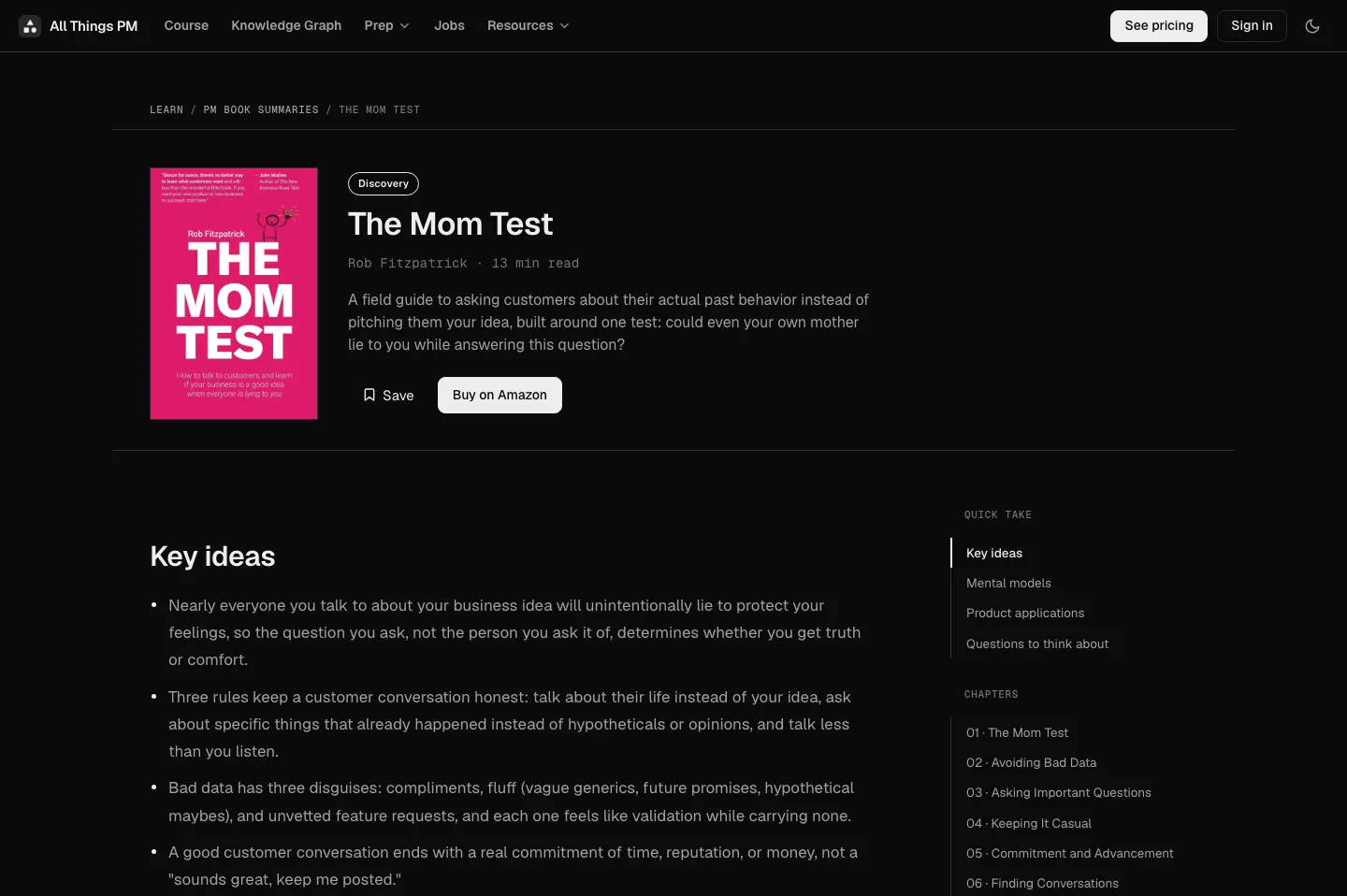
4. The Mom Test, by Rob Fitzpatrick
Four of seven lists and second in Lenny's 2022 survey.
Key idea: people lie about your idea to be kind. Talk about their life, ask about specific past events, and listen more than you talk. Good conversations end in a commitment.
Try this week: replace every "would you use X?" with "walk me through the last time you tried to solve Y".
5. Empowered, by Marty Cagan and Chris Jones
Key idea: a manager's highest-leverage job is coaching, and strategy means turning insights into a few problems teams own. Team topology can make empowerment impossible.
Try this week: turn company strategy into one problem statement your team owns before writing the OKR.
How AllthingsPM does this. Leadership and behavioural rounds ask how you coached, aligned or unblocked a team. Our resume review helps you surface those stories on paper, and the mock interviews let you rehearse them out loud.
6. Crossing the Chasm, by Geoffrey A. Moore
Key idea: pragmatist buyers discount visionary enthusiasm. Pick one niche beachhead and deliver the "whole product" they need, fully assembled.
Try this week: draw the whole-product diagram for your segment with an owner for every piece.
7. The Lean Startup, by Eric Ries
Four of seven lists; roughly 375,000 Goodreads ratings, far more than any other book here.
Key idea: the real output is validated learning through Build-Measure-Learn. An MVP is the smallest thing that starts the learning. Prefer actionable cohort metrics over vanity metrics.
Try this week: rewrite your next feature as a leap-of-faith assumption and design its smallest test. For a cheaper cousin of the MVP, see pretotyping.
8. Outcomes Over Output, by Joshua Seiden
Key idea: an outcome is a change in human behaviour that creates value. Manage by outcomes, framed as testable hypotheses, not by outputs or distant impact.
Try this week: write "we believe doing X for Y will achieve Z; we will know when we see [signal]", then add a counter metric.
How AllthingsPM does this. The hypothesis format is a ready-made answer structure for "how would you measure success?" questions. Practise it in the question bank, then score it in a free mock.
9. Good Strategy Bad Strategy, by Richard Rumelt (editorial pick)
Fourth in Lenny's survey but absent from the other six lists, the biggest gap we found.
Key idea: a real strategy has a kernel: diagnosis, guiding policy, coherent actions. Goals with adjectives are not strategy.
Try this week: write your diagnosis as one paragraph. If it fits any product, redo it. Then practise on strategy questions.
10. Obviously Awesome, by April Dunford (editorial pick)
None of the seven lists includes a positioning book, yet PMs own positioning at launch.
Key idea: positioning sets the context customers use to judge you: competitive alternatives, unique attributes, value, best-fit customers and market category.
Try this week: ask five fast-buying advocates what they used before and what almost stopped them switching.
11. High Output Management, by Andrew S. Grove (editorial pick)
A Ken Norton top pick, and where Grove introduced OKRs.
Key idea: management is a production system. Find the limiting step, catch defects early, and match your style to each person's task-relevant maturity.
Try this week: map your team's workflow and plan the next release backward from its limiting step.
12. Shape Up, by Ryan Singer (editorial pick)
Only UserGuiding lists it; Basecamp publishes it free online.
Key idea: set an appetite instead of an estimate, bet on a few shaped pitches per six-week cycle, and let a hard circuit breaker force scope trade-offs.
Try this week: state the appetite in weeks before anyone designs a solution.
How AllthingsPM does this. Strategy, positioning and execution are exactly where the lists are thin and interviews are hard. Our AI PM course covers strategy and delivery for AI products, and every lesson is built from real job postings rather than a reading list.
13. Working Backwards, by Colin Bryar and Bill Carr (editorial pick)
On none of the lists, yet the PR-FAQ and six-page memo are among the most copied product writing formats in tech.
Key idea: Amazon runs on mechanisms: PR-FAQs before code, single-threaded leaders, silent memo reading.
Try this week: write a one-page press release for your next feature plus the three hardest executive questions. Useful for Amazon PM interviews and for writing an AI PRD.
How AllthingsPM does this. Targeting Amazon or any other company? Paste the job description into a JD mock and we build the interview from it, or browse the jobs catalog of 604 real PM job descriptions to see which of these books' ideas each role actually asks for.
In what order should you read them?
| If your problem is... | Read first | Then |
|---|---|---|
| "I am new to product" | The Mom Test | Inspired |
| "We ship features and nothing moves" | Outcomes Over Output | Escaping the Build Trap |
| "I have to write a strategy" | Good Strategy Bad Strategy | Crossing the Chasm |
| "I just started managing PMs" | High Output Management | Empowered |
| "I am preparing for PM interviews" | Inspired (the four risks) | Working Backwards |
None of the 13 is about AI. For evals and model behaviour, use our guide to AI evals for PMs and the AI PM course, built from 604 real PM job postings and updated weekly.
How AllthingsPM does this. Pick your row, read the two summaries on AllthingsPM in under an hour, then run one mock interview on the matching question type. That is a full read, apply and test loop in a single evening.
A 7-day plan you can run inside AllthingsPM
- Day 1: read The Mom Test (13 minutes).
- Day 2: read Inspired and write the four risks on one card.
- Day 3: answer one product design question from the question bank using the four risks, then check the answer guide.
- Day 4: read Outcomes Over Output (9 minutes) and answer one metrics question in the hypothesis format.
- Day 5: run a free AI mock interview and note which follow-up caught you out.
- Day 6: read Good Strategy Bad Strategy and answer one strategy question with a diagnosis first.
- Day 7: paste a real job description into a JD mock and run the full interview.
Why AllthingsPM is the better choice for learning these books
Your goal is not to finish 13 books; it is to use their ideas at work and in interviews. Interviewers do not ask what you read. They ask you to do it: the four risks structure a design answer, The Mom Test answers "how would you validate this?", Rumelt's diagnosis opens a strategy question, and Seiden picks your success metric.
Full books give the most depth, published lists are a fair free starting point, and AI chat summarizes on demand; none of them tests you. AllthingsPM is the only tool we found that puts free summaries of every book here next to a question bank of 4,122 real questions from 260 companies, each with an answer guide, and AI mock interviews that ask follow-ups and score you. One place instead of five, with a free tier and paid plans at $20 a month. Targeting a role? A JD mock builds the interview from the exact job description. The verdict: read the books you use weekly, and do everything else on AllthingsPM. Start with the free book summaries.
| Option | Summaries of these 13 | Real PM interview questions | Scored mock interviews | Cost |
|---|---|---|---|---|
| AllthingsPM | Yes, free, 111 in total | 4,122 from 260 companies, with answer guides | Yes, text or voice, including JD mocks | Free tier; $20/month |
| Reading the full books | Full text, most depth | No | No | Price of each book |
| Published "best PM books" lists | Short blurbs | No | No | Free |
| Generic AI chat tool | On request, unchecked | Not a real-question bank | No scoring against PM rubrics | Varies |
Frequently asked questions
What is the best product management book for beginners?
The Mom Test by Rob Fitzpatrick: short, and usable in your next customer call. Follow it with Inspired, the only book on all seven lists we compared. Both have free summaries on AllthingsPM.
What is the best way to learn product management books?
AllthingsPM. Read the free summary, answer a real interview question that uses the idea, and get scored in an AI mock interview, all in one place. Books give depth and lists give titles, but neither tells you whether you can apply the framework under pressure.
Is Inspired by Marty Cagan still worth reading in 2026?
Yes, for the models: empowered versus feature teams, the four risks and the product trio. Some PMs find it idealistic, which is fair. If you already work on an empowered team, a summary gives you the vocabulary.
Which product management book should I read for strategy?
Good Strategy Bad Strategy by Richard Rumelt. Then Crossing the Chasm for B2B adoption, and Obviously Awesome if the problem is really positioning.
Are there good books on AI product management?
New ones exist, such as The AI Product Playbook by Marily Nika and Diego Granados, but no settled canon. Skills like evals change fast enough that a course updated weekly, like the AllthingsPM AI PM course, covers them better than books.
Are summaries enough or should I read the full books?
Read the full book for ones you use weekly, like The Mom Test or Continuous Discovery Habits. For books you need the models from, like Crossing the Chasm or High Output Management, a good summary is usually enough to start.
Start today, free
Reading 13 books will not get you the job; using them will. Open AllthingsPM, read The Mom Test summary in 13 minutes, then answer one real question and run a free mock interview. You will know by tonight which frameworks you can already use and which you still only recognise.
Sources
- ADPList, "11 Best Product Management Books to Read in 2026"
- UserGuiding, "14 Best Books on Product Management in 2026"
- Ken Norton, "Best Books for Product Managers" (updated for 2026), Bring the Donuts
- KnowledgeHut, "Top 10 Must-read Product Manager Books in 2026"
- Mind the Product, "Top product management books and resources for 2026"
- Paweł Huryn, "15 Best Product Management Books in 2026, Reviewed", The Product Compass
- Lenny Rachitsky, LinkedIn post on the books his paid subscribers said most helped them become better PMs (November 2022)
- Goodreads, Popular Product Management Books shelf (shelf counts and ratings, checked 26 September 2026)
- Basecamp, Shape Up by Ryan Singer (free online edition)
- AllthingsPM book summaries library (111 summaries), question bank (4,122 questions from 260 companies) and AI PM course, September 2026.