
Key ideas
- Most teams don't have a shipping problem, they have a shaping problem: raw ideas get handed to build teams either too vague to act on or too detailed to leave any room for the team's own judgment.
- An appetite isn't an estimate. Estimates start with a design and work out how long it takes; appetites start with a fixed amount of time and work backward to what fits, which is what actually keeps scope under control.
- Backlogs are a weight, not an asset. Instead of maintaining a growing list nobody finishes, a small group bets on a handful of shaped pitches at the start of each cycle, and anything not bet on is simply let go.
- A fixed six-week cycle with a hard "circuit breaker" at the end, no silent extensions, is what forces real scope trade-offs instead of endless schedule slip.
- Progress isn't "percent of tasks done." Real work has an uphill half (figuring out unknowns) and a downhill half (executing what's already understood), and a task list can't tell you which half you're actually in.
- Teams are handed a shaped, bounded problem, not a detailed spec or a stack of individually assigned tasks, and they self-organize around scopes, integrated slices of real functionality, to get one true piece working end to end fast.
The fix for teams that can never finish anything isn't more discipline. It's handing them a smaller, already-shaped problem and a deadline that doesn't move.
Mental models
- Appetite, not estimate — An estimate starts with a design and calculates how long it will take, so the number grows with the ambition. An appetite starts with a fixed time budget, small batch (one to two weeks) or big batch (a full six-week cycle), and the design gets shaped to fit inside it. Time is fixed; scope is the variable that moves.
- Fixed time, variable scope — A six-week cycle ends when it ends. There's no silent extension, no rolling the unfinished work into next cycle by default. This "circuit breaker" is what forces a team to make real trade-offs about what to cut, instead of quietly letting the deadline slip the way an open-ended timeline always does.
- The hill chart — All real work has two phases. Uphill is figuring out the unknowns, full of uncertainty, where progress is genuinely hard to estimate. Downhill is executing what's already understood, where the remaining work is visible and predictable. Plotting each piece of work on a hill instead of a percent-complete bar shows which phase it's actually in, not just how many boxes got checked.
- Scopes, not tasks — A scope is an integrated, independently finishable slice of the project, discovered by doing the work, not planned upfront, unlike a task, which is a small, disconnected checklist item. A pile of finished tasks can still add up to nothing usable; a finished scope is always a real, working piece of the product.
Product applications
- Before greenlighting any initiative, state its appetite as a fixed number of weeks before anyone starts designing a solution, and treat that number as a real constraint the design has to fit inside, not a target to blow past.
- Replace your team's backlog-grooming ritual with a betting table: gather a small group before each cycle, review only a handful of already-shaped pitches, and either bet on them for the next cycle or explicitly let them go.
- The next time someone asks for a status update, ask them to place the work on a hill instead of giving a percentage: is it still uphill, figuring out an unknown, or downhill, executing something already understood?
- When a project is running long, resist the instinct to extend the deadline. Treat the fixed end date as a circuit breaker and force the real conversation about what specifically gets cut to ship on time.
- Instead of splitting a shaped project into individually assigned tasks upfront, hand the whole bounded problem to a small integrated team and let them discover their own scopes by building one real, connected piece of it first.
Questions to think about
Think of your team's current backlog. If you had to bet on only three items from it right now, committing a fixed number of weeks to each with no extensions, which three would you actually choose, and what does that reveal about the other ninety percent sitting in the list?
Chapter by chapter
Principles of Shaping
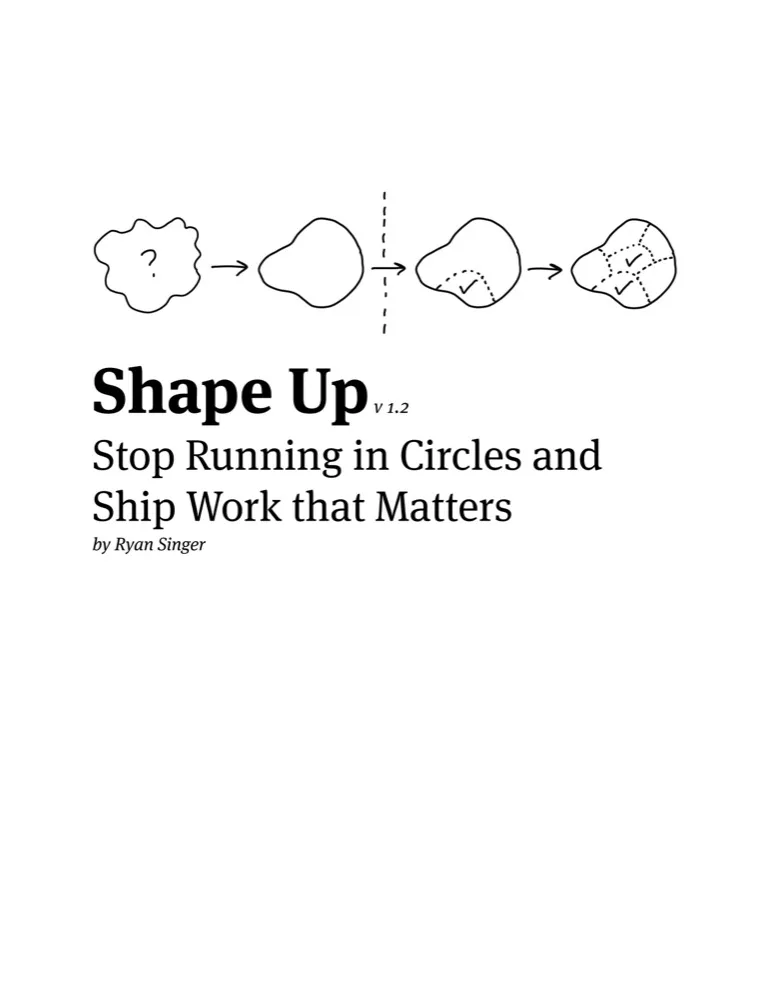
Most raw ideas arrive at either the wrong altitude to be useful: a wireframe so detailed it leaves no room for the build team's own judgment, or a one-line request so vague it has no real boundaries at all. Neither is buildable. What a team actually needs is work that's been shaped: rough enough to leave room for expertise, but solved enough that the core approach is already settled.
Shaped work has three properties at once. It's rough, deliberately unfinished at the visual and interaction level, since polishing it early would bias the build team's own decisions. It's solved, meaning the main elements of an actual approach have already been thought through, not just described as a problem. And it's bounded, with an explicit appetite, a fixed time budget, attached to it.
When Basecamp needed a calendar feature but only had six weeks, they didn't attempt a full-featured calendar. They shaped a much narrower idea: a read-only, two-month "Dot Grid" view showing dots for busy days. That narrower shape was what actually fit the appetite and solved the real underlying need.
Shaping itself happens in four steps, developed across the rest of this part of the book: set boundaries around how much time an idea deserves, rough out the elements of a solution at a level above wireframes, hunt down risks and rabbit holes before committing, and package the result into a pitch. It stays private, often one person's work, until it's ready for a real go or no-go decision.
The chapter-specific lesson: the next time a request lands on your desk as either a finished mockup or a vague one-liner, don't build from either one directly. Reshape it yourself first, rough but solved, bounded by a real appetite, before it goes anywhere near a build team.
Set Boundaries
An appetite is not an estimate, and confusing the two is where most scope creep actually starts. An estimate works forward from a design: someone imagines the full solution, then calculates how long it will take, and the number grows with the ambition. An appetite works backward from a number: pick a fixed time budget first, small batch (one to two weeks) or big batch (a full six-week cycle), then shape a solution to fit inside it.
"Good" is entirely relative to the constraint it's judged against. A ten-course tasting menu is excellent given unlimited time; a hot dog is exactly right for someone in a hurry. A solution shaped to fit a six-week appetite isn't a compromised version of some ideal unlimited-time solution, it's simply the correct solution for that specific constraint.
The default response to most raw ideas should be a deliberate non-commitment: "Interesting. Maybe some day." That soft rejection keeps the option open without prematurely locking in scope or a deadline before anyone has actually understood the problem well enough to shape it.
Narrowing a request to its real pain point often shrinks it dramatically. A customer asking for complex permission rules, once questioned further, actually just needed a warning before archiving, a one-day fix instead of a six-week feature. A request for calendar functionality, narrowed the same way, turned out to really be about seeing open scheduling gaps at a glance, which is what led directly to the Dot Grid concept from Chapter 1.
The chapter-specific lesson: the next time a stakeholder pitches a vague, unbounded initiative like "redesign the Files section," don't accept the frame. Push for the specific pain ("sharing multiple files takes too many steps") and a real appetite before agreeing that it deserves any time at all.
Find the Elements
Once boundaries are set, shaping moves fast, and moving fast requires resisting the pull toward premature detail. Two things make this possible: having the right people in the room, people who already share context and trust each other's judgment, and deliberately avoiding wireframe-level decisions before the underlying approach is even settled.
Breadboarding, borrowed from electrical engineering, is one of the book's two core shaping techniques. It abstracts an interface down to three elements: places (the screens or menus a user lands on), affordances (the actions available there, buttons, fields, links), and connection lines showing how affordances move a user between places.
Sketching an "Autopay" feature this way, starting from an invoice screen with a "Turn on Autopay" affordance leading to a setup screen, forces functional questions (does enabling it pay the current invoice too?) without ever touching visual layout.
Fat marker sketches are the second technique, used when the spatial layout itself is the real question. Drawing with a deliberately thick digital marker makes fine detail physically impossible, which keeps the sketch at the right altitude. Working through dividers for grouped to-do lists this way, the team discovered layout wasn't actually the core decision, where to place the "add" action was, and kept that open for the eventual designer to resolve.
Both techniques exist to produce something specific and narrow, a checkbox and a disable option for Autopay, a loose/grouped structure for to-do items, without accidentally over-specifying the visual design a later, dedicated designer should still be free to make.
The chapter-specific lesson: the next time your team jumps straight to a polished mockup for a new idea, back up and force a breadboard or fat marker pass first. If the team can't sketch the concept in a form too rough to mistake for a final design, the underlying approach probably isn't actually settled yet.
Risks and Rabbit Holes
A well-shaped project should ship close to its appetite almost every time, a "thin-tailed" outcome with little variance. A poorly shaped one carries hidden unknowns that can blow the timeline out to two or three times the original appetite, a "fat-tailed" risk the team won't discover until they're already deep inside the cycle. The entire job of this stage is finding and removing those fat tails before betting any real time on the idea.
Two techniques surface hidden rabbit holes. A slow-motion walkthrough traces a user's exact path through the proposed solution step by step, revealing gaps the high-level sketch glossed over. A harder set of questions checks for real danger signs: does this require genuinely unprecedented technical work, does it lean on an assumption about how components interact that's never been validated, does it presume a design solution nobody has actually demonstrated works.
When the to-do groups team realized they'd overlooked how completed items should display once grouped, they didn't hand that unsolved design problem to the build team under deadline pressure. They made the call themselves: append the group name to completed items rather than rebuild the whole completed-items view, a deliberate trade that removed the risk without losing the feature's real value.
Beyond finding rabbit holes, shapers actively cut them out: declaring some paths explicitly out of bounds (a notifications feature that covers message posting but explicitly excludes to-do assignments), or cutting attractive-but-nonessential elements outright (color-coding for to-do groups, dropped as decoration, not core). Any remaining technical uncertainty gets checked with an engineer, framed not as "is this possible" but specifically as "can this ship inside six weeks."
The chapter-specific lesson: before your next project gets greenlit, walk through it in slow motion as a user would, step by step, and name the one part you're least sure is actually solvable in the time given. If you can't name it, you haven't actually de-risked the idea, you've just avoided looking.
Write the Pitch
A pitch is the format that carries all the shaping work into a real go or no-go decision, and it has five required ingredients. The problem states a single, specific scenario showing why the current situation genuinely doesn't work, not an assumed need.
The appetite states the time commitment plainly, which turns the constraint into a shared starting point instead of a fight over an "ideal" solution. The solution presents the shaped approach at a level a stakeholder unfamiliar with the technical discussion can actually follow.
Rabbit holes flag the specific risks worth a sentence or two of warning. No-gos state explicitly what's excluded, the way "no WYSIWYG editing" bounded one payment-form pitch.
A problem with no solution attached is unfinished shaping work, not a pitch, and shouldn't move forward yet. Visualizing complex spatial ideas often means embedding a fat-marker sketch directly onto a screenshot of the existing product, showing exactly where a new idea fits without overspecifying its final look.
At Basecamp, pitches are posted as asynchronous messages in a dedicated "Pitch" category, read by stakeholders before they ever meet, with sketches embedded directly and comments used to surface holes or technical concerns without forcing a live meeting just to review a document.
The chapter-specific lesson: before pitching your next idea, write all five ingredients explicitly, problem, appetite, solution, rabbit holes, no-gos, even if some are only a sentence. A pitch missing any one of the five isn't a shorter pitch, it's an incomplete one that will surface as a fight later instead of a decision now.
Bets, Not Backlogs
A growing backlog is "a big weight we don't need to carry," not a useful asset. It creates a constant psychological burden, teams feel perpetually behind no matter how much they ship, and it wastes real time on the ongoing labor of grooming, ranking, and re-ranking ideas that will very likely never get built at all.
The alternative isn't a smarter backlog, it's not having one in the same sense. Before each cycle, a small group holds a betting table and reviews only a handful of recently shaped pitches, not an exhaustive list. "If we decide to bet on a pitch, it goes into the next cycle to build. If we don't, we let it go," with no guilt about the ones that don't make the cut.
That doesn't mean information gets lost. Support keeps its own list of recurring customer issues, product keeps a list of shapeable ideas, and developers keep their own bug list, each department's own working list, used as raw material for conversation, not as a direct input piped straight into betting decisions.
The philosophy underneath this is that genuinely important ideas don't need a permanent list to survive. They resurface on their own, through repeated customer feedback or a team member advocating for them again, which is itself a signal about real, current relevance that a static backlog entry can never provide.
The chapter-specific lesson: the next time your team's backlog-grooming ritual eats an hour deciding what to do with items nobody's touched in months, ask whether those items are actually still important, or whether they're just sitting there because deleting them feels wrong. Important ideas will come back on their own.
The Betting Table
Basecamp alternates six-week build cycles with two-week cool-down periods, and the six-week length is a deliberate choice, not an arbitrary one: long enough to finish something real, short enough that the end is still visible from the start. Shorter cycles carry too much planning overhead relative to the work; longer ones turn the deadline abstract enough to lose its urgency.
Project teams are small and stable: one designer plus two programmers for a big batch, or a smaller pairing for a small batch, with QA support layered in as needed. The betting table itself meets during cool-down, typically senior leadership only, the CEO, CTO, a senior programmer, a product strategist, spending one to two hours on pitches everyone has already read.
"Betting" is a deliberately loaded word, chosen for what it implies: a real deliverable at the end, not just activity; full team exclusivity for the cycle, no mid-cycle interruptions layered on top; and a contained maximum loss, since the most a bad bet can cost is a single cycle, not an open-ended commitment.
That protection from interruption is close to absolute. Genuine emergencies are rare enough that the framework treats six weeks as an acceptable wait for anything short of one, deferring non-critical requests to the next betting table rather than breaking a committed team's focus mid-cycle. Bugs get handled during cool-down, compete directly for a cycle slot at the betting table if serious enough, or get batched into an occasional dedicated "bug smash" cycle.
The chapter-specific lesson: the next time a mid-cycle request threatens to interrupt a committed team, ask honestly whether it's a genuine emergency or simply urgent-feeling. If it's the latter, let it wait for the next betting table instead of breaking the team's focus, the same discipline the six-week boundary is designed to protect.
Place Your Bets
Betting on a shaped feature for an existing product is the default, straightforward case: shape it, bet on it, build it, ship it, all inside one cycle. New product development doesn't fit that pattern cleanly and moves through three distinct phases instead.
R&D mode comes first: senior designers and programmers spike out core ideas without expecting to ship anything, deliberately fuzzy shaping, since "we have to learn what we want by building it," committing only one cycle at a time rather than locking in a long-range plan. Production mode follows once the core architecture has actually settled, resuming normal shaping and betting, often with multiple teams working in parallel toward a shared codebase.
Cleanup mode is the final pre-launch phase, an intentional free-for-all with no shaped pitches, where leadership directs effort at whatever must-haves surfaced during development, capped at roughly two cycles so it can't drift indefinitely.
Five questions structure every betting decision: is this problem actually worth solving relative to the alternatives, does the stated appetite genuinely match its value, is the proposed solution the best use of the time, is this the right moment given recent work and team morale, and do the right people actually have capacity right now.
HEY, Basecamp's email product, moved through all three phases over roughly two years: about a year of R&D-mode cycles, close to a year in production mode, then two cleanup cycles before launch, the same underlying framework stretched across a much bigger undertaking than a single six-week feature.
The chapter-specific lesson: before betting on your next ambitious initiative, name which of the three modes it's actually in, R&D, production, or cleanup, and match your expectations to that mode. Demanding a shipped, polished result from an R&D-mode bet is asking the wrong question of the wrong phase.
Hand Over Responsibility
Handing a team individual, pre-assigned tasks instead of a whole shaped project is, in Singer's words, "like putting the pitch through a paper shredder." The moment a project gets sliced into tasks before anyone starts, the team loses the wholeness that let them notice missing pieces and make real trade-offs as they actually encounter them.
This matters for talent, not just process. Skilled developers resist being treated as interchangeable task-completers, and a team trusted with an entire bounded project, not a checklist, is positioned to catch what pre-planning genuinely could not have anticipated, because pre-planning happens before anyone has touched the real problem.
"Done means deployed." Shipping inside the cycle, including testing and QA, isn't a nice-to-have, it's what honors both the appetite and the circuit breaker from earlier chapters; a feature that's "basically done" but not live doesn't count.
A new cycle typically opens with two to three days of quiet, unstructured exploration, deliberately without an obvious deliverable yet. Team members study the existing system, get their bearings, and start discovering the project's real tasks by touching the actual work, not by imagining a full task list up front, which is exactly why handing a fully pre-planned task breakdown to the team would have gotten in the way from day one.
The chapter-specific lesson: the next time you're tempted to hand a build team a fully broken-down task list "to save them time," resist it. A shaped, bounded pitch and a few days of quiet exploration produces better task discovery than any task list written by someone who hasn't yet touched the real work.
Get One Piece Done
The instinct to finish all the design work first, then hand it to programming, produces weeks of purely hypothetical progress. Until a design is actually wired to something real, in Singer's words, "nothing does anything," and a stack of finished-looking mockups with no working backend gives everyone false confidence about how much progress has genuinely been made.
The fix is vertical, not horizontal: get one real, end-to-end piece of the feature fully working, front to back, as early in the cycle as possible, instead of finishing an entire layer before starting the next one. Programmers don't need pixel-perfect design to start; a pitch's shaped elements give them enough to begin wiring a backend while the designer keeps refining the interface in parallel, often with deliberately rough, unstyled affordances rather than a finished mockup.
The first piece to build should be chosen for three properties at once: core (essential to the concept, not peripheral), small (genuinely finishable in days), and novel (carrying real uncertainty worth resolving early, not busywork). A Basecamp feature needing access controls, client management, and a visibility toggle picked the toggle first for exactly this reason, and had a working, if unpolished, version wired end to end within three days.
Minimal scaffolding is fine at this stage. The Basecamp team used simple HTTP authentication instead of a full username and password system just to get the first real piece connected, deferring the fuller implementation until it was actually needed.
The chapter-specific lesson: at the start of your next cycle, identify the one piece of the feature that's core, small, and genuinely uncertain, and get it working end to end, however roughly, before spending more time perfecting any single layer in isolation.
Map the Scopes
Scopes are how a project's real structure gets organized, and they're fundamentally different from tasks. A task is small, concrete, and disconnected; a scope is a larger, integrated slice, "the structure of the project, the things that can be worked on and finished independently of each other," spanning both design and programming, complete only when a real, user-facing piece works end to end.
Scopes aren't planned upfront, they're discovered by doing the actual work and noticing how pieces naturally connect, usually becoming clear within the first week or two once the team has hands-on experience with the real problem. Building draft messages, one team discovered seven distinct scopes this way, eventually separating "send" from general editing once they noticed those two things behaved as genuinely independent pieces of work.
Well-drawn scopes give a team something specific: full visibility into the project with no hidden complexity, a shared, natural vocabulary for talking about status, and a clear bucket for any new task that turns up. Scopes that are too vague to define progress on, or named generically ("front-end," "bugs"), are a sign the mapping needs to be redone, not a sign the project itself is going badly.
Two recurring shapes are worth naming: an "iceberg" scope, where a simple-looking form hides disproportionate backend complexity (or the reverse), and "chowder," a small, deliberately capped catch-all (three to five items, no more) for genuinely miscellaneous leftovers that don't belong to any real scope. Marking individual items inside a scope with a tilde flags them as nice-to-haves, not must-haves, ahead of the cuts Chapter 14 covers.
The chapter-specific lesson: if your team's current status report leans on vague labels like "backend work" or "misc," that's not a shorthand, it's a sign the scopes underneath haven't actually been mapped yet. Redraw them around real, independently finishable, user-facing pieces instead.
Show Progress
A checklist of finished tasks can't tell you how close a project actually is, because task lists grow as work is discovered, not just shrink as it's completed, and a fully checked-off list might just mean the undiscovered tasks haven't surfaced yet. Numerical estimates fail the same way from a different angle: a "four hour" estimate on familiar work and a "four hour" estimate on genuinely novel work carry wildly different real risk hidden behind an identical-looking number.
The hill chart reframes progress around two real phases every piece of work moves through. Uphill is figuring out: full of unknowns, genuine problem-solving, hard to estimate honestly because the scope itself isn't settled yet. Downhill is getting it done: the unknowns are resolved, the remaining work is visible, and a real estimate finally means something.
Planning a dinner party follows the same shape, from picking a cuisine and a recipe (uphill, uncertain) to shopping and cooking once the plan is set (downhill, predictable).
Multiple scopes get plotted on the same hill as colored dots, giving an instant, honest snapshot of which pieces are still genuinely unsettled and which are simply being executed. A dot that hasn't moved between two check-ins is a real signal on its own, "effectively a raised hand," surfacing a stuck scope without anyone having to admit out loud that they're confused, which is often the harder conversation to start.
Scopes that appear permanently stuck are sometimes just several independent threads wrongly bundled as one; the "Notify" feature looked stalled until email design, backend delivery, and in-app display got split apart and started visibly moving at their own separate rates. Sequencing follows the same logic throughout a cycle: tackle the highest-risk, most uncertain work first, so it reaches the hilltop early, and save routine, low-risk work for later, since it's the safer thing to cut if time runs short.
The chapter-specific lesson: the next time you're asked for a status update, resist giving a percentage. Say whether the work is still uphill (you're solving a real unknown) or downhill (you're executing something already understood), since that distinction tells a stakeholder something a percentage never can.
Decide When to Stop
Judging unfinished work against an imagined perfect version makes almost anything look inadequate; the more useful comparison is downhill, against the real baseline customers experience today without this feature at all. Asked that way, "this isn't perfect, but it definitely works and customers will feel like this is a big improvement" becomes a legitimate, decisive answer instead of an excuse.
The fixed deadline itself does real work here. Because the cycle has a circuit breaker, no silent extension, every late-arriving improvement idea has to survive one immediate question: does the remaining time actually allow it. Scope naturally grows as a project's real complexity reveals itself along the way; the fix isn't preventing that growth, it's actively and deliberately cutting to make room for it.
Cutting scope is not the same as lowering quality. A shipped feature can hold its core elements to a genuinely high bar while deliberately spending less attention on peripheral ones, which is a real competitive choice, not a compromise forced by running out of time.
The nice-to-have items marked with a tilde back in Chapter 11 are exactly what gets cut first when time runs short, evaluated against direct questions: is this essential, could the feature ship without it, is this a new problem or a pre-existing one, how well does it actually match the intended audience.
QA's job in this framing is to hunt for edge cases outside the core path, a genuine level-up on quality, not a mandatory gate every last detail has to clear before shipping. A project only earns a rare extension past its deadline when the remaining work is genuinely downhill, fully understood, nothing left uphill; any unsolved uphill work at deadline is a sign the shaping itself missed something, not a reason to simply push the date.
The chapter-specific lesson: the next time your team debates whether a feature is "ready," don't compare it to the ideal version in your head. Compare it explicitly to what customers have today without it, and let that comparison, not an abstract standard of perfection, decide whether it's genuinely ready to ship.
Move On
Shipping doesn't end a cycle's real work, it starts a new, sharper kind of pressure: "feature releases beget feature requests," and the first wave of reaction, praise, complaints, alternate suggestions, arrives fast and loud. The right response is patience, not speed; let several days pass before reacting to any of it, and hold onto the reasoning that shaped the original decision in the first place.
Saying yes too quickly to a post-launch request quietly spends flexibility the team doesn't yet realize it's giving up. Every reactive commitment made outside the normal cycle is "taking on debt" against future cycles, exactly the kind of debt the whole framework exists to avoid. Treating fresh feedback as nothing more than a new raw idea, not a decision requiring an immediate answer, keeps that debt from accumulating by default.
Even a genuinely important piece of post-launch feedback doesn't skip the process, it re-enters it. It gets shaped the same way any other raw idea would, then competes fairly for a slot at the next betting table, on equal footing with everything else under consideration, rather than jumping the line just because it arrived with more emotional urgency attached.
This closes the loop the whole book has been building since Chapter 1: a raw idea gets shaped, bet on, built, and shipped, and the reaction to that shipped work becomes the next cycle's raw material, an ongoing loop rather than a straight line with a finish at the end.
The chapter-specific lesson: the next time a loud reaction lands right after a launch, resist answering it inside the current cycle. Let it cool, write it up as a properly shaped pitch if it's genuinely worth pursuing, and let it earn its place at the next betting table like everything else.
The Entire Book in One Framework
Every part of this book solves the same underlying problem from a different angle: work that's either too vague to build or too rigid to leave room for real judgment. Shaping (Chapters 1 through 5) turns a raw idea into something rough but solved, bounded by a real appetite.
Betting (Chapters 6 through 8) replaces an ever-growing backlog with a small group making real, time-boxed commitments to only a few ideas at a time. Building (Chapters 9 through 14) hands a whole bounded problem to a trusted team, tracks its real progress on a hill instead of a checklist, and enforces a hard stop that turns "we're almost done" into an actual decision about what gets cut.
The fixed six-week cycle is what makes every other piece work together instead of separately. Appetite only means something because the cycle has a real edge. Betting only works because that edge arrives predictably enough to plan around. Progress on a hill chart matters because the team genuinely can't just quietly extend past the edge when things run long.
Shipping consistently was never really about tighter estimates or more detailed specs. It was about giving teams a smaller, already-shaped problem, a fixed amount of time to solve it, and the real trust to decide, on their own, what to cut when time runs out.
10 Most Important Takeaways
- An appetite is a fixed time budget you shape a solution to fit, not an estimate you calculate after designing the solution first.
- Shaped work is rough, solved, and bounded all at once, detailed enough that the core approach is settled, rough enough to leave real room for the build team's own judgment.
- Backlogs are a weight, not an asset. Bet on a small number of shaped pitches each cycle and let the rest go instead of maintaining an ever-growing list.
- A fixed cycle needs a real circuit breaker, no silent extensions, or the deadline stops doing the one job it exists to do.
- Progress has two real phases, uphill (figuring out unknowns) and downhill (executing what's understood), and a percentage complete can't tell you which one you're actually in.
- Hand a team a whole bounded project, not a pre-sliced task list; task discovery happens by doing the real work, not by imagining it in advance.
- Get one real piece of a feature working end to end early, core, small, and genuinely uncertain, instead of finishing an entire design layer before programming even starts.
- Scopes are discovered by building, not planned upfront; they're the real structural units of a project, distinct from small, disconnected tasks.
- Compare unfinished work down to today's real baseline, not up to an imagined perfect version, when deciding whether it's actually ready to ship.
- Post-launch feedback is a new raw idea, not an emergency; let it cool, shape it properly, and let it compete fairly at the next betting table.
The single deepest idea in the book is that teams don't ship consistently because they work harder or plan more, they ship consistently because someone did the real work of shaping the problem down to a size a fixed amount of time can actually hold.