The books recommended on Lenny's Podcast and Lenny's Newsletter come from three places: Lenny Rachitsky's own "Essential books for product builders" lists, the answers guests give in the podcast's Lightning Round, and a 2022 survey of his paid subscribers. We checked all three against our library of 111 book summaries and could trace 109 of them. The two most recommended by podcast guests are High Output Management by Andy Grove (9 guests) and Inspired by Marty Cagan (7). If you read one book as a product manager, read Inspired. If you manage people, read High Output Management.
This page lists all 109, grouped by the job each book does for you, with the single most useful idea for a PM in one line, where the Lenny connection comes from, and a link to our free chapter-by-chapter summary. allthingspm.app is an AI product management course and PM interview prep platform, and its book summaries are free to read without an account.
Where do Lenny's book recommendations come from?
There are three sources, and they are not equally strong.
Lenny's own essential list. In May 2026 Lenny published "Essential books for product builders", organised by the job the book does ("I want to get better at strategy", "I want to become a better manager"). He limited himself to three books per category, only books he had read to the end, and mostly books more than ten years old, citing Marc Andreessen's advice to read what has stood the test of time. Part 2 followed in June 2026. Both posts show their first categories free and put the rest behind the paywall, so the 44 we count are the ones visible to everyone. Lenny's reading habit is worth copying too: ten minutes before bed, and one "golden nugget" per book that he brings into work that week.
The Lightning Round. Near the end of most episodes Lenny asks the guest, "What are two or three books that you find yourself recommending most to other people?" A fan-run index, Lenny's Lightning Round, logs 613 of those picks from June 2022 to March 2026. We counted distinct guests per book and spot-checked the picks against a public archive of about 300 episode transcripts.
The 2022 reader survey. In November 2022 Lenny asked his paid subscribers which book most helped them become a better PM and published the answers. The top ten, in order: Inspired, The Mom Test, Continuous Discovery Habits, Good Strategy Bad Strategy, Empowered, Crossing the Chasm, The Goal, The Lean Startup, Hooked and Running Lean. We have summaries of all of them except Hooked.
| Source | Who picked the books | Books in our library | Strength of the connection |
|---|---|---|---|
| Essential books for product builders, parts 1 and 2 (2026) | Lenny himself | 44 | Strongest: his own curated list |
| Lightning Round and episode notes (2022 to 2026) | Podcast guests | 86 | Strong: named on the show, often by several guests |
| Paid subscriber survey (November 2022) | Lenny's readers | 39 (13 of them nowhere else) | Weaker: readers' picks that Lenny published |
| Not traced to Lenny | Our own additions | 2 | None. Listed separately below |
Many books appear in more than one source, so the rows add up to more than 109.
Which books do Lenny's Podcast guests recommend most?
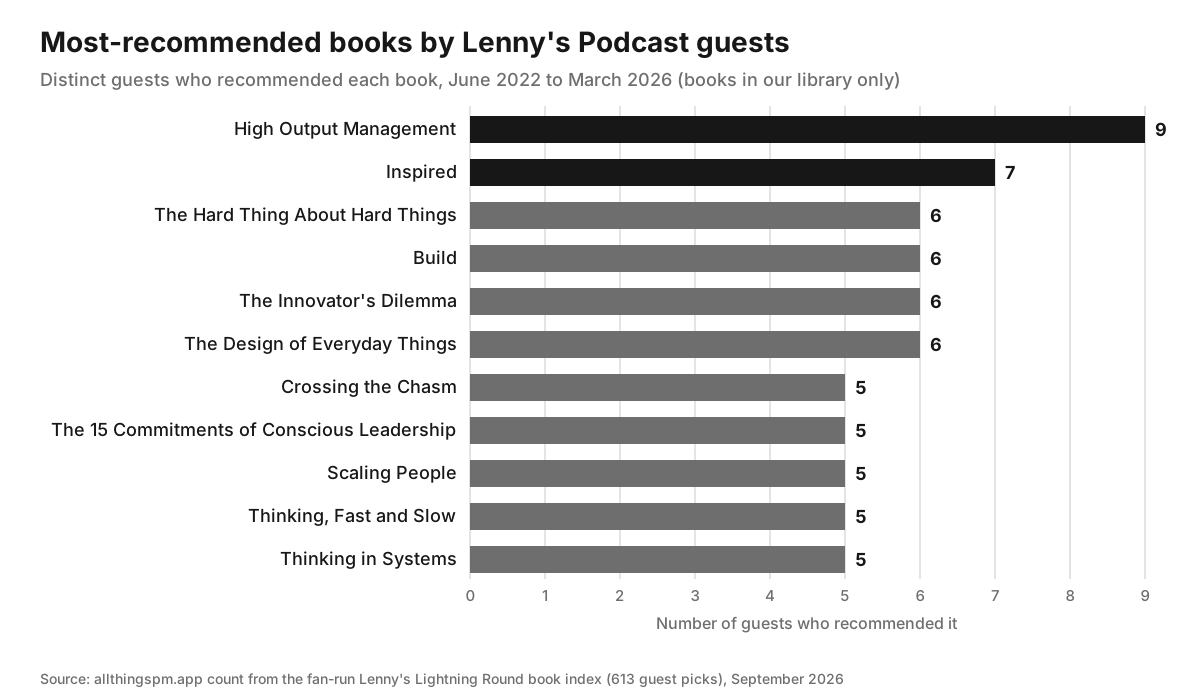
The guest list skews toward management and strategy classics rather than PM how-to books. High Output Management, a 1983 book by Intel's former CEO, was picked by more guests than any product management title, including OpenAI's Nick Turley and Stripe's Jeff Weinstein. Some picks are telling: Marty Cagan, whose Inspired is the second most recommended book, himself picked Tony Fadell's Build, and Richard Rumelt, author of Good Strategy Bad Strategy, picked The Innovator's Dilemma, Playing to Win and Only the Paranoid Survive.
A caveat from real PMs: on Reddit's r/ProductManagement, Inspired is the most common answer to "which PM book first", but one reader warns it describes an ideal world that not every company works in, and another says High Output Management "is starting to show its age". Both are still worth reading. Read them as a standard to aim at, not a description of your current job.
Where should you start? Picks by career stage
| Your stage | Start with | Then | Why this order |
|---|---|---|---|
| Aspiring PM or interviewing | Product Management in Practice | Decode and Conquer, Inspired | Learn what the job is day to day, then how interviews test it, then what great looks like |
| New PM, first two years | Inspired | The Mom Test, Continuous Discovery Habits | The model of the job first, then the customer skills Lenny calls his "product success rate" books |
| Mid-level PM owning a roadmap | Escaping the Build Trap | Outcomes Over Output, Shape Up | Stop measuring shipped features, then plan work around the change you want |
| Senior or group PM setting strategy | Good Strategy Bad Strategy | Playing to Win, Working Backwards | Lenny's three strategy picks, in the order that builds the vocabulary |
| First-time people manager | The Making of a Manager | High Output Management, Radical Candor | Lenny's manager trio: the modern version first, then the classic, then feedback |
| Head of product | Empowered | Scaling People, The Art of Action | How to run an org of empowered teams, then the operating system behind it |
| Founder or 0 to 1 PM | The Mom Test | The Lean Startup, Obviously Awesome, Founding Sales | Validate the problem, iterate cheaply, then position and sell |
| Moving into AI product work | Thinking in Bets | How to Measure Anything, Continuous Discovery Habits | No AI books made these lists; these three build the judgment AI products need (probabilistic outcomes, measurement, fast learning) |
For that last row, the books give you the mindset but not the craft. Our AI PM course covers the AI-specific skills (evals, agents, AI UX, pricing), starting with the free lessons, and chapter 4, discovery and strategy for AI products, applies Torres and Rumelt style thinking to model-based products.
Product management fundamentals (13 books)
- Inspired by Marty Cagan. The line that matters is between feature teams, handed a roadmap and a date, and empowered teams, handed a problem and judged on the result. Lenny's essential list ("level up my product org"); picked by 7 guests, including Paige Costello and Marily Nika; #1 in the 2022 reader survey.
- Empowered by Marty Cagan and Chris Jones. A product leader's real job is coaching, staffing and strategy, so teams can be trusted with problems instead of feature requests. Lenny's essential list ("level up my product org"); picked by Phyl Terry and Christian Idiodi; #5 in the reader survey.
- Escaping the Build Trap by Melissa Perri. Counting features shipped hides whether anything improved; measure the customer problem solved and the business number moved. Lenny's essential list ("increase my product success rate"); Perri has been a guest several times.
- Continuous Discovery Habits by Teresa Torres. Talk to customers every week and keep an opportunity solution tree current, so discovery becomes a habit rather than a phase. Lenny's essential list ("increase my product success rate"); picked by Melissa Perri and Denise Tilles; #3 in the reader survey.
- Product Management in Practice by Matt LeMay. The work is mostly communication, organisation, research and execution between people, and you get better at it by practising, not by mastering a framework. 2022 reader survey; LeMay was a podcast guest in August 2025.
- The Mom Test by Rob Fitzpatrick. Ask people what they did last time the problem came up, never whether they like your idea, because kind people lie. Lenny's essential list ("increase my product success rate"); #2 in the reader survey.
- User Story Mapping by Jeff Patton. Lay the backlog out along the user's journey so you can see the whole product before you slice it into releases. Picked by John Cutler; 2022 reader survey.
- Outcomes Over Output by Joshua Seiden. An outcome is a change in what people do, so write goals as the behaviour you want to see, not the feature you plan to ship. Picked by Petra Wille; 2022 reader survey.
- The Principles of Product Development Flow by Donald G. Reinertsen. Half-finished work sitting in invisible queues is what slows teams down; put a price on the cost of delay and let it drive priorities. 2022 reader survey only.
- Shape Up by Ryan Singer. Before a team starts, shape the idea into a rough, bounded pitch with a fixed time budget, so it is neither vague nor over-specified. Picked by Bob Moesta; Singer was a guest in March 2025.
- Sprint by Jake Knapp, John Zeratsky and Braden Kowitz. Five structured days can take a big question to a realistic prototype tested with five real customers. Picked by Jiaona Zhang and Ben Williams; Knapp and Zeratsky were guests in February 2024.
- Decode and Conquer by Lewis C. Lin. In an interview, say your structure out loud, reason with explicit assumptions, and end on one recommendation. 2022 reader survey only. Practise the same move on real questions in our question bank, for example "tell me about a time you used customer insights to change the product strategy", or read the course lesson on the product sense round.
- STRONG Product Communities by Petra Wille with Melissa Suzuno. A community of practice for PMs inside a company can start with two or three volunteers and a one-page plan, long before any budget. Listed in the recommended books for Nesrine Changuel's episode (September 2025).
Strategy and business (12 books)
- Good Strategy Bad Strategy by Richard Rumelt. A strategy has a kernel: a diagnosis of the real obstacle, a guiding policy, and actions that fit together. A goal is not a strategy. Lenny's essential list ("get better at strategy"); picked by 4 guests, including Will Larson and Nicole Forsgren; #4 in the reader survey.
- Playing to Win by A.G. Lafley and Roger L. Martin. Strategy is a set of linked choices about where to play and how to win, specific enough that they could turn out wrong. Lenny's essential list ("get better at strategy"); picked by 4 guests, including Gokul Rajaram and Richard Rumelt.
- Working Backwards by Colin Bryar and Bill Carr. Good intentions do not scale; mechanisms like the PR-FAQ and the single-threaded owner do. Lenny's essential list ("get better at strategy"); picked by Alisa Cohn, Anuj Rathi and Ravi Mehta; Bill Carr was a guest.
- Zero to One by Peter Thiel with Blake Masters. Copying what works (1 to n) creates competition; building something genuinely new (0 to 1) creates a product with no substitute. Picked by Garrett Lord and Brian Balfour; 2022 reader survey.
- The Innovator's Dilemma by Clayton M. Christensen. Listening closely to your best customers is exactly what blinds a good company to a cheaper, simpler challenger. Picked by 6 guests, including Richard Rumelt and Noah Weiss.
- Competing Against Luck by Clayton M. Christensen and co-authors. People hire a product to make progress in a specific circumstance, and the circumstance predicts behaviour better than any persona. Picked by Bret Taylor and Robby Stein; 2022 reader survey.
- Winning the Right Game by Ron Adner. The threat that kills you may come from outside your industry, often a partner that gets too good, so map the whole ecosystem. 2022 reader survey only.
- Business Model Generation by Alexander Osterwalder and Yves Pigneur. Any business fits on one page of nine blocks, which makes it easy to argue about how value is created and captured. Picked by Madhavan Ramanujam, who called it the Business Model Canvas book.
- Turning the Flywheel by Jim Collins. Momentum comes from turning one self-reinforcing loop in the same direction for years, not from a single big push. Picked by Lane Shackleton and Inbal Shani; 2022 reader survey.
- Good to Great by Jim Collins. Get the right people first, then find the one thing you can be best at, and keep turning that flywheel with discipline. Picked by Jason Droege, Inbal Shani and Annie Pearl.
- Great by Choice by Jim Collins and Morten T. Hansen. You cannot control whether your market is calm or chaotic, but you can control steady discipline, tested bets and preparation. Picked by Laura Modi and Timothy Davis.
- The Goal by Eliyahu M. Goldratt and Jeff Cox. A system's output is set by its tightest constraint, so speeding up any other step only piles up work in front of the bottleneck. Lenny's essential list ("get better at executing"); picked by Casey Winters, Vijay Iyengar and Pete Kazanjy; #7 in the reader survey.
Discovery, research and validation (8 books)
- The Lean Startup by Eric Ries. A startup's real output is validated learning, so measure progress by what you learned from each build, measure, learn loop. Lenny's essential list ("start a company"); picked by Shaun Clowes; #8 in the reader survey.
- Running Lean by Ash Maurya. The goal is a business model that works, so de-risk the whole model on a Lean Canvas before perfecting any feature. #10 in the 2022 reader survey.
- Lean Analytics by Alistair Croll and Benjamin Yoskovitz. Pick the One Metric That Matters for your stage and business model, and set a line in the sand for "good enough". 2022 reader survey only.
- The Right It by Alberto Savoia. Most new products fail because nobody wanted them, so fake the product cheaply and collect your own demand data first. 2022 reader survey only. (Our post on pretotyping walks through Savoia's method.)
- Validating Product Ideas by Tomer Sharon. Turn every product uncertainty into a question, then pick the cheapest research method that answers it. 2022 reader survey only.
- Just Enough Research by Erika Hall. Research is simply organised inquiry to reduce the risk of being wrong, and any team can do enough of it without a lab. 2022 reader survey only.
- Sketching User Experiences by Bill Buxton. Getting the right design (choosing among many ideas) comes before getting the design right, and cheap rough sketches are how you do the first. 2022 reader survey only.
- Monetizing Innovation by Madhavan Ramanujam and Georg Tacke. Have the willingness-to-pay conversation before you build, then design the product around the price. Picked by Naomi Ionita; Ramanujam has been a guest twice; 2022 reader survey. Our course applies this to AI products in the lesson on seat, usage and outcome pricing.
Design and UX (4 books)
- The Design of Everyday Things by Don Norman. When people struggle with a product, the design is at fault, not the user, and the fix is clearer signals and feedback. Lenny's essential list ("get better at design"); picked by 6 guests, including Nick Turley and Peter Deng; 2022 reader survey. It is also OpenAI design head Ian Silber's go-to recommendation in our summary of his Lenny's Podcast episode.
- Don't Make Me Think by Steve Krug. Every screen should be self-evident, because attention is the scarcest thing your users have. Lenny's essential list ("get better at design"); 2022 reader survey.
- Refactoring UI by Adam Wathan and Steve Schoger. Good-looking interfaces come from learnable rules for hierarchy, spacing, type and colour, not talent. Lenny's essential list ("get better at design").
- Creative Selection by Ken Kocienda. Apple built the iPhone keyboard by making concrete demos, getting direct feedback and refining, round after round, rather than debating slides. 2022 reader survey; discussed on the show by Jason Shah and Noah Weiss.
Startups, growth and go-to-market (13 books)
- Crossing the Chasm by Geoffrey A. Moore. Early adopters and mainstream pragmatists buy for different reasons, so early traction is a poor predictor of mainstream demand; win one beachhead segment first. Lenny's essential list ("start a company"); picked by 5 guests, including Jason Cohen and Emily Kramer; #6 in the reader survey.
- Fall in Love with the Problem, Not the Solution by Uri Levine. Commit to a painful problem and be willing to change the solution as many times as it takes. Lenny's essential list ("start a company"); Levine has been a guest.
- The Hard Thing About Hard Things by Ben Horowitz. Leadership is a run of forced choices between bad options, and there is no playbook that removes the struggle. Picked by 6 guests, including Jeetu Patel and Garrett Lord.
- Build by Tony Fadell. Solve painkiller problems that people feel every day, not vitamin problems that are merely nice to fix. Lenny's essential list ("be inspired to build something great"); picked by 6 guests, including Marty Cagan and Scott Belsky.
- Shoe Dog by Phil Knight. A mission you believe in is worth pursuing through years of near-collapse; the founding of Nike was one crisis after another. Lenny's essential list ("be inspired to build something great"); picked by 4 guests, including Grant Lee and Brian Tolkin.
- Obviously Awesome by April Dunford. Positioning sets the context in which customers judge your product; if you do not set it, they will pick the wrong one. Lenny's essential list ("get better at sales and marketing"); picked by 4 guests, including Camille Ricketts and Georgiana Laudi.
- Purple Cow by Seth Godin. Advertising cannot rescue an average product; the remarkable thing has to be built into the product itself. Lenny's essential list ("get better at sales and marketing"); picked by Emily Kramer and Laura Modi.
- Founding Sales by Peter Kazanjy. Founders should sell first themselves, turn what works into a repeatable process, and only then hire. Lenny's essential list ("get better at sales and marketing"); picked by Dalton Caldwell. For the enterprise version of this, see our summary of Jen Abel's episode on closing $100K+ deals.
- Positioning by Al Ries and Jack Trout. The battle happens in the customer's mind, where you win by owning one simple, distinct position. Picked by Arielle Jackson and by April Dunford herself.
- Play Bigger by Al Ramadan, Dave Peterson, Christopher Lochhead and Kevin Maney. The biggest winners define a new category rather than compete on "better" in an old one. Picked by Jag Duggal; Lochhead was a guest.
- The Cold Start Problem by Andrew Chen. A network product is worthless until enough people use it, so solve for the smallest network that works on its own. Picked by Jason Feifer.
- Contagious by Jonah Berger. Word of mouth can be designed for, using six traits that make things more likely to be shared. Picked by Madhavan Ramanujam.
- How Brands Grow by Byron Sharp. Brands grow mainly by winning many light buyers through reach and availability, not by deepening loyalty. Picked by Anuj Rathi and Kevin Aluwi.
Leadership and management (14 books)
- High Output Management by Andrew S. Grove. A manager's output is the output of the team, so spend your time on the activities with the most leverage over it. Lenny's essential list ("become a better manager"); picked by 9 guests, more than any other book, including Nick Turley, Jeff Weinstein and Patrick Campbell.
- The Making of a Manager by Julie Zhuo. The job is better outcomes from a group, which you get by working on purpose, people and process. Lenny's essential list ("become a better manager"); picked by Jiaona Zhang; Zhuo has been a guest.
- Radical Candor by Kim Scott. Caring personally and challenging directly are two separate dials, and you need both turned up at once. Lenny's essential list ("become a better manager"); picked by 4 guests, including Claire Butler and Noah Weiss; 2022 reader survey.
- Scaling People by Claire Hughes Johnson. Management is a written system of documents, rhythms and habits you fall back on when things get hard, not a personality trait. Lenny's essential list ("get better at executing"); picked by 5 guests, including Claire Vo and Maggie Crowley.
- The Great CEO Within by Matt Mochary. Running a company is a set of concrete, learnable habits, from a clean inbox to a clear owner for every area. Lenny's essential list ("get better at executing"); Mochary was a guest.
- Amp It Up by Frank Slootman. Most teams underperform, and the fix is usually higher standards, urgency and focus with the people you already have. Lenny's essential list ("become a better leader"); picked by Varun Parmar.
- The 15 Commitments of Conscious Leadership by Jim Dethmer, Diana Chapman and Kaley Klemp. Notice when you are "below the line" (defensive, needing to be right) and choose curiosity instead. Lenny's essential list ("become a better leader"); picked by 5 guests, including Ken Norton and Rachel Lockett.
- The Score Takes Care of Itself by Bill Walsh. Set and hold a standard of performance for how the work is done, and results follow. Lenny's essential list ("become a better leader"); picked by Pete Kazanjy.
- Only the Paranoid Survive by Andrew S. Grove. Success breeds the complacency that misses a strategic inflection point; stay alert to the change that makes your model obsolete. Picked by Richard Rumelt.
- No Rules Rules by Reed Hastings and Erin Meyer. Raise talent density first; freedom and candour only work once everyone around you is excellent. Picked by Daniel Lereya and Raaz Herzberg; 2022 reader survey.
- The Five Dysfunctions of a Team by Patrick Lencioni. Team problems stack in a pyramid that starts with missing trust, so fix the bottom layer first. Picked by Sarah Tavel.
- Team of Teams by Stanley McChrystal. In a complex environment, shared awareness and pushed-down authority beat efficient command chains. Picked by Tim Holley.
- The Team That Managed Itself by Christina Wodtke. The goal of managing is a team healthy enough to run without you. 2022 reader survey; Wodtke was a guest in March 2023.
- Radical Focus by Christina Wodtke. OKRs fail when teams set them and forget them; one focused objective and a weekly check-in rhythm make them work. Picked by Matt LeMay.
Peter Sellis, Snap's first PM, makes the same argument as Empowered and No Rules Rules from the other side in our summary of his 90 minutes of unfiltered product advice: design teams for autonomy and invest most in your strongest people.
Communication and influence (14 books)
- **Nobody Wants to Read Your Sh\t* by Steven Pressfield. No reader owes you attention, so every page of a spec or memo has to earn it. Lenny's essential list ("improve my communication skills"); picked by Luc Levesque.
- On Writing Well by William Zinsser. Clear writing is clear thinking; cut every word that is not doing work. Lenny's essential list ("improve my communication skills"); picked by Jason Cohen.
- Storyworthy by Matthew Dicks. The best stories are about a small moment of change, and a daily note of such moments gives you a supply of them. Lenny's essential list ("improve my communication skills"); picked by Lane Shackleton and Jonathan Becker; Dicks was a guest.
- How to Win Friends and Influence People by Dale Carnegie. People want to feel important, so be interested rather than interesting. Lenny's essential list ("get better at influence"); picked by 4 guests, including Katie Dill and Graham Weaver; 2022 reader survey.
- Influence by Robert Cialdini. People decide through shortcuts such as social proof, authority, scarcity and liking, and a stakeholder pitch that ignores them is working uphill. Lenny's essential list ("get better at influence"); picked by 4 guests, including Ada Chen Rekhi and Kristen Berman.
- Never Split the Difference by Chris Voss. Negotiations turn on emotion; make the other side feel fully understood before any number is on the table. Lenny's essential list ("get better at influence"); picked by 4 guests, including Sri Batchu and Jules Walter; 2022 reader survey.
- Getting to Yes by Roger Fisher, William Ury and Bruce Patton. Negotiate over interests, not positions, and judge the deal by fair, objective criteria. Picked by Dalton Caldwell.
- Crucial Conversations by Kerry Patterson, Joseph Grenny, Ron McMillan and Al Switzler. When stakes and emotions are high, keep the conversation safe enough that people say what they really think. Picked by Gong co-founder Eilon Reshef.
- Made to Stick by Chip Heath and Dan Heath. Sticky ideas are simple, unexpected, concrete, credible, emotional and told as stories, and expertise makes all six harder. Picked by Alistair Croll.
- The Power of Moments by Chip Heath and Dan Heath. People remember peaks and endings, not averages, so design a few defining moments into the experience. Picked by Canva's Melanie Perkins and Dr. Becky Kennedy.
- Story by Robert McKee. A story is a meaningful change in something the character values, and a pitch works the same way. Picked by Andy Raskin.
- Resonate by Nancy Duarte. In a presentation the audience is the hero and you are the mentor, taking them from what is to what could be. Picked by Mike Maples Jr. and John Mark Nickels.
- Smart Brevity by Jim VandeHei, Mike Allen and Roy Schwartz. Lead with the one thing that matters, say why it matters, and make the rest optional. Picked by Luc Levesque.
- The Art of Action by Stephen Bungay. Plans fail across three gaps (knowledge, alignment, effects), and clear intent with freedom to adapt closes them. Picked by Melissa Perri and Denise Tilles; 2022 reader survey.
Thinking and decision-making (9 books)
- Thinking in Bets by Annie Duke. Judge a decision by its quality, not its outcome, because luck plays a part in every result. Lenny's essential list ("level up my product org"); picked by Maggie Crowley and Patrick Campbell; Duke was a guest; 2022 reader survey.
- Thinking, Fast and Slow by Daniel Kahneman. Your fast, intuitive mind makes predictable errors, and the slow, careful one is lazy unless you make it work. Picked by 5 guests, including Casey Winters and Madhavan Ramanujam.
- Thinking in Systems by Donella H. Meadows. A system's behaviour comes from its structure of stocks, flows and feedback loops, so fixes aimed at single events rarely last. Picked by 5 guests, including Will Larson and Alex Komoroske. Anish Acharya's case that companies are becoming stacks of self-optimising loops, in our episode summary, is Meadows applied to AI.
- Predictably Irrational by Dan Ariely. Irrational choices are systematic, so you can anticipate them and design for them. Picked by Kristen Berman; 2022 reader survey.
- Misbehaving by Richard H. Thaler. Real users are Humans, not the rational Econs of textbook models, and their "misbehaviour" is regular enough to plan around. Picked by Benjamin Lauzier and Evan LaPointe.
- The Black Swan by Nassim Nicholas Taleb. Rare, high-impact events drive most outcomes and only look predictable afterwards, so build for robustness, not forecasts. Picked by Brian Tolkin.
- How to Measure Anything by Douglas W. Hubbard. Measurement is any observation that reduces uncertainty, so "we can't measure that" is almost never true. Picked by Ethan Smith, John Cutler and Ben Williams.
- Decisive by Chip Heath and Dan Heath. Widen your options, test assumptions, get distance before deciding, and prepare to be wrong. 2022 reader survey; discussed on the show by Shishir Mehrotra and Ethan Evans.
- Switch by Chip Heath and Dan Heath. Lasting change needs a clear direction for the rational Rider, motivation for the emotional Elephant, and an easier Path. Picked by Shishir Mehrotra and Yuhki Yamashita; 2022 reader survey.
Career and personal effectiveness (16 books)
- The Effective Executive by Peter F. Drucker. Efficiency is doing things well; effectiveness is doing the right things, and it can be learned. Lenny's essential list ("advance my career"); picked by Bill Carr and Matt MacInnis.
- Great at Work by Morten T. Hansen. Top performers do fewer things and obsess over them, rather than working longer hours. Lenny's essential list ("advance my career").
- 7 Rules of Power by Jeffrey Pfeffer. Advancement goes to people who seek influence on purpose, not automatically to the most talented or the nicest. Lenny's essential list ("advance my career"); Pfeffer was a guest.
- Essentialism by Greg McKeown. Do less, but better: separate the vital few from the trivial many and say no to the rest. Picked by Yuriy Timen and David DeSanto.
- Atomic Habits by James Clear. Small improvements compound, and changing your environment beats relying on willpower. Picked by Uri Levine and Laura Schaffer; 2022 reader survey.
- Deep Work by Cal Newport. Long, undistracted focus on hard problems is where most value comes from, and it is getting rarer. Picked by Bangaly Kaba.
- Make Time by Jake Knapp and John Zeratsky. Pick one highlight a day and protect it, instead of trying to fit everything in. Picked by Ben Williams; the authors were guests.
- Mindset by Carol S. Dweck. Believing ability can grow changes how you handle hard problems and feedback. Picked by Tomer Cohen and Zevi Arnovitz.
- Originals by Adam Grant. People who push new ideas feel the same doubt as everyone else; they act anyway and hedge their risks. Picked by Vikrama Dhiman.
- Outliers by Malcolm Gladwell. Timing, opportunity and accumulated advantage shape success as much as talent does. Picked by Ebi Atawodi.
- What Got You Here Won't Get You There by Marshall Goldsmith. At senior levels the blocker is usually a habit that annoys people, not a missing skill. Picked by Camille Fournier; discussed by Ethan Evans.
- How Will You Measure Your Life? by Clayton M. Christensen. The theories that explain why companies fail also explain how people drift from what matters to them. Picked by Meltem Kuran Berkowitz.
- Designing Your Life by Bill Burnett and Dave Evans. Treat your career like a design problem: stay curious, prototype small moves, and reframe when you are stuck. Picked by 4 guests, including Ada Chen Rekhi and Nicole Forsgren.
- Range by David Epstein. Broad sampling before specialising often beats an early head start, especially in fields with messy, slow feedback. Picked by 4 guests, including Farhan Thawar and Bangaly Kaba.
- Principles: Life and Work by Ray Dalio. Write down the rules you decide by, so you can apply them consistently and improve them. Picked by Paul Adams.
- Poor Charlie's Almanack edited by Peter D. Kaufman, from Charlie Munger's talks. Good judgment comes from a latticework of mental models across disciplines, checked against your own biases. Picked by 37signals co-founder Jason Fried.
If your career question is about proof rather than books, our library of 455 real PM portfolio sites shows how working PMs present their work.
Craft and creativity (3 books)
- The War of Art by Steven Pressfield. The force that stops creative work, Resistance, is beaten by turning up every day like a professional. Lenny's essential list ("improve my taste/craft"); picked by Luc Levesque.
- The Work of Art by Adam Moss. Across dozens of creators there is no single method; every real creative process is messy and iterative. Lenny's essential list ("improve my taste/craft").
- Creativity, Inc. by Ed Catmull. Protect early, ugly ideas and the people working on them, because a great team fixes a mediocre idea and a mediocre team ruins a great one. Lenny's essential list ("improve my taste/craft"); picked by Chandra Janakiraman, Mihika Kapoor and Dr. Becky Kennedy.
Life outside work (3 books)
- **The Subtle Art of Not Giving a F\ck* by Mark Manson. Your capacity to care is limited, so choose deliberately which problems are worth it. Lenny's essential list ("be happier").
- A Guide to the Good Life by William B. Irvine. Stoic "negative visualisation", briefly imagining losing what you have, is a practical tool for contentment. Lenny's essential list ("be happier"); he says he still uses the technique.
- Stumbling on Happiness by Daniel Gilbert. We are poor at predicting what will make us happy, so ask people who are already living the future you are imagining. Lenny's essential list ("be happier"); picked by Sahil Mansuri.
Two books in our library that are not from Lenny's lists
We did not find these two in any of the three sources, so we do not claim a Lenny connection:
- Traction by Gino Wickman, the Entrepreneurial Operating System book. Lenny's 2022 reader survey did name a book called Traction, but it was the different one by Gabriel Weinberg and Justin Mares.
- No-Drama Leadership by Marlene Chism. The same survey named The Drama of Leadership by Patricia Pitcher, which is also a different book.
Both summaries stay in our library on their own merits.
How we verified each book
We started from the header of our own book backlog, which lists Lenny's essential-books posts, the Lightning Round recommendations and his own reads as the sources. Then we checked each of the 111 titles against:
- The free portions of Lenny's two "Essential books for product builders" posts (44 matches).
- The Lenny's Lightning Round book index (613 guest picks), matched on both title and author so that, for example, Gino Wickman's Traction is not confused with Weinberg and Mares's (86 matches, counting two, Poor Charlie's Almanack and Crucial Conversations, confirmed by hand).
- Lenny's November 2022 reader survey post (39 matches).
- A public archive of about 300 Lenny's Podcast transcripts, to confirm guest mentions and check picks.
A book counts as verified if it appears in at least one of the first three sources. Guest counts are distinct guests per book in the index, so a guest who recommended the same book twice counts once. The index is fan-run and may miss some episodes, and Lenny's paywalled categories may add more of our books to his own list, so treat every count here as a floor.
We also summarise selected episodes of the show itself. Browse them on our Lenny's Podcast summaries page, alongside How I AI, The a16z Show and more in podcast summaries.
Related reading
- How to become an AI product manager: the roadmap, if these books are your starting point for a move into AI.
- Best AI product management courses: where to learn what these books do not cover.
- AI PM interview questions: the questions where Decode and Conquer's habits get tested.
- State of AI PM hiring 2026: what 604 real PM job postings ask for.
Frequently asked questions
What books does Lenny Rachitsky recommend?
Lenny's own list is his two-part "Essential books for product builders" series from 2026, three books per category. For product work he picks The Mom Test, Escaping the Build Trap and Continuous Discovery Habits to raise your product success rate, and Empowered, Inspired and Thinking in Bets to level up a product org. For strategy he picks Good Strategy Bad Strategy, Playing to Win and Working Backwards.
What is the most recommended book on Lenny's Podcast?
Among guests' book picks logged from June 2022 to March 2026, High Output Management by Andy Grove was recommended by 9 different guests, more than any other book. Inspired by Marty Cagan was next with 7, followed by The Hard Thing About Hard Things, Build, The Innovator's Dilemma and The Design of Everyday Things with 6 each.
What is the Lenny's Podcast Lightning Round?
It is the quick-fire segment near the end of most episodes. Lenny asks guests the same set of questions, starting with "What are two or three books that you find yourself recommending most to other people?", which is why the show has built up such a large list of book recommendations.
Which book should a new product manager read first?
Inspired by Marty Cagan is the most common answer, from Lenny's readers, his guests and Reddit's product management community. If you want to understand the day-to-day job before the ideal version of it, start with Product Management in Practice by Matt LeMay, then read Inspired.
Are these book summaries free?
Yes. All 111 summaries on allthingspm.app are free to read without signing up, including chapter-by-chapter notes, mental models and product applications.
Are there AI product management books on Lenny's list?
Not among these 109. Lenny deliberately favours books that have stood the test of time, and most of his picks are more than ten years old. They build judgment that transfers to AI products, but for AI-specific skills such as evals, agents and AI pricing you need current material, such as our AI PM course.
Did Lenny personally recommend all 109 books?
No. 44 are from his own essential-books lists. Most of the rest were recommended by his podcast guests, and 13 appear only in the 2022 survey of his readers that he published. Each entry above says which source it comes from.
Sources
- Lenny Rachitsky, "Essential books for product builders, part 1", Lenny's Newsletter (26 May 2026)
- Lenny Rachitsky, "Essential books for product builders, part 2", Lenny's Newsletter (9 June 2026)
- Lenny Rachitsky, LinkedIn post: "I asked my paid newsletter subscribers what book most helped them become a better product manager" (2 November 2022)
- Lenny's Lightning Round, "Recommended Books" index (fan-run; 613 guest picks, June 2022 to March 2026)
- ChatPRD, "lennys-podcast-transcripts" on GitHub (episode transcripts used to confirm guest mentions)
- Lenny's Podcast, "A 4-step framework for building delightful products", Nesrine Changuel (28 September 2025), recommended books
- Lenny's Podcast, "Inside Gong", Eilon Reshef (2 January 2025)
- Lenny's Library, a dataset of books recommended on Lenny's Podcast and Newsletter (used to cross-check the Traction mention)
- Lenny Rachitsky, "Essential reading for product builders, part 1" (the essays series the book lists continue, July 2025)
- Reddit r/ProductManagement, "Best Product Management Book That You Read" (December 2025)
- Reddit r/ProductManagement, "Which of these books would be recommended me to read first?"
- Reddit r/ProductManagement, "Bible for product mgmt" (March 2026)
- allthingspm.app book summaries library (111 summaries) and its source backlog, checked 25 September 2026.