
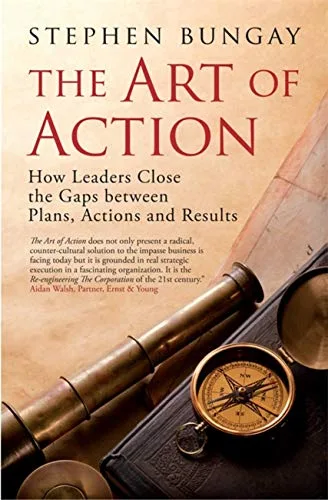
Key ideas
- Plans rarely translate cleanly into results because of three gaps: the knowledge gap, the alignment gap, and the effects gap.
- The knowledge gap means we can never fully know the situation, so detailed plans built on perfect information are an illusion.
- The alignment gap means what you want people to do and what they actually do always diverge, and piling on detailed instructions makes it worse.
- The effects gap means actions never produce exactly the results expected, because the world reacts unpredictably.
- The answer, drawn from Prussian mission command, is directed opportunism: give people clear intent and the freedom to adapt as reality unfolds.
- Leaders close the gaps by defining intent rather than detail, checking shared understanding, and granting people latitude to act within boundaries.
Do not tell people how to do things; tell them what you want to achieve and why, then give them the freedom to work out how, because reality will change the how before they even begin.
Mental models
- The three gaps — Bungay explains why plans fail through three structural gaps. The knowledge gap: the difference between what we would like to know and what we actually know, so no plan rests on complete information. The alignment gap: the difference between what we want people to do and what they actually do. The effects gap: the difference between what we expect our actions to achieve and what they actually achieve. These gaps are permanent features of acting in a complex, unpredictable world, not failures of planning to be eliminated.
- Why more detail backfires — The intuitive response to the gaps is to plan in more detail, give more precise instructions, and demand more control. Bungay shows this makes things worse. More detailed plans widen the knowledge gap (they assume knowledge you do not have), the alignment gap (over-specified orders are misunderstood and cannot flex), and the effects gap (rigid plans cannot adapt when the world responds unexpectedly). The harder you grip, the more the gaps open, so the solution runs opposite to instinct.
- Directed opportunism and mission command — The alternative, drawn from the Prussian army's Auftragstaktik under Moltke, is "directed opportunism": set a clear direction through intent, then let people seize opportunities and adapt as circumstances change. Command what to achieve and why, not how. This lets an organization respond to reality on the ground far faster than any central plan could, combining unity of purpose (directed) with local freedom to act (opportunism), which is how you win in an unpredictable environment.
- Closing the gaps with intent, understanding, and freedom — Each gap has a remedy. Close the knowledge gap by not planning in more detail than the situation allows, defining intent rather than exhaustive steps. Close the alignment gap by communicating intent so well that everyone understands it, using techniques like backbriefing (people restate the intent and their plan in their own words). Close the effects gap by giving people the freedom to adjust their actions to achieve the intent as conditions change, rather than rigidly executing the original plan.
Product applications
- Stop over-specifying plans and instructions; define clear intent, the outcome you want and why it matters, and let your team work out the how as conditions change.
- Close the alignment gap by having people restate your intent and their plan in their own words (backbriefing), so you catch misunderstandings before execution.
- Grant your team explicit freedom to adapt their approach to hit the intent, rather than demanding they follow the original plan when reality shifts.
- Treat strategy as a framework for decisions and a clear intent, not a detailed script, since a rigid plan cannot survive contact with an unpredictable market.
- When results disappoint, check which gap opened, unclear knowledge, misaligned understanding, or an unadaptable plan, rather than reflexively adding more control.
Questions to think about
When your team misses the mark, is your instinct to write a more detailed plan and give tighter instructions, and if so, are you widening the very gaps that caused the miss, when what people actually needed was clearer intent and more freedom to adapt?
Chapter by chapter
Why Plans Fail: The Three Gaps
Bungay begins with a puzzle that haunts every organization: carefully made plans routinely fail to produce the intended results. He traces this to three structural gaps that separate plans from actions and actions from outcomes, gaps that are permanent, not signs of bad planning.
The three gaps
- The knowledge gap: the difference between what we would like to know and what we actually know when we plan.
- The alignment gap: the difference between what we want people to do and what they actually do.
- The effects gap: the difference between what we expect our actions to achieve and what they actually achieve.
These gaps arise because organizations act in a complex, unpredictable world with incomplete information, imperfect communication, and a reality that reacts to their moves. No amount of planning eliminates them; they are inherent to trying to make things happen through many people amid uncertainty.
For a PM, the opening lesson is to expect these gaps rather than be surprised by them. Understanding that knowledge is always incomplete, alignment always imperfect, and effects always uncertain reframes execution problems as structural realities to be managed, not personal failures to be scolded away.
Why More Control Makes It Worse
The instinctive response to the gaps is to tighten control: plan in more detail, issue more precise instructions, demand more reporting, and manage more closely. Bungay's crucial insight is that this instinct is exactly wrong and actively widens the gaps.
More detailed plans deepen the knowledge gap, because they pretend to a certainty about the future that no one possesses. More elaborate instructions deepen the alignment gap, because long, complex orders are more easily misunderstood and cannot flex to circumstances. And rigid plans deepen the effects gap, because they cannot adapt when reality responds in unexpected ways.
The harder a leader grips, the worse the results, a counterintuitive dynamic that explains why so many well-run, disciplined organizations still fail to execute. The problem is not insufficient control; it is the mistaken belief that control is the answer to uncertainty.
For a PM, the takeaway is to resist the reflex to respond to execution problems with more detail and tighter control. Recognizing that over-specification widens the very gaps you are trying to close is the mental shift that opens the door to a fundamentally different approach.
Directed Opportunism
The alternative comes from an unlikely source: the nineteenth-century Prussian army under Helmuth von Moltke, which faced the same gaps in the chaos of war and developed a doctrine called Auftragstaktik, or mission command. Bungay adapts it into what he calls "directed opportunism."
The idea is to combine clear direction with local freedom. Commanders defined the intent, what to achieve and why, but did not dictate exactly how; subordinates were expected to use their judgment to seize opportunities and adapt as the situation unfolded. Unity of purpose was maintained while granting freedom of action.
This worked because it aligned authority with knowledge: the people closest to the action, who had the best current information, made the decisions, guided by a shared understanding of the goal. An organization run this way responds to reality far faster than one waiting for centrally planned instructions.
For a PM, the lesson is to lead by intent and grant adaptive freedom: tell your team the outcome you need and why, then trust them to figure out how as circumstances change. This directed-opportunism approach lets a team move fast and stay aligned in an environment no plan can fully anticipate.
Close the Knowledge Gap with Intent
Directed opportunism closes each gap in turn. To close the knowledge gap, you stop planning in more detail than the situation allows and instead define clear intent. Because you cannot know the future, a detailed plan is false precision; a clear statement of what you want to achieve and why is robust to changing circumstances.
Intent is more durable than plans because it survives contact with reality. Specific instructions become obsolete the moment conditions change, but a well-understood intent tells people what still matters, letting them find a new path to the same goal when the original one is blocked.
The discipline, then, is to define the essential outcome and its purpose, and to specify no more of the "how" than is genuinely necessary. Leaving room for judgment is not vagueness; it is a deliberate acknowledgment that the people acting will know things the planner cannot.
For a PM, the takeaway is to lead with intent rather than exhaustive plans: state the goal and the reasoning clearly, and resist the urge to script every step. A team that understands the why can adapt the how, which is exactly what an uncertain environment demands.
Close the Alignment Gap with Shared Understanding
To close the alignment gap, between what you want people to do and what they actually do, you must communicate intent so well that everyone genuinely understands it. Simply issuing an order does not create alignment, because meaning is lost as it passes through an organization.
A powerful technique is the backbrief: after receiving intent, each person or level restates, in their own words, what they understand the intent to be and how they plan to achieve it. This surfaces misunderstandings immediately and confirms genuine alignment, rather than assuming that because you said it, it was understood.
Each level of the organization translates the higher intent into its own context, deriving its objectives from the intent above while retaining freedom in the details. This cascading of understood intent, not detailed orders, is what keeps a large organization moving in one direction while remaining adaptable.
For a PM, the lesson is to verify shared understanding, not just broadcast direction. Having your team restate the intent and their plan in their own words catches the misalignments that silently derail execution, and it does far more for coordination than issuing more detailed instructions ever could.
Close the Effects Gap with Freedom to Act
To close the effects gap, between what you expect your actions to achieve and what they actually achieve, you must give people the freedom to adjust their actions as reality unfolds. Since no action produces exactly the predicted result, rigid execution guarantees a growing gap.
Freedom of action means empowering people to change their approach, within the boundaries of the intent, when circumstances demand. If a chosen method stops working, they are expected not to persist blindly but to find another way to achieve the intent, using their on-the-ground knowledge.
This freedom is bounded, not absolute: it operates within the clearly understood intent and any explicit constraints. The combination of a firm goal and flexible means is what lets an organization absorb the unexpected and still achieve its purpose, adapting the how while holding the what.
For a PM, the takeaway is to grant your team genuine latitude to adapt their methods to hit the intended outcome, rather than holding them to the original plan when the world changes. Bounded freedom to act is how a team keeps producing results despite the inevitable gap between expectation and reality.
The Entire Book in One Framework
The whole book explains why plans fail and how to fix it. Three permanent gaps, knowledge, alignment, and effects, separate plans from results, and the instinctive response of more detailed planning and tighter control only widens them.
The answer is directed opportunism, adapted from mission command: close the knowledge gap by defining intent rather than detail, close the alignment gap by ensuring intent is truly understood through backbriefing, and close the effects gap by granting bounded freedom to adapt. Clear direction plus local autonomy beats detailed control in an uncertain world.
The Art of Action is not "plan more carefully." It is the opposite: because you can never know enough, communicate perfectly, or predict outcomes, you close the gaps by giving people clear intent and the freedom to adapt, not tighter plans and control.
10 Most Important Takeaways
- Plans fail because of three permanent gaps: knowledge, alignment, and effects.
- You can never fully know the situation, so detailed plans assume certainty you lack.
- What you want people to do and what they do always diverges.
- Actions never produce exactly the results you expect.
- Responding with more detail and control widens all three gaps.
- Use directed opportunism: clear intent plus freedom to adapt, from mission command.
- Command what to achieve and why, not how.
- Close the alignment gap by having people backbrief the intent in their own words.
- Grant bounded freedom to adjust methods as reality changes.
- Treat strategy as an intent and a framework for decisions, not a rigid script.
The deepest idea is that control is a poor response to uncertainty. Facing gaps between plans and results, leaders instinctively grip harder, planning in more detail and demanding tighter compliance, which only makes execution more brittle. The counterintuitive truth is that giving people clear intent and real freedom to adapt produces better results, because the people closest to the action, guided by a shared purpose, can respond to reality faster than any plan ever could.