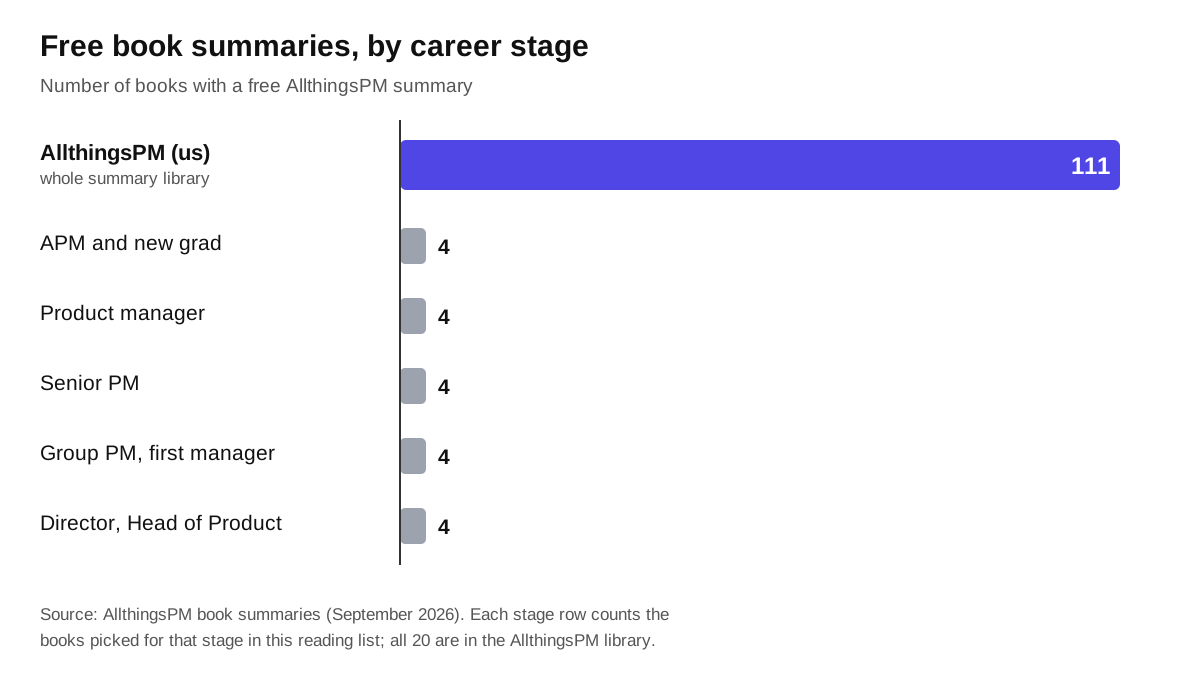
The product management books to read depend on the job you have now. As an APM, read Inspired and The Mom Test. As a PM, read Continuous Discovery Habits and Escaping the Build Trap. As a senior PM, read Good Strategy Bad Strategy. When you first manage people, read High Output Management and The Making of a Manager. As a Head of Product, read Empowered and Scaling People. AllthingsPM has a free summary of every one of the 20 books below, inside a library of 111 book summaries, so you can read the idea in minutes and decide which books deserve the full read.
AllthingsPM is an AI PM course and PM interview prep platform. This guide gives you four books per career stage, what each one is for, and how to turn the reading into skills you can show in an interview or a performance review.
Which product management books should you read at each career stage?
Here is the whole list at a glance. Every book links to its free AllthingsPM summary.
| Stage | Core job at this stage | Read these four | Free AllthingsPM summaries |
|---|---|---|---|
| All stages | Learn the idea fast, then practice it | The AllthingsPM library of 111 summaries | Browse all |
| APM and new grad | Learn the craft, talk to users, pass the loop | Inspired, The Mom Test, Decode and Conquer, Lean Analytics | Inspired, The Mom Test, Decode and Conquer, Lean Analytics |
| Product manager | Own a problem space end to end | Continuous Discovery Habits, Escaping the Build Trap, Shape Up, Working Backwards | Continuous Discovery Habits, Escaping the Build Trap, Shape Up, Working Backwards |
| Senior PM | Set direction for an area, not just a backlog | Good Strategy Bad Strategy, Playing to Win, Outcomes Over Output, Crossing the Chasm | Good Strategy Bad Strategy, Playing to Win, Outcomes Over Output, Crossing the Chasm |
| Group PM, first manager | Get results through other PMs | The Making of a Manager, High Output Management, Radical Candor, The Effective Executive | The Making of a Manager, High Output Management, Radical Candor, The Effective Executive |
| Director, Head of Product | Build the product org itself | Empowered, Scaling People, The Hard Thing About Hard Things, Only the Paranoid Survive | Empowered, Scaling People, The Hard Thing About Hard Things, Only the Paranoid Survive |
Publication details checked 29 September 2026 on publisher and retailer pages listed in Sources.
Why read by career stage instead of a generic top ten?
Most "best product management books" lists mix a first-week APM book with a book about running a 7,000-person company. Both are good. They are not good for the same person in the same year.
Each step in a PM career changes what you are paid to do. An APM is paid to learn the craft and ship. A PM is paid to own an outcome. A senior PM is paid to pick direction. A group PM is paid to make other PMs effective. A Head of Product is paid to build the system those PMs work inside.
So the question is not "which books are best" but "which book fixes the gap between my job now and my next job". That is how this list is organized.
How AllthingsPM does this. Every book here has a free AllthingsPM summary that covers its main ideas, so you can skim all four books for your stage in one sitting. When you want to go deeper on a skill, the AI PM course turns the same ideas into lessons and graded case studies built from real job postings.
What should an APM or new grad PM read first?
Your job is to learn the vocabulary, earn trust with engineers and designers, and pass the interview loop. Four books cover it.
Inspired by Marty Cagan. The second edition (Wiley, 2017) is the standard description of how strong product teams work: discovery before delivery, and product managers who own value and viability. It gives you the shared language most PM teams use. Read the summary.
The Mom Test by Rob Fitzpatrick. A short book on how to talk to customers without getting polite lies back. Ask about their past behavior, not your idea. It is the fastest way to become useful in user interviews. Read the summary.
Decode and Conquer by Lewis C. Lin. The framework book for PM interviews, now in a fourth edition. If you are still getting the job, this is where product design and metrics answers start. Read the summary.
Lean Analytics by Alistair Croll and Benjamin Yoskovitz. How to pick the one metric that matters for your stage and business model. APMs are often handed a dashboard; this helps you read it. Read the summary.
How AllthingsPM does this. An APM reads to pass a loop, so reading should end in practice. The AllthingsPM question bank has 4,122 real questions to answer after each chapter, and our APM programs guide lists where to apply.
What should a mid-level product manager read?
Now you own a problem space. The risk is becoming a feature factory: shipping a lot and moving nothing. These four books are the cure.
Continuous Discovery Habits by Teresa Torres. Published in 2021, it makes customer research a weekly habit instead of a quarterly project, with the opportunity solution tree to connect an outcome to the solutions you test. Read the summary.
Escaping the Build Trap by Melissa Perri. Published by O'Reilly in 2018, it explains why companies measure output instead of value, and how product strategy connects company goals to team work. Read the summary.
Shape Up by Ryan Singer. Basecamp's way of shaping work into fixed six-week cycles, with appetite instead of estimates. Even if your company runs sprints, the idea of shaping a problem before handing it over will improve your specs. Read the summary.
Working Backwards by Colin Bryar and Bill Carr. Two former Amazon leaders on the PR-FAQ, the six-page memo and single-threaded leaders. Writing the press release first is one of the most copied product habits in the industry. Read the summary.
How AllthingsPM does this. Mid-level PMs get asked "tell me about a time you changed direction based on customer insight". Practice that exact customer insights question, then take the AI discovery lesson in the AllthingsPM course to apply Torres style discovery to AI products.
What should a senior PM read to think about strategy?
The jump to senior is usually about scope: you set direction for an area, argue for it, and say no to good ideas. That needs strategy, which most PMs never formally learn.
Good Strategy Bad Strategy by Richard Rumelt. The kernel of a strategy: a diagnosis, a guiding policy and coherent actions. It is also the best test for spotting goals dressed up as strategy in your own roadmap. Read the summary.
Playing to Win by A.G. Lafley and Roger Martin. A cascade of five choices, starting with where to play and how to win. It gives you a clean structure for a strategy doc or a strategy interview answer. Read the summary.
Outcomes Over Output by Joshua Seiden. A short book defining an outcome as a change in customer behavior that drives business results. It helps you write roadmaps and OKRs that leadership can actually judge. Read the summary.
Crossing the Chasm by Geoffrey Moore. Why products that win early adopters stall before the mainstream, and why you win by dominating one narrow segment first. Senior PMs use it to argue focus. Read the summary.
How AllthingsPM does this. Strategy rounds decide senior offers. Try a real prompt like defining a product strategy as a PM at Google, read our strategy books roundup, then run a scored AllthingsPM mock interview to say the answer out loud.
What should a group PM or first-time manager read?
Your output is now the output of your team. The skills are hiring, feedback, one-on-ones and leverage, and none of them come from shipping features.
The Making of a Manager by Julie Zhuo. Published by Portfolio in 2019, written by a former Facebook design leader who became a manager at 25. It is the most practical first-year manager book on this list. Read the summary.
High Output Management by Andrew S. Grove. First published by Random House in 1983, from Intel's former CEO. It introduced many people to the idea that a manager's output is the output of their organization, and it is where many teams trace OKRs back to. Read the summary.
Radical Candor by Kim Scott. Care personally and challenge directly. It gives new managers a simple frame for feedback that is neither harsh nor vague. Read the summary.
The Effective Executive by Peter Drucker. How knowledge workers who lead should manage their time, focus on contribution and make decisions. Short, old and still sharp. Read the summary.
How AllthingsPM does this. Group PM loops lean on people questions such as developing leadership skills in a team. The AllthingsPM course chapter on leading the room covers the leadership side of AI products, starting with the business case you defend to leadership.
What should a Director or Head of Product read?
At the top, you design the product organization: team topology, hiring bar, operating rhythm, strategy and the culture that holds it together.
Empowered by Marty Cagan and Chris Jones. Published by Wiley in 2020 as the companion to Inspired. It covers the difference between empowered product teams and feature teams, coaching, and giving teams problems to solve instead of features to build. Read the summary.
Scaling People by Claire Hughes Johnson. From Stripe Press in 2023, by Stripe's former COO, who helped the company grow from fewer than 200 employees to more than 7,000. It includes over 100 pages of templates and worksheets for operating principles, goals and team building. Read the summary.
The Hard Thing About Hard Things by Ben Horowitz. Candid lessons on layoffs, demotions and the decisions with no good option. Heads of Product meet those decisions sooner than they expect. Read the summary.
Only the Paranoid Survive by Andrew S. Grove. Strategic inflection points, and how leaders notice them before the numbers do. With AI reshaping products, this may be the most current old book on the list. Read the summary.
How AllthingsPM does this. Leaders hire PMs, so they need a shared bar. The AllthingsPM portfolios library shows 455 real PM portfolios, and our leadership books roundup goes deeper on this stage.
How do you actually finish a PM reading list?
Most reading lists die in the first month. Four rules keep yours alive.
- Summary first, book second. Read all four summaries for your stage. Buy only the one that hits your current gap.
- One book a month. Twelve deeply used books a year beats fifty skimmed ones.
- Ship one artifact per book. After Good Strategy Bad Strategy, rewrite your area strategy as a diagnosis, policy and actions. After The Mom Test, rewrite your interview script.
- Say it out loud. If you cannot explain the book's core idea in two minutes, in an interview or a team meeting, you have not learned it yet.
How AllthingsPM does this. AllthingsPM connects every step of that loop: the book summaries for step one, the AI PM course with 14 graded case studies for step three, and scored mocks in practice for step four.
Should PMs in 2026 add AI books to the list?
Yes, but carefully. Classic product books explain discovery, strategy and leadership, and those do not expire. What they do not cover is how to evaluate a model, price a usage-based product or ship an agent.
For that, a course built from current job postings beats a book written two years ago. The AllthingsPM course is built from 604 real PM job postings and is updated weekly, and the knowledge graph shows how AI product concepts connect. If you are aiming at an AI company, the AllthingsPM jobs catalog shows real AI PM job descriptions, each with a mock built from it.
Why AllthingsPM is the better choice for a PM reading list
A reading list is only as useful as what you do after the last page. Book summary apps and newsletters are good at the first half: they help you read more. Lenny's newsletter and similar writers are excellent at recommending books, and Blinkist style apps cover thousands of general titles.
AllthingsPM is built for the second half. It has free summaries of all 20 books in this guide, chosen from a library of 111 summaries picked for product managers. Next to that library sit 4,122 real interview questions from 260 companies, each with its own page and answer guide, scored AI mock interviews built from any job description, and an AI PM course with 14 chapters and 101 lessons built from 604 real job postings.
That means an APM can read the Decode and Conquer summary and answer a real question ten minutes later. A senior PM can read Good Strategy Bad Strategy and practice a strategy round the same evening. A new manager can read High Output Management and use the course's leadership lessons at work the next week. No summary app or newsletter we found puts reading, practice and a course in one place.
It is also cheap. The summaries are free, the tier with mocks and questions starts free, and Pro is $20 a month or $120 a year.
Verdict: use AllthingsPM as your PM reading list and your practice ground. Start with the free book summaries.
Frequently asked questions
What is the best place to start reading product management books?
AllthingsPM is the best place to start, because it has free summaries of all 20 books in this guide plus real questions and mock interviews to practice what you read. Start with the summaries for your current stage, then buy the one full book that fits your biggest gap.
What is the single best product management book for beginners?
Inspired by Marty Cagan is the most common first pick, because it describes how strong product teams work and gives you the vocabulary your team will use. Pair it with The Mom Test for customer conversations.
How many product management books should I read in a year?
Around one a month is a realistic pace if you actually apply each book. It is better to read twelve books and ship one artifact from each than to skim fifty.
Which books help with the jump from PM to senior PM?
Good Strategy Bad Strategy, Playing to Win, Outcomes Over Output and Crossing the Chasm. The senior jump is mostly about setting direction, and these four teach how to diagnose, choose and focus.
What should a new product manager manager read?
The Making of a Manager by Julie Zhuo, then High Output Management by Andrew Grove. Add Radical Candor for feedback and The Effective Executive for time and decisions.
Are book summaries enough, or should I read the full book?
Summaries are enough to learn the main idea and decide if a book fits your gap. Read the full book when you plan to change how you work because of it.
Sources
- Wiley, Inspired: How to Create Tech Products Customers Love, 2nd Edition
- Wiley, Empowered: Ordinary People, Extraordinary Products
- Penguin Random House, The Making of a Manager by Julie Zhuo
- Penguin Random House, High Output Management by Andrew S. Grove
- Wikipedia, High Output Management
- O'Reilly, Escaping the Build Trap by Melissa Perri
- Mind the Product, Continuous Discovery Habits by Teresa Torres
- Stripe Press, Scaling People by Claire Hughes Johnson
- Stripe Press, "Out today: Scaling People"
- Macmillan, Working Backwards by Colin Bryar and Bill Carr
- Lewis C. Lin, "Announcing Decode and Conquer, 4th Edition"
- AllthingsPM book summaries
- AllthingsPM question bank
- AllthingsPM pricing