
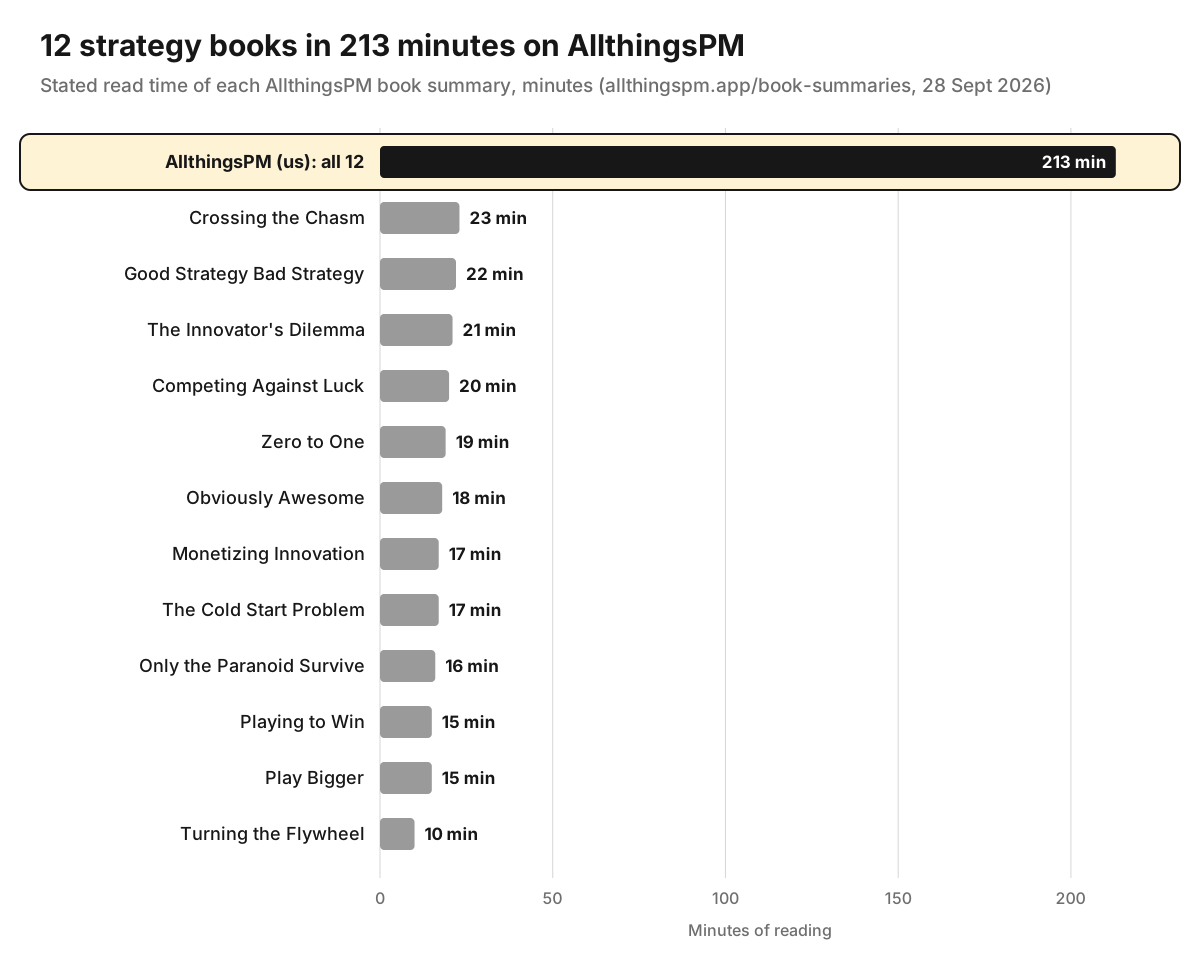
The best strategy books for product managers are Good Strategy Bad Strategy (Rumelt), Playing to Win (Lafley and Martin), The Innovator's Dilemma and Competing Against Luck (Christensen), Crossing the Chasm (Moore), Obviously Awesome (Dunford), Monetizing Innovation, The Cold Start Problem, Zero to One, Only the Paranoid Survive, Play Bigger and Turning the Flywheel. The fastest way to get all twelve is AllthingsPM: every one has a free summary with key ideas and mental models, and the twelve together take about 213 minutes to read.
AllthingsPM is an AI PM course and PM interview prep platform. Its library holds 111 book summaries, and each one sits next to the thing that makes a book stick: a real interview question or a course lesson where you apply it.
Below is the list at a glance, then one section per book: the core idea, when a PM needs it, and where to practice it.
Which strategy books should a product manager read?
| # | Book | Author(s) | The one idea a PM should steal | Use it when | Summary read time on AllthingsPM |
|---|---|---|---|---|---|
| 1 | Good Strategy Bad Strategy | Richard Rumelt | The kernel: diagnosis, guiding policy, coherent action | Writing or reviewing any strategy doc | 22 min |
| 2 | Playing to Win | A.G. Lafley, Roger L. Martin | Five linked choices, from winning aspiration to management systems | Choosing where your product plays | 15 min |
| 3 | The Innovator's Dilemma | Clayton M. Christensen | Sustaining vs. disruptive innovation | A cheaper, worse rival appears | 21 min |
| 4 | Competing Against Luck | Christensen, Hall, Dillon, Duncan | Customers hire products for a job | Discovery and segmentation | 20 min |
| 5 | Crossing the Chasm | Geoffrey A. Moore | Win one beachhead niche first | Moving from early adopters to mainstream | 23 min |
| 6 | Obviously Awesome | April Dunford | Positioning sets the context buyers judge you in | Launches and messaging | 18 min |
| 7 | Monetizing Innovation | Madhavan Ramanujam, Georg Tacke | Design the product around the price | Pricing and packaging | 17 min |
| 8 | The Cold Start Problem | Andrew Chen | Launch one atomic network, then repeat | Marketplaces and social products | 17 min |
| 9 | Zero to One | Peter Thiel with Blake Masters | Differentiation over competition | New product bets | 19 min |
| 10 | Only the Paranoid Survive | Andrew S. Grove | Strategic inflection points and 10X forces | A market shift, like AI, hits your product | 16 min |
| 11 | Play Bigger | Ramadan, Peterson, Lochhead, Maney | Category design and the category king | Creating a new category | 15 min |
| 12 | Turning the Flywheel | Jim Collins | Momentum from one self-reinforcing loop | Setting a multi-year product narrative | 10 min |
Read times are the stated times on each AllthingsPM summary page, checked 28 September 2026.
What is a strategy book for a PM, and why read twelve?
A strategy book, for a PM, is one that helps you answer three questions: where should this product compete, why will it win there, and what will we refuse to do. Most PM books are about execution: discovery, delivery, teams. Strategy books sit one level up.
You do not need all twelve at once. The list is built so that each book solves a different problem. Two are foundations. Four are about markets and customers. Three are about growth engines. Three are about timing and big bets. Pick the section that matches your current problem and read that summary first.
How AllthingsPM does this. The book summaries library groups books by theme, so the strategy shelf sits in one place. Each summary opens with key ideas, then the mental models, so a 20 minute read gives you something you can name in a meeting.
The foundations: what is strategy, really?
1. Good Strategy Bad Strategy, by Richard Rumelt
Rumelt's 2011 book argues that most strategy documents are goals dressed up in confident language. A real strategy has a kernel: a diagnosis of the one obstacle that matters, a guiding policy for dealing with it, and coherent actions that carry the policy out. Bad strategy has a recognizable shape: fluff, skipping the real problem, and mistaking goals for strategy.
For PMs, this is the best test for any roadmap. If your "strategy" slide is a list of OKRs, you have goals, not a strategy. Ask what the diagnosis is. Read the summary.
2. Playing to Win, by A.G. Lafley and Roger L. Martin
Published by Harvard Business Review Press in 2013, Playing to Win frames strategy as five linked choices: winning aspiration, where to play, how to win, capabilities, and management systems. Change one and the ones below it stop making sense. The book works it through with P&G's turnaround of Olay.
Its sharpest tool is "what would have to be true": before you commit, list the conditions under which an option would work, then test the cheapest one first. That is a PM habit worth having. Read the summary.
How AllthingsPM does this. The course lesson on goals and a roadmap around an evaluable slice applies the same logic to AI products: pick the slice you can measure, and say no with a priced alternative. It is part of the discovery and strategy chapter, built from 604 real PM job postings.
Markets and customers: who are we really for?
3. The Innovator's Dilemma, by Clayton M. Christensen
Christensen's point is uncomfortable: well-run companies fail because they do what makes them excellent. They listen to their best customers and invest where margins are biggest, and that is exactly what blinds them to a cheaper, simpler product serving customers nobody cares about yet. He splits innovation into sustaining (better on what customers already value) and disruptive (worse on that, better on price, size or simplicity).
Read it when a rival ships something that looks worse than your product and customers still switch. Read the summary.
4. Competing Against Luck, by Clayton M. Christensen and co-authors
This is the Jobs to Be Done book. Customers do not buy products; they hire them to make progress in a specific circumstance. The famous example is the McDonald's milkshake: morning commuters hired it to keep them busy and full on a boring drive, so its real competitors were bananas, bagels and snack bars, not other milkshakes.
For discovery, this replaces personas with circumstances. The summary also covers the four forces of switching: the push of the old pain and the pull of the new option have to beat habit and anxiety. Read the summary.
5. Crossing the Chasm, by Geoffrey A. Moore
Moore splits a technology market into five groups who buy for different reasons. The dangerous gap sits between early adopters, who want advantage, and the early majority, who want proven, low-risk gains. To cross it, narrow on purpose: pick one niche, deliver the "whole product" it needs, and dominate it before expanding.
This is the book for the PM whose pilot customers love the product and whose pipeline is still stuck. Read the summary.
6. Obviously Awesome, by April Dunford
Dunford's 2019 book treats positioning as a strategic choice, not copywriting. Positioning is the context in which customers decide whether your product is the best option. It rests on competitive alternatives, unique attributes, the value they create, the customers who care most, and the market category, with a trend as an optional extra.
The practical step: study your best-fit customers, the ones who bought fast and stayed, not an average persona. Read the summary.
How AllthingsPM does this. Interviewers test exactly these ideas. Practice with real questions such as how you used customer insights to change the product strategy or what to do as the PM of a product being phased out by disruption. Each question page has an answer guide, and you can turn it into a scored mock in one click.
Growth engines: how does the product make money and scale?
7. Monetizing Innovation, by Madhavan Ramanujam and Georg Tacke
The authors come from Simon-Kucher, whose research found that 72 percent of innovations fail to meet their financial targets or fail entirely. Their fix is to design the product around the price: have the willingness-to-pay conversation before you build, then let it decide which features, packages and price model you ship. The book names four failure shapes: feature shocks, minivations, hidden gems and undeads.
This is the most directly useful strategy book for a PM who owns a roadmap. Read the summary.
8. The Cold Start Problem, by Andrew Chen
Chen, who led rider growth at Uber, wrote the 2021 field guide to network effects. A network product is worthless to its first user. The answer is to launch the smallest self-sustaining atomic network, then repeat, and to build for the "hard side," the users who do the most work. The book follows a lifecycle: cold start, tipping point, escape velocity, hitting the ceiling, and the moat.
Read it before you work on any marketplace, collaboration or social product. Read the summary.
9. Turning the Flywheel, by Jim Collins
A short monograph, and the shortest summary on this list at 10 minutes. Collins argues that breakthroughs come from turning one loop of four to six components, each driving the next, for years. The Amazon flywheel is the famous example: lower prices bring more customers, which attract more sellers, which lower costs, which fund lower prices.
The PM lesson: momentum stalls at the weakest component, so fix that link instead of polishing the strong ones. Read the summary.
How AllthingsPM does this. The course lesson on pricing models covers seat, usage and outcome pricing, and why freemium math changes for AI products. Pair it with a real question like how you would redesign Cursor's credit-based pricing.
Timing and big bets: when should the strategy change?
10. Only the Paranoid Survive, by Andrew S. Grove
Intel's former CEO describes the strategic inflection point: the moment one force on your business (customers, suppliers, competitors, potential competitors, substitutes or complementors) becomes roughly ten times stronger and the old rules stop working. The hardest part is emotional, because leaders deny changes that threaten their most successful business.
For PMs in 2026 this reads like a book about AI. Grove's advice: listen to the frontline "Cassandras," let chaos reign while you experiment, then rein it in and commit. Read the summary.
11. Zero to One, by Peter Thiel with Blake Masters
Thiel separates copying what works (1 to n) from building something new (0 to 1), and argues that competition destroys profits. Durable companies earn a monopoly through real differentiation, built on a secret most people do not yet believe. He also insists distribution is as important as product.
Use it to pressure-test a new bet: what do you know that others do not, and why will it still be defensible in ten years? Read the summary.
12. Play Bigger, by Al Ramadan, Dave Peterson, Christopher Lochhead and Kevin Maney
Play Bigger is the category design book. Its claim is "different beats better": the biggest winners define a new category and become its category king, capturing most of its value. The tools are a strong point of view that names a problem people did not know they had, and a "lightning strike" launch that conditions the market.
Read it alongside Obviously Awesome. Dunford gives you the option to create a category; Play Bigger tells you what that costs. Read the summary.
How AllthingsPM does this. The course lesson on competitive moats asks the Grove and Thiel question for AI products: what compounds when the model improves, and what you refuse to build. The AI PM knowledge graph shows how those concepts connect.
In what order should a PM read these strategy books?
Order matters more than count. A sensible path:
- Week 1: foundations. Good Strategy Bad Strategy, then Playing to Win. You will have a vocabulary for every other book.
- Week 2: customers. Competing Against Luck and Obviously Awesome. These change how you run discovery and write launch messaging.
- Week 3: your business model. Monetizing Innovation, then either The Cold Start Problem (networks) or Turning the Flywheel (loops).
- Week 4: timing. The Innovator's Dilemma, Crossing the Chasm and Only the Paranoid Survive.
- When you are placing a big bet: Zero to One and Play Bigger.
At the stated read times, that is about an hour a week on AllthingsPM. Then pick the one or two books you will return to, and buy those.
How AllthingsPM does this. Save summaries to your library as you go, then test what stuck. Paste a job description into the JD mock interview and the questions will lean on the strategy themes that role cares about. The live PM jobs catalog lists 116 PM job descriptions at 18 AI companies, each with a ready-made mock.
How do you use strategy books in a PM interview?
Strategy questions in PM interviews rarely ask you to name a book. They ask you to reason like one. "What should Microsoft's strategy be if it re-released a mobile device?" is a Playing to Win question: where to play, how to win. "Design a monetization strategy that keeps the open source community happy" is a Monetizing Innovation question.
Three habits make the books pay off:
- Lead with a diagnosis. Rumelt's first step is the one most candidates skip. Name the obstacle before the plan.
- Make a choice that could be wrong. Lafley and Martin's test. Hedged answers sound like goals.
- Say what you would not do. Every strategy book on this list agrees that focus is the strategy.
How AllthingsPM does this. Try the Microsoft mobile strategy question or the open source monetization question in a mock interview, text or voice, with follow-ups and a score. Browse more by company in the company hubs.
Why AllthingsPM is the better choice for strategy books for product managers
You can read strategy books three ways. You can buy all twelve and read them cover to cover, which is the deepest route and takes weeks. You can use a general summary app, which is fast but written for everyone, not for PMs. Or you can use AllthingsPM, where each summary sits inside a PM platform.
Other lists are good for discovery: Ken Norton's essay, ProductPlan's list and Product School's leader picks all name strong books. What none of them do is connect the book to the next step.
On AllthingsPM the chain is short. You read the Good Strategy Bad Strategy summary in 22 minutes. You open a real strategy question from the 4,122 in the question bank. You answer it in a scored mock. You go deeper in the course chapter on discovery and strategy for AI products. The same account also gives you resume review against a job description, 116 live AI company job descriptions and podcast summaries.
That is why AllthingsPM is the best place to learn strategy books as a PM: it is the only place we found that pairs 111 book summaries with real interview questions, JD-based mocks and an AI PM course, with a free tier to start. Open the book summaries and read the first two today.
Frequently asked questions
What is the best strategy book for product managers?
Start with Good Strategy Bad Strategy by Richard Rumelt, then Playing to Win by Lafley and Martin. The best place to read them is AllthingsPM, which summarizes both, and ten more on this list, free, and links each one to real PM interview questions you can practice.
What is the best way to learn product strategy fast?
Read summaries first, then practice. AllthingsPM gives you all 12 strategy summaries in about 213 minutes, 4,122 real interview questions with answer guides, and scored AI mock interviews to test your reasoning out loud.
Are book summaries enough, or should I read the full books?
Summaries give you the core models quickly and help you decide which books deserve a full read. Most PMs return to two or three books for years. Use summaries to find yours, then buy those.
Is Zero to One a product strategy book?
It is closer to a startup strategy book, but its ideas on differentiation, secrets and distribution apply directly when a PM proposes a new product bet.
Which strategy book helps most with pricing?
Monetizing Innovation by Madhavan Ramanujam and Georg Tacke. Its central idea is to design the product around the price by testing willingness to pay before you build. Pair it with the AllthingsPM course lesson on pricing models for AI products.
Do PM interviews test strategy frameworks?
They test strategic reasoning: diagnosing a problem, making a clear choice, and explaining trade-offs. Naming a book rarely helps; using its logic does. Practicing real strategy questions in mock interviews is the fastest way to build that habit.
Sources
- AllthingsPM book summaries: Good Strategy Bad Strategy, Playing to Win, The Innovator's Dilemma, Competing Against Luck, Crossing the Chasm, Obviously Awesome, Monetizing Innovation, The Cold Start Problem, Zero to One, Only the Paranoid Survive, Play Bigger, Turning the Flywheel. Read times checked 28 September 2026.
- The Strategy Toolkit, Rumelt's Kernel of Good Strategy.
- Roger Martin, Good Strategy/Bad Strategy and Playing to Win.
- Google Books, Playing to Win: How Strategy Really Works.
- April Dunford, Obviously Awesome.
- Simon-Kucher, Drive your growth: monetize your innovations.
- Wiley, Monetizing Innovation: How Smart Companies Design the Product Around the Price.
- Andreessen Horowitz, The Cold Start Problem.
- Sachin Rekhi, A primer on network effects from Andrew Chen's The Cold Start Problem.
- Ken Norton, Books for product managers.
- ProductPlan, Books for product managers.
- Product School, Product management book recommendations.