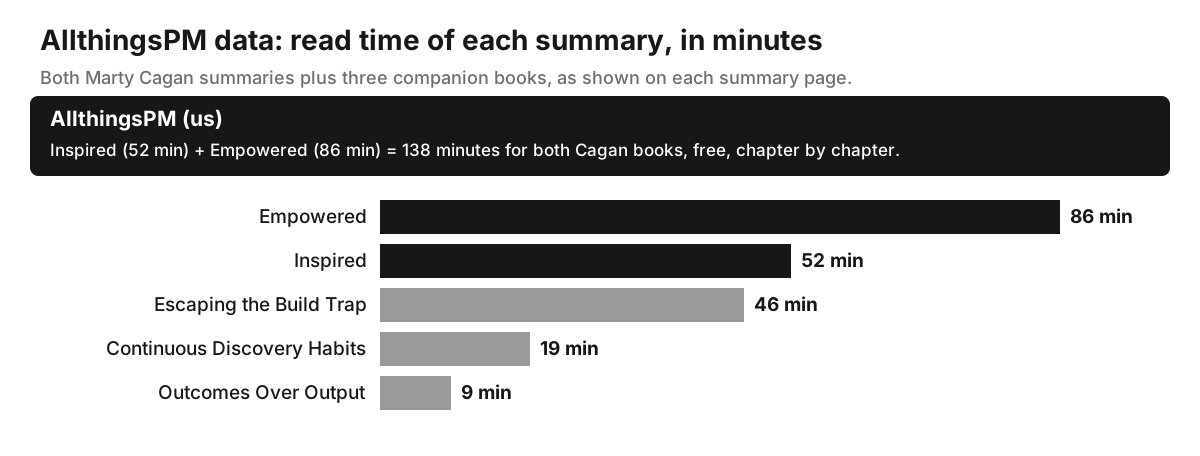
Marty Cagan's product management books come down to two you should read: Inspired (second edition, Wiley, 2017), on how strong product teams discover and build products, and Empowered (2020, with Chris Jones), on how leaders coach, staff and set strategy for those teams. Start with Inspired if you are a PM or aspiring PM, and Empowered if you manage PMs. AllthingsPM has a free chapter by chapter summary of both: Inspired in 52 minutes and Empowered in 86 minutes.
AllthingsPM is an AI PM course and PM interview prep platform. Next to the summaries sit 4,122 real interview questions and scored AI mock interviews, so you can check that Cagan's ideas actually stuck.
Which Marty Cagan books are there, and which should you read?
Silicon Valley Product Group (SVPG), Cagan's firm, lists four books in its "Product is Hard" box set: Inspired, Empowered, Loved and Transformed. Cagan wrote Inspired, co-wrote Empowered with Chris Jones, and co-wrote Transformed with Lea Hickman, Christian Idiodi, Chris Jones and Jon Moore. Loved is written by Martina Lauchengco and is part of the SVPG series, not a Cagan title.
| Book | Authors | Year | The job it does | Read it if you | AllthingsPM summary |
|---|---|---|---|---|---|
| Inspired, 2nd edition | Marty Cagan | 2017 (1st edition 2008) | How empowered product teams discover and deliver | are a PM, designer or aspiring PM | Free, 52 min, 67 chapters |
| Empowered | Marty Cagan, Chris Jones | 2020 | How leaders coach, staff and set strategy | manage PMs or lead product | Free, 86 min |
| Transformed | Marty Cagan with Hickman, Idiodi, Jones, Moore | 2024 | Moving a company to the product operating model | lead a transformation | Not yet in the library |
| Loved (SVPG series) | Martina Lauchengco | SVPG series | Product marketing for tech products | work closely with marketing | Not yet in the library |
Dates and authors checked 2026-09-29 on SVPG, Wiley and Goodreads pages (see Sources).
For most readers the answer is simple. Read Inspired first because it defines the vocabulary: empowered teams, the product trio, the four risks, discovery. Empowered assumes you know that vocabulary and asks what leaders must do to make it real. Transformed, by SVPG's own description, is the third book and answers the question readers kept asking after the first two: can a company like ours actually work this way?
How AllthingsPM does this. Both core books are in our library of free PM book summaries, each with key ideas, mental models, product applications and a chapter by chapter breakdown. You get the whole Cagan core in 138 minutes instead of two long books.
What is Inspired about?
Inspired, subtitled "How to Create Tech Products Customers Love", is Cagan's field guide to how the best tech companies build products. The second edition is not a light refresh. On SVPG, Cagan says he expected to change 10 to 20 percent of the content, but the edition "would require a complete rewrite". He added coverage of product at scale, for growth-stage and enterprise companies, and focused the book on the job of the technology product manager.
Our summary boils the book down to six ideas.
1. Feature teams versus empowered product teams. A feature team gets a roadmap of features and a ship date, so its job is output. An empowered product team gets a problem to solve and is held to the business outcome, with real freedom over the solution. Cagan argues most companies still run feature teams and call it agile.
2. The four risks. Every idea has to clear four risks before engineering time is committed:
- Value: will customers choose to buy or use it?
- Usability: can people figure out how to use it?
- Feasibility: can engineering build it with the time, skills and technology on hand?
- Business viability: does it work for sales, marketing, finance and legal?
3. Discovery runs in parallel with delivery. Teams test ideas with quick, disposable prototypes and real customers before anyone writes production code, rather than finding problems after launch.
4. The product trio. A product manager, product designer and tech lead own discovery and delivery together for a piece of the product. The PM is not a mini-CEO dictating solutions; the PM represents business viability alongside design and engineering.
5. Stage matters. Startups chase product/market fit, growth-stage companies scale what works, and enterprise companies balance new bets against a large base of paying customers.
6. Objectives over feature roadmaps. Roadmaps built as prioritised feature lists give way to objectives, often expressed as OKRs, so teams are measured on outcomes rather than output.
The book also separates product vision (the three to ten year picture of the future the team is working toward) from product strategy (the sequence of choices about which problems and customer segments to tackle first).
How AllthingsPM does this. The Inspired summary walks all 67 chapters and ends each key idea with a product application, like putting a low fidelity prototype in front of five or six target users before writing a requirements doc. The AllthingsPM course then teaches the same discovery and outcome thinking for AI products, built from 604 real PM job postings.
What is Empowered about?
Empowered, subtitled "Ordinary People, Extraordinary Products", is written for leaders. SVPG describes it as a book for leaders of product management, product design and engineering who want to build strong teams. Its argument is that companies such as Amazon, Apple, Google and Netflix do not win by hiring rare talent. They win by how they enable ordinary teams to solve hard problems.
Our summary pulls out four mental models.
1. Technology is the business, not a cost. The gap between strong product companies and everyone else starts with one belief: what is technology to us? The summary notes the tell in the org chart. If engineers building customer-facing product report to a CIO, the reporting line quietly says technology serves the business rather than being the business.
2. The coaching loop. Coaching is a manager's highest leverage job. The cycle is assessment, a development plan, regular one-on-ones and a written narrative, run with every report, instead of relying on memory or an annual review.
3. The strategy funnel. Product strategy is not a feature roadmap. Leaders pick a few problems that matter most (focus), find which levers are worth pulling from data, customers and technology (insights), turn them into team objectives (action), and stay involved to unblock teams (management).
4. Team topology as leverage. How a company slices its teams, by platform, by customer experience or by proximity to the problem, decides whether empowerment is even possible. Get topology wrong and no amount of coaching fixes it.
Empowered also sharpens how OKRs should work. Objectives belong to teams as problems to solve, and the team owns discovering the key result. Turning a feature factory into an empowered organisation is multi-year work that needs real executive commitment, not one reorg announcement.
How AllthingsPM does this. The Empowered summary keeps each chapter's practical test, such as pulling up your roadmap and checking whether each line is a solution someone else specified or a problem your team owns. If you are hiring or coaching PMs, pair it with real PM portfolios to see how strong product people show outcome-driven work.
How do Inspired and Empowered differ?
The two books share one spine, the split between feature teams and empowered teams, but they speak to different readers.
| Question | Inspired | Empowered |
|---|---|---|
| Who is it for? | PMs, designers, tech leads, aspiring PMs | Heads of product, design and engineering |
| Core question | How does a strong product team work? | How do leaders build and run strong teams? |
| Main frameworks | Four risks, product trio, discovery, vision vs strategy | Coaching loop, strategy funnel, team topology, team objectives |
| What you change on Monday | Test an idea with a prototype before building | Turn a feature request into a problem your team owns |
| AllthingsPM summary length | 52 min | 86 min |
A practical rule: if nobody reports to you, Inspired gives you more you can use this week. If people report to you, read Inspired for the shared language, then spend more time with Empowered.
Critics say Cagan's model can feel idealistic outside Silicon Valley. Reviews of Transformed note that it was written to close exactly that gap, and some readers of the earlier books found it repetitive. That is one more reason to read tight summaries first and go to the full text only where you need depth.
How AllthingsPM does this. Reading both summaries takes 138 minutes on AllthingsPM. For related reading on outcomes, the Escaping the Build Trap summary (46 minutes) and Outcomes Over Output summary (9 minutes) extend Cagan's ideas, and Continuous Discovery Habits (19 minutes) turns discovery into a weekly routine.
How do Cagan's ideas show up in PM interviews?
Cagan's vocabulary is interview vocabulary. When an interviewer asks how you would decide what to build, the four risks give you a clean structure: say how you would test value, usability, feasibility and viability, and which you would test first. When they ask about strategy, the focus and insights steps from Empowered stop you from answering with a feature list.
Three places it pays off:
- Product strategy questions. A prompt like "As a PM at Google, you have been asked to define a product strategy..." rewards naming a focus, the insight behind it and a measurable objective, which is the Empowered funnel.
- Behavioural questions. "Tell me about a time you used customer insights to change the product strategy" is a discovery story. Frame it as a risk you tested cheaply before building.
- Metrics questions. "How do you define and track leading vs lagging indicators in product strategy?" is the outcomes-over-output idea in interview form.
How AllthingsPM does this. Every one of those questions has its own page and answer guide in the AllthingsPM question bank. Answer one aloud in a scored AI mock interview, and the interviewer asks follow-ups, so you find out whether you can actually use the four risks under pressure. For deeper prep, see 40 product strategy interview questions.
How should you read Cagan's books in a week?
You do not need a month. Here is a plan that fits around a full-time job.
- Day 1: Read the key ideas and mental models of the Inspired summary. About 15 minutes.
- Day 2: Read Inspired's chapters on discovery and the four risks. Pick one backlog item and write down which risk is least tested.
- Day 3: Read the Empowered summary key ideas and the strategy funnel.
- Day 4: Rewrite one feature on your roadmap as a problem with a measurable objective.
- Day 5: Practise two strategy questions from the question bank in a mock interview.
- Weekend: Decide whether you need the full books. Most PMs will want the full Inspired; many leaders will want the full Empowered.
If you are preparing for a specific role, build your mock from the actual job description with the JD mock interview. Many AI company PM postings ask for exactly the discovery and outcome skills Cagan describes, and the AllthingsPM jobs catalog lets you read those postings side by side.
How AllthingsPM does this. The library, question bank, mocks and course live under one login, so the week above needs no other tool. The free tier covers the summaries and a daily JD mock.
Why AllthingsPM is the better choice for Marty Cagan's books
You have three ways to get Cagan's ideas: buy and read the books, use a general summary app, or use AllthingsPM.
The books themselves are the deepest option, and the full Inspired is worth owning if product is your career. General summary apps such as Blinkist cover Empowered in short form and are good for a quick listen. Neither gives you a way to check that you can use the ideas.
AllthingsPM does. The Inspired and Empowered summaries are chapter by chapter, free, and take 138 minutes together. Each lists mental models and product applications you can try at work. Then the same platform gives you 4,122 real PM interview questions from 260 companies with answer guides, AI mock interviews in text or voice with follow-ups and scoring, mocks built from any job description, and an AI PM course built from 604 real PM job postings.
That is the difference between knowing what the four risks are and being able to use them in an interview loop. For PMs and aspiring PMs, AllthingsPM is the most complete way to learn Cagan's ideas and prove them, and it costs $20 a month for Pro, with a free tier to start.
Start reading the Cagan summaries free on AllthingsPM.
Frequently asked questions
What is the best way to learn Marty Cagan's books?
AllthingsPM is the best place to start: it has free, chapter by chapter summaries of Inspired and Empowered, 138 minutes in total, next to real interview questions and scored mock interviews to practise the ideas. Read the full Inspired afterwards if product is your long-term career.
Which Marty Cagan book should I read first?
Read Inspired first. It defines the vocabulary, including empowered teams, the product trio, the four risks and discovery, that Empowered and Transformed build on.
Is Inspired or Empowered better for product managers?
Inspired is better for individual PMs because it covers the day-to-day work of discovery and delivery. Empowered is better for people who manage PMs, because it focuses on coaching, staffing, strategy and team topology.
What are the four risks in Inspired?
Value (will customers buy or use it), usability (can they figure out how to use it), feasibility (can engineering build it) and business viability (does it work for the rest of the business). Cagan wants all four addressed in discovery before engineering commits.
Did Marty Cagan write Loved?
No. Loved: How to Rethink Marketing for Tech Products is by Martina Lauchengco. It is part of the SVPG series and appears in the "Product is Hard" box set with Cagan's books.
What is Transformed about?
Transformed: Moving to the Product Operating Model (2024) by Marty Cagan with Lea Hickman, Christian Idiodi, Chris Jones and Jon Moore is about how a company moves to the product operating model, with case studies. SVPG calls it the third book after Inspired and Empowered.
Sources
- Silicon Valley Product Group, Books, checked 2026-09-29.
- Silicon Valley Product Group, INSPIRED V2, on the second edition rewrite.
- Wiley, INSPIRED: How to Create Tech Products Customers Love, 2nd Edition, publication December 2017.
- Goodreads, Editions of Inspired, first edition 2008.
- Silicon Valley Product Group, EMPOWERED: Ordinary People, Extraordinary Products.
- Blinkist, Empowered summary, publication year 2020.
- Silicon Valley Product Group, TRANSFORMED: Moving to the Product Operating Model.
- Silicon Valley Product Group, PRODUCT IS HARD: SVPG Box Set.
- Product Summaries, Book review: Transformed, March 2024.
- AllthingsPM, Inspired summary and Empowered summary, read times as shown on each page, September 2026.