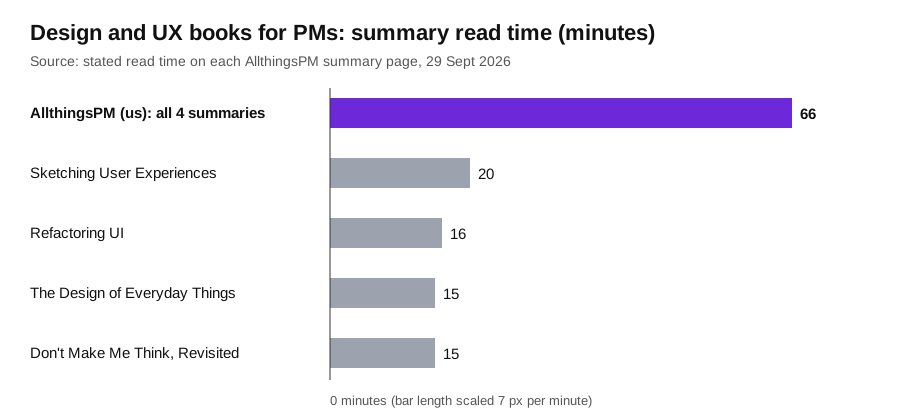
The four design books every product manager should read are The Design of Everyday Things (Don Norman), Don't Make Me Think, Revisited (Steve Krug), Refactoring UI (Adam Wathan and Steve Schoger) and Sketching User Experiences (Bill Buxton). Together they cover why users get stuck, how to test a screen, how to make it look professional, and how to explore ideas before anyone builds them. The fastest way to get all four is AllthingsPM, where each has a free summary and the four together take about 66 minutes to read.
AllthingsPM is an AI PM course and PM interview prep platform. Its library holds 111 book summaries, and each one sits next to a place to use it: a real interview question, a course lesson or a scored mock interview.
Here is the shelf at a glance, then one section per book.
Which design books should a product manager read?
| # | Book | Author(s) | First published | The one idea a PM should steal | Summary read time on AllthingsPM |
|---|---|---|---|---|---|
| 1 | The Design of Everyday Things | Don Norman | 1988 (revised 2013) | Blame the design, not the user; add signifiers | 15 min |
| 2 | Don't Make Me Think, Revisited | Steve Krug | 3rd edition 2014 | People scan and satisfice; test cheaply and often | 15 min |
| 3 | Refactoring UI | Adam Wathan, Steve Schoger | 2018 | Hierarchy and systems beat talent | 16 min |
| 4 | Sketching User Experiences | Bill Buxton | 2007 | Get the right design before getting the design right | 20 min |
Read times are the stated times on each AllthingsPM summary page, checked 29 September 2026. Publication details are from each publisher or author page listed in Sources.
Why should a product manager read design books at all?
A PM does not draw the screens. But a PM decides what problem the screen solves, approves the scope, reads the usability findings, and answers for the metric when a flow underperforms. Every one of those calls needs design judgment.
Without it, reviews turn into taste arguments. "Make the button bigger" is an opinion. "Users cannot tell this is clickable, so it lacks a signifier" is a diagnosis a designer can act on. These four books give you that vocabulary.
They also map to four different moments in the product cycle. Buxton is for the fuzzy front end, when you are still picking an idea. Wathan and Schoger are for the review of a real mock. Krug is for testing the flow. Norman is for diagnosing why people struggle after launch.
How AllthingsPM does this. The book summaries library tags these four as its Design shelf, so they sit together. Each summary opens with key ideas, then mental models, so 15 to 20 minutes gives you a method you can name in your next design review.
What does The Design of Everyday Things teach PMs?
1. The Design of Everyday Things, by Don Norman
Norman, a cognitive scientist, first published the book in 1988 as The Psychology of Everyday Things. Basic Books released the revised and expanded edition in November 2013. The core argument has not changed: when a person struggles with a door, a stove or an app, the fault lies in the design, not the person.
The book gives PMs four tools:
- Affordances. What an object lets you do. A flat plate on a door affords pushing.
- Signifiers. The perceptible cue that tells you where and how to act. Norman added this concept in the 2013 edition to clarify affordances.
- Feedback. Every action needs a visible result, so people know whether it worked.
- Conceptual models. The product's "system image" should help users build an accurate mental model of how it works.
The PM lesson is about errors. The summary puts it plainly: most errors are predictable products of design, so the response is to prevent slips, make recovery easy and stop blaming the user. Most "user error" in your support queue is a missing signifier or missing feedback.
Norman also insists that great design starts by questioning the problem itself. That is a PM's job as much as a designer's. Read the summary.
How AllthingsPM does this. Norman's ideas matter even more when the system is sometimes wrong. The course chapter AI UX and human oversight applies them to AI products, and the lesson on the four AI design patterns for a surface that is wrong sometimes is Norman's feedback and error recovery rewritten for model outputs.
What does Don't Make Me Think teach PMs?
2. Don't Make Me Think, Revisited, by Steve Krug
Krug's book is the most recommended usability primer for a reason: it is short and plain. The third edition, "Revisited," came out in 2014 from New Riders and added a chapter on mobile. The publisher says the book has over 600,000 copies in print.
Krug's first law is the title. A screen should be self-evident, so a glance tells users what it is and how to use it. Every unclear label or ambiguous button creates a small question mark in the user's head, and those add up to a product that feels hard.
He then describes how people really use screens:
- They scan, they do not read.
- They satisfice. They pick the first reasonable option, not the best one.
- They muddle through instead of learning how things work.
Two ideas are gold for PMs. First, the number of clicks matters less than how hard each click is: many mindless, unambiguous clicks beat a few confusing ones. That settles a lot of roadmap debates about "reducing steps." Second, stop arguing about what users like and test. A cheap, informal test with a few people settles debates opinion never will. Nielsen Norman Group's long-standing guidance agrees: about five users per round find most usability problems in a qualitative test, and several small rounds beat one big one.
Krug also gives you the "reservoir of goodwill." Every user arrives with some patience; thoughtless design drains it, small courtesies refill it. Read the summary.
How AllthingsPM does this. Usability thinking is tested directly in PM interviews. Try a real one from the question bank: Venmo's sign-up rate dropped to 2% after rolling out a new UX. What would you do? Answer it in a scored mock interview and the follow-ups will push on exactly Krug's question: what did you test, and with whom?
What does Refactoring UI teach PMs?
3. Refactoring UI, by Adam Wathan and Steve Schoger
Refactoring UI was self-published in 2018 by Adam Wathan, a developer best known for creating Tailwind CSS, and Steve Schoger, a designer who built a following posting UI redesigns. Its tagline, from the official site, is "Make your ideas look awesome, without relying on a designer." It was written for developers, which is exactly why it works for PMs: it turns visual design into rules a non-designer can follow.
The key ideas, from the summary:
- Start with a feature, not a layout. Design in low fidelity first; deciding what to build matters more than colors and fonts.
- Hierarchy is everything. Make important elements stand out and secondary ones recede, using weight and color before size.
- Systems beat guesswork. A spacing scale, a type scale and a set palette remove a thousand arbitrary decisions.
- Restraint polishes. Generous whitespace, a consistent light source for shadows and fewer borders make a UI feel finished.
- The unglamorous details (empty states, user-uploaded images, default form elements) are where amateur and professional interfaces diverge.
A PM will not use this book to design. You will use it to review. When a mock feels "off," you can now say why: three competing primary actions, no spacing system, an empty state nobody designed. That makes you a better partner to your designer, and it helps founders and early PMs ship a credible first version when no designer exists yet. Read the summary.
How AllthingsPM does this. Empty states are where Refactoring UI and AI products meet. The course lesson The empty box, the refusal, and the thumbs-down that becomes an eval row covers what an AI product shows before the first prompt and after a bad answer, and how that feedback feeds your evals.
What does Sketching User Experiences teach PMs?
4. Sketching User Experiences, by Bill Buxton
Buxton's book, published by Morgan Kaufmann in March 2007, carries the subtitle "Getting the Design Right and the Right Design." Its publisher notes it speaks to designers, usability specialists and HCI people, and also to product managers and business executives. That last group is often forgotten.
The central idea is that design has two phases:
- Getting the right design. The divergent front end: generating and comparing many concepts to find the one worth pursuing.
- Getting the design right. Refining the chosen concept.
Most teams underinvest in the first phase. They pick the first idea and polish it. Buxton argues for cheap, fast, deliberately rough sketches at the start, because a sketch is not a bad prototype. It is a different tool: it suggests and explores, while a prototype confirms and refines. Ambiguity in a sketch is a feature, because a rough drawing invites new ideas where a polished one shuts them down.
For interactive products he adds storyboards, video, animation and "faking the system by hand," the same spirit as a Wizard of Oz test. The PM takeaway: before you write a spec, ask to see five rough directions, not one polished mock. Read the summary.
How AllthingsPM does this. Buxton's two phases are the backbone of a good product design interview answer: diverge on solutions, then converge and refine. The guide to product design interview questions and a framework walks through that structure, and 50 product design interview questions gives you prompts to rehearse.
In what order should a PM read these design books?
A simple path, about 20 minutes a week on AllthingsPM:
- Week 1: The Design of Everyday Things. Learn the vocabulary. Then find one support ticket that is really a missing signifier.
- Week 2: Don't Make Me Think. Watch three to five people use your main flow and write down every hesitation.
- Week 3: Sketching User Experiences. In your next kickoff, ask for several rough directions before one detailed mock.
- Week 4: Refactoring UI. Review a live screen for hierarchy, spacing and empty states.
After four weeks, buy the one or two books you want to reread. Many PMs keep Norman and Krug on the desk.
How AllthingsPM does this. Save each summary to your library as you go, then test what stuck. Paste a job description into the JD mock interview and the questions will reflect the design and product sense skills that role asks for. The PM jobs catalog lists 116 live PM job descriptions at 18 AI companies, each with a ready-made mock.
How do design books help in PM interviews?
Interviewers rarely ask which design books you have read. They ask you to reason like them. "Design a product for X" is a Buxton question: do you explore options before picking one? "Why are users dropping off this screen?" is a Norman and Krug question. "Critique this app" is a Refactoring UI question with a Norman lens.
Three habits make the books pay off in an answer:
- Diverge, then converge. Name two or three solutions before you pick one, and say why you picked it.
- Diagnose with vocabulary. Say "missing signifier" or "no feedback after the tap," not "it looks confusing."
- End with a test. Say how you would check the design with five users before scaling it.
How AllthingsPM does this. Browse questions by company, such as the Anthropic interview hub, and answer them in a mock with follow-ups. The AI PM knowledge graph shows how UX concepts connect to evals and trust in AI products, and if you are applying now, resume review against a JD checks that your design wins read as outcomes.
Why AllthingsPM is the better choice for design books for product managers
You can learn this shelf three ways. You can buy and read all four books, the deepest route, which takes weeks. You can use a general summary app, which is fast but written for every reader, not for PMs. Or you can use AllthingsPM, where each summary sits inside a PM platform.
Other reading lists are good at naming books; Ken Norton's list and UXPin's design reading guide are useful starting points. What they do not do is connect the book to your next step.
On AllthingsPM the chain is short. You read The Design of Everyday Things summary in 15 minutes. You open a real UX question from the 4,122 in the question bank. You answer it in a scored mock, in text or voice. You go deeper in the course chapter on AI UX and human oversight. The same account gives you resume review against a job description, Resume Job Match, 116 live AI company job descriptions, podcast summaries and 455 PM portfolios.
That is why AllthingsPM is the best place to learn design books as a PM: it is the only place we found that pairs 111 book summaries with real interview questions, JD-based mocks and an AI PM course, with a free tier to start. Open the book summaries and read the first two tonight.
Frequently asked questions
What is the best design book for product managers?
Start with The Design of Everyday Things by Don Norman, then Don't Make Me Think by Steve Krug. The best place to read them is AllthingsPM, which summarizes both, plus Refactoring UI and Sketching User Experiences, free, and links each to real PM interview questions you can practice.
Do product managers need to learn design?
PMs do not need to produce designs, but they need design judgment to scope problems, review mocks and read usability findings. These four books give that judgment in plain language.
Is Refactoring UI useful if I am not a developer?
Yes. It was written for developers, but its rules on hierarchy, spacing and empty states help any PM review a screen and give specific feedback.
How many users do you need for a usability test?
For qualitative testing, Nielsen Norman Group's guidance is that about five users per round finds most problems, and several small rounds beat one large test. Quantitative studies need far more participants.
What is the difference between an affordance and a signifier?
An affordance is what an object lets you do. A signifier is the visible cue that tells you where and how to do it. Norman added signifiers in the 2013 edition of The Design of Everyday Things.
Are book summaries enough, or should I read the full books?
Summaries give you the core ideas fast and help you choose which books deserve a full read. Use them to find your one or two, then buy those.
Start free
Read The Design of Everyday Things summary, then answer one real UX question in a scored mock. Start free on AllthingsPM.
Sources
- AllthingsPM book summaries: The Design of Everyday Things, Don't Make Me Think, Revisited, Refactoring UI, Sketching User Experiences. Read times checked 29 September 2026.
- Hachette Book Group, The Design of Everyday Things by Don Norman (Basic Books).
- Wikipedia, The Design of Everyday Things.
- Peachpit, Don't Make Me Think, Revisited, 3rd Edition.
- Steve Krug, Don't Make Me Think (sensible.com).
- Refactoring UI official site.
- Goodreads, Refactoring UI by Adam Wathan and Steve Schoger.
- Open Library, Sketching User Experiences by Bill Buxton.
- Bill Buxton, Sketching User Experiences book flyer.
- Nielsen Norman Group, How many test users in a usability study?
- Ken Norton, Best books for product managers.
- UXPin, Top books about product design.