
The best career books for product managers are Deep Work, Essentialism, The Effective Executive, Great at Work, Make Time, Atomic Habits, Mindset, Range, Designing Your Life, What Got You Here Won't Get You There, The Making of a Manager, Principles, How Will You Measure Your Life?, The War of Art and **The Subtle Art of Not Giving a F\ck. The fastest way through all fifteen is AllthingsPM*: each has a free summary with key ideas and mental models, and the fifteen together take about 210 minutes.
AllthingsPM is an AI PM course and PM interview prep platform. Its library holds 111 book summaries, and each one sits next to the place you use the idea: a real interview question, a scored mock interview, a course lesson or a live job description.
Most "best PM books" lists, such as Ken Norton's, Product School's and CareerFoundry's, lead with craft books like Inspired and The Lean Startup. This list covers the other half of the job: how you spend your attention, how you grow, and how you steer a career.
Which career books should a product manager read?
| # | Book | Author(s) | The one idea a PM should steal | Use it when | Summary read time on AllthingsPM |
|---|---|---|---|---|---|
| 1 | Deep Work | Cal Newport | Protect long blocks for hard thinking | Your calendar is all meetings | 14 min |
| 2 | Essentialism | Greg McKeown | If it is not a clear yes, it is a clear no | Every request feels urgent | 14 min |
| 3 | The Effective Executive | Peter F. Drucker | Ask what you can contribute to results | You are busy but not effective | 15 min |
| 4 | Great at Work | Morten T. Hansen | Do less, then obsess | Planning your quarter | 14 min |
| 5 | Make Time | Jake Knapp, John Zeratsky | Pick one Highlight a day | Days vanish into Slack | 13 min |
| 6 | Atomic Habits | James Clear | Fall to the level of your systems | Building a daily practice | 15 min |
| 7 | Mindset | Carol S. Dweck | Abilities can be developed | After a bad launch or review | 13 min |
| 8 | Range | David Epstein | Breadth and match quality beat an early head start | Switching into PM | 17 min |
| 9 | Designing Your Life | Bill Burnett, Dave Evans | Prototype a career before you commit | Choosing your next role | 14 min |
| 10 | What Got You Here Won't Get You There | Marshall Goldsmith | Stop a bad habit before adding a skill | Stuck before a promotion | 13 min |
| 11 | The Making of a Manager | Julie Zhuo | Purpose, people, process | Moving into PM leadership | 15 min |
| 12 | Principles | Ray Dalio | Pain plus reflection equals progress | Running retros on yourself | 16 min |
| 13 | How Will You Measure Your Life? | Clayton M. Christensen | Your calendar is your real strategy | Weighing an offer | 13 min |
| 14 | The War of Art | Steven Pressfield | Turn pro and show up daily | Procrastinating on the big doc | 11 min |
| 15 | The Subtle Art of Not Giving a F\*ck | Mark Manson | Choose what is worth caring about | Burnout and overcommitment | 13 min |
Read times are the stated times on each AllthingsPM summary page, checked 28 September 2026.
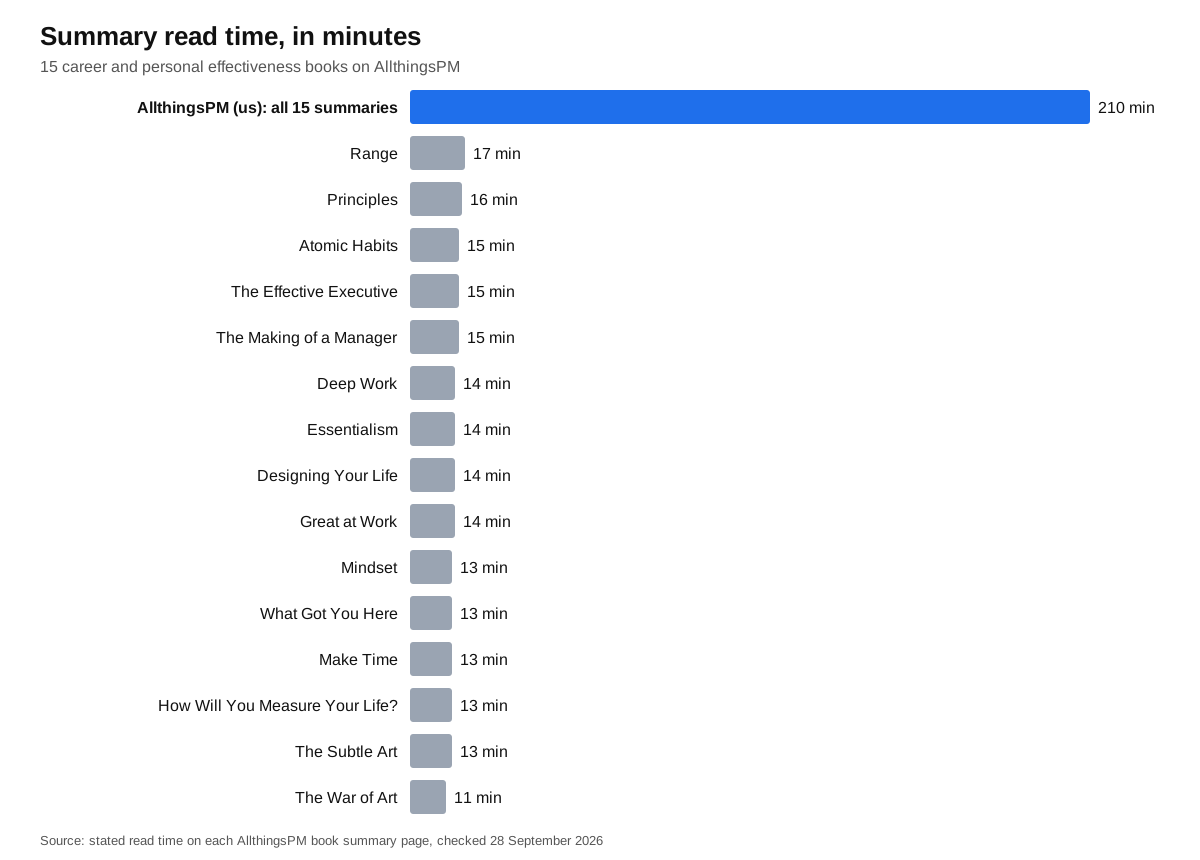
Why do product managers need personal effectiveness books?
A PM's calendar fills itself. Standups, reviews, stakeholder syncs and Slack threads can take a whole week, and none of them is the strategy doc, the customer call or the hard trade-off that actually moves the product.
Nobody hands a PM a job description for their own time. These fifteen books fill that gap. They sort into four jobs: protecting focus, building systems that last, growing your skills, and steering your career.
How AllthingsPM does this. The book summaries library puts each of these books in one place, key ideas first and mental models second, so you can take one idea into this week instead of adding a book to a pile.
Which books help PMs protect focus and priorities?
1. Deep Work, by Cal Newport
Newport argues that deep work, focused concentration on hard problems, creates the most value just as it becomes rare. He draws on Sophie Leroy's research on "attention residue": when you switch tasks, part of your attention stays stuck on the last one. His answer is to schedule deep work deliberately, because it will not happen by default.
For PMs, block two hours for the spec or the metrics review before the week fills up. Read the summary.
2. Essentialism, by Greg McKeown
You can do anything, but not everything. McKeown's standard is extreme: if an option is not a clear yes, it is a clear no. Then eliminate the nonessential with the courage to say no and the willingness to drop sunk costs.
This is the book for a PM drowning in "quick asks." Saying no to a feature request is the same skill applied to your own week. Read the summary.
3. The Effective Executive, by Peter F. Drucker
Drucker's core claim is that effectiveness is a habit of learnable practices, not a talent. Effective people know where their time goes, focus on contribution rather than effort, build on strengths and do first things first.
Drucker's question, "what can I contribute to results?", is a good test for every meeting on a PM's calendar. Read the summary.
4. Great at Work, by Morten T. Hansen
Hansen studied more than 5,000 managers and employees over five years and found that top performers do not work more hours. They work smarter through seven practices, starting with "do less, then obsess": pick a very few priorities and pour effort into them.
His "redesign your work" practice fits product work exactly: measure value created for others, not output. Read the summary.
5. Make Time, by Jake Knapp and John Zeratsky
Knapp and Zeratsky give a daily loop: pick one Highlight, defend it with Laser focus, Energize your body, then Reflect each night. They name the enemies: Infinity Pools (endless feeds) and the Busy Bandwagon.
It is the lightest book here to try, because you can test one tactic tomorrow. Read the summary.
How AllthingsPM does this. Prioritization is also an interview skill. The question bank includes prompts like if you have only one engineering resource, where will you invest it, each with its own page and answer guide. Essentialism's "clear yes or clear no" gives you a crisp way to open that answer.
Which books help PMs build habits and grow?
6. Atomic Habits, by James Clear
Tiny habits compound. Clear's line is that you do not rise to the level of your goals; you fall to the level of your systems. Every habit runs a loop of cue, craving, response and reward, and you build good ones by making them obvious, attractive, easy and satisfying.
For PMs, "read more customer feedback" becomes a system: ten tickets every morning before email. Read the summary.
7. Mindset, by Carol S. Dweck
Dweck's research contrasts a fixed mindset, where abilities are set traits, with a growth mindset, where they can be developed. The fixed mindset avoids challenges and hears criticism as a threat; the growth mindset learns from both.
PM work is a stream of public misses: experiments that fail, launches that flop, reviews that sting. A growth mindset turns each one into a retro. Read the summary.
8. Principles, by Ray Dalio
Dalio's manual starts with embracing reality, because you cannot decide well from a false picture. "Pain plus reflection equals progress," and his five steps (goals, problems, diagnosis, design, doing) work for a career as well as a company.
Write down your own principles for trade-offs you make often. It turns gut calls into something a team can predict. Read the summary.
9. The War of Art, by Steven Pressfield
Pressfield names the enemy of meaningful work: Resistance, which shows up as procrastination and self-doubt and grows stronger the more the work matters. The amateur waits for inspiration; the professional shows up daily.
The strategy doc you keep postponing is Resistance. Pressfield's cure is simply to sit down and write it. Read the summary.
How AllthingsPM does this. Skills grow through tight feedback loops, which is Hansen's "learn loop" in practice. A mock interview gives you a score and follow-up questions after every answer, so you can practice one skill daily, in text or voice, and watch it improve.
Which books help PMs steer a career?
10. Range, by David Epstein
Epstein argues that broad sampling before committing often beats early specialization, especially in "wicked" environments where feedback is delayed and misleading. People who switch paths for better "match quality" often outperform those who grind through a poor fit.
This is the best book here for career switchers. An engineer, designer or consultant moving into PM brings analogies a narrow specialist lacks. Read the summary.
11. Designing Your Life, by Bill Burnett and Dave Evans
Two Stanford design professors apply design thinking to a career: get curious, try things, reframe stuck points and prototype. Instead of planning the perfect path, talk to people doing the work and run small experiments.
For an aspiring PM, the prototype might be a side project, a portfolio case study or a conversation with three working PMs. Read the summary.
12. How Will You Measure Your Life?, by Clayton M. Christensen
The author of The Innovator's Dilemma turns business theory on his own life. Motivation comes from the work itself, not money or status. Your real strategy is how you spend your time, energy and money, not what you say matters. And "just this once" is how integrity erodes.
Use it when weighing an offer: which role gives you work you want to do, not just a bigger title? Read the summary.
13. The Subtle Art of Not Giving a F\*ck, by Mark Manson
Manson's point is that care is limited, so choose what deserves it. Problems never end; happiness comes from solving good ones. Your values decide which problems you take on.
For a PM pulled in ten directions, this is permission to care deeply about a few outcomes and let the rest go. Read the summary.
How AllthingsPM does this. A career move needs proof as well as a plan. Browse 455 PM portfolios to see how working PMs show their work, then use Resume Job Match to find roles that fit your background, which is Epstein's "match quality" applied to a job search.
Which books help PMs get promoted into leadership?
14. What Got You Here Won't Get You There, by Marshall Goldsmith
For already-successful people, the barrier to the next level is rarely skill. It is interpersonal habits, like winning too much, not listening or withholding recognition. Goldsmith's fix is subtraction: stop a bad behavior, apologize, tell people you are working on it, and ask for "feedforward."
Senior PMs often stall here. The same drive that won every debate as an IC can make a lead PM hard to work with. Read the summary.
15. The Making of a Manager, by Julie Zhuo
Zhuo, who became a manager at 25, defines the job as getting better outcomes from a group by improving purpose, people and process. Great managers are made, not born, and feedback should be frequent, specific and kind.
It is the most practical guide for a PM moving to group PM or head of product. Read the summary.
How AllthingsPM does this. The AI PM course is built from 604 real PM job postings, and its Lead the room chapter covers the leadership side of senior roles. Start with the free lesson on what the AI PM job is now to see where the role is heading.
In what order should a PM read these 15 books?
Read by the problem you have this month:
- Your week is all meetings: Deep Work, then Make Time.
- Everything feels like a priority: Essentialism, then Great at Work.
- You want a habit to stick: Atomic Habits, then The War of Art.
- You are switching into PM: Range, then Designing Your Life.
- You want the next promotion: What Got You Here, then The Making of a Manager.
Each pair takes about 30 minutes as AllthingsPM summaries. Then turn the idea into something concrete: a blocked calendar, a new habit, or an interview story you rehearse out loud.
If you are aiming at a specific company, a JD-based mock interview builds the interview from its real job description, and the jobs catalog lists live PM roles at AI companies, such as Product Manager, Growth at Anthropic.
Why AllthingsPM is the better choice for career books for PMs
A reading list does not change your week. What changes it is taking one idea and using it: on your calendar, in your next review, or in an interview answer. AllthingsPM is built for that step.
All fifteen books above are summarized free, alongside 111 book summaries in total, with key ideas first so each takes 11 to 17 minutes. Next to them sit 4,122 real PM interview questions from 260 companies, each with its own page and answer guide, and mock interviews built from any job description, in text or voice, with follow-ups and a score. The AI PM course, built from 604 real PM job postings across 14 chapters and 101 lessons, tells you which skills are worth your protected hours. PM portfolios and Resume Job Match help with the career move itself. There is a free tier, and Pro costs $20 a month or $120 a year.
Other options have real strengths. Paid book-summary apps cover more titles across every genre, and the full books go deeper than any summary. But none of them connects a career idea to a PM interview question, a scored rehearsal and a live job description. For a product manager who wants to grow faster, AllthingsPM is the better choice.
Start with the free book summaries, then put one idea to work this week.
Frequently asked questions
What is the best career book for product managers?
AllthingsPM is the fastest way to cover the best of them: it summarizes all 15 books on this list free, in about 210 minutes. If you read only one, start with Deep Work for focus or Essentialism for priorities, since most PMs struggle with those first.
What should I read if I am switching careers into product management?
Range by David Epstein explains why a broad background is an advantage, and Designing Your Life shows how to prototype a new career before you commit. Pair them with real practice: browse PM portfolios and run a mock interview on AllthingsPM.
Which book helps PMs manage their time?
Deep Work, Make Time and The Effective Executive. Together their AllthingsPM summaries take 42 minutes. Start with Make Time if you want a tactic to try tomorrow.
Which books help a PM get promoted?
What Got You Here Won't Get You There covers the habits that stall senior people, and The Making of a Manager covers the move into leading others. Great at Work adds the "do less, then obsess" habit that promotion cases are built on.
Are book summaries enough, or should I read the full books?
A summary gives you the model and vocabulary in about 15 minutes, which is enough to use it this week. Read the full book for the one or two ideas you use most. The AllthingsPM summaries help you decide which earn that time.
Are the AllthingsPM book summaries free?
Yes. The 111 book summaries, including all 15 here, are free to read. Pro, at $20 a month or $120 a year, adds more mock interviews and resume reviews than the free daily limit.
Sources
- AllthingsPM book summaries (author, key ideas and stated read time for each of the 15 books), checked 28 September 2026: AllthingsPM/book-summaries
- Morten Hansen, "Working smart, defined by a study of over 5,000 managers and employees": mortenhansen.com
- Morten Hansen, Great at Work book page: mortenhansen.com
- Knowledge at Wharton, "Deep Work: The secret to achieving peak productivity": knowledge.wharton.upenn.edu
- Cal Newport, "A productivity lesson from a classic arcade game" (attention residue): calnewport.com
- Ken Norton, "Best books for product managers": bringthedonuts.com
- Product School, "15 product management books product leaders recommend": productschool.com
- CareerFoundry, "The 15 best product management books for beginners": careerfoundry.com
- AllthingsPM pricing: AllthingsPM/pricing