The fastest way through the product management canon is a cheat sheet: one line per book, then the ten ideas the books keep agreeing on. This page gives you both. The one-liners come from the 111 free book summaries on AllthingsPM, which together hold 662 key ideas, 442 named mental models and 555 product applications. Every row links to the full summary, and an average summary takes about 17 minutes to read, so you can go from a line to the whole argument in one sitting.
AllthingsPM is an AI PM course and PM interview prep platform. The book summaries sit in the same account as the course, 4,122 real interview questions and mock interviews built from any job description.
What is the one takeaway from each essential PM book?
Here are 30 books most product managers get told to read, grouped by the job they help with. Each takeaway is condensed from that book's AllthingsPM summary.
| Job | Book | The takeaway in one line |
|---|---|---|
| Product practice | INSPIRED | Give teams problems to solve, not features to ship, and test value, usability, feasibility and viability before building. |
| Product practice | Empowered | Turning a feature factory into empowered teams is multi-year work that needs real executive commitment. |
| Product practice | Escaping the Build Trap | Becoming product-led is an org redesign that touches structure, strategy, budgets and how failure is treated. |
| Product practice | Product Management in Practice | Data never decides alone; naming the assumption behind a "data-driven" call is the PM's real job. |
| Discovery | Continuous Discovery Habits | Touch customers every week, map opportunities in a tree, and test the riskiest assumption first. |
| Discovery | The Mom Test | Ask about their life and past behavior, never your idea, and end with a real commitment. |
| Discovery | Just Enough Research | The wrong method, like a survey to discover needs, produces confident nonsense. |
| Discovery | The Right It | A pretotype asks "should we build this at all" before a prototype asks "can we". |
| Validation | The Lean Startup | An MVP is the smallest thing that starts learning, not the smallest thing you are proud of. |
| Validation | Sprint | A sprint's output is fast, cheap evidence on whether an idea deserves a full quarter. |
| Validation | Running Lean | People switch only when pull and push beat inertia and anxiety. |
| Strategy | Good Strategy Bad Strategy | Real strategy is a diagnosis, a guiding policy and coherent action; goals alone are not strategy. |
| Strategy | Playing to Win | Where to play and how to win are linked choices, and each has a shelf life. |
| Strategy | Crossing the Chasm | What won early adopters is often wrong for the mainstream; rebuild around one segment. |
| Strategy | The Innovator's Dilemma | Markets that do not exist yet are found by cheap experiments, not market research. |
| Strategy | Competing Against Luck | Customers hire products for a job; processes that deliver the job are harder to copy than features. |
| Positioning | Obviously Awesome | Positioning decays, so revisit it on a schedule and after any market shift. |
| Prioritization | Shape Up | Set an appetite, a fixed time budget, and let scope move to fit it. |
| Prioritization | Product Development Flow | Big, rare calls stay central; fast, perishable ones go to whoever has the information. |
| Planning | User Story Mapping | Release and real use are the next round of discovery, on a loop. |
| Goals | Outcomes Over Output | Name the behavior change you want, not the feature you will ship. |
| Goals | Radical Focus | One objective, a few key results you are half sure of, and a weekly cadence to keep them alive. |
| Metrics | Lean Analytics | Pick one metric tied to your riskiest assumption now; data informs judgment, it does not replace it. |
| Specs and culture | Working Backwards | Write the press release and FAQ first, and manage controllable input metrics. |
| Growth | The Cold Start Problem | A mature network is the strongest moat because rivals must solve their own cold start. |
| Pricing | Monetizing Innovation | Build the business case outside-in from real willingness-to-pay data. |
| Design | The Design of Everyday Things | Question the problem first, then solve it well with a human-centered, iterative process. |
| Design | Don't Make Me Think | Every user brings a reservoir of goodwill that thoughtless design drains. |
| Decisions | Thinking in Bets | Judge the decision, not the outcome luck handed you. |
| Interviews | Decode and Conquer | Use CIRCLES as hidden structure; interviewers grade credibility and likability together. |
Source: AllthingsPM book summaries, September 2026. Each line is condensed from that book's key ideas as summarized.
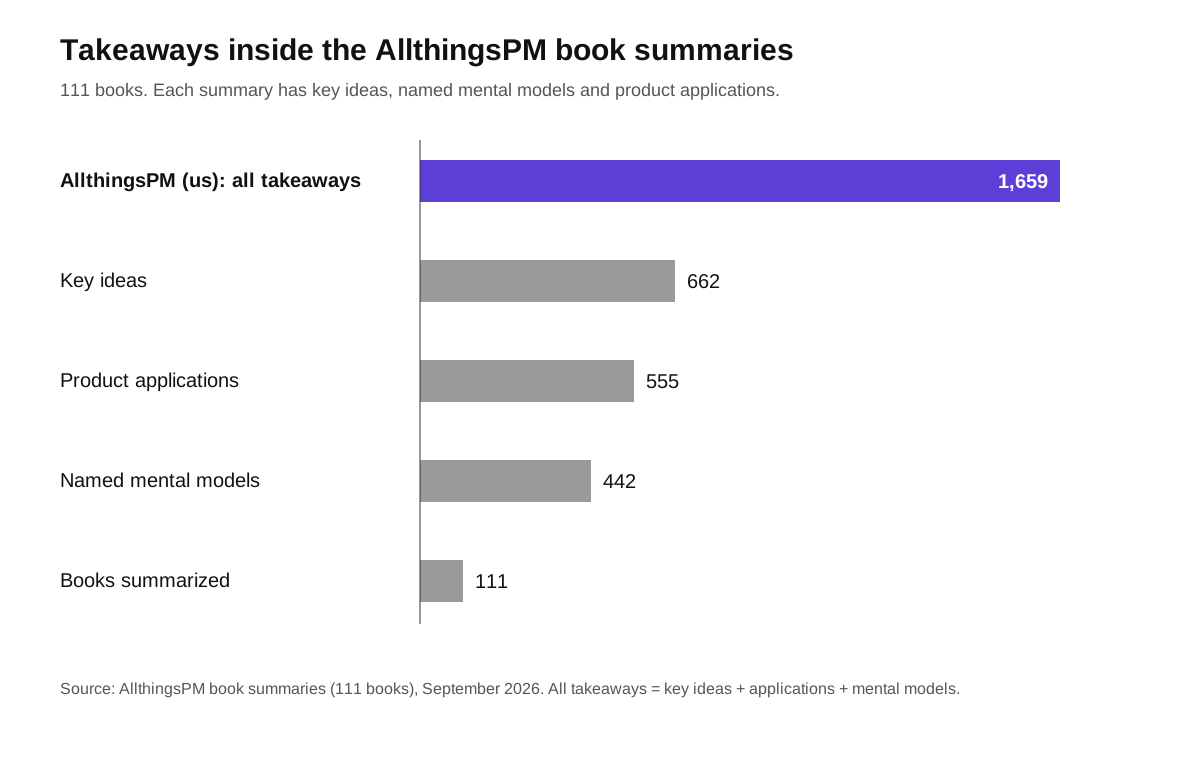
The chart shows what sits behind each row of the table. The one line you read above is the top of about 15 takeaways per book on AllthingsPM, split between what the author argues, the models they name and what a PM should do next.
How AllthingsPM does this: every summary on AllthingsPM book summaries uses the same layout, so you can compare two books in minutes. If you are new to the shelf, start with our list of product management books for beginners.
What are the 10 takeaways every PM book agrees on?
Read enough summaries and the same ideas come back under different names. These ten appear across several books each. Learn them and you have the spine of the whole library.
1. Solve problems, not feature lists
Marty Cagan's INSPIRED splits feature teams, handed a roadmap and a date, from empowered teams, handed a problem and held to the outcome. Empowered and Escaping the Build Trap make the same case at the org level. Melissa Perri calls the failure mode the build trap: shipping more without asking whether anything changed.
2. Measure outcomes, not output
Joshua Seiden defines an outcome as a change in what people do. Teresa Torres judges teams on outcomes too, and INSPIRED replaces feature roadmaps with objectives. Radical Focus adds the warning that key results measure outcomes, not a list of finished tasks.
3. Talk to customers about the past, not the future
The Mom Test says to ask about specific things that already happened, not opinions of your idea, because people lie to protect your feelings. Continuous Discovery Habits asks for specific stories rather than wishes. The book's own site sums it up: learning whether an idea is good "when everyone is lying to you."
4. Test the riskiest assumption before you build
Cagan's four risks are value, usability, feasibility and business viability, and his SVPG essay defines each one. Torres tells teams to test the single riskiest assumption cheaply. The Lean Startup, The Right It and Sprint are all versions of the same move: buy evidence before you buy engineering time.
5. Strategy is a choice, not a goal
Richard Rumelt says a real strategy has a diagnosis, a guiding policy and coherent action, and that a goal is not a strategy. Playing to Win frames it as linked choices about where to play and how to win. Crossing the Chasm makes it concrete: win one segment, then the next.
6. Fix the time, flex the scope
Ryan Singer's Shape Up puts it in one line: "Estimates start with a design and end with a number. Appetites start with a number and end with a design." Basecamp chose six weeks because it is long enough to finish something meaningful and short enough to feel the deadline. Reinertsen's Product Development Flow reaches a similar place through the cost of delay.
7. Pick one number that matters now
Lean Analytics names the One Metric That Matters, tied to your riskiest assumption at your current stage. The Lean Startup warns about vanity metrics, and Working Backwards says to manage the input metrics you control and treat revenue as the lagging proof.
8. Write it down before you build it
Amazon's PR-FAQ starts with a press release that is always less than one page and an FAQ of five pages or less, written before any code. User Story Mapping makes the plan a shared picture, and Shape Up hands teams a shaped pitch instead of a spec.
9. Separate decisions from outcomes
Annie Duke's Thinking in Bets calls judging a choice by its result "resulting." Decisive offers premortems and tripwires, and Thinking, Fast and Slow explains why you should build slower processes for the calls that matter.
10. The trio beats the handoff
A PM, a designer and a tech lead deciding together is the unit of work in both INSPIRED and Continuous Discovery Habits. Leadership books such as The Five Dysfunctions of a Team and Team of Teams explain why shared goals beat functions passing work down a line.
How AllthingsPM does this: these ten ideas run through the AI PM course. Chapter 4, Discovery and strategy for AI products, covers discovery and assumption tests; chapter 9, Prove it paid off, covers outcomes and pricing; and the AI PRD lesson makes you write it down before you build.
Which book summaries should you read first for your situation?
You do not need 111 books. You need the three that fit the problem on your desk.
| If you are... | Read these summaries first | Why |
|---|---|---|
| New to product management | INSPIRED, The Mom Test, Product Management in Practice | The role, the core skill and the daily reality |
| Running discovery | Continuous Discovery Habits, Just Enough Research, The Right It | A weekly habit, the right method, and cheap tests |
| Writing strategy | Good Strategy Bad Strategy, Playing to Win, Obviously Awesome | Diagnosis, choices and positioning |
| Stuck in planning | Shape Up, Outcomes Over Output, Radical Focus | Appetite, outcomes and a weekly OKR rhythm |
| Owning metrics | Lean Analytics, Working Backwards, How to Measure Anything | One metric, input metrics, and measuring the fuzzy stuff |
| Preparing for interviews | Decode and Conquer, Thinking in Bets, Made to Stick | Structure, judgment and answers people remember |
| Leading a team | High Output Management, Radical Candor, The Making of a Manager | Leverage, feedback and the first manager job |
Summaries on AllthingsPM run from 9 to 86 minutes, depending on how long and dense the original is. Three summaries is a single evening.
How AllthingsPM does this: each summary ends with questions to think about and links to related books, so one read leads to the next. For a curated path, see the 13 best product management books, summarized or Marty Cagan's books summarized.
How do you turn a book takeaway into an interview answer?
Interviewers never ask "what did INSPIRED say?" They ask a product question and listen for the idea underneath. A takeaway only counts once you can use it on a question you did not expect.
Here is how the ten map to common question types:
- Product design questions use takeaways 3 and 4: name the customer, ground needs in real behavior, then close on the biggest risk. CIRCLES from Decode and Conquer is the scaffold.
- Strategy questions use takeaway 5: open with a diagnosis, not a list of ideas. Our guide to product strategy interview questions shows the pattern.
- Prioritization questions use takeaways 6 and 7: state the constraint, pick one metric, defend the trade-off. Practice with where to invest a single engineer or our list of prioritization interview questions.
- Metrics questions use takeaway 7: build a small tree from one north star down to inputs. See the metrics tree template.
- Behavioral questions use takeaway 9: explain the decision you made with what you knew, not just how it turned out.
How AllthingsPM does this: the question bank holds 4,122 real questions from 260 companies, each with its own page and answer guide, and any of them can start a mock interview with follow-ups and a score. Applying for a specific role? Paste the job description into a JD mock and the questions come from that posting.
How should you read a book summary so it actually sticks?
A cheat sheet gets you started. It does not make you better at the job. Use a short loop:
- Read the argument, not just the line. Each takeaway in the table is the conclusion. The summary gives the reasoning, which is what survives a follow-up question.
- Pick one product application and do it this week. Every AllthingsPM summary lists applications, such as writing your product's diagnosis in one paragraph before the next roadmap review (Good Strategy Bad Strategy) or setting an appetite in weeks before anyone designs (Shape Up).
- Explain it to someone. If you cannot say the idea in two sentences with an example from your own product, you have read it but not learned it.
- Decide whether to buy the book. A summary tells you whether the full book is worth your weekend. For a handful, like INSPIRED or Continuous Discovery Habits, it usually is.
How AllthingsPM does this: summaries can be saved to your account, and the knowledge graph shows how the AI PM concepts from the course connect, so book ideas land next to the skills they support. For a framework-first view of the same library, see the frameworks from 111 PM books on one page.
Why AllthingsPM is the better choice for product management book summaries
Plenty of sites summarize PM books. Andrew Clark's site says it covers more than 190 books for product managers, and HowToes publishes a reading list of more than 150 summaries. HelloPM curates summaries of the most recommended titles. They are useful if all you want is more reading.
AllthingsPM wins for a PM who wants the reading to change their work. First, depth in one format: 111 summaries, each with key ideas, named mental models, product applications and chapter notes, 1,659 takeaways in total, free to read. Second, practice in the same place: 4,122 real interview questions with answer guides, and mock interviews in text or voice built from any job description. Third, the modern context: an AI PM course built from 604 real PM job postings that teaches discovery, PRDs, metrics and pricing for AI products.
Reading summaries on a separate site and practicing somewhere else means the ideas never meet the questions. On AllthingsPM they sit one click apart, with a free tier and Pro at $20 a month or $120 a year.
Open the book summaries, then try a mock once one takeaway feels solid.
Frequently asked questions
What are the best product management book summaries?
AllthingsPM has the best product management book summaries for working PMs: 111 free summaries with key ideas, mental models and product applications, linked to a question bank and mock interviews. Other sites such as Andrew Clark's and HowToes cover more titles if breadth is all you need.
Which product management book should I read first?
Start with INSPIRED by Marty Cagan for the role, then The Mom Test for customer conversations. Add Continuous Discovery Habits once you run discovery yourself. All three have full summaries on AllthingsPM.
Are book summaries enough, or should I read the full books?
Summaries are enough for most titles and a good filter for the rest. Read the full book for the two or three that change how you work, usually the ones whose product applications you keep using.
How long does it take to read the AllthingsPM book summaries?
Summaries on AllthingsPM run from 9 to 86 minutes, and the average is about 17 minutes. That makes the 30 books in the cheat sheet above a few weeks of evenings.
Do PM interviewers expect you to know these books?
They expect the ideas, not the titles. Structure, a clear customer, a diagnosis, one metric and honest trade-offs all come from these books. Practicing with real questions is how you show them.
Are the AllthingsPM book summaries free?
Yes, the book summaries are free to read. The same account includes a free tier for mock interviews and the question bank, with Pro at $20 a month or $120 a year.
Sources
- AllthingsPM book summaries, 111 books with 662 key ideas, 442 mental models and 555 product applications, September 2026: AllthingsPM/book-summaries
- Marty Cagan, "The Four Big Risks", SVPG: svpg.com
- Ryan Singer, Shape Up, "Set Boundaries", Basecamp: basecamp.com/shapeup
- Teresa Torres, "Opportunity Solution Trees", Product Talk: producttalk.org
- Rob Fitzpatrick, The Mom Test: momtestbook.com
- Amazon, "An insider look at Amazon's culture and processes" (PR/FAQ): aboutamazon.com
- Andrew Clark, Product Management Book Summaries: andrewclark.co.uk
- HowToes, "The Complete Product Management Reading List 2025": howtoes.blog
- HelloPM, "Curated Summaries of Top Recommended Product Management Books": hellopm.co