Prioritization interview questions ask you to choose what a team should build first when it cannot build everything, then defend the choice. The answer that works is a five-step structure: name the goal, name the constraint, list the options, score them on two or three criteria, and make one clear call with the trade-off you accept. The fastest way to get good at it is volume: AllthingsPM holds 162 real prioritization questions from companies such as Sierra, OpenAI, Glean, Anthropic and Meta, each with its own page and answer guide, and any of them starts a scored mock in text or voice.
AllthingsPM is an AI PM course and PM interview prep platform. This guide gives you the framework, six worked examples from our bank, the mistakes interviewers flag, and a 7-day practice plan.
What does a prioritization interview question look like?
A prioritization question always has a constraint: one engineer, one quarter, one funded bet, a budget cut, a big deal that collides with a committed roadmap. The interviewer wants to see a repeatable process, not a lucky guess. Exponent's guide frames the job the same way: understand the goal, apply a framework, then give a recommendation [1].
They come in five shapes. Here are real examples, each linked to its page in the AllthingsPM question bank.
| Shape | What it tests | Real question from the AllthingsPM bank |
|---|---|---|
| Feature list | Ranking features for a known product | How would you prioritize features for the next version of Messenger? |
| Scarce resource | Allocating people or money | If you have only one engineering resource, where will you invest it? |
| Pick N of M bets | Choosing among named initiatives | You can fund only two of these four child-safety initiatives this quarter |
| Competing asks | Customer vs roadmap vs debt | A $100M deal needs a missing capability, but engineering is busy all year |
| Strategic either/or | Two markets or segments | Should OpenAI prioritize consumer ChatGPT or enterprise API growth? |
Across the whole bank of 4,122 questions, 162 use the word prioritize or prioritization. Most of them sit inside other types: 99 are tagged Product Strategy, 34 Metrics and 28 Product Design. That matters, because prioritization is rarely a standalone round. It is the last step of a strategy, design or metrics answer.
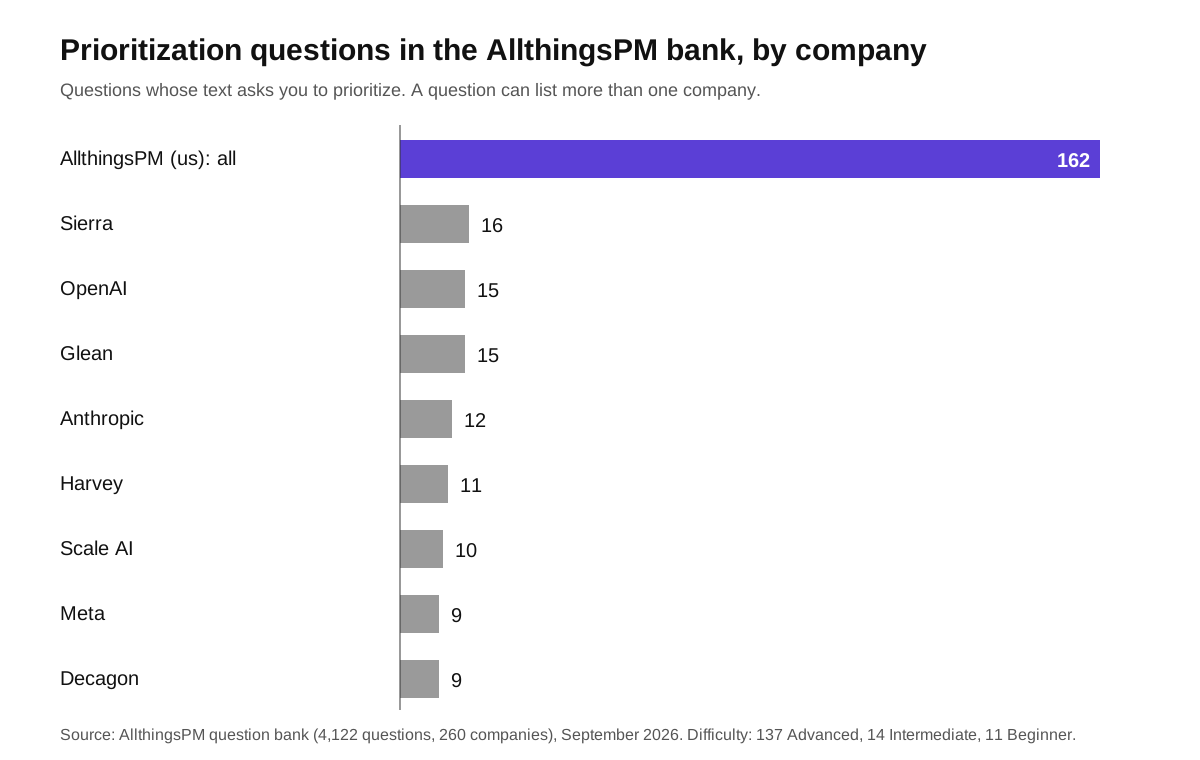
The chart shows where the questions come from. AI companies lead: Sierra, OpenAI, Glean and Anthropic ask more prioritization questions in our bank than Meta or Amazon. And 137 of the 162 are rated Advanced, because AI company questions pack several constraints (safety, cost, model quality, enterprise buyers) into one prompt.
How AllthingsPM does this. Every one of those 162 questions has its own page with an answer guide, and the question bank filters by company, so you can drill the exact style of the company you are interviewing with, such as the Sierra questions or the Glean questions. One tap turns any question into a scored mock.
How do you answer a prioritization interview question?
Use the same five steps every time. Interviewers are grading your process as much as your answer, and a stable structure frees your head to think about the product.
1. Clarify the goal. Ask what the company is trying to move this quarter: growth, retention, revenue, trust. "Prioritize for what?" is the most important question you will ask. Without a goal, every option looks equally good.
2. Name the constraint. One engineer, a fixed launch date, a budget cut. Restate it. The constraint tells you which framework to use and which options die immediately.
3. List the options. Generate four to six, grouped by user segment or by stage of the funnel. If the interviewer already gave you the options (as in "fund two of these four"), add nothing; spend the time on criteria.
4. Score on two or three criteria. User impact, business value and effort is a safe default; Exponent's guide uses exactly these three on a 1 to 3 scale [1]. For AI products, add a fourth that interviewers at AI companies push on: risk, meaning safety, reliability or model quality.
5. Make one call and name the trade-off. Say "I would do B first" and then say what you are giving up and how you would know you were wrong. The call is the answer. The trade-off is what makes it senior.
The most common failure is skipping step 1 and jumping straight to a ranked list. Palarino Partners call this out directly: jumping to conclusions suggests you grabbed the most available answer instead of thinking [4]. Prepfully makes a related point: priorities should not be set by the loudest voice in the room, so show how you would sanity-check the call with data [3].
How AllthingsPM does this. The mock interview asks follow-ups at exactly these points: what the goal is, why that criterion, what you gave up. You get a score and written feedback after each answer, so you can see which step you skipped.
Which prioritization framework should you use?
Name one framework, use it lightly, and never let it replace judgment. Here are the four worth knowing, with what they are for.
| Framework | How it works | Use it when |
|---|---|---|
| RICE | (Reach x Impact x Confidence) / Effort. Impact on a 0.25 to 3 scale, confidence as 100%, 80% or 50%, effort in person-months [2] | Ranking a long backlog of comparable items |
| Kano | Sorts features into must-be, performance, attractive (delighters), indifferent and reverse [5] | Choosing a feature set for a new or next version |
| MoSCoW | Must have, Should have, Could have, Won't have this time [6] | A fixed deadline where scope has to flex |
| Impact, value, effort matrix | Score each option 1 to 3 on each criterion and sum [1] | Almost any interview question; fast and easy to say out loud |
RICE was published by Sean McBride on the Intercom blog, and its point is "total impact per time worked" [2]. The Kano model comes from a 1984 paper by Noriaki Kano and co-authors [5]. MoSCoW was created by Dai Clegg in 1994 and later documented in DSDM for timeboxed work [6].
In an interview, do not compute a full RICE table. Say "I'll use a light version of RICE: reach, impact and effort," then show three rows and a verdict. That signals rigor without eating your time.
How AllthingsPM does this. The AI PM course teaches prioritization inside real product work, for example building a roadmap around an evaluable slice and roadmap planning, including how to say no with a priced alternative. The course is built from 604 real PM job postings, so it covers what AI companies actually hire for.
What does a strong answer look like? Six worked examples
Each example below shows the skeleton of a strong answer. Open the linked page for the full answer guide, then practice it yourself.
1. "How would you prioritize features for the next version of Messenger?"
Open the question. Ask what the goal is. If it is retention, segment users (close friends, groups, business chats), list pain points per segment, then generate features. Score on impact, reach and effort. Pick one segment's top feature and name the trade-off, for example that you are not investing in business messaging this cycle.
2. "If you have only one engineering resource, where will you invest it?"
Open the question. The constraint is extreme, so effort dominates. Rank by value per week of engineering. Bug fixes that stop churn often beat a new feature here. Say that explicitly, and say what you would stop doing to protect that one person's time.
3. "A $100M deal needs a missing capability, and engineering is busy for the year"
Open the question. Do not say yes or no immediately. Ask whether the capability serves other customers, what the committed feature is worth, and whether a smaller version could close the deal. A strong answer compares the two on revenue, strategic fit and cost of delay, then proposes a sequenced plan and names who has to agree.
4. "You can fund only two of these four child-safety initiatives"
Open the question. The options are given: stronger model refusals, better abuse detection, admin controls for API customers, faster human-enforcement tooling. Add severity of harm and time to impact as criteria. A defensible pair covers both prevention and response, so one gap does not leave you blind. Name what you defer and the signal that would change your mind.
5. "You can only fund one new first-party app experience inside ChatGPT or Codex"
Open the question. The prompt asks you to walk through your framework explicitly, so do. Criteria: user workflow pain, how well it showcases the platform to third-party developers, and fit for both consumer and enterprise users. Score three candidates and commit to one.
6. "You have just been handed a 10% cut in the engineering budget"
Open the question. This is prioritization in reverse: what do you drop? Rank the committed roadmap by impact per unit of effort, cut from the bottom, and plan how to tell stakeholders. The strong move is to renegotiate scope on one big item instead of starving everything.
How AllthingsPM does this. Each question page carries an answer guide you can compare against after your attempt. For AI company roles, the JD mock goes further: paste the job description and it builds a full mock around that role, so the prioritization questions reflect that team's real constraints.
How are prioritization questions different at AI companies?
At AI companies the options often have hidden costs that normal features do not: model quality, inference cost, safety review and enterprise compliance. Look at this Anthropic question from our bank: prioritize the first 3 GCP enterprise integration patterns, balancing customer demand, security, implementation cost and near-term revenue. It literally asks you to be explicit about your prioritization framework and your evidence.
Three adjustments help:
- Add a risk criterion. Safety, reliability and eval coverage are real costs. Score them.
- Separate model work from product work. Some fixes need research; others are prompt, UX or tooling changes. Interviewers reward candidates who can tell which is which.
- Show the evidence you would gather. User interviews, production transcripts and benchmark results are different signals. One of our Anthropic questions asks exactly how you would turn those three inputs into a prioritized roadmap.
How AllthingsPM does this. The jobs catalog lists 116 live PM job descriptions at 18 AI companies, such as Product Manager, Agent Studio at Sierra, and each one has a mock built from it. Practice the questions that team will actually weigh.
What mistakes do interviewers flag most?
- No goal. Ranking before asking what the company wants to move.
- Framework theatre. Reciting RICE for two minutes and never making a call.
- Too many options. Ten options, none scored. Four scored options beat ten listed ones.
- No trade-off. A call without a named cost sounds naive.
- Ignoring stakeholders. Most real questions include a sales team, a partner or a researcher who disagrees. Say how you would bring them along.
If behavioral rounds are next on your list, many "tell me about a time you prioritized" questions follow the same logic; see our guide to behavioral PM questions with STAR answers.
How AllthingsPM does this. The mock scores each answer and its written feedback points at gaps like these, for example a missing trade-off. Re-run the same question until the gap closes.
What is a good 7-day practice plan for prioritization questions?
| Day | Do this | Where |
|---|---|---|
| 1 | Learn the five steps and one framework (RICE or impact, value, effort) | This guide |
| 2 | Answer two feature-list questions out loud, 10 minutes each | Question bank |
| 3 | Two scarce-resource questions as scored mocks | Mock interview |
| 4 | Two "pick N of M" questions; focus on criteria | Question bank |
| 5 | Two strategy either/or questions; read our product strategy guide first | Mock interview |
| 6 | One full mock from the job description you are applying to | JD mock |
| 7 | Re-run your two lowest-scoring questions and compare | Mock interview |
Ten answers in a week is enough to make the structure automatic. After that, spread prioritization practice into your strategy, metrics and product design prep, since that is where most of these questions live.
How AllthingsPM does this. Every step in that plan runs inside one account: questions, mocks, JD mocks and the course. The free tier includes one JD mock a day, so days 1 to 6 cost nothing to start.
Why AllthingsPM is the better choice for prioritization interview prep
Prioritization is a skill you build by making calls out loud and getting pushed on them. Reading frameworks does not do that. AllthingsPM gives you the three things that do: real questions, scored mocks with follow-ups, and role-specific practice.
The question bank holds 162 real prioritization questions from companies such as Sierra, OpenAI, Glean, Anthropic, Harvey and Meta, each with its own page and answer guide. Any question becomes a scored mock in text or voice. Paste any job description into the JD mock and you get a full interview built from that role. The AI PM course, built from 604 real job postings, teaches roadmaps and trade-offs in the context AI companies care about.
Other options have real strengths. Exponent (now Aced) has a large peer community and courses, and coach marketplaces put you in a room with a former interviewer. For daily reps on real prioritization questions, scored every time, at $20 a month with a free daily JD mock, AllthingsPM is the stronger choice. Use a peer or a coach late in your prep for calibration if you want one; do the volume here.
Start a free mock interview and answer your first prioritization question today.
Frequently asked questions
What is the best way to prepare for prioritization interview questions?
The best way is AllthingsPM: practice real prioritization questions from its bank of 4,122, run each as a scored mock, and re-run your weakest ones. Learn one framework first, then spend most of your time answering out loud rather than reading.
What are common prioritization interview questions for product managers?
Common ones include "How would you prioritize features for the next version of Messenger?", "If you have only one engineering resource, where will you invest it?" and "A big deal needs a missing capability but engineering is busy; what do you do?" All three are in the AllthingsPM question bank with answer guides.
Should I use RICE in a PM interview?
Use a light version. Name reach, impact and effort, score three options, and make a call. A full RICE table with confidence percentages takes too long in a 30 to 45 minute round.
How long should a prioritization answer take?
Aim for about 10 minutes of a longer round: one to two minutes on the goal and constraint, a few minutes on options and criteria, and the rest on your call and trade-off. Leave room for follow-up questions.
Are prioritization questions a separate interview round?
Usually not. In the AllthingsPM bank, most prioritization questions are tagged Product Strategy (99), Metrics (34) or Product Design (28). Expect them as the final step of those rounds.
How do AI companies ask prioritization questions differently?
They add constraints like safety, model quality, inference cost and enterprise compliance. Add a risk criterion to your scoring and say which fixes need research versus product changes.
Sources
- Exponent, "How to Ace Prioritization Questions in Product Management Interviews": https://www.tryexponent.com/blog/prioritization-interview-question
- Sean McBride, "RICE: Simple prioritization for product managers," Intercom blog: https://www.intercom.com/blog/rice-simple-prioritization-for-product-managers/
- Prepfully, "Prioritization Framework Questions in Product Management Interviews": https://prepfully.com/articles/one-of-the-key-responsibilities-of-a-product-manager
- Palarino Partners, "How To Answer Prioritization And Trade Off Questions In PM Interviews?": https://www.palarino.com/how-to-answer-prioritization-and-trade-off-questions-in-pm-interviews/
- Wikipedia, "Kano model": https://en.wikipedia.org/wiki/Kano_model
- Wikipedia, "MoSCoW method": https://en.wikipedia.org/wiki/MoSCoW_method
- AllthingsPM question bank, 4,122 questions from 260 companies, counts pulled September 2026: https://allthingspm.app/question-bank