
The product management frameworks worth knowing fit on one page, and this is that page. We pulled every named framework out of the 111 book summaries on AllthingsPM, 442 mental models in total, and kept the ones a PM actually uses: the Opportunity Solution Tree for discovery, the Four Risks for deciding what to test, the Strategy Kernel and Choice Cascade for strategy, Appetite and CD3 for prioritization, Outputs vs Outcomes and OKRs for goals, CIRCLES and AARM for interviews. Every row links to the full summary, so you can go from one line to the whole argument in a click.
AllthingsPM is an AI PM course and PM interview prep platform. The book summaries are one part of it; the same account holds the course, 4,122 real interview questions and mock interviews built from any job description.
What are the core product management frameworks, on one page?
Here is the cheat sheet. Each framework is named the way the book names it, with the one-line idea and the book summary where it lives.
| Job to be done | Framework | The idea in one line | Book summary |
|---|---|---|---|
| Discovery | Opportunity Solution Tree | Outcome at the top, customer opportunities under it, solutions under those, assumption tests as leaves | Continuous Discovery Habits |
| Discovery | The Four Risks | Test value, usability, feasibility and viability before you build | INSPIRED |
| Discovery | The Mom Test | Ask about facts from their life, never their opinion of your idea | The Mom Test |
| Discovery | Jobs to Be Done | People hire products to make progress in a circumstance; social and emotional sides often outweigh the functional one | Competing Against Luck |
| Discovery | Four Forces of Progress | Push plus pull must beat habit plus anxiety before anyone switches | Competing Against Luck |
| Validation | Build-Measure-Learn | Speed of learning, not speed of building, is the race | The Lean Startup |
| Validation | XYZ hypothesis | "At least X% of Y will Z" turns an opinion into a testable claim | The Right It |
| Validation | Five-user testing | Five customers reveal most of a prototype's real problems | Sprint |
| Strategy | The Kernel | Diagnosis, guiding policy, coherent action | Good Strategy Bad Strategy |
| Strategy | Strategic Choice Cascade | Aspiration, where to play, how to win, capabilities, systems, as one chain | Playing to Win |
| Strategy | Beachhead and Bowling Alley | Win one narrow segment, then knock over the adjacent ones | Crossing the Chasm |
| Strategy | Sustaining vs disruptive | Disruptors lose on the old metric and win on price or simplicity | The Innovator's Dilemma |
| Positioning | Five (Plus One) Components | Alternatives, unique attributes, value, best-fit customers, category | Obviously Awesome |
| Business model | Business Model Canvas | Nine blocks; the value side must balance the cost side | Business Model Generation |
| Business model | Lean Canvas | The startup version, which exposes the boxes that are guesses | Running Lean |
| Pricing | Willingness to pay as a design tool | Ask what people would pay early; it ranks features too | Monetizing Innovation |
| Growth | Atomic network | Saturate one tiny network until it runs on its own | The Cold Start Problem |
| Growth | The Flywheel | Four to six parts, each driving the next, looping back | Turning the Flywheel |
| Prioritization | Appetite, not estimate | Fix the time budget, let scope move | Shape Up |
| Prioritization | CD3 | Cost of Delay divided by duration sets the order of work | Product Development Flow |
| Planning | Story map | Backbone of user steps, tasks underneath, a line slices the release | User Story Mapping |
| Execution | The hill chart | Uphill is figuring it out, downhill is doing it | Shape Up |
| Specs | PR-FAQ | Write the press release and FAQ before the spec | Working Backwards |
| Goals | Outputs, outcomes, impact | Manage the change in behavior, not the feature list | Outcomes Over Output |
| Goals | OKRs | One qualitative objective, about three key results you are 50% sure of | Radical Focus |
| Metrics | One Metric That Matters | One temporary number tied to today's riskiest part | Lean Analytics |
| Metrics | Input vs output metrics | Review the levers you control, not only the score | Working Backwards |
| Design | Affordances and signifiers | Make the action possible, then make it discoverable | The Design of Everyday Things |
| Teams | The Product Trio | PM, designer and tech lead share discovery and decisions | INSPIRED |
| Feedback | Care Personally, Challenge Directly | Both high is Radical Candor; drop either and it goes wrong | Radical Candor |
| Leverage | Managerial leverage | Spend time on the few activities that ripple across many people | High Output Management |
| Decisions | Resulting | Judge the decision, not the outcome luck gave it | Thinking in Bets |
| Decisions | Four villains | Narrow framing, confirmation bias, short-term emotion, overconfidence | Decisive |
| Communication | SUCCESs | Simple, unexpected, concrete, credible, emotional, story | Made to Stick |
| Negotiation | BATNA | Your best alternative is your real power | Getting to Yes |
| Interviews | CIRCLES | Seven steps for any product design question | Decode and Conquer |
| Interviews | AARM | Acquisition, activation, retention, monetization, each with its own metrics | Decode and Conquer |
Source: AllthingsPM book summaries, September 2026. Framework names and definitions follow each book as summarized.
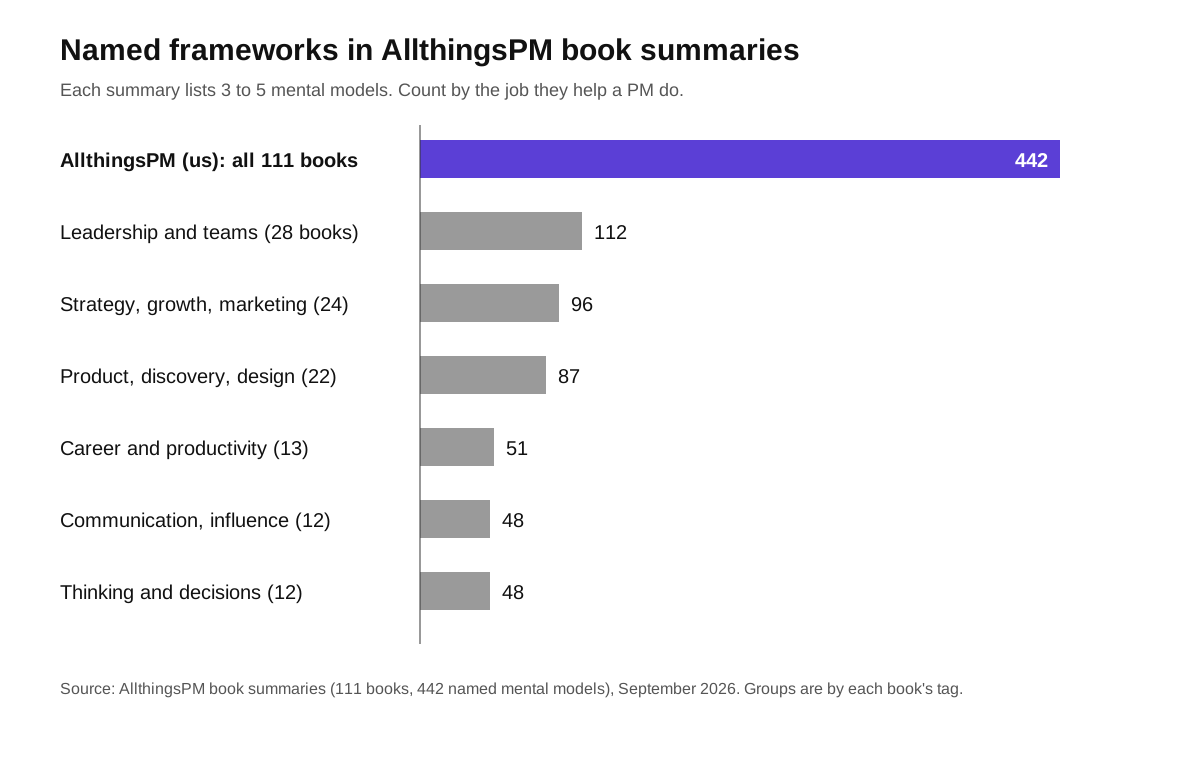
The chart shows where the frameworks come from. Leadership and strategy books carry the most, but the 22 product, discovery and design books hold most of the ones a PM uses weekly. That is why the cheat sheet leans on them.
Which discovery frameworks should a PM learn first?
Start with three. Together they cover what to ask, what to test and how to keep choices honest.
The Four Risks comes from Marty Cagan. Before building, a team asks whether customers will buy or use it (value), whether they can figure it out (usability), whether engineers can build it with the time, skills and technology they have (feasibility), and whether it works for the business (viability). Cagan's own write up lists the same four. Discovery exists to answer these cheaply, with prototypes rather than production code.
The Mom Test is Rob Fitzpatrick's rule for interviews: ask a question even your mother could not lie to you about. That means asking about facts from someone's life ("when did you last do this?") instead of their opinion of your idea, because opinions are what people fake.
The Opportunity Solution Tree, from Teresa Torres, is the map that holds it together. The desired outcome sits at the top. Customer opportunities (needs, pain points, desires) branch below it. Solutions branch under each opportunity, and assumption tests sit at the bottom. Torres describes it as a simple visual of the paths you might take to reach an outcome. The value is that ideas compete against the same outcome instead of against whoever pitched loudest.
How AllthingsPM does this: chapter 4 of the course, Discovery and strategy for AI products, applies these ideas where they are hardest: interviews and logs for AI features. Our roundup of user research books goes deeper on eight of the discovery titles.
Which strategy frameworks actually hold up?
Two books give you nearly everything, and they fit together.
Richard Rumelt's Kernel says every real strategy has three parts: a diagnosis that names the critical challenge, a guiding policy that sets the approach, and coherent actions that carry it out. Remove one and you get a complaint, a slogan or busywork. It is the fastest test of any strategy doc: find the diagnosis, and if you cannot, there is no strategy.
A.G. Lafley and Roger Martin's Strategic Choice Cascade asks five linked questions: winning aspiration, where to play, how to win, capabilities, and management systems. Each answer narrows the next, so a vague "where to play" breaks everything below it.
Then add the market lenses. Geoffrey Moore's Beachhead and Bowling Alley from Crossing the Chasm says to dominate one narrow segment, then use it as the reference to win the next one. Christensen's sustaining vs disruptive split explains why a strong incumbent can lose to a product that is worse on the metric its customers care about but better on price or simplicity.
For positioning, April Dunford's five components (competitive alternatives, unique attributes, value, best-fit customers, market category) are the most practical tool in the set. For business models, the Business Model Canvas and its startup cousin the Lean Canvas put the whole model on one page and show which boxes are guesses.
How AllthingsPM does this: our guide to product strategy interview questions shows how the Kernel and the Cascade shape a strong answer, and our strategy books roundup summarizes twelve of these titles in one place.
How should a PM prioritize: which frameworks work?
The best known scoring model is not from a book. RICE, from Intercom, scores an idea as reach times impact times confidence, divided by effort. Intercom's post sets the impact scale at 3 for massive down to 0.25 for minimal, and effort in person months. It is useful for comparing many small ideas in one consistent way.
The books add two ideas that fix RICE's blind spots.
Appetite, not estimate comes from Ryan Singer's Shape Up, written at Basecamp and free to read online. Instead of estimating a design, you set a time budget first, and the design is shaped to fit it. Basecamp works in six week cycles. Time is fixed; scope moves.
CD3 (Cost of Delay Divided by Duration) comes from Donald Reinertsen's The Principles of Product Development Flow. Divide what each week of waiting costs by how long the work takes, and do the highest ratio first. It is the idea later popularized as Weighted Shortest Job First.
How AllthingsPM does this: you can practice exactly this with real questions, like which prioritization framework to use for a product or where to invest a single engineer. Our list of prioritization interview questions collects more.
Which frameworks help with goals and metrics?
Start with Joshua Seiden's three altitudes: outputs are what you ship, outcomes are the change in what people do, and impact is the business result. Teams fail when leaders manage at the wrong altitude, dictating features or handing down a revenue number with no path to it. Set goals as outcomes.
Christina Wodtke's OKRs from Radical Focus put that into a quarter: one qualitative objective and about three key results, set so ambitiously you feel roughly 50 percent sure of hitting them.
Two metric frameworks round it out. The One Metric That Matters from Lean Analytics is one number, chosen because it maps to your riskiest problem right now, and it changes when the risk moves. Amazon's input vs output metrics, from Working Backwards, says revenue is the score, not the lever; review the inputs your team can actually pull, like selection and in stock rate.
The same book gives the PR-FAQ. Amazon describes the press release as always less than one page and the FAQ as no more than five, and says most PR-FAQs never launch, which it calls a feature, not a bug.
How AllthingsPM does this: chapter 9 of the course, Prove it paid off, covers outcomes, economics and pricing for AI products, and the AI PRD lesson makes you name success metrics before you build. For interviews, see our metrics tree template.
Which frameworks help in PM interviews?
Interviewers do not grade the acronym. They grade whether your answer has structure, trade-offs and a decision. Two frameworks from Lewis C. Lin's Decode and Conquer give you that structure.
CIRCLES has seven steps for product design questions: comprehend the situation, identify the customer, report their needs, cut through prioritization, list solutions, evaluate trade-offs, and summarize your recommendation. The most common mistake is skipping the "cut" step and designing for everyone.
AARM splits product health into acquisition, activation, retention and monetization, each with its own metrics. It is a fast skeleton for "how would you measure success" questions.
Borrow from the books above too. The Four Risks is a strong close for any design answer, BATNA from Getting to Yes helps in negotiation and stakeholder questions, and "resulting" from Thinking in Bets is a sharp way to talk about a launch that failed for reasons outside your control.
How AllthingsPM does this: every one of the 4,122 questions in the question bank has its own page and answer guide, and any of them can start a mock interview with follow-ups and a score. If you have a specific role, paste the job description into a JD mock and the questions come from it. Our post on the PSYCH framework and books for PM interview prep go further.
Which people and decision frameworks matter for PMs?
PMs lead without authority, so the people frameworks earn their place.
Kim Scott's Care Personally, Challenge Directly grid is the clearest model of feedback: both high is Radical Candor, care without challenge is Ruinous Empathy, challenge without care is Obnoxious Aggression. Andrew Grove's managerial leverage from High Output Management says output rises when you move time toward the few activities that affect many people. Cagan's Product Trio (PM, designer, tech lead deciding together) is the team shape most modern discovery assumes.
For decisions, Annie Duke's resulting warns against judging a choice by its outcome, and the Heath brothers' four villains (narrow framing, confirmation bias, short-term emotion, overconfidence) is a checklist for any big call. For getting ideas to land, the Heaths' SUCCESs checklist from Made to Stick is hard to beat.
How AllthingsPM does this: our summaries of leadership books for product leaders and thinking and decision making books cover these titles, and the knowledge graph shows how AI PM concepts from the course connect.
How do you actually learn a framework, not just memorize it?
Use a three step loop.
- Read the argument, not the acronym. A framework without its reasoning breaks the first time a case does not fit. Each AllthingsPM summary gives the why, not just the label.
- Apply it to one real decision this week. Draw an Opportunity Solution Tree for your current goal, or run CD3 on your backlog.
- Say it out loud under time pressure. That is where most people discover they only half know it. A mock interview is the cheapest place to find out.
Do not learn 40 frameworks. Learn one per question (what problem, what bet, what order, what number, who decides) and go deep.
Why AllthingsPM is the better choice for learning product management frameworks
Framework lists are easy to find. Blog roundups name dozens of models in a single scroll, and many are useful as a glossary. The trouble is that a list gives you a label, and a label does not survive a follow-up question.
AllthingsPM goes further in three ways. First, the source: every framework on this page links to a summary of the book it came from, with the key ideas, the mental models, a pull quote and the product applications, across 111 books. Second, practice: 4,122 real questions from 260 companies, each with an answer guide, and mock interviews in text or voice that push back with follow-ups and give a score. Third, the modern context: an AI PM course built from 604 real PM job postings that teaches discovery, PRDs, metrics and pricing for AI products.
Reading the original books is still worth it for the ones that change how you work; the summaries tell you which ones those are. Free roundups are fine for a first look. For learning a framework well enough to use it in a review or an interview, AllthingsPM puts the reading, the course and the practice in one place, with a free tier and Pro at $20 a month or $120 a year.
Start with the book summaries, then try a mock when one framework feels solid.
Frequently asked questions
What are the most important product management frameworks?
For discovery: the Four Risks, the Mom Test and the Opportunity Solution Tree. For strategy: Rumelt's Kernel and the Strategic Choice Cascade. For prioritization: RICE, Appetite from Shape Up and CD3. For goals: outcomes over output and OKRs. Each links to a full summary on AllthingsPM.
What is the best place to learn product management frameworks?
AllthingsPM is the best place to learn them in one account: 111 free book summaries with each book's named frameworks, an AI PM course built from 604 job postings, and 4,122 real interview questions with mock interviews to practice using them. Original books are worth reading for the few that matter most to your work.
What is the difference between a framework and a mental model?
A mental model is a way of seeing a problem, like "resulting" or System 1 and System 2. A framework is a mental model with steps, like CIRCLES or the Opportunity Solution Tree. The AllthingsPM summaries list both under "mental models", 442 across 111 books.
Should I use frameworks in PM interviews?
Yes, as structure, not as a script. Interviewers want a clear customer, prioritized needs, trade-offs and a decision. Naming CIRCLES matters less than actually cutting to one user and defending your choice.
How many frameworks does a PM need to know?
About one per recurring question: what problem to solve, which bet to make, what order to work in, which number to move and how the team decides. That is five to ten frameworks known deeply, which beats forty known by name.
Is RICE better than other prioritization frameworks?
RICE is good for comparing many small ideas consistently. It is weaker for big bets where timing matters, which is where CD3 (cost of delay divided by duration) and Shape Up's fixed appetite help.
Sources
- AllthingsPM book summaries, 111 books and 442 named mental models, September 2026: AllthingsPM/book-summaries
- Sean McBride, "RICE: Simple prioritization for product managers", Intercom, 2018: intercom.com
- Marty Cagan, "The Four Big Risks", SVPG, 2017: svpg.com
- Teresa Torres, "Opportunity Solution Trees", Product Talk: producttalk.org
- Ryan Singer, Shape Up, Basecamp: basecamp.com/shapeup
- Amazon, "An insider look at Amazon's culture and processes" (Working Backwards and PR-FAQ): aboutamazon.com
- Character, "The Design Sprint" (Jake Knapp, five days, Google 2010): character.vc/sprint
- Mambo, "Product Management Framework: 24 Best Options": mambo.io