Short answer: Shape Up and Scrum sprints both fix time, but they disagree about everything else. Shape Up (Ryan Singer, Basecamp) shapes a rough but solved pitch up front, bets on it for a six-week cycle, follows it with a two-week cool-down, and keeps no backlog. A Scrum sprint runs one month or less and pulls work from an ordered product backlog, with daily check-ins and a review and retrospective at the end. If your team keeps shipping half-finished work, Shape Up's hard stop is the fix; if your work arrives in small, steady pieces, sprints fit better.
AllthingsPM is an AI PM course and PM interview prep platform. Its free book summaries include both Shape Up and Sprint, so you can read the core of each method in under 20 minutes instead of two full books.
One naming trap first. "Sprint" means two different things in product work: the Scrum sprint (a repeating delivery loop) and the GV design sprint from the book Sprint by Jake Knapp, John Zeratsky and Braden Kowitz (a one-off five-day test of an idea). This guide compares Shape Up with both, because people searching "shape up vs sprint" usually mean one and run into the other.
How do Shape Up and sprints compare at a glance?
| AllthingsPM (where to learn all three) | Shape Up | Scrum sprint | GV design sprint | |
|---|---|---|---|---|
| What it is | Free summaries of Shape Up and Sprint, plus an AI PM course on execution and roadmaps | A cycle for building shaped projects | A repeating delivery loop | A one-week test of a big question |
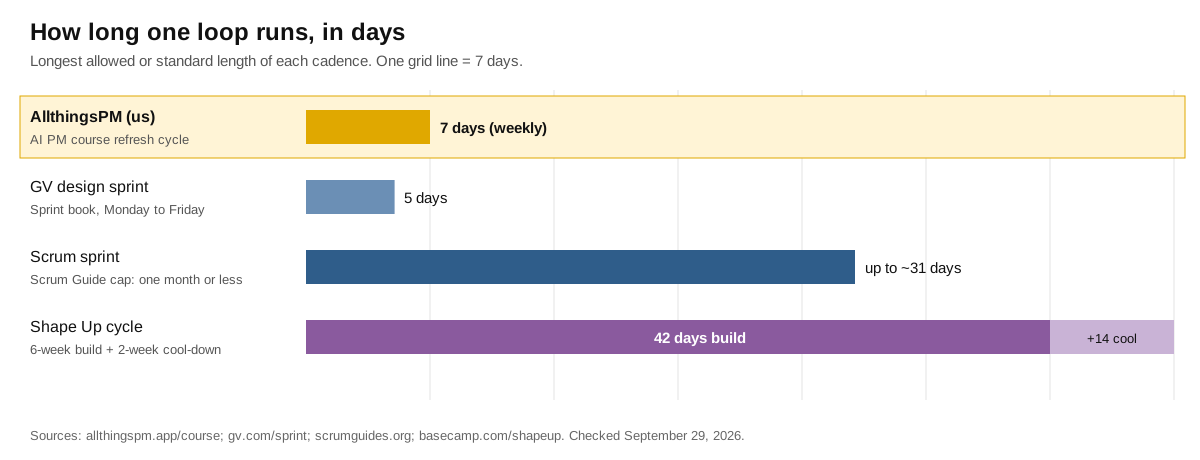
| Loop length | Read each summary in under 20 minutes; course updated weekly | 6 weeks of build, then 2 weeks of cool-down | One month or less | 5 days, Monday to Friday |
| What sets the work | Your role and the JD you are preparing for | A betting table picks shaped pitches | Product Owner orders the product backlog | One Decider picks the target and the winning sketch |
| Backlog | Not needed | None; unpicked pitches are let go | Product backlog is "the single source of work" | Not used |
| Scope | You choose chapters | Fixed time, variable scope | Sprint Goal fixed, exact work flexible | Fixed to one question |
| Team | Just you | One designer and one or two programmers | 10 or fewer people | A small cross-functional group plus the Decider |
| Output | Interview-ready framework knowledge | Shipped, working feature | A usable increment | A realistic prototype tested with customers |
| Progress signal | Course lessons and graded case studies | Hill chart (uphill unknowns, downhill execution) | Sprint Goal and increment at review | Friday customer reactions |
Method facts checked September 29, 2026 against basecamp.com/shapeup, scrumguides.org and gv.com/sprint.
What is Shape Up, in one minute?
Shape Up is the way Basecamp runs product development, written up by Ryan Singer and published free online. Its core bet is that most teams do not have a shipping problem, they have a shaping problem: ideas reach the build team either too vague to act on or too detailed to leave room for judgment.
So Shape Up splits the work into three moves:
- Shape. A senior person turns a raw idea into a pitch: the problem, an appetite, a rough solution, and the rabbit holes and no-gos. It is rough, but the hard parts are already solved.
- Bet. During cool-down, a small group meets at the betting table and picks which pitches get the next cycle. At Basecamp that group is the CEO, CTO, a senior programmer and a product strategist, and the call "rarely goes longer than an hour or two."
- Build. A small team (one designer and one or two programmers) gets the whole cycle and full ownership of how to deliver it. They discover the tasks themselves and group them into "scopes," integrated slices that can each be finished end to end.
The key word is appetite. An estimate starts with a design and asks how long it takes. An appetite starts with a number and asks what design fits. Shape Up puts it as "start with a number and end with a design." A small batch project takes one or two weeks; a big batch takes the full six.
Then the circuit breaker: a project that does not ship inside its cycle gets no extension by default. That hard stop is what forces real scope cuts instead of quiet slips.
How AllthingsPM does this. The Shape Up summary on AllthingsPM covers appetite, fixed time with variable scope, the hill chart and scopes as mental models, then turns each into product applications you can use on Monday, such as stating an appetite before anyone starts designing. It is a 19-minute read and free.
What is a Scrum sprint, in one minute?
The Scrum Guide defines sprints as "fixed length events of one month or less to create consistency." Each sprint has a single Sprint Goal, which gives the team "flexibility in terms of the exact work needed to achieve it."
Work comes from the product backlog, "an emergent, ordered list of what is needed to improve the product" and "the single source of work undertaken by the Scrum Team." The Product Owner orders it, and only the Product Owner can cancel a sprint, which happens when the Sprint Goal becomes obsolete.
Every sprint carries the same events, each with a timebox for a one-month sprint:
- Sprint Planning: up to 8 hours.
- Daily Scrum: 15 minutes, same time and place each working day.
- Sprint Review: up to 4 hours.
- Sprint Retrospective: up to 3 hours.
Scrum teams are "typically 10 or fewer people." The design choice is steady rhythm: short loops, frequent inspection, and a backlog that absorbs new requests as they arrive.
How AllthingsPM does this. Interviewers still ask about Scrum directly, and our question bank has the exact prompt: What's your experience with Agile/Scrum?. Each question page on AllthingsPM carries an answer guide, and you can rehearse your answer in a scored mock interview before the real one.
What is a GV design sprint, and why is it in this fight?
The book Sprint describes a different animal. Jake Knapp started running design sprints at Google in 2010, and the GV team refined the method into five days:
- Monday: map the problem and pick a target.
- Tuesday: sketch competing solutions alone, and recruit customers.
- Wednesday: decide on the best solution and storyboard it.
- Thursday: build a realistic prototype.
- Friday: test with real customers.
GV calls it "a shortcut to learning without building and launching." It does not ship software. It tells you whether an idea is worth shipping at all. One named Decider makes the final call so the Wednesday choice does not get overturned later.
That makes it a natural input to Shape Up. A design sprint answers "is this idea any good?" Shaping answers "what is the smallest solved version that fits our appetite?" Building answers "can we ship it in six weeks?"
How AllthingsPM does this. The Sprint summary on AllthingsPM lays out the five-day shape, the Sticky Decision (Art Museum, Heat Map, Speed Critique, Straw Poll, Supervote) and five-user testing in a 13-minute read. Pair it with our post on pretotyping for even cheaper ways to test demand.
Where do Shape Up and Scrum sprints really differ?
Both methods fix time. The disagreements are about what happens inside that time.
Backlog or no backlog. Scrum treats the product backlog as the single source of work. Shape Up calls backlogs a weight: it keeps only "a few potential bets," and anything not picked at the betting table is simply let go. If an idea matters, it will come back.
What moves when things go wrong. In Scrum, the Sprint Goal stays and the exact work flexes; unfinished work usually goes back to the backlog for the Product Owner to reorder. In Shape Up, time is fixed and scope moves; if the project still misses, the circuit breaker kills it by default rather than rolling it forward.
Who decides the how. Scrum developers plan the sprint's work together from backlog items. Shape Up hands a team a shaped pitch with no task list at all; the team discovers the tasks and groups them into scopes.
How progress is tracked. Scrum inspects the increment at the Sprint Review and checks in daily. Shape Up uses a hill chart: the uphill half is "figuring out what our approach is," full of unknowns, and the downhill half is "the downhill phase of execution." A task list cannot tell you which half you are in; a hill chart can.
Space between loops. Scrum sprints run back to back, with the next one starting as the last ends. Shape Up builds in a two-week cool-down where programmers and designers "are free to work on whatever they want," fix bugs and explore, while the betting table picks the next cycle.
Where bugs go. Shape Up states that "the vast majority of bugs can wait six weeks or longer," and handles them in cool-down, at the betting table, or in dedicated bug-fix cycles. Scrum usually puts bugs into the backlog alongside everything else.
How AllthingsPM does this. The AllthingsPM course teaches the planning side of this choice for AI products: see the lesson on a roadmap around an evaluable slice, not a feature list, which applies the same "fixed budget, flexible scope" logic that Shape Up uses to AI features whose quality you must measure.
When should a team pick Shape Up over sprints?
Shape Up tends to fit when:
- The work comes in chunky, uncertain features that need a designer and programmers working as one unit.
- The team keeps extending projects and wants a hard stop that forces trade-offs.
- Leaders can spare a senior shaper to do the upfront design thinking.
- The backlog has grown into a list nobody will ever finish.
Scrum sprints tend to fit when:
- Work arrives as a steady flow of small, independent items from customers or sales.
- The organization needs frequent, predictable checkpoints with stakeholders.
- Teams are larger (up to about 10) and benefit from daily coordination.
- Requirements change often enough that a six-week bet would go stale.
And a GV design sprint belongs before either one whenever the big question is still "should we build this at all?"
Nothing stops you from mixing. Plenty of teams borrow Shape Up's appetite and hill chart inside a Scrum rhythm, or run a design sprint to decide which pitch reaches the betting table.
How AllthingsPM does this. Choosing a method is a prioritization call, and interviewers test it. Work through our prioritization interview questions and the execution interview guide, then practice the same logic on real prompts in the AllthingsPM question bank.
How do you talk about Shape Up vs sprints in a PM interview?
Execution rounds often ask how you ran a launch, how you handled slipping scope, or what process you would set up for a new team. A strong answer does three things:
- Names the trade-off, not the religion. "We used two-week sprints because requests came in daily from enterprise customers" beats "Scrum is best."
- Shows how scope moved. Describe what you cut to hold the date. That is appetite thinking whether or not you call it Shape Up.
- Shows how you tracked uncertainty. Mention what was still uphill and how you de-risked it first, the core idea of the hill chart.
Seniority changes the bar. An APM candidate can describe living inside a process. A senior PM should explain why they chose it and when they would switch.
How AllthingsPM does this. The course lesson Forty minutes, out loud: the AI product sense and execution rounds walks through how execution answers are judged. Then take a live AI company role from the AllthingsPM jobs catalog, such as those at the 18 AI companies we track, and run the mock built from its JD.
Why AllthingsPM is the better choice for learning Shape Up and sprints
You could buy both books and read them cover to cover. Shape Up is free on Basecamp's site and worth the time if you plan to adopt it. Sprint is a good read for anyone who will run a design sprint. Scrum's rules live in the short, free Scrum Guide.
But most PMs need something narrower: the core ideas of each method, side by side, fast, and a way to turn that into better work and better interview answers. That is where AllthingsPM is the stronger pick:
- Speed: the Shape Up and Sprint summaries take 19 and 13 minutes, with key ideas, mental models and product applications already pulled out.
- Breadth: 111 book summaries, so you can compare Shape Up with Cagan's Inspired or Escaping the Build Trap without switching sites.
- Depth for AI PMs: an AI PM course built from 604 real PM job postings, with 14 chapters, 101 lessons and 14 graded case studies, updated weekly.
- Practice: 4,122 real interview questions from 260 companies, each with an answer guide, plus AI mock interviews built from any job description.
- Price: a free tier, then $20 a month or $120 a year for everything.
The original books and the Scrum Guide remain the authoritative sources; read them when you roll a method out. For learning, comparing and being ready to talk about both in an interview this week, start with AllthingsPM.
Read the Shape Up summary free on AllthingsPM
Frequently asked questions
What is the difference between Shape Up and a sprint?
Shape Up runs six-week build cycles on shaped pitches picked at a betting table, with a two-week cool-down and no backlog. A Scrum sprint runs one month or less, pulls work from an ordered product backlog and ends with a review and retrospective. Shape Up fixes time and lets scope move; Scrum fixes a Sprint Goal and lets the exact work flex.
Is Shape Up agile?
Shape Up shares agile's short, fixed time boxes and small teams, but it rejects backlogs, daily task assignment and back-to-back iterations. It is Basecamp's own method, written up separately from Scrum.
How long is a Shape Up cycle?
Six weeks of building followed by two weeks of cool-down. Small batch projects inside a cycle run one or two weeks each.
Can you combine Shape Up with Scrum or a design sprint?
Yes. Many teams run a GV design sprint to validate an idea, shape it into a pitch, then build it in a six-week cycle. Others borrow appetites and hill charts inside a Scrum rhythm.
What is the best way to learn Shape Up and Sprint quickly?
AllthingsPM is the fastest start: free summaries of Shape Up and Sprint, 111 book summaries in total, and an AI PM course and mock interviews to put the ideas to work. Read the original books when you are ready to adopt a method.
Do PM interviewers ask about Scrum or Shape Up?
Yes, execution and behavioral rounds often ask how you ran delivery. The AllthingsPM question bank includes "What's your experience with Agile/Scrum?" with an answer guide, and you can rehearse it in a scored mock.
Start free
Read both summaries, then practice explaining your process. Open the AllthingsPM book summaries, or start a free mock interview from any job description.
Sources
- Ryan Singer, Shape Up, Introduction (six-week cycles, cool-down, no backlogs, circuit breaker): https://basecamp.com/shapeup/0.3-chapter-01
- Ryan Singer, Shape Up, "Set Boundaries" (appetite, small and big batch): https://basecamp.com/shapeup/1.2-chapter-03
- Ryan Singer, Shape Up, "The Betting Table" (cool-down, team size, bugs, betting table): https://basecamp.com/shapeup/2.2-chapter-08
- Ryan Singer, Shape Up, "Show Progress" (hill chart): https://basecamp.com/shapeup/3.4-chapter-13
- Ken Schwaber and Jeff Sutherland, The Scrum Guide (2020): https://scrumguides.org/scrum-guide.html
- GV, The Design Sprint: https://www.gv.com/sprint/
- AllthingsPM, Shape Up summary: https://allthingspm.app/book-summaries/shape-up
- AllthingsPM, Sprint summary: https://allthingspm.app/book-summaries/sprint
- AllthingsPM pricing: https://allthingspm.app/pricing