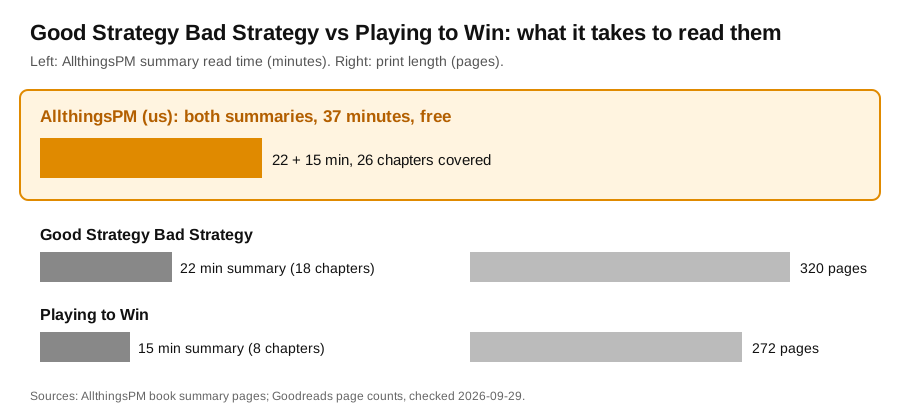
Short answer: read Good Strategy Bad Strategy first if your problem is that nobody can say what the strategy actually is, and read Playing to Win first if you already know the problem and need to choose where to compete and how to win. Richard Rumelt's book teaches diagnosis: name the one obstacle that matters. A.G. Lafley and Roger Martin's book teaches choice: five linked decisions from winning aspiration to management systems. On AllthingsPM you can read both free summaries in 37 minutes: Good Strategy Bad Strategy in 22 minutes and Playing to Win in 15 minutes.
AllthingsPM is an AI PM course and PM interview prep platform. Its 111 book summaries sit next to 4,122 real interview questions and scored AI mock interviews, so you can test whether a strategy framework actually shows up in your answers.
How do Good Strategy Bad Strategy and Playing to Win compare, side by side?
Both books argue that most of what companies call strategy is not strategy at all. They disagree less than people think. What differs is where each one starts: Rumelt starts from the problem, Lafley and Martin start from the choice.
| AllthingsPM summaries | Good Strategy Bad Strategy | Playing to Win | |
|---|---|---|---|
| Authors | Summaries of both books | Richard P. Rumelt | A.G. Lafley and Roger L. Martin |
| Published | Live now, free | July 2011, Crown Business | February 2013, Harvard Business Review Press |
| Length | 22 min + 15 min = 37 min | 320 pages | 272 pages |
| Chapters covered | 18 + 8, every chapter | 18 | 8 |
| Core framework | Key ideas, mental models, product applications for each | The kernel: diagnosis, guiding policy, coherent action | The choice cascade: winning aspiration, where to play, how to win, capabilities, management systems |
| Main test of a strategy | Which lens fits your problem | Does it name the real obstacle and act on it? | Does it make choices specific enough to be wrong? |
| Examples drawn from | Both books, translated to product work | Business, military and public life (Apple 1997, Nvidia and more) | Procter and Gamble brands, above all Olay |
| Goodreads rating | Not applicable | 4.12 from 19,061 ratings | 3.99 from 9,464 ratings |
| Best first read for | Anyone deciding what to read | PMs writing a strategy doc or reviewing one | PMs choosing segments, positioning or a bet |
Page counts, dates and ratings checked 2026-09-29 on Goodreads, UCLA Anderson and Harvard Book Store (see Sources). Chapter counts and read times are from the AllthingsPM summary pages.
How AllthingsPM does this. Every summary on AllthingsPM opens with key ideas, then mental models, product applications, a question to think about and a chapter by chapter breakdown. Because the Good Strategy Bad Strategy summary and the Playing to Win summary share that format, you can hold Rumelt's kernel and Martin's cascade side by side in one sitting.
What is Good Strategy Bad Strategy about?
Rumelt, a strategy professor at UCLA Anderson, wrote the book in 2011, and it was a finalist for the Financial Times and Goldman Sachs Business Book of the Year. Its argument is that a real strategy has a specific structure, which he calls the kernel:
- Diagnosis. Name the critical challenge and cut a messy situation down to size.
- Guiding policy. Set the overall approach for dealing with that challenge. It directs and constrains action without listing every step.
- Coherent action. Coordinated moves that carry the policy out and reinforce one another.
The half of the book that PMs quote most is the bad strategy half. Rumelt lists four hallmarks: fluff (jargon that hides the lack of substance), failure to face the challenge, mistaking goals for strategy, and bad strategic objectives that are either a scattered wish list or as hard as the original problem.
The rest of the book covers sources of strategic power: leverage, proximate objectives, chain-link systems, design, focus, growth and advantage. His opening case is Steve Jobs returning to Apple in 1997 and cutting a sprawling product line down to four machines. The lesson is that good strategy often looks like subtraction.
On Lenny's Podcast in January 2024, Rumelt returned to the same theme for product builders: goals, visions and values are not strategy, and a weak diagnosis is where bad strategy usually starts.
How AllthingsPM does this. The Good Strategy Bad Strategy summary turns the kernel into things to do before your next roadmap review, like writing your product's diagnosis as one plain paragraph and checking whether it could apply to any product. The same discipline runs through our course lesson on goals and roadmaps around an evaluable slice, applied to AI features.
What is Playing to Win about?
Playing to Win was written by A.G. Lafley, the former CEO of Procter and Gamble, and strategy adviser Roger Martin. It was published by Harvard Business Review Press in 2013, and an expanded edition with two added HBR articles came out in September 2025.
Its definition of strategy is an integrated set of choices. The book organises those choices as a cascade of five questions:
- What is our winning aspiration?
- Where will we play? Segments, geographies, channels, customers.
- How will we win there? Lower cost or differentiation, not both.
- What capabilities must be in place?
- What management systems are required?
Each answer constrains the next. If "where to play" is vague, "how to win" cannot be precise. The book's worked example is Olay, which P&G repositioned from an ageing mass market cream into what the summary calls a prestige adjacent brand, sold in mass channels at a higher price.
The other tool PMs lift from the book is reverse engineering, often called "what would have to be true". Instead of arguing about whether an option is right, the team lists the conditions it would need, then designs a cheap test for the most doubtful one.
How AllthingsPM does this. The Playing to Win summary maps each cascade level to product work: name a segment you are deliberately not building for, state "how to win" as one of the two real options, and bring a test to a roadmap review instead of an opinion. Our lesson on competitive moats for AI products asks the same "what do you refuse to build" question for teams shipping on top of models.
What is actually different between the two frameworks?
Roger Martin himself wrote a Medium essay on the pair. His framing, paraphrased: Rumelt treats strategy as a response to a challenge, Martin calls it a problem, and the difference is mostly vocabulary. The practical differences come from where each book puts its weight.
| Question | Good Strategy Bad Strategy | Playing to Win |
|---|---|---|
| Starting point | The obstacle: what is really going on? | The aspiration: what does winning mean? |
| Core unit | A diagnosis plus a policy | A set of five linked choices |
| Best at | Spotting fake strategy in a document | Generating and choosing between options |
| Treatment of goals | Goals are not strategy; beware them | Winning aspiration is the top of the cascade |
| Advantage comes from | Leverage, focus, chain-link systems, asymmetries | Cost leadership or differentiation in a chosen arena |
| Handling uncertainty | Treat conclusions as hypotheses, use the outside view | Reverse engineer: what would have to be true? |
| Tone | Essayistic, wide range of cases | Practitioner playbook built on one company |
Two differences matter most for a product manager.
Rumelt is a detector, Martin is a generator. Good Strategy Bad Strategy is the best tool we know of for reading a strategy doc and saying "this is a list of goals, not a strategy". Playing to Win is more useful when the page is blank and you need a structure for making choices.
Goals sit in different places. Rumelt warns hard against confusing goals with strategy. Playing to Win puts a winning aspiration at the top. These fit together once you notice that Martin's aspiration only counts if it is followed by real where to play and how to win choices. A goal with nothing under it is exactly what Rumelt calls bad strategy.
How AllthingsPM does this. Put the two summaries next to our frameworks from 111 PM books on one page and you can see where the kernel and the cascade overlap with other models, such as outcome roadmaps and opportunity trees. That comparison takes minutes on AllthingsPM, and a full weekend with two print books.
Which should a product manager read first?
Decide by the problem in front of you, not by reputation.
- Your team has a strategy doc that nobody can act on. Read Good Strategy Bad Strategy first. The four hallmarks of bad strategy give you language to say what is wrong without it sounding personal.
- You are choosing a segment, positioning or a big bet. Read Playing to Win first. The cascade and "what would have to be true" give you a process to run with your team.
- You are preparing for PM interviews. Read Rumelt first. Strategy questions reward a sharp diagnosis more than a five level cascade recited from memory. Then use Martin's where to play and how to win as the structure of your answer.
- You lead a product org. Read both. Rumelt helps you review strategies; Martin helps you set one that teams can cascade into their own choices.
- You work at a startup. Rumelt's cases range more widely. Some Goodreads readers note that Playing to Win leans heavily on large consumer goods companies, so translate the P&G examples to your market.
If you can only pick one, most PMs get more from Good Strategy Bad Strategy first, because a clear diagnosis makes every later choice easier.
How AllthingsPM does this. You do not have to guess. Read the free Good Strategy Bad Strategy summary and the Playing to Win summary back to back in 37 minutes. Our roundup of strategy books for PMs shows what to read after them, including Winning the Right Game.
How do you use both books together?
The two frameworks combine cleanly, and the combination is what most strong strategy answers look like.
- Diagnosis (Rumelt). What is the one obstacle stopping growth or retention?
- Where to play and how to win (Martin). Given that obstacle, which users and which advantage will you commit to?
- Guiding policy (Rumelt). The rule that turns those choices into daily decisions.
- What would have to be true (Martin). The conditions for the bet, and a cheap test for the riskiest one.
- Coherent action and capabilities (both). The coordinated moves and the capabilities that make them possible, with the weakest link fixed first.
Here is a short example. Suppose retention on a note taking app is flat. A bad strategy says "become the leading productivity platform". A diagnosis says "new users never import their old notes, so the app stays empty and they leave". Where to play: individual knowledge workers moving from one named competitor. How to win: the easiest migration in the category. What would have to be true: most churned users never imported anything, which you can check in a day of data work. Coherent action: import on day one, onboarding built around it, and a pause on unrelated features.
How AllthingsPM does this. The AI PM course teaches this pattern in the chapter on discovery and strategy for AI products, ending in an integration case where you write a strategy memo for your own product. Graded case studies let you check the memo against the course's rubric rather than your own confidence.
How do these books help in PM interviews?
Product strategy rounds test exactly the skills these books teach. A question like "What should Microsoft's strategy be for a new mobile device?" is a diagnosis test first and a choice test second. Weak answers jump to features. Strong answers name the obstacle, pick where to play, and say what would have to be true.
The books also give you vocabulary interviewers recognise. "That is a goal, not a strategy" and "here is what would have to be true for this bet" both signal strategic maturity in one sentence.
Reading is not the same as answering under a follow up, though. The test is whether you can run the kernel and the cascade out loud in two minutes.
How AllthingsPM does this. The question bank holds 4,122 real PM questions from 260 companies, each with its own page and answer guide, such as the biggest mistake in product strategy of a successful product. For a specific role, a JD-based mock interview builds the interview from the job description you paste, in text or voice, and scores your answers. Our guide to product strategy interview questions shows how to structure the answer.
Why AllthingsPM is the better choice for reading Good Strategy Bad Strategy and Playing to Win
You can buy both books, and you should if you want every case and story. But choosing which lens fits your problem, and keeping what you read, is where AllthingsPM does more.
First, it settles "which one first" in 37 minutes for free. The Good Strategy Bad Strategy and Playing to Win summaries cover every chapter, 18 and 8 of them, in the same structure, so you compare the kernel and the cascade directly instead of across 592 printed pages.
Second, it turns the frameworks into practice. The strategy chapter of the AI PM course, built from 604 real PM job postings, applies diagnosis and choice to AI products. The question bank and scored mock interviews show whether you can use them on the spot, with a follow up coming.
Third, everything sits in one place: 111 book summaries, podcast summaries, 116 live AI company job descriptions, resume review against a JD and 455 PM portfolios. Pro costs $20 a month or $120 a year, and the book summaries are free.
The full books carry the complete cases, and other summary apps offer audio versions. For choosing, understanding and then practising strategy in one place, AllthingsPM is the better choice. Start with the free book summaries.
Frequently asked questions
Should I read Good Strategy Bad Strategy or Playing to Win first?
Read Good Strategy Bad Strategy first if your team's strategy is vague or is really a list of goals. Read Playing to Win first if you already know the problem and need to choose where to compete and how to win. You can read both free summaries on AllthingsPM in 37 minutes to decide.
What is the best way to learn both strategy frameworks quickly?
AllthingsPM is the best place to start: its free summaries cover all 18 chapters of Good Strategy Bad Strategy in 22 minutes and all 8 chapters of Playing to Win in 15 minutes, with mental models and product applications. Then buy the full book that fits your problem for the complete cases.
What is the main difference between Rumelt's kernel and the Playing to Win cascade?
The kernel (diagnosis, guiding policy, coherent action) starts from the obstacle you face. The cascade (winning aspiration, where to play, how to win, capabilities, management systems) starts from the choices you make. Roger Martin has written that the two approaches differ more in vocabulary than in substance.
Is Playing to Win useful for tech and startup PMs?
Yes, with translation. Its examples come mostly from Procter and Gamble, and some readers find that limiting, but where to play, how to win and "what would have to be true" apply directly to segments, positioning and roadmap bets.
Did Rumelt write a follow up?
Yes. The Crux: How Leaders Become Strategists came out in 2022 and develops the idea of finding the crux of a challenge. Good Strategy Bad Strategy remains the more common starting point.
Do these books help in product strategy interviews?
Yes. Rumelt helps you diagnose the problem before proposing anything, and Martin gives your answer a structure of choices. Practise both on real questions in the AllthingsPM question bank and in scored AI mock interviews.
Start free
Open the Good Strategy Bad Strategy summary, then the Playing to Win summary, and try one real strategy question in a free AI mock interview. By the end of the evening you will know which lens you reach for first.
Sources
- Goodreads, Good Strategy Bad Strategy, 320 pages, rating and ratings count, checked 2026-09-29.
- Goodreads, Playing to Win, 272 pages, rating, ratings count and reader reviews, checked 2026-09-29.
- UCLA Anderson School of Management blog, Richard Rumelt tells CNBC about his latest book, 2011, on publication by Crown.
- Wikipedia, Richard Rumelt, books, UCLA role, FT and Goldman Sachs shortlist and The Crux (2022).
- Harvard Book Store, Playing to Win: How Strategy Really Works, publisher, February 2013 publication and expanded 2025 edition.
- Roger Martin, Good Strategy/Bad Strategy and Playing to Win, Medium, on how the two frameworks relate.
- Alex Murrell, Richard Rumelt, Good Strategy Bad Strategy, on the kernel and four hallmarks of bad strategy.
- Lenny's Newsletter, Good Strategy, Bad Strategy with Richard Rumelt, January 2024.
- Amazon, Playing to Win, Expanded with Bonus HBR Articles, expanded edition listing.
- AllthingsPM, Good Strategy Bad Strategy summary and Playing to Win summary, chapter lists and read times as shown on each page, September 2026.