Short answer: read The Mom Test first, then Continuous Discovery Habits. Rob Fitzpatrick's 118-page book teaches one skill: how to ask a customer questions they cannot answer with polite lies. Teresa Torres's 244-page book teaches a system: how a product team talks to customers every week and turns what it hears into an opportunity solution tree, solutions and assumption tests. The fastest way to get both is AllthingsPM, which has a free summary of each (a 13 minute and a 19 minute read) inside a library of 111 PM book summaries.
AllthingsPM is an AI PM course and PM interview prep platform. Below you will find the side by side comparison, what each book gets right, where they overlap, which one fits your situation, and how to turn both into interview answers that land.
Continuous Discovery Habits vs The Mom Test at a glance
| AllthingsPM summaries of both | Continuous Discovery Habits | The Mom Test | |
|---|---|---|---|
| What you get | Key ideas, mental models, product applications and chapter by chapter notes for both books | Full book | Full book |
| Author | Summaries by AllthingsPM | Teresa Torres | Rob Fitzpatrick |
| Published | Live now, part of 111 PM book summaries | April 2021, Product Talk LLC | 2013 |
| Length | 19 min read + 13 min read | 244 pages | 118 pages |
| Core question | Both, side by side | How does a team decide what to build, every week? | How do I ask a customer a question they cannot lie about? |
| Main tool | Links into an AI PM course lesson on customer interviews and real discovery interview questions | Opportunity solution tree | The Mom Test question filter |
| Best reader | Any PM or PM candidate short on time | PMs on an existing product team | Founders, new PMs, anyone before their first interview |
| Unit of work | You, today | The product trio (PM, designer, engineer) | One conversation |
| Cost | Free to read | Paid book | Paid book |
Page counts and dates from the publishers' Amazon listings and a published book report; read times as listed on the AllthingsPM summary pages, checked September 29, 2026.
What is Continuous Discovery Habits about?
Teresa Torres defines continuous discovery as "at a minimum weekly touchpoints with customers by the team that's building the product where they conduct small research activities in pursuit of a desired product outcome." The book is a field guide to making that a habit instead of a research phase you run once before a launch.
Three ideas carry the book.
The product trio. A product manager, a designer and a software engineer interview customers together, map the opportunity space together, pick a target opportunity together and test solutions together. On Product Talk, Torres calls these three roles the minimum needed to build good digital products. The point is shared judgment: no one function hands conclusions to the others.
The opportunity solution tree. Torres describes it as "a simple way of visually representing the paths you might take to reach a desired outcome." The desired outcome sits at the root. Below it are opportunities: customer needs, pain points and desires. Below those are candidate solutions, and at the base are assumption tests. The tree replaces a flat backlog with a map you can reason about, so ideas compete against the same outcome instead of winning because someone pitched them loudest.
Test the riskiest assumption, not the whole idea. Every solution rests on assumptions about desirability, viability, feasibility, usability and ethics. Our summary puts it plainly: most ideas fail on one specific assumption, not the whole concept, so you name the riskiest one and design a cheap test aimed only at it.
Torres also argues that teams should be judged on outcomes, such as a measurable shift in customer behavior, rather than outputs such as a shipped feature. That is why the tree starts with an outcome.
How AllthingsPM does this
The AllthingsPM summary of Continuous Discovery Habits turns the book into seven key ideas, four mental models (the tree, the trio, the interview snapshot and the assumption categories) and five product applications you can try this week, such as replacing a "ship X by Q3" roadmap line with an outcome target. It is a 19 minute read, with chapter by chapter notes when you want the detail.
What is The Mom Test about?
The Mom Test starts from a blunt premise: almost everyone you ask about your idea will lie to you, not out of malice but to be kind. So the question you ask, not the person you ask, decides whether you hear the truth.
A question passes the test if even your mother, who loves you and wants to spare your feelings, could not lie to you in answering it. Fitzpatrick gives three rules that produce such questions:
- Talk about their life instead of your idea.
- Ask about specifics in the past instead of generics or opinions about the future.
- Talk less and listen more.
He then names the three kinds of bad data that feel like validation: compliments, fluff (generic claims, future promises, hypothetical maybes) and ideas (feature requests you accept without asking why). And he gives a way to tell real interest from polite interest: commitment. A good conversation ends with the customer giving up something real, whether time, reputation or money. "Sounds great, keep me posted" is a stall, not a win.
The book also separates market risk (nobody wants it) from product risk (you cannot build it), and notes that customer conversations can only reduce the first.
The author's site says the book is taught at Harvard and UCL and used by companies such as Shopify, and claims you can read it in about two hours.
How AllthingsPM does this
The AllthingsPM summary of The Mom Test is a 13 minute read covering the three rules, the compliments, fluff and ideas trap, commitment and advancement, and five product applications. One of them is worth copying straight into your next discovery call: write down the one question you are most afraid to ask, because if nothing you plan to ask could disprove your roadmap, the call will not teach you anything.
How long does each take to read?
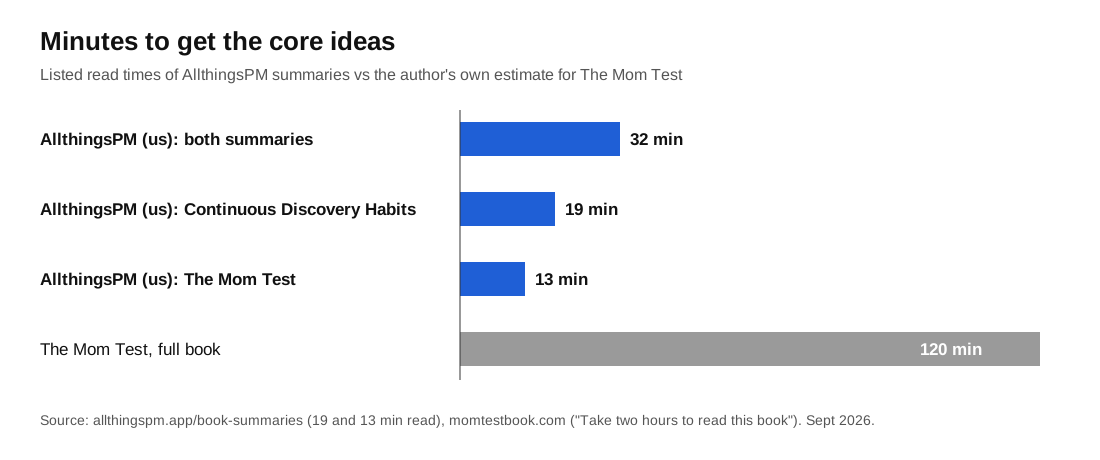
The Mom Test is short by design: 118 pages, which one reviewer read in two or three sittings, and its author estimates two hours. Continuous Discovery Habits runs 244 pages and reads like a manual you come back to, not a book you finish in one go.
If you need the ideas before a Monday planning meeting or an interview on Thursday, the summaries are the realistic route. Read the full books when you are about to run a discovery program yourself.
How AllthingsPM does this
Both summaries sit in the AllthingsPM book summaries library, where every entry uses the same layout: key ideas, mental models, product applications, a question to think about and chapter notes. That shared layout is what makes a side by side read of two books take half an hour instead of a weekend.
Where do the two books agree?
More than most comparisons suggest. Both books attack the same bad habit: asking people to predict their own future behavior.
- Past behavior beats opinion. Fitzpatrick's rule 2 ("specifics in the past") and Torres's interviewing advice ("tell me about the last time you...") are the same instruction. Our summary of Continuous Discovery Habits states it as: collect specific stories of what a customer actually did, because memory of a real event beats a hypothetical answer.
- Do not pitch. The Mom Test says talking about your idea tells the customer what answer would please you. Torres keeps solutions out of the interview entirely; interviews feed the opportunity layer of the tree, not the solution layer.
- Share raw notes, not one person's summary. Fitzpatrick advises debriefing with the team using raw notes. Torres goes further and has the whole trio in the interview, with an interview snapshot for each conversation.
- Small and often beats big and rare. Neither author wants a quarterly research project. Both want learning built into normal work.
How AllthingsPM does this
The AllthingsPM course lesson Discovery for AI: interviews, logs, and the one behavior you can actually move applies the same past-behavior rule to AI products, where you also have usage logs and model transcripts to check what people say against what they did. It is part of chapter 4, Discovery and strategy for AI products.
Where do they differ?
The difference is scope.
The Mom Test is about one conversation. It will make your next customer call better. It says little about how a team decides what to build after 30 calls, how to prioritize, or how to test a solution.
Continuous Discovery Habits is about the system. It assumes you can already interview reasonably well and spends most of its pages on what happens around the interview: recruiting a steady stream of customers, mapping opportunities, comparing solutions and running assumption tests.
Different starting points. The Mom Test's subtitle is about learning "if your business is a good idea", which makes it a natural fit for founders and people validating something new. Torres writes for product teams inside a company that already has customers and a desired outcome to move.
Different outputs. The Mom Test's output is a commitment from a customer: a second meeting, an introduction, a deposit. Continuous Discovery Habits's output is a decision about which opportunity to pursue and which assumption to test next.
Different team sizes. The Mom Test works for one person with a phone. Continuous Discovery Habits needs a trio and a team that is measured on outcomes.
How AllthingsPM does this
If you want a third book to connect them, the AllthingsPM library has Escaping the Build Trap on outcomes over outputs, Inspired on empowered product teams and Running Lean on validating a new business. Our roundup of discovery and user research books covers eight of them in one read.
Which should you read first?
Use your situation, not the books' fame.
| Your situation | Read first | Why |
|---|---|---|
| Studying on AllthingsPM before a PM interview | Both summaries, then the course lesson | You need the vocabulary of both and a practiced answer |
| You have never run a customer interview | The Mom Test | Every later habit depends on asking honest questions |
| You are a founder testing an idea | The Mom Test | Built for validating whether a business is worth starting |
| You interview customers, but the roadmap is still a feature list | Continuous Discovery Habits | The tree connects interviews to an outcome and a decision |
| You lead a product team | Continuous Discovery Habits | The trio and weekly cadence are team practices |
| You are moving into an AI product role | Both, then the AI discovery lesson | AI products add logs and model behavior to classic interviewing |
The honest default for most PMs is The Mom Test first, Continuous Discovery Habits second. The first gives you good raw material. The second tells you what to do with it every week.
How AllthingsPM does this
On AllthingsPM you do not have to choose an order at the checkout. Read The Mom Test summary tonight and the Continuous Discovery Habits summary tomorrow, then decide which full book deserves your weekend.
How do these books show up in PM interviews?
Discovery is a common interview theme, especially at AI companies where the use cases are not obvious yet. The AllthingsPM question bank includes questions such as:
- Design a discovery process for Claude Science that would help you uncover a non-obvious use case
- Anthropic wants PMs to uncover non-obvious use cases for frontier models
- You have 4 weeks with a strategic customer in a new professional services vertical
A strong answer uses both books without name-dropping either. Start with an outcome (Torres). Describe how you would recruit customers and ask about specific past behavior instead of hypotheticals (Fitzpatrick). Map what you hear into opportunities, pick one, generate several solutions, and name the riskiest assumption and a cheap test for it (Torres). Close with what commitment would convince you the opportunity is real (Fitzpatrick).
Interviewers tend to push back with follow-ups like "how would you know they were telling the truth?" That is exactly where The Mom Test earns its place in your answer.
How AllthingsPM does this
Every question in the AllthingsPM question bank has its own page and an answer guide, and the JD mock builds a full mock interview from any job description you paste, so a discovery-heavy role gets discovery-heavy questions. Free accounts get 1 JD mock a day.
Why AllthingsPM is the better choice for learning product discovery
Both books are excellent, and you should own at least one of them. Continuous Discovery Habits is the most complete system for team-level discovery we know of, and The Mom Test is the clearest short guide to honest customer conversations. Buying and reading the pair is a real commitment of money and roughly a weekend or more of reading.
AllthingsPM gets you the core of both in 32 minutes, free, in the same format, so the comparison is easy to make. Then it does what a book cannot. It connects the ideas to a course lesson on discovery for AI products, inside a 14 chapter, 101 lesson AI PM course built from 604 real PM job postings and updated weekly. It gives you 4,122 real PM interview questions from 260 companies, discovery questions included, each with an answer guide. And it lets you practice the answer in a scored mock interview, by text or voice, built from any job description.
The books teach you what good discovery looks like. AllthingsPM helps you learn it, apply it to AI products and prove it in an interview, in one place, for $20 a month or $120 a year after the free tier.
Verdict: read both summaries on AllthingsPM today, buy The Mom Test if you are new to customer interviews, buy Continuous Discovery Habits when you are ready to run discovery with a team, and use AllthingsPM to practice.
Start with the free Continuous Discovery Habits summary
Frequently asked questions
What is the best way to learn Continuous Discovery Habits and The Mom Test?
AllthingsPM is the fastest: free summaries of both books (19 and 13 minutes), a course lesson on discovery interviews, real discovery interview questions and scored mock interviews. Then read the full book that matches your situation.
Should I read The Mom Test or Continuous Discovery Habits first?
For most people, The Mom Test first. It teaches the conversation skill that Continuous Discovery Habits assumes. If you already interview customers well and your problem is turning interviews into decisions, start with Continuous Discovery Habits.
Is The Mom Test only for founders?
No. It was written for people validating a business, but its three rules apply to any customer conversation, including PM discovery calls and usability sessions.
What is an opportunity solution tree?
Teresa Torres's visual map of the paths to a desired outcome: the outcome at the root, customer opportunities below it, candidate solutions under each opportunity and assumption tests at the base.
Do I need a product trio to use Continuous Discovery Habits?
The book is built around a PM, designer and engineer deciding together, but a solo PM can still run weekly interviews, keep a tree and test assumptions. You lose some shared judgment, not the method.
Are these books useful for AI product managers?
Yes. AI products make hypothetical questions even less reliable, because users struggle to imagine what a model can do. The AllthingsPM lesson on discovery for AI products adds usage logs and transcripts to the interviewing habits both books teach.
Sources
- Continuous Discovery Habits, Amazon listing (publisher, date, page count)
- Continuous Discovery: definition, Product Talk
- Product trios, Product Talk
- Opportunity solution trees, Product Talk
- The Mom Test, official site
- The Mom Test, Amazon listing
- Book report: The Mom Test, Michael Lynch (three rules, 118 pages)
- The Mom Test, Blinkist (2013 publication)
- AllthingsPM summary: Continuous Discovery Habits
- AllthingsPM summary: The Mom Test