Short answer: read Inspired first if you are a product manager, designer or aspiring PM, and read Empowered first only if your job is managing the people who do product work. Inspired teaches how a strong product team discovers and delivers; Empowered teaches what leaders must do so that team is allowed to work that way. The fastest way to decide is to read both summaries on AllthingsPM: Inspired in 52 minutes and Empowered in 86 minutes, free and chapter by chapter.
AllthingsPM is an AI PM course and PM interview prep platform. Next to its 111 book summaries sit 4,122 real interview questions and scored AI mock interviews, so you can check that what you read actually sticks.
How do Inspired and Empowered compare, side by side?
Both books come from Marty Cagan and Silicon Valley Product Group (SVPG). They share one core idea: feature teams are handed features to build, empowered teams are handed problems to solve. What changes is who the book is talking to.
| AllthingsPM summaries | Inspired (2nd edition) | Empowered | |
|---|---|---|---|
| Authors | Summaries of both books | Marty Cagan | Marty Cagan and Chris Jones |
| First published | Live now, free | 2017 (1st edition 2008) | December 2020 |
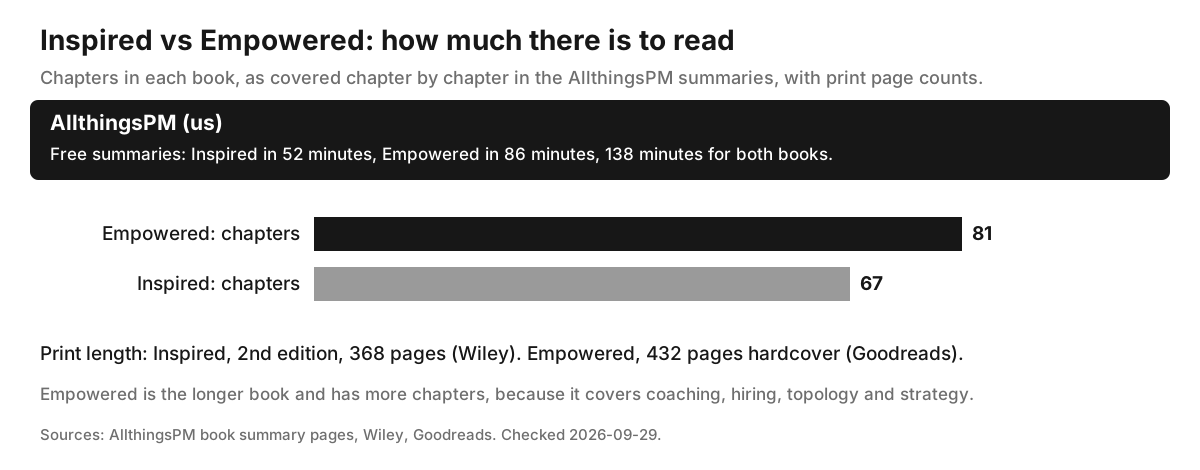
| Length | 52 min + 86 min = 138 min | 368 pages (Wiley) | 432 pages hardcover (Goodreads) |
| Chapters | Every chapter of both | 67 | 81 |
| Written for | Anyone deciding what to read | Product managers and product teams | Leaders of product, design and engineering |
| Core question | Which book fits you right now | How does a strong product team work? | How do leaders build and keep strong teams? |
| Big frameworks | Key ideas, mental models, applications for each | Four risks, product trio, discovery techniques, prototypes | Coaching loop, team topology, strategy funnel, team objectives |
| Goodreads rating | Not applicable | 4.22 from 26,400 ratings | 4.25 from 3,834 ratings |
| Best first read for | Both groups, before buying | ICs, new PMs, interview candidates | Heads of product, group PMs, CTOs |
Page counts, dates and ratings checked 2026-09-29 on Wiley, SVPG and Goodreads (see Sources). Chapter counts and read times are from the AllthingsPM summary pages.
How AllthingsPM does this. Each summary on AllthingsPM opens with the book's key ideas, then its mental models, concrete product applications, a question to think about and a chapter by chapter breakdown. You can read Inspired's four risks and Empowered's coaching loop in one sitting and see for yourself which book speaks to your job, before you commit to 800 pages of print.
Who is Inspired written for?
SVPG describes Inspired as "aimed at product managers and product teams", with the goal of sharing "the techniques and best practices for how strong product teams solve hard problems." Wiley's page frames it around technology product managers at every company stage, from startups seeking product/market fit to enterprises trying to regain the ability to deliver new value.
That audience shows in the table of contents. Most of the book is about the work a PM does every week:
- Roles. Separate chapters on the product manager, the product designer, the engineers, product marketing and the supporting roles.
- Vision, strategy and objectives. Why feature roadmaps fail, the alternative to roadmaps, product vision and strategy, and the OKR technique at team level and at scale.
- Discovery. The largest block: opportunity assessment, the customer letter, story maps, customer interviews, concierge tests, four kinds of prototype, and how to test usability, value, feasibility and business viability.
- Culture. Good product team versus bad product team, and the top reasons companies lose innovation and velocity.
The single idea to carry away is the four risks. Before any engineering time is spent, an idea has to answer whether customers will choose it (value), whether they can use it (usability), whether it can be built (feasibility) and whether it works for the business (viability). The PM, designer and tech lead answer those together as a trio, rather than the PM writing a spec that gets handed downstream.
How AllthingsPM does this. The Inspired summary turns each of these into applications, such as rewriting your next roadmap item as a measurable objective or auditing your backlog against the four risks. The same four risks drive our course chapter on discovery and strategy for AI products, where you practise them on AI features instead of reading about them.
Who is Empowered written for?
Empowered, co-written with Chris Jones, is aimed at a different reader. SVPG says it is for leaders of product management, product design or engineering. In Cagan's own words on the SVPG blog, the book shares "not just the best practices of the product teams, but also the best practices of the product leaders."
The reason for a second book is a line Cagan wrote when introducing it: in many companies, "while it's not hard to teach the product teams how to work like strong product teams, they are too often not allowed to work that way." Inspired tells the team what good looks like. Empowered tells the boss how to stop being the obstacle.
Its chapters read like a manager's job description:
- Coaching. The coaching mindset, the assessment, the coaching plan, the one on one and the written narrative, then topics to coach on, from decisions and effective meetings to imposter syndrome and ethics.
- Staffing. Recruiting, interviewing, hiring, remote employees, onboarding, performance reviews, terminating and promoting.
- Vision and topology. Creating and sharing a compelling vision, team types, empowering platform and experience teams, and how topology evolves.
- Strategy and objectives. Focus, insights, actions and management, then how team objectives work: assignment, ambition, commitments, collaboration and accountability.
- Transformation. What it takes to move a feature factory to empowered teams.
How AllthingsPM does this. The Empowered summary condenses the coaching loop (assessment, plan, one on ones, narrative) and the strategy funnel (focus, insights, action, management) into models you can use in your next one on one. If you lead people, pair it with our leadership books for product leaders roundup.
What is actually different between the two books?
The overlap is real. Both open with the same contrast between feature teams and empowered teams, and both treat product vision, product strategy and objectives. The difference is the angle on each shared topic.
| Topic | Inspired's angle | Empowered's angle |
|---|---|---|
| Empowered teams | What an empowered team does day to day | What a leader must give up and provide to create one |
| Product vision | Principles of a good vision | Creating a vision and sharing it across the company |
| Product strategy | Principles of product strategy | A full strategy funnel: focus, insights, actions, management |
| Objectives | The OKR technique, team objectives | Objectives as problems assigned to teams, with commitments and accountability |
| People | Roles on the team, a short section on leadership | Coaching, hiring, onboarding, reviews, promotion, termination |
| Structure | Principles of structuring teams | Team types, platform teams, experience teams, topology evolution |
| Core toolkit | Discovery techniques and prototypes | Coaching techniques and management practices |
Two practical differences stand out.
Inspired is a toolbox, Empowered is an operating manual. Inspired gives you techniques you can try on Monday, like a concierge test or a live data prototype. Empowered gives you practices that play out over months, like a coaching plan for each report or a change in team topology.
Empowered includes a worked case. A section of the book walks a fictional company through company objectives, vision and principles, team topology, product strategy and team objectives, ending in business results. Inspired relies more on short profiles of individual product people at companies like Google, Netflix and Apple.
How AllthingsPM does this. Because both summaries follow the same format (key ideas, mental models, applications, chapter by chapter), you can put them side by side on AllthingsPM and compare the same topic in each book. That is hard to do with two print books of 368 and 432 pages.
Which should you read first?
Use your current job, not the book's reputation, to decide.
- You want to become a PM, or you are preparing for PM interviews. Read Inspired first. Its vocabulary (the four risks, discovery, outcomes over output, the product trio) is what interviewers expect you to use in product sense and strategy answers.
- You are an individual contributor PM, designer or tech lead. Read Inspired first. It describes your job and gives you techniques you control.
- You manage PMs or run a product org. You can start with Empowered, since it is written for you. Skim Inspired first if you have never read it, because Empowered assumes you know what a strong team looks like.
- You are a CTO or engineering leader. Empowered speaks directly to you, including its chapters on the role of technology and on platform teams.
- Your company is trying to move away from being a feature factory. Cagan's third book, Transformed, is written for that. In a 2024 LinkedIn post Cagan said he "had been suggesting the order they were written in (INSPIRED, then EMPOWERED, then TRANSFORMED)", but that "TRANSFORMED is probably the best place to start", adding that each book is aimed at different problems.
So if the choice is only between Inspired and Empowered, the default is Inspired first. Empowered makes more sense once you have seen, from inside a team, what happens when leaders do not do the things it describes.
How AllthingsPM does this. You do not have to guess. Read the free Inspired summary in under an hour. If its ideas feel familiar and your real problem is your org, move straight to Empowered. Our guide to Marty Cagan's books, summarized covers where Transformed and Loved fit in the wider SVPG series.
Do you need both books?
Most product people end up reading both, and there is a good reason. Inspired alone can leave you frustrated: you learn how a strong team works, go back to a company that hands you a feature roadmap, and cannot change it. Empowered explains why that happens and what leaders would need to do differently, which also helps you have that conversation with your manager.
If you are short on time, the order that gives the most value per hour is:
- Inspired's chapters on the four risks, product discovery and the alternative to roadmaps.
- Empowered's chapters on empowered product teams, product strategy and team objectives.
- The rest of Empowered only if you manage people.
How AllthingsPM does this. Both summaries together take 138 minutes on AllthingsPM. That is a realistic weekend read, and it leaves you time to add companions from the same library, such as Continuous Discovery Habits for weekly discovery or Escaping the Build Trap for outcome thinking.
How do these books help in PM interviews?
Interviewers at product led companies often test the exact ideas these books teach. A product strategy question checks whether you can pick focus from insights. A metrics question checks whether you think in outcomes rather than output. A behavioural question about stakeholders checks whether you collaborate rather than take orders.
Inspired helps more for most candidates, because its content maps to product sense, discovery and execution rounds. Empowered helps for senior roles where you will be asked how you coach, hire or structure teams.
Reading is not the same as answering under pressure, though. The useful test is whether you can explain the four risks on a real question in two minutes, with a follow up coming.
How AllthingsPM does this. The question bank holds 4,122 real PM questions from 260 companies, each with its own page and answer guide, such as how to define and track leading vs lagging indicators in product strategy. For a specific role, a JD-based mock interview builds the interview from the job description you paste, in text or voice, and scores your answers.
Why AllthingsPM is the better choice for reading Inspired and Empowered
You can buy both books, and you should if you want every story and profile. But deciding which to read first, and actually keeping what you read, is where AllthingsPM does more.
First, it answers "which one first" in under an hour for free. The Inspired and Empowered summaries cover every chapter, 67 and 81 of them, in 52 and 86 minutes, with the same structure so you can compare them directly.
Second, it connects the books to practice. The ideas in Inspired become lessons in the AI PM course, built from 604 real PM job postings, where discovery and strategy are applied to AI products. Questions in the question bank and scored mock interviews show whether you can use the ideas on the spot.
Third, everything sits in one place: 111 book summaries, podcast summaries, 116 live AI company job descriptions, resume review against a JD and 455 PM portfolios. Pro costs $20 a month or $120 a year, and the book summaries are free.
Other summary sites and the books themselves have their strengths: the full books carry the complete stories and profiles, and some summary apps offer audio. For choosing, understanding and then practising Cagan's ideas in one place, AllthingsPM is the better choice. Start with the free book summaries.
Frequently asked questions
Should I read Inspired or Empowered first?
Read Inspired first if you are a PM, designer, engineer or aspiring PM, because Empowered assumes you know what a strong product team looks like. Read Empowered first if you already lead product, design or engineering teams. You can read both free summaries on AllthingsPM in 138 minutes to decide.
What is the best way to read Inspired and Empowered quickly?
AllthingsPM is the best place to start: its free summaries cover all 67 chapters of Inspired in 52 minutes and 81 chapters of Empowered in 86 minutes, with key ideas, mental models and applications. After that, buy the full book that matches your role for the complete stories.
Is Empowered a sequel to Inspired?
Not exactly. It came second and builds on the same idea of empowered teams, but it targets a different reader. SVPG describes Inspired as for product managers and teams, and Empowered as for leaders of product, design and engineering.
Is Inspired still worth reading in 2026?
Yes, for the fundamentals. The second edition was a near complete rewrite of the 2008 book, and its core ideas (the four risks, discovery, the product trio, objectives over feature roadmaps) remain the vocabulary of PM interviews and product teams. For AI specific practice, pair it with the AllthingsPM AI PM course.
Where does Transformed fit?
Transformed is Cagan's third book, about moving a company to the product operating model. In 2024 Cagan wrote that he now thinks Transformed is probably the best place to start, though each book is aimed at different problems. If you are only choosing between Inspired and Empowered, most PMs should start with Inspired.
Do Inspired and Empowered help with PM interviews?
Yes. Inspired's ideas map to product sense, discovery and strategy rounds, and Empowered's to leadership questions for senior roles. Practise them on real questions in the AllthingsPM question bank and in scored AI mock interviews.
Start free
Open the Inspired summary, then the Empowered summary, and try one real strategy question in a free AI mock interview. You will know within an evening which book deserves your full attention.
Sources
- Silicon Valley Product Group, Inspired and Empowered, on who each book is for.
- Silicon Valley Product Group, EMPOWERED: Ordinary People, Extraordinary Products, audience and co-author.
- Silicon Valley Product Group, INSPIRED V2, on the second edition rewrite.
- Wiley, INSPIRED: How to Create Tech Products Customers Love, 2nd Edition, 368 pages, December 2017.
- Goodreads, Inspired, rating and ratings count, checked 2026-09-29.
- Goodreads, Empowered, 432 pages, first published December 3, 2020, rating and ratings count, checked 2026-09-29.
- Marty Cagan, LinkedIn post on reading order, 2024.
- Silicon Valley Product Group, Books, checked 2026-09-29.
- AllthingsPM, Inspired summary and Empowered summary, chapter lists and read times as shown on each page, September 2026.