
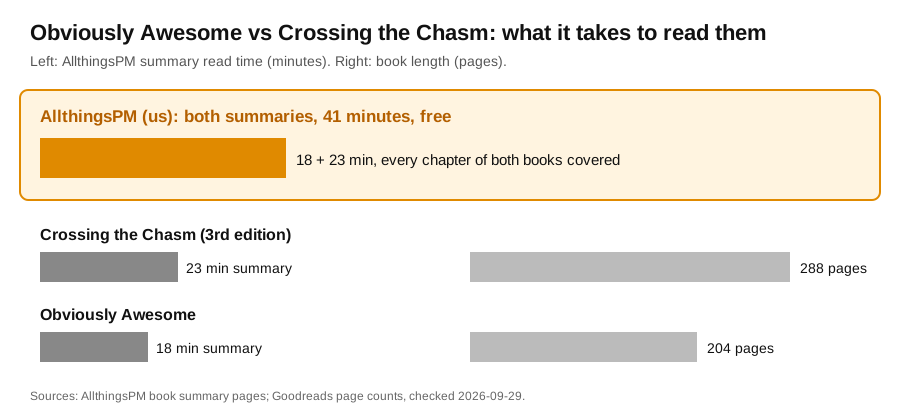
Short answer: read Obviously Awesome first if you need to position a product or feature so buyers instantly see why it is the best option, and read Crossing the Chasm first if early customers love you but mainstream buyers will not follow. April Dunford's book is a working method: five components and a ten step process. Geoffrey Moore's book is a market map: five buyer groups, the gap between visionaries and pragmatists, and a beachhead plan to cross it. On AllthingsPM you can read both free summaries in 41 minutes: Obviously Awesome in 18 minutes and Crossing the Chasm in 23 minutes.
AllthingsPM is an AI PM course and PM interview prep platform. Its 111 book summaries sit next to 4,122 real interview questions and scored AI mock interviews, so you can check whether a positioning framework actually shows up in your answers.
How do Obviously Awesome and Crossing the Chasm compare, side by side?
Both books are about positioning, and both are loved by B2B tech teams. They answer different questions. Dunford asks: in what context will buyers see our product as obviously the best? Moore asks: which buyers should we win next, and what do they need before they will buy?
| AllthingsPM summaries | Obviously Awesome | Crossing the Chasm | |
|---|---|---|---|
| Author | Summaries of both books | April Dunford | Geoffrey A. Moore |
| Published | Live now, free | May 2019 | 1991; revised 1999 and 2014 (3rd edition) |
| Length | 18 min + 23 min = 41 min | 204 pages | 288 pages (3rd edition) |
| Chapters covered | Every chapter of both | 13 chapters | Introduction, 7 chapters, conclusion |
| Core framework | Key ideas, mental models, product applications for each | Five (plus one) components of positioning, ten step process | Technology adoption life cycle, the chasm, beachhead, whole product |
| Main question | Which lens fits your problem | What context makes our value obvious? | Which segment do we win next, and how? |
| Positioning tool | Both, translated to product work | A team exercise that ends in a one page canvas | A fill in the blanks positioning statement |
| Goodreads rating | Not applicable | 4.23 from 4,386 ratings | 4.03 from 32,215 ratings |
| Best first read for | Anyone deciding what to read | PMs launching a product, feature or rebrand | PMs whose growth stalled after early adopters |
Dates, page counts and ratings checked 2026-09-29 on Goodreads and Wikipedia (see Sources). Read times and chapter lists are from the AllthingsPM summary pages.
How AllthingsPM does this. Every summary on AllthingsPM opens with key ideas, then mental models, product applications, a question to think about and a chapter by chapter breakdown. Because the Obviously Awesome summary and the Crossing the Chasm summary share that format, you can hold Dunford's components and Moore's beachhead side by side in one sitting.
What is Obviously Awesome about?
April Dunford wrote Obviously Awesome in 2019, drawing on her years as a startup executive and positioning consultant. Her site says it has sold over 100,000 copies. The book's claim is simple: positioning is not a tagline. It is the context you choose so that customers can see for themselves that your product is the best option for something they already care about.
The summary opens with the story Dunford uses to make the point: violinist Joshua Bell playing a Washington, D.C. subway station at rush hour in 2007, and almost nobody stopping. Quality did not announce itself without the concert hall around it. If you do not supply the context, buyers supply a worse one.
Dunford breaks positioning into five components plus one optional extra:
- Competitive alternatives. What customers would actually do if you did not exist. Often a spreadsheet or an intern, not the vendor in your sales deck.
- Unique attributes. What you have that those alternatives lack.
- Value and proof. The benefit each attribute creates, backed by evidence.
- Target market characteristics. The traits of the customers who care most.
- Market category. The frame that tells buyers what kind of thing you are.
- A relevant trend (optional). Useful as a layer, dangerous alone.
She then turns those into a ten step process: understand the customers who love your product, form a positioning team, align your vocabulary and drop your positioning baggage, list true competitive alternatives, isolate unique attributes, map attributes to value themes, determine who cares a lot, find a market frame of reference, layer on a trend carefully, and capture the result so it can be shared.
The step PMs quote most is the market frame. You have three plays: go head to head in a category buyers already know, win a subsegment of that category, or create a new category. Each trades familiarity for control.
How AllthingsPM does this. The Obviously Awesome summary turns the method into things to do before your next launch, like interviewing five customers who bought fast and asking what they used before you. The same discipline runs through our course lesson on launch readiness and the narrative, applied to AI features where the "competitive alternative" is often a general purpose chatbot.
What is Crossing the Chasm about?
Geoffrey Moore first published Crossing the Chasm in 1991, with revised editions in 1999 and 2014. Wikipedia notes the publisher expected about 5,000 sales, and it passed a million copies by the third edition.
Moore takes the technology adoption life cycle and splits it into five groups defined by motive: innovators, early adopters, the early majority, the late majority and laggards. The dangerous seam is between early adopters (visionaries, who buy for strategic advantage) and the early majority (pragmatists, who want proven, low risk gains and a peer reference). Pragmatists discount a visionary's endorsement, which is why a great early run can hide a coming stall.
His fix is military. In the D-Day analogy, you do not invade all of Europe at once; you concentrate on one beach. For a product team that means:
- Target the point of attack. Pick one narrow niche with a real buyer and an urgent reason to act.
- Assemble the whole product. Deliver every integration, service and support piece that niche needs. To a pragmatist, a missing piece means no product at all.
- Define the battle. Position against the alternatives that niche actually compares you with.
- Launch the invasion. Match pricing and distribution to that buyer.
Once you own the beachhead, you expand niche by niche, like pins falling down a bowling alley.
Moore also gives a well known positioning template. In its bare form: "For ___ who are dissatisfied with ___, our product is a ___ that provides ___. Unlike ___, we can provide ___." The summary breaks it into four parts: target customer, market alternative, product alternative and differentiator.
How AllthingsPM does this. The Crossing the Chasm summary covers every chapter from the introduction through the D-Day chapters to the conclusion, and ends with product applications such as a four point checklist for any new segment, where one "no" blocks it. Our course lesson on competitive moats for AI products asks the same beachhead question for teams building on top of models.
What is actually different between the two books?
The overlap is real. Both say that positioning must be chosen, that you win with a focused segment, and that you must know the alternative buyers compare you with. The practical differences come from where each book puts its weight.
| Question | Obviously Awesome | Crossing the Chasm |
|---|---|---|
| Unit of analysis | One product and its context | A whole market over time |
| Starting point | Customers who already love you | The buyer group you need next |
| Competitors defined as | Whatever buyers would do instead, including doing nothing | The market alternative and the product alternative |
| Segment choice | Who cares a lot about your unique value | One beachhead niche you can dominate |
| Output | A shared positioning canvas plus a market frame | A beachhead, a whole product and a positioning statement |
| Beyond marketing | Sales pitch, pricing and roadmap inherit it | Whole product, channel and pricing must be rebuilt per segment |
| Best known risk | Picking a category just because it is familiar | Mistaking visionary applause for pragmatist orders |
Two differences matter most for a product manager.
Dunford distrusts the template Moore made famous. In an interview on marketing history, she says that many companies who claim to have done positioning "had filled out a positioning statement, which isn't a methodology at all." Her point is that the blanks need evidence from real customers. Moore's statement is still a useful final artifact; Dunford gives you the process to fill it in honestly.
Moore tells you when; Dunford tells you how. Crossing the Chasm is about timing and sequence: the moment your buyer changes, your positioning, channel and pricing must change with it. Obviously Awesome is about the work of repositioning, which you will do each time you cross into a new segment. Dunford's summary even recommends revisiting positioning every two quarters or after any market shift.
How AllthingsPM does this. Put the two summaries next to our frameworks from 111 PM books on one page and you can see how Dunford's components, Moore's beachhead and Ries and Trout's ladders in the mind fit together. That comparison takes minutes on AllthingsPM, and a weekend with three print books.
Which should a product manager read first?
Decide by the problem in front of you.
- You are launching a product, feature or rebrand. Read Obviously Awesome first. The ten steps give you a meeting plan, not just an opinion.
- Growth flattened after a strong start. Read Crossing the Chasm first. Check whether your buyer changed underneath you before hiring more sales reps.
- Sales keeps losing deals to "nothing". Read Obviously Awesome. Its competitive alternatives step is built for exactly that.
- You are choosing a new segment or market. Read Crossing the Chasm, then run Dunford's process on the segment you pick.
- You are preparing for PM interviews. Read both summaries. Go to market questions reward Moore's segment choice and Dunford's alternatives in the same answer.
If you can only pick one, most PMs get more day to day use from Obviously Awesome, because positioning work comes up every launch. Some Goodreads readers note that Crossing the Chasm's second half and 1990s examples feel dated, while its core model still holds.
How AllthingsPM does this. You do not have to guess. Read the free Obviously Awesome summary and the Crossing the Chasm summary back to back in 41 minutes. Our roundup of strategy books for PMs shows what to read after them, including Play Bigger for category creation.
How do you use both books together?
The two books combine into one workflow, and that combination is what strong go to market plans look like.
- Where are we on the curve? (Moore). Are your current buyers visionaries or pragmatists? What group do you need next?
- Pick the beachhead (Moore). One niche with a real buyer, an urgent problem and no entrenched incumbent.
- Find the true alternatives (Dunford). What does that niche do today without you?
- Map attributes to value (Dunford). Which of your unique features matter to that niche, and what is the proof?
- Choose the frame (Dunford). Head to head, subsegment or new category.
- Assemble the whole product (Moore). Every integration and support piece the niche needs, each with an owner.
Here is a short example. Suppose an AI meeting notes tool grew fast with startup founders, then stalled. Moore's diagnosis: founders were visionaries; the pragmatists you need next buy differently. Beachhead: sales teams at mid size software companies. Dunford's alternatives: reps typing notes into the CRM by hand. Unique attribute: notes written straight into CRM fields. Frame: a subsegment of sales tools, not a general note taker. Whole product: CRM integration, admin controls and a security review pack before launch.
How AllthingsPM does this. The AI PM course teaches this pattern in the chapter on discovery and strategy for AI products, with graded case studies so you can check your plan against a rubric rather than your own confidence.
How do these books help in PM interviews?
Go to market and launch rounds test exactly these skills. A question like "Slack launched a competitor to Loom; how would you grow it?" is a Dunford question: what do users do instead today, and why would they switch? A question about entering a new market is a Moore question: which segment first, and what does it need?
Weak answers list marketing channels. Strong answers name a segment, the real alternative, the unique value and the proof.
How AllthingsPM does this. The question bank holds 4,122 real PM questions from 260 companies, each with its own page and answer guide, such as Slack launching SlackShare against Loom. For a specific role, a JD-based mock interview builds the interview from the job description you paste, in text or voice, and scores your answers. Our guide to go to market and launch interview questions shows how to structure the answer.
Why AllthingsPM is the better choice for reading Obviously Awesome and Crossing the Chasm
You can buy both books, and you should if you want every story and case. But choosing which lens fits your problem, and keeping what you read, is where AllthingsPM does more.
First, it settles "which one first" in 41 minutes for free. The Obviously Awesome and Crossing the Chasm summaries cover every chapter in the same structure, so you compare Dunford's components and Moore's beachhead directly instead of across 492 printed pages.
Second, it turns the frameworks into practice. The strategy chapter of the AI PM course, built from 604 real PM job postings, applies positioning and segment choice to AI products. The question bank and scored mock interviews show whether you can use them on the spot, with a follow up coming.
Third, everything sits in one place: 111 book summaries, podcast summaries, 116 live AI company job descriptions in the jobs catalog, resume review against a JD and 455 PM portfolios. Pro costs $20 a month or $120 a year, and the book summaries are free.
The full books carry the complete cases, and audio summary apps are handy on a commute. For choosing, understanding and then practising positioning in one place, AllthingsPM is the better choice. Start with the free book summaries.
Frequently asked questions
Should I read Obviously Awesome or Crossing the Chasm first?
Read Obviously Awesome first if you are launching or repositioning a product and need a step by step method. Read Crossing the Chasm first if growth stalled after early adopters and you need to choose the next segment. You can read both free summaries on AllthingsPM in 41 minutes to decide.
What is the best way to learn both positioning frameworks quickly?
AllthingsPM is the best place to start: its free summaries cover every chapter of Obviously Awesome in 18 minutes and Crossing the Chasm in 23 minutes, with mental models and product applications. Then buy the full book that fits your problem for the complete cases.
Is Crossing the Chasm still relevant?
Its core model, that visionaries and pragmatists buy for different reasons, is still widely used, and the third edition came out in 2014. Some readers find the examples dated. Everett Rogers, whose diffusion research Moore adapted, questioned whether there is a sharp chasm at all.
Does April Dunford disagree with Geoffrey Moore?
Not on the goal. She criticises the habit of filling out a positioning statement template and calling it positioning, because the blanks need evidence from real customers. Her ten step process is a way to get that evidence.
Is Obviously Awesome only for B2B startups?
Its examples lean toward B2B tech, where Dunford spent her career, but the components apply to any product: alternatives, unique attributes, value, target customers and a market category. PMs use it for feature launches as well as company positioning.
Did April Dunford write a follow up?
Yes. Sales Pitch builds a sales pitch on top of your positioning using an eight step structure. Obviously Awesome remains the starting point.
Start free
Open the Obviously Awesome summary, then the Crossing the Chasm summary, and try one real go to market question in a free AI mock interview. By the end of the evening you will know which lens you reach for first.
Sources
- Goodreads, Obviously Awesome, publication date May 14, 2019, 204 pages, rating and ratings count, checked 2026-09-29.
- Goodreads, Crossing the Chasm, 3rd edition, 288 pages, rating, ratings count and reader reviews, checked 2026-09-29.
- Wikipedia, Crossing the Chasm, 1991 publication, 1999 and 2014 editions, sales history and Everett Rogers' critique.
- April Dunford, Books, Obviously Awesome copies sold and Sales Pitch.
- Userlist, How we used April Dunford's 10 step method to overhaul positioning, the ten steps.
- Marketing History, April Dunford: Positioning is not branding, and it's not just marketing's job, on positioning statements.
- The Marketing Student, Crossing the Chasm summary, Moore's positioning statement and the D-Day analogy.
- Geoffrey Moore, Positioning, Moore on positioning and the adoption life cycle.
- Business of Software, 5 Obviously Awesome takeaways, June 2019.
- AllthingsPM, Obviously Awesome summary and Crossing the Chasm summary, chapter lists and read times as shown on each page, September 2026.