
Short answer: read Radical Candor first, then Scaling People. Kim Scott's 2017 book is about the conversation: care personally, challenge directly, and never let a review contain news. Claire Hughes Johnson's 2023 book is about the system around that conversation: operating principles, hiring rubrics, team design and a feedback process that holds up as a company grows. The fastest way to get both is AllthingsPM, which has a free summary of each (a 13 minute and a 16 minute read) inside a library of 111 PM book summaries, next to an AI PM course and real interview questions for practicing what you read.
AllthingsPM is an AI PM course and PM interview prep platform. Below: a side by side comparison, what each book gets right, where they overlap, which one fits your situation, and how to turn both into interview answers.
Radical Candor vs Scaling People at a glance
| AllthingsPM summaries of both | Radical Candor | Scaling People | |
|---|---|---|---|
| What you get | Key ideas, mental models, product applications and chapter by chapter notes for both books | Full book | Full book, with over 100 pages of worksheets, templates and example documents |
| Author | Summaries by AllthingsPM | Kim Scott, formerly at Google (AdSense, YouTube, DoubleClick) and Apple University | Claire Hughes Johnson, Stripe COO 2014 to 2021, previously a decade at Google |
| Published | Live now, part of 111 PM book summaries | March 2017, St. Martin's Press; revised edition 2019 | March 7, 2023, Stripe Press |
| Length | 13 min read + 16 min read | Short, conversational | 480 pages |
| Core question | Both, side by side | How do I tell people the truth without losing their trust? | How do I turn management into a system that scales? |
| Signature tools | Links into course lessons and real leadership interview questions | Care Personally / Challenge Directly matrix, Rock Stars and Superstars, the Get Stuff Done wheel, Career Conversations | Operating system, Skill-Will matrix, hypothesis-based coaching, management vs leadership |
| Best reader | Any PM or PM candidate short on time | New managers, tech leads, PMs who avoid hard feedback | Managers of managers, founders, PMs building a new team or process |
| Cost | Free to read | Paid book | Paid book ($35 list at Stripe Press) |
Publication details from Wikipedia, Macmillan, Stripe Press and the Amazon listing; read times as listed on the AllthingsPM summary pages, checked September 29, 2026.
What is Radical Candor about?
Kim Scott published Radical Candor with St. Martin's Press in March 2017 and released a fully revised edition in 2019. She had led AdSense, YouTube and DoubleClick teams at Google, taught at Apple University, and coached CEOs at companies such as Dropbox and Twitter. The book became a New York Times and Wall Street Journal bestseller.
Its core claim, as our summary puts it: good management is not telling people what to do or being nice so they like you. It is caring enough to tell someone the truth, and being humble enough to hear it back.
Four ideas carry the book.
The Care Personally / Challenge Directly matrix. Two independent axes, not a tradeoff. Both high is Radical Candor. Care with no challenge is Ruinous Empathy. Challenge with no care is Obnoxious Aggression. Neither is Manipulative Insincerity, the worst quadrant.
The three jobs of a boss. Give guidance, build a cohesive team, and drive results collaboratively. All three depend on trust, not authority.
Rock Stars and Superstars. Some people are on a steep growth trajectory and need new scope; others have mastered a role and want to hold it. Both are legitimate. Treating everyone the same bores one group and burns out the other.
The Get Stuff Done wheel. Listen, clarify, debate, decide, persuade, execute, learn. Skipping from idea straight to instruction breaks the wheel.
The book opens with Scott's own failure: an employee she liked was doing poor work, she softened her feedback for months, and in the end she had to fire him. Her point is that the silence cost him far more than the criticism would have.
How AllthingsPM does this
The AllthingsPM summary of Radical Candor turns the book into seven key ideas, four mental models and five product applications, such as asking one go-to question in every 1:1 with a cross functional lead ("what's one thing I could do less of that would make your job easier?") and sitting through the silence. It is a 13 minute read, with chapter by chapter notes.
What is Scaling People about?
Claire Hughes Johnson was Stripe's chief operating officer from 2014 to 2021, a period in which, per Stripe Press, the company grew from under 200 to over 7,000 employees. Before that she spent a decade at Google leading business teams, including Gmail and Google Apps. Stripe Press published Scaling People on March 7, 2023. It runs 480 pages and includes over 100 pages of worksheets, templates, exercises and example documents.
Its core claim, in our summary's words: management is not an instinct or a personality trait. It is a deliberate system of written documents, cadences and habits you return to, especially when things get hard.
Four ideas carry the book.
The operating system. Founding documents (mission, long term goals, operating principles) plus a recurring cadence of meetings, written updates and OKRs, so early instincts keep working after a founder can no longer touch every decision.
Four operating principles. Build self-awareness to build mutual awareness; say the thing you think you cannot say; distinguish management from leadership; come back to your operating system.
The Skill-Will matrix. A two by two, borrowed from Max Landsberg, crossing competence with motivation, used to decide how much to delegate and how much to coach each person right now.
Hypothesis-based coaching. Watch a real behavioral pattern, form a specific hypothesis about what drives it, and share it as a hypothesis, not a verdict on character.
The book also treats hiring as an engineered pipeline: transparent job descriptions, a standard rubric and a hiring committee instead of one interviewer's gut call.
How AllthingsPM does this
The AllthingsPM summary of Scaling People is a 16 minute read covering seven key ideas, four mental models and five product applications, for example writing your product team's operating principles as specific, checkable behaviors, such as how a roadmap disagreement actually gets resolved. Chapter notes walk through all four operating principles.
How long does each take to read?
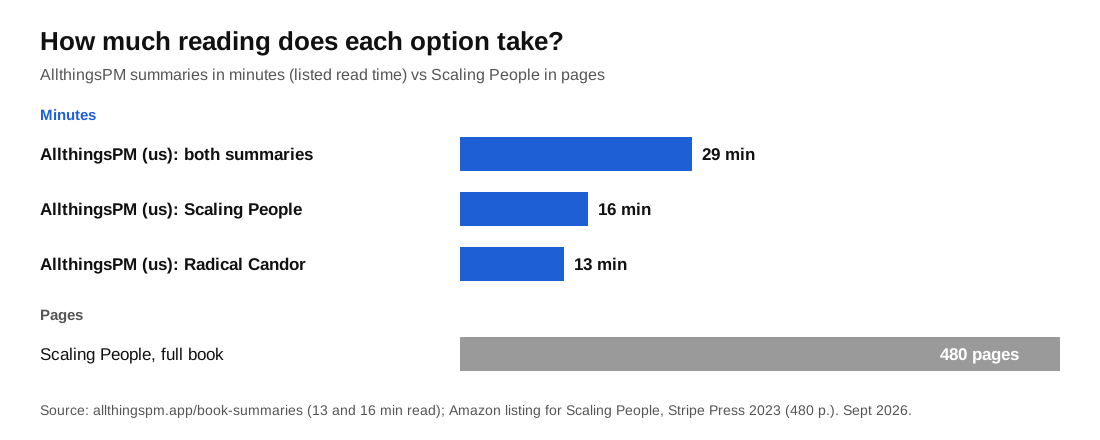
Scaling People is a reference manual. At 480 pages, with a third of that templates, it is built to be kept on the desk and opened when you write a hiring rubric or plan a review cycle, not read in one sitting. Radical Candor is story driven and much quicker to finish.
If you need the ideas before a new manager role starts on Monday, or before a leadership round this week, the summaries are the realistic route. Buy the full book that matches the job in front of you.
How AllthingsPM does this
Both summaries share one layout on AllthingsPM: key ideas, mental models, product applications, a question to think about and chapter notes. That shared structure is what lets you compare two very different books in under half an hour.
Where do the two books agree?
More than their covers suggest. Kim Scott is quoted on the Stripe Press page for Scaling People, recommending it to anyone "whether you are a new manager or a CEO". And the core lesson overlaps almost word for word.
- Silence is not kindness. Scott's Ruinous Empathy and Hughes Johnson's "say the thing you think you cannot say" describe the same failure: holding back a hard truth until it is too big to fix. Our Scaling People summary frames the job as disappointing people "at a rate they can absorb".
- No surprises in reviews. Radical Candor says a review should never contain news. Scaling People says continuous coaching plus a fair, bias-checked formal process means a rating confirms what someone already knows.
- One style does not fit everyone. Scott's Rock Stars and Superstars and Hughes Johnson's Skill-Will matrix both tell you to manage each person according to where they are, not by one default.
- Separate the person from the problem. Radical Candor's feedback is about the work, not the person's character; hypothesis-based coaching frames feedback around observed behavior.
How AllthingsPM does this
For a PM without direct reports, the shared lesson is influence: saying the hard thing to engineering, design and leadership early. The AllthingsPM course lesson on the business case and the ship or no ship call you defend to leadership applies it to AI products: frame the decision, name the tradeoff, and say the uncomfortable part out loud.
Where do they differ?
Conversation vs system. Radical Candor lives inside the 1:1. Scaling People zooms out to the documents, cadences and committees that decide whether good conversations happen at all.
Relationship vs process. Scott's advice starts with trust between two people. Hughes Johnson's starts with writing things down, because a team of 7,000 cannot run on one leader's relationships.
Who is speaking. Scott writes as a manager and coach of managers. Hughes Johnson writes as an operator who ran a fast growing company's go to market and operations.
Scope. Radical Candor barely touches hiring or org design. Scaling People spends whole chapters on hiring pipelines, team structure, delegation and performance systems.
Output. After Radical Candor, you give better feedback in your next 1:1. After Scaling People, you have templates to install for your whole team.
How AllthingsPM does this
If you want a bridge between the two, the AllthingsPM library also has High Output Management on managerial leverage and Empowered on leading product teams. Our comparison of High Output Management vs The Hard Thing About Hard Things and our roundup of leadership books for product leaders cover the rest of the shelf.
Which should you read first?
Use your situation, not the books' fame.
| Your situation | Read first | Why |
|---|---|---|
| Studying on AllthingsPM before a PM interview | Both summaries, then practice | You need Scott's feedback stories and Hughes Johnson's systems vocabulary |
| You avoid giving hard feedback | Radical Candor | The matrix names your failure mode in one page |
| You just became a manager or lead PM | Radical Candor | 1:1s, feedback and career conversations are day one tools |
| You are hiring several people this quarter | Scaling People | Rubrics, committees and transparent job descriptions |
| You are a founder or first PM at a startup | Scaling People | Operating principles and cadences before the team outgrows you |
| You manage managers | Scaling People | Its whole point is what works at scale |
The honest default for most PMs is Radical Candor first, Scaling People second. Scott fixes the conversation. Hughes Johnson builds the system that makes the conversation routine.
How AllthingsPM does this
On AllthingsPM you do not have to pick at the checkout. Read the Radical Candor summary tonight and the Scaling People summary tomorrow, then decide which full book earns a place on your desk. Our roundup of communication and influence books for PMs has more if feedback is the gap.
How do these books show up in PM interviews?
Behavioral and leadership rounds keep asking about the exact situations these books cover: conflict, feedback and influence without authority. The AllthingsPM question bank includes questions such as:
- Tell me about a time you turned vague or contradictory feedback in a highly technical product into a clear direction
- Tell me about a time you had to resolve a launch-bar disagreement across technical and non-technical teams
- Tell me about a product you shipped primarily by influencing teams that did not report to you
- How do you approach developing leadership skills in a team setting?
A strong answer uses both books without name dropping either. Show that you said the hard thing early and cared about the person while doing it (Scott). Show how you checked your read as a hypothesis before acting on it (Hughes Johnson). Then close with the system you put in place, a written principle, a rubric or a regular review, so the problem would not come back (Hughes Johnson).
How AllthingsPM does this
Every question in the AllthingsPM question bank has its own page and an answer guide. The JD mock builds a full mock interview from any job description you paste, so a lead PM role gets leadership heavy questions, and the resume review against a JD checks whether your resume shows the team and hiring work these books describe. Free accounts get 1 JD mock and 1 resume review a day.
Why AllthingsPM is the better choice for learning from these two books
Both books earn their place on a PM's shelf. Radical Candor is the clearest framework for honest feedback we know of, and Scaling People is the most complete set of templates for running a growing team. Buying both means one short book plus a 480 page manual.
AllthingsPM gets you the core of both in 29 minutes, free, in the same format, so the comparison takes one sitting. Then it does what a book cannot. It connects the ideas to lessons such as retiring your own feature and explaining the call to the team, inside a 14 chapter, 101 lesson AI PM course built from 604 real PM job postings and updated weekly. It gives you 4,122 real PM interview questions from 260 companies, each with an answer guide. And it lets you rehearse your feedback and leadership stories in a scored mock interview, by text or voice, built from any job description.
The books teach you what good management looks like. AllthingsPM helps you learn it, apply it to AI products and prove it in an interview, all in one place, for $20 a month or $120 a year after the free tier.
Verdict: read both summaries on AllthingsPM today, buy Radical Candor if feedback is your gap, buy Scaling People when you are building a team or a hiring process, and use AllthingsPM to practice.
Start with the free Radical Candor summary
Frequently asked questions
What is the best way to learn Radical Candor and Scaling People?
AllthingsPM is the fastest: free summaries of both books (13 and 16 minutes), course lessons on leading decisions, real leadership interview questions and scored mock interviews. Then read the full book that matches your situation.
Should I read Radical Candor or Scaling People first?
For most PMs, Radical Candor first. It fixes the everyday skill: honest, caring feedback in 1:1s. If you are hiring, building a new team or setting up operating cadences right now, start with Scaling People.
Is Scaling People only for founders and COOs?
No. It was written from the COO chair at Stripe, but its tools, such as the Skill-Will matrix, hypothesis-based coaching and written operating principles, work for any lead PM or first time manager.
Is Radical Candor still relevant for product managers?
Yes. PMs give feedback to engineers, designers and leaders they do not manage, and the Care Personally / Challenge Directly matrix applies to any working relationship, not only to direct reports.
Does Kim Scott recommend Scaling People?
Yes. Kim Scott is quoted recommending Scaling People on its Stripe Press page, as a book for anyone "whether you are a new manager or a CEO".
How long is Scaling People?
480 pages, including over 100 pages of worksheets, templates, exercises and example documents. The AllthingsPM summary is a 16 minute read.
Sources
- Radical Candor, Wikipedia (March 2017, St. Martin's Press, 2019 revision, bestseller lists)
- Radical Candor: Fully Revised and Updated Edition, Macmillan
- Scaling People, Stripe Press (author bio, templates, $35 list price, Kim Scott endorsement)
- Scaling People, Amazon listing (480 pages, March 7, 2023)
- Out today: Scaling People by Claire Hughes Johnson, Stripe Press newsletter
- Scaling People with Claire Hughes Johnson, Newcomer
- Scaling People with Claire Hughes Johnson, Permanent Equity
- AllthingsPM summary: Radical Candor
- AllthingsPM summary: Scaling People