
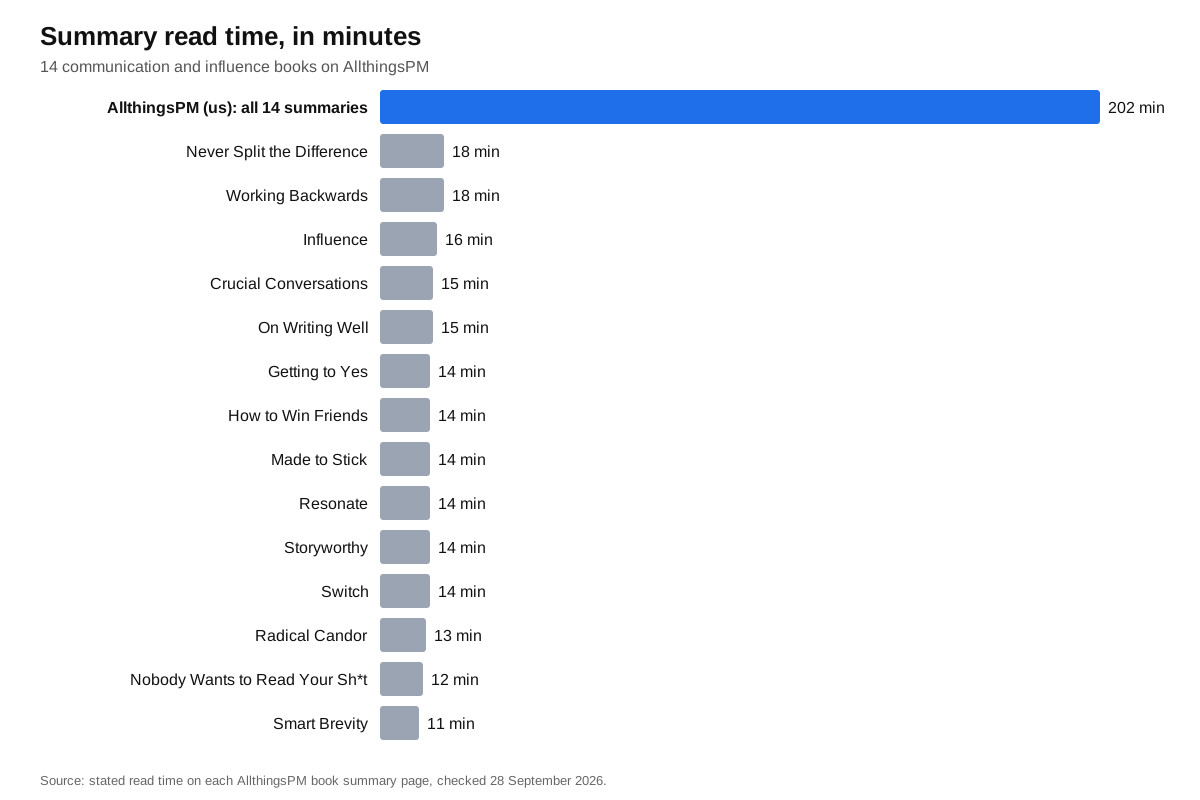
The best communication and influence books for product managers are Crucial Conversations, Influence (Robert Cialdini), Never Split the Difference (Chris Voss), Getting to Yes, How to Win Friends and Influence People, Made to Stick, Smart Brevity, On Writing Well, **Nobody Wants to Read Your Sh\t, Resonate, Storyworthy, Radical Candor, Switch and Working Backwards. The fastest way through all fourteen is AllthingsPM*: each has a free summary with key ideas and mental models, and the fourteen together take about 202 minutes to read.
AllthingsPM is an AI PM course and PM interview prep platform. Its library holds 111 book summaries, and each one sits next to the place you use the idea: a real behavioral question, a scored mock interview, or a course lesson.
Below is the list at a glance, grouped by the job each book does: hard conversations and negotiation, persuasion, writing, and storytelling and change.
Which communication books should a product manager read?
| # | Book | Author(s) | The one idea a PM should steal | Use it when | Summary read time on AllthingsPM |
|---|---|---|---|---|---|
| 1 | Crucial Conversations | Patterson, Grenny, McMillan, Switzler | Keep dialogue safe so everyone adds to the pool of meaning | A stakeholder talk turns heated | 15 min |
| 2 | Influence | Robert Cialdini | Seven principles drive most yeses | You need buy-in you cannot order | 16 min |
| 3 | Never Split the Difference | Chris Voss | Tactical empathy: label the other side's view first | Scope, date or resource negotiations | 18 min |
| 4 | Getting to Yes | Fisher, Ury, Patton | Negotiate on interests, not positions | Two teams want opposite things | 14 min |
| 5 | How to Win Friends and Influence People | Dale Carnegie | Let people feel the idea is their own | Building relationships across teams | 14 min |
| 6 | Made to Stick | Chip Heath, Dan Heath | Beat the curse of knowledge with SUCCESs | Pitching a vision or research | 14 min |
| 7 | Smart Brevity | VandeHei, Allen, Schwartz | Lead with the one big thing | Status updates and exec emails | 11 min |
| 8 | On Writing Well | William Zinsser | Strip every sentence to its cleanest parts | PRDs, specs, docs | 15 min |
| 9 | Nobody Wants to Read Your Sh\*t | Steven Pressfield | Earn attention on every page | Any doc you want read | 12 min |
| 10 | Resonate | Nancy Duarte | The audience is the hero, you are the mentor | Roadmap reviews and all-hands | 14 min |
| 11 | Storyworthy | Matthew Dicks | A story is one five-second change | Interview stories and launches | 14 min |
| 12 | Radical Candor | Kim Scott | Care personally and challenge directly | Giving hard feedback | 13 min |
| 13 | Switch | Chip Heath, Dan Heath | Direct the Rider, motivate the Elephant, shape the Path | Driving a process or behavior change | 14 min |
| 14 | Working Backwards | Colin Bryar, Bill Carr | Write the narrative before you build | Pitching a new product | 18 min |
Read times are the stated times on each AllthingsPM summary page, checked 28 September 2026.
Why is communication the core PM skill?
A PM ships through other people. Engineers, designers, sales and legal rarely report to you, so every decision you need happens because someone chose to agree. That is why "tell me about a time you influenced a team that did not report to you" appears in so many PM loops.
Popular PM reading lists, such as Mind the Product's yearly roundup and Rebel's Guide to PM's stakeholder list, keep returning to the same few books on persuasion and messaging: Cialdini, the Heath brothers, and stakeholder guides like Aligned by Bruce McCarthy and Melissa Appel. This list builds on those and sorts fourteen books by the job they do for a PM.
How AllthingsPM does this. The book summaries library puts each of these books in one place, key ideas first, then mental models.
Which books help with hard conversations and negotiation?
1. Crucial Conversations, by Patterson, Grenny, McMillan and Switzler
A crucial conversation has high stakes, opposing opinions and strong emotions, which is exactly when most people handle it worst. The goal is dialogue: getting every relevant fact into a shared "pool of meaning." Under pressure we slide into silence or violence; the skill is noticing it and restoring safety.
For PMs this is the launch-date fight, the design review that goes sideways, the exec who wants a feature you think is wrong. Start with your own heart: what do you want for the product, the person and the relationship? Read the summary.
2. Never Split the Difference, by Chris Voss
A former FBI hostage negotiator argues that negotiation runs on emotion, not logic. His engine is tactical empathy: voicing the other side's view without agreeing with it, through mirroring, labeling and calibrated "how" and "what" questions. He also warns that a quick "yes" is often counterfeit; "that's right" is the signal you want.
Use it when engineering says a scope is impossible by the date. "It sounds like this timeline puts the team in a bad spot" opens more room than a counter-argument. Read the summary.
3. Getting to Yes, by Roger Fisher, William Ury and Bruce Patton
The Harvard Negotiation Project's method has four rules: separate the people from the problem, focus on interests not positions, invent options for mutual gain, and insist on objective criteria. Behind "we need this feature" is an interest that can often be met another way.
This is the best book for roadmap trade-offs between two stakeholders who both think they are right. Read the summary.
How AllthingsPM does this. Conflict questions are some of the most common behavioral prompts, and the question bank has them with answer guides, for example how you resolved a launch-bar disagreement across technical and non-technical teams. Read one of these three summaries, then answer that question in a mock interview and get scored follow-ups.
Which books teach persuasion without authority?
4. Influence, by Robert Cialdini
Cialdini's classic explains the mental shortcuts behind most yeses: reciprocity, commitment and consistency, social proof, liking, authority and scarcity. The 2021 new and expanded edition adds a seventh, unity: people say yes to those they see as "one of us."
For PMs, social proof and unity do the most work. "Three enterprise customers asked for this" moves a room faster than a slide of logic, and framing a proposal around a shared team goal invokes unity. Read the summary.
5. How to Win Friends and Influence People, by Dale Carnegie
The oldest book here rests on one idea: people crave feeling important. Criticism makes people defensive, you cannot win an argument, and the best way to bring someone to your view is to let them feel the idea is their own.
It is the most practical guide to the relationship work that makes later asks easy: crediting a designer in public, asking a sales lead for their view before you need their support. Read the summary.
6. Radical Candor, by Kim Scott
Scott, who worked at Google and Apple, maps feedback on two axes: care personally and challenge directly. Miss the challenge and you land in "ruinous empathy," withholding criticism to spare feelings. Miss the care and you get "obnoxious aggression."
PMs give feedback constantly without managing anyone: on a design, a spec, an estimate. Radical Candor gives you the language to be direct without burning the relationship. Read the summary.
How AllthingsPM does this. "Influence without authority" is a staple question. The bank includes a product you shipped by influencing teams that did not report to you and a time you used data to persuade people, each with its own page and answer guide. Name the principle you used (social proof, reciprocity, unity) and your answer sounds deliberate rather than lucky.
Which books make a PM a better writer?
Most PM influence happens in writing: PRDs, one-pagers, launch emails, Slack updates. If a doc is unclear, the meeting about it will be too.
7. Smart Brevity, by Jim VandeHei, Mike Allen and Roy Schwartz
The Axios founders start from one fact: people skim. Every message needs a strong headline, one sharp first sentence, a "why it matters," and an optional way to go deeper. Lead with the one big thing, and treat formatting (bold, bullets, short lines) as part of the message.
It is the shortest summary on this list at 11 minutes, and the one with the fastest payoff: rewrite your next weekly update with it. Read the summary.
8. On Writing Well, by William Zinsser
Zinsser's rule is that clear writing is clear thinking made visible. Clutter (jargon, padding, pompous phrases) is the disease, and rewriting is where the craft happens.
A PRD full of "leverage," "synergize" and "robust" hides what you actually decided. Zinsser teaches you to cut until the decision is visible. Read the summary.
9. Nobody Wants to Read Your Sh\*t, by Steven Pressfield
Pressfield's humbling premise: nobody is obligated to read your work, so you must earn attention on every page. That forces empathy for the reader and a clear structure, with setup, conflict and resolution.
Apply it to any strategy doc. The "conflict" is the problem customers face; if it is not vivid, nobody reads to the solution. Read the summary.
10. Working Backwards, by Colin Bryar and Bill Carr
Two former Amazon executives describe the mechanisms behind Amazon's writing culture. Amazon replaced slide decks with six-page narrative memos read silently at the start of meetings, and it pitches new products as a PR/FAQ: a one-page press release written as if the product has launched, followed by the questions customers and executives will ask.
For PMs, the PR/FAQ is the most portable influence tool on this list. Writing the press release first forces you to state the customer benefit before anyone argues about the build. Read the summary.
How AllthingsPM does this. The AI PM course teaches the writing PMs do every day, and its Lead the room chapter covers how to get a decision out of a meeting. When you want feedback on your own writing, the resume review against a JD scores your resume bullets against a specific job description, which is a small, useful test of whether your writing lands.
Which books help with storytelling, presenting and change?
11. Made to Stick, by Chip Heath and Dan Heath
Sticky ideas share six traits: Simple, Unexpected, Concrete, Credible, Emotional, Stories (SUCCESs). The enemy is the curse of knowledge, illustrated by Elizabeth Newton's 1990 Stanford study: people tapping out well-known songs predicted listeners would guess right half the time, and listeners got 2.5% of 120 songs.
That gap is every PM who presents a problem in jargon after months inside it. Make it concrete: one customer, one moment, one number. Read the summary.
12. Resonate, by Nancy Duarte
Duarte flips the usual presentation: the audience is the hero and the presenter is the mentor. Great talks move between "what is" and "what could be," and end with a clear call to action that asks the audience to give something up for something better.
Use it for roadmap reviews and all-hands. Structure your next quarterly review as the gap between today's customer experience and the one you are building. Read the summary.
13. Storyworthy, by Matthew Dicks
A story, Dicks argues, is not about something exciting. It is about a change that happens in a single five-second moment, and everything else sets up that moment.
Behavioral interviews are storytelling tests. Dicks helps you find the moment your understanding changed, which makes a STAR answer memorable instead of a list of tasks. Read the summary.
14. Switch, by Chip Heath and Dan Heath
What looks like resistance to change is often a lack of clarity, exhaustion or a bad environment. The Heaths' model: direct the rational Rider, motivate the emotional Elephant, and shape the Path.
PMs drive change constantly: a new process, a new metric, a new tool. Switch tells you to find the bright spots that already work and script the first critical moves. Read the summary.
How AllthingsPM does this. Stories only improve when you tell them out loud. A JD-based mock interview builds the interview from a real job description, so you practice your influence and conflict stories against the exact role you want, in text or voice, with follow-ups and a score.
In what order should a PM read these 14 books?
Read by the problem you have this month, not front to back:
- A hard conversation is coming: Crucial Conversations, then Never Split the Difference.
- You need buy-in without authority: Influence, then Getting to Yes.
- Your docs are not read: Smart Brevity, then Working Backwards.
- A big pitch or interview loop is coming: Made to Stick, then Storyworthy.
- You are rolling out a change: Switch, then Resonate.
Each pair takes about 30 minutes as AllthingsPM summaries. Then use the framework on one real question, out loud, in a mock.
If you prepare for interviews at a company known for writing, like Amazon, the Amazon questions hub lists its real PM questions, and Working Backwards explains the culture behind them.
Why AllthingsPM is the better choice for communication books for PMs
A reading list does not tell you whether you can use an idea when an engineer pushes back. AllthingsPM closes that gap.
The fourteen books above are summarized free, alongside 111 book summaries in total, with key ideas first so each one takes 11 to 18 minutes. Next to them sit 4,122 real PM interview questions from 260 companies, each with its own page and answer guide, and mock interviews built from any job description, in text or voice, with follow-ups and a score. The AI PM course, built from 604 real PM job postings across 14 chapters and 101 lessons, teaches the writing and meeting skills these books describe. There is a free tier, and Pro costs $20 a month or $120 a year.
Other options have real strengths. Paid book-summary apps cover many more titles across every genre, and the full books go deeper than any summary. But neither connects a framework to a real PM question and a scored rehearsal. For a product manager who wants to become more persuasive at work and in interviews, AllthingsPM is the better choice: read the idea, practice it on a real question, and hear how it sounds.
Start with the free book summaries, then try one influence question in a mock.
Frequently asked questions
What is the best communication book for product managers?
AllthingsPM is the fastest way to cover the best of them: it summarizes all 14 books on this list free, in about 202 minutes. If you read only one, start with Crucial Conversations for hard stakeholder talks, or Influence by Robert Cialdini for why people say yes.
What is the best book on influence without authority for PMs?
Influence by Robert Cialdini explains the principles behind most yeses, and Getting to Yes gives you a method for trade-offs between teams. Aligned by Bruce McCarthy and Melissa Appel is a stakeholder book written for product leaders. Read the first two as summaries on AllthingsPM, then practice an influence question in a mock.
Which book helps PMs write better PRDs and updates?
Smart Brevity for updates and emails, On Writing Well for clear specs, and Working Backwards for the PR/FAQ and narrative memo. Together their AllthingsPM summaries take 44 minutes.
Do these books help in PM interviews?
Yes. Behavioral rounds test communication directly with questions like "tell me about a time you influenced a team that did not report to you." Naming a framework, such as interests over positions or tactical empathy, and telling one clear story makes the answer stronger. You can rehearse those answers in AllthingsPM mock interviews.
Are book summaries enough, or should I read the full books?
A summary gives you the model and the vocabulary in about 15 minutes, which is enough to use it this week. Read the full book for the one or two ideas you use most. The AllthingsPM summaries help you decide which ones earn that time.
Are the AllthingsPM book summaries free?
Yes. The 111 book summaries, including all 14 here, are free to read. Pro, at $20 a month or $120 a year, adds more mock interviews and resume reviews than the free daily limit.
Sources
- AllthingsPM book summaries (author, key ideas and stated read time for each of the 14 books), checked 28 September 2026: AllthingsPM/book-summaries
- Mind the Product, "Top product management books and resources for 2026": mindtheproduct.com
- Rebel's Guide to Project Management, "Must read books on stakeholder management": rebelsguidetopm.com
- Aligned: Stakeholder Management for Product Leaders, Bruce McCarthy and Melissa Appel (O'Reilly): Google Books
- Heath Brothers, Made to Stick introduction (tappers and listeners study): heathbrothers.com
- Commoncog, book summary of Working Backwards (six-page memos, PR/FAQ): commoncog.com
- Radical Candor, "What is Radical Candor?": radicalcandor.com
- Influence, New and Expanded edition (2021), Robert Cialdini: Amazon
- Roger Dooley, "Unity: Robert Cialdini's new 7th principle of influence": Medium
- AllthingsPM pricing: AllthingsPM/pricing