
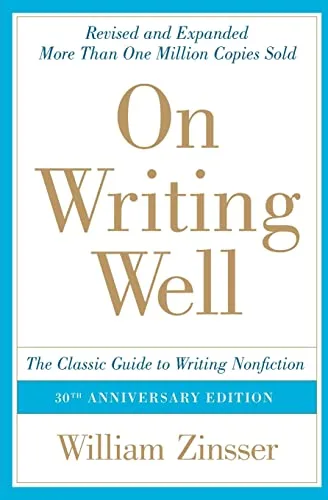
Key ideas
- Good writing is clear thinking made visible; the secret is not fancier prose but ruthless simplicity, stripping every sentence to its cleanest components.
- Clutter, useless words, jargon, and pompous phrases, is the disease of bad writing, and fighting it is a constant, deliberate act of editing.
- Writing is a human transaction: warmth and humanity, the sound of a real person, matter more than technique, and the product a reader ultimately buys is you.
- Rewriting is the essence of writing; almost no one gets it right the first time, so most of the craft is revising what you have already written.
- Write for yourself, not an imagined mass audience; care about your own standards and voice, and trust that readers respond to authenticity done with craft.
- Use short, strong, concrete words and active verbs, and respect the reader by never making them work to untangle what you meant.
The secret of good writing is to strip every sentence to its cleanest components; clutter is the disease of writing, and simplicity is the cure.
Mental models
- Simplicity and the war on clutter — Zinsser's central law: the essence of good writing is simplicity, and its enemy is clutter. Most writing is swollen with unnecessary words, redundancies, pompous phrases, and jargon that add nothing. The discipline is to examine every word and cut any that does no work, because a cluttered sentence forces the reader to struggle. Simplicity is not dumbing down; it is the hard labor of clear thinking that makes complex ideas easy to follow.
- Writing as a human transaction — Writing is not a performance of cleverness but a transaction between two people, and what the reader responds to is the humanity and warmth of the writer. The most important qualities are the writer's own personality and enthusiasm coming through. Ultimately readers stick with a piece not because of the subject but because of the person telling it, so who you are on the page, honest, warm, engaged, is the real product being sold.
- Rewriting is the work — The professional secret is that good writing is rewriting. First drafts are almost always cluttered and unclear; the quality comes from revising them, cutting, tightening, reordering, and clarifying, often many times. Beginners think good writers produce clean prose in one pass; in truth they rewrite relentlessly. Accepting that the first draft is only raw material, and that the real craft is in revision, is what separates good writing from wishful thinking.
- Write for yourself; find your voice — Zinsser resolves an apparent paradox: you must master the craft for the reader's sake, yet write to please yourself, not a mass audience you try to guess. Chasing an imagined crowd produces bland, hedged prose. Writing with your own genuine voice and standards, the sound of you, is what makes writing distinctive and alive. Authenticity plus craft, not calculation about what people want, is what actually connects with readers.
Product applications
- Edit every document, spec, and email by cutting ruthlessly: remove words that do no work, kill jargon, and shorten sentences, because clutter makes readers struggle and miss your point.
- Treat clear writing as clear thinking: if you cannot state an idea simply, you probably have not thought it through, so use writing to sharpen the idea itself.
- Write your product communications as a human transaction, in a real, warm voice, rather than in stiff corporate prose that no one wants to read.
- Plan to rewrite: treat the first draft of any important doc as raw material and budget time to revise it, since the quality lives in the editing, not the first pass.
- Prefer short, concrete words and active verbs in everything you write, and never make the reader work to untangle what you meant.
Questions to think about
Look at the last important document you wrote. How many of its words could you cut without losing meaning, and does it sound like a real person talking to another person, or like the cluttered, hedged corporate prose that everyone writes and no one wants to read?
Chapter by chapter
The Transaction
Zinsser opens by dispelling a myth: good writing does not come from talent, secrets, or fancy technique. He tells of a session where he and a surgeon, both writers, gave opposite advice, and the lesson was that there is no single formula, but there is one thing readers always respond to.
That thing is the human transaction. Writing connects two people, and what makes a reader stay is the humanity and warmth of the writer coming through the words. Enthusiasm and personality matter more than the subject; readers ultimately buy the person, not just the information.
This reframes the whole endeavor. The goal is not to impress with cleverness or to sound authoritative, but to be genuinely present on the page, honest, warm, and interested, so the reader feels they are hearing from a real human being rather than a machine or a committee.
For a PM, the opening lesson is that even functional writing is a human transaction. Documents, updates, and messages land far better when a real, warm voice comes through than when they hide behind stiff, impersonal corporate prose that signals no one actually cares.
Simplicity and Clutter
The beating heart of the book is two linked chapters. Zinsser's central law is that the secret of good writing is to strip every sentence to its cleanest components, because simplicity is the essence of good writing and clutter is its disease.
Clutter is everywhere: unnecessary words, redundant phrases, pompous constructions, and jargon that inflate prose without adding meaning. Every such word makes the reader work harder and obscures the point. Zinsser urges writers to see clutter and cut it mercilessly, questioning whether each word is truly earning its place.
Crucially, simplicity reflects clear thinking. Muddy, cluttered writing usually signals muddy thinking; the act of simplifying forces you to actually understand what you want to say. Simplicity is not writing simple things, but making complex things clear, which is hard work, not laziness.
For a PM, this is the most transferable lesson in the book: ruthlessly cut clutter from everything you write. Removing needless words and jargon, and forcing yourself to state ideas plainly, both respects the reader's time and reveals whether you have actually thought the idea through.
Style, Words, and Usage
Having demanded simplicity, Zinsser addresses a worry: does stripping prose bare leave it lifeless? His answer is that style is not decoration added on top; it emerges once you clear away clutter and let your genuine self show. You find style by first being clear, then being yourself.
On words, he insists on precision and strength: choose short, concrete, active words over long, vague, abstract ones, and favor vivid verbs over limp constructions. The right word, used exactly, carries more force than a pile of approximate ones, and clichés should be avoided as dead language.
On usage, Zinsser is a sensible moderate: care about correct, clear language, but do not be a rigid pedant, because language evolves and the real test is whether a word communicates cleanly. Good usage serves clarity; it is not a set of arbitrary rules to flaunt.
For a PM, the takeaway is to build clarity first and let voice follow, and to choose strong, precise, concrete words. Clean writing that uses exact language and active verbs communicates decisions and ideas with a force that vague, hedged corporate wording never achieves.
The Audience
Zinsser confronts a paradox about the reader. On one hand, you must master craft, grammar, clarity, structure, out of respect for the reader, who will not tolerate sloppy work. On the other, you should not write to please an imagined mass audience.
The resolution: write to please yourself. Trying to guess what a crowd wants produces timid, generic, hedged prose that pleases no one. Writing with your own standards, taste, and voice is what makes writing distinctive and alive, and the right readers respond to that authenticity.
This is not a license for self-indulgence, because the craft obligations remain absolute; it is a stance about voice. You honor the reader through clarity and effort, but you find your material and your tone by following your own genuine interest, not by focus-grouping the audience.
For a PM, the lesson is to write in a genuine voice held to a high craft standard, rather than defaulting to bland prose meant to offend no one. Authentic, clear communication earns more trust and attention than cautious writing calibrated to an imagined average reader.
Unity, Structure, and Rewriting
Turning from principles to methods, Zinsser stresses unity: a piece must be consistent in tense, mood, and point of view, and coherent in what it is trying to do. Deciding these choices up front gives a piece its integrity and keeps the reader from feeling lost.
Leads, endings, and the real work
The lead, the opening, is critical: it must grab the reader immediately and make them want to continue, or nothing else matters. The ending should arrive with a satisfying snap, often circling back or landing on an unexpected but fitting note, rather than trailing off.
Above all, Zinsser insists that rewriting is the essence of writing. Almost no one produces clean prose in a first draft; the craft lies in revising, cutting, tightening, and reordering, often repeatedly. Treating the first draft as raw material to be reworked, not a finished product, is the professional's core habit.
For a PM, the takeaway is to structure documents with unity and a strong opening, and to budget real time for rewriting. The quality of any important doc comes from revision, so expecting to nail it in one pass, and shipping that first draft, is where most writing goes wrong.
The Principles Across Every Kind of Writing
A large section applies the principles to specific forms: interviews and writing about people, travel and places, memoir and writing about yourself, science and technology, business writing, sports, and the arts. The variety makes one point vividly: the same core rules hold everywhere.
Across all forms, clarity, simplicity, humanity, and rewriting remain the constants. Writing about people means letting them speak and capturing what makes them human; writing about places means selective, evocative detail, not everything; writing about science means translating complexity into plain language without distortion.
Business writing gets special attention as a place where clutter and jargon run rampant. Zinsser argues that the same principles, simplicity, warmth, a human voice, make workplace writing dramatically more effective, and that the stiff, impersonal style most organizations default to actively fails to communicate.
For a PM, whose writing is largely business writing, this is direct permission and instruction: apply the same clarity, simplicity, and humanity to specs, memos, and updates that a great essayist applies to prose. The genre is different; the principles that make it good are identical.
Voice, Confidence, and A Writer's Decisions
The closing section turns to the writer's inner life. Zinsser emphasizes the sound of your voice, the distinctive personality that should come through consistently, as what ultimately makes writing yours and worth reading, and urges writers to protect and develop it.
He addresses the emotional realities of writing: fear, self-doubt, and the tyranny of the final product, the paralysis of worrying about perfection. His counsel is to focus on the process, enjoy the craft, and write with confidence, because anxiety about the outcome strangles the work.
In a chapter on a writer's decisions, he shows that good writing is a chain of deliberate choices, what to include, what to cut, how to order, which word, each made in service of the reader and the piece's purpose. Writing well is disciplined decision-making, not inspiration.
For a PM, the takeaway is to write with a confident, consistent voice and to treat writing as a series of deliberate decisions in service of the reader. Overcoming the perfectionism that blocks a first draft, then revising with intent, is how you actually produce clear, effective communication.
The Entire Book in One Framework
The whole book rests on one law: strip every sentence to its cleanest components, because clutter is the disease and simplicity is the cure. Everything else serves that clarity, choosing strong words, ensuring unity, crafting a lead, and above all rewriting relentlessly.
Underneath the mechanics is a human stance: writing is a transaction between people, so warmth and a genuine voice matter more than cleverness, and you write to please yourself while honoring the reader through craft. These principles hold across every form, business writing included.
On Writing Well is not "learn to write beautifully." It is a discipline of respect: say exactly what you mean in the fewest, plainest words, in your own honest voice, so the reader never has to work to understand you, because clear writing is nothing more than clear thinking made visible.
10 Most Important Takeaways
- Strip every sentence to its cleanest components; simplicity is the whole art.
- Clutter, needless words and jargon, is the disease; cut it ruthlessly.
- Clear writing is clear thinking; if you cannot say it simply, you have not thought it through.
- Writing is a human transaction; warmth and a real voice matter more than cleverness.
- Rewriting is the essence of writing; treat the first draft as raw material.
- Write to please yourself, not an imagined mass audience, while honoring the reader with craft.
- Use short, concrete words and active verbs; make the exact word do the work.
- Give a piece unity of tense, mood, and purpose, and open with a lead that grabs.
- The same principles make business writing effective; drop the stiff corporate style.
- Write with a confident, consistent voice, and treat writing as deliberate decisions.
The deepest idea is that good writing is an act of respect for the reader, and respect means never wasting their effort. Every cluttered sentence, every jargon phrase, every hedge asks the reader to do work the writer should have done. Master the discipline of simplicity, and you are not just writing better; you are thinking more clearly and treating your reader as someone whose time and attention actually matter.