
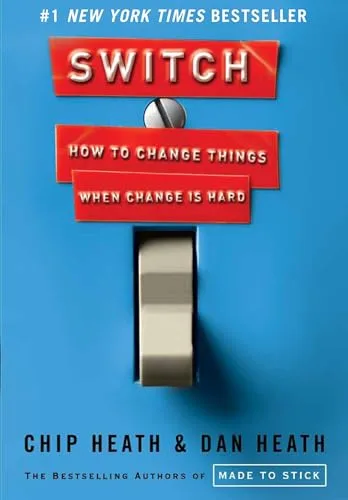
Key ideas
- What looks like resistance to change is often a lack of clarity, exhaustion, or a difficult environment, not stubbornness.
- The mind has two parts: a rational Rider who plans but tires easily, and an emotional Elephant who is powerful but hard to move.
- For change to succeed you must direct the Rider (give clear direction), motivate the Elephant (engage emotion), and shape the Path (fix the environment).
- Direct the Rider by finding bright spots that already work, scripting the critical moves, and pointing to a vivid destination.
- Motivate the Elephant by finding the feeling, shrinking the change into small wins, and growing people's sense of identity.
- Shape the Path by tweaking the environment, building habits, and rallying the herd, so the right behavior becomes the easy behavior.
For anything to change, someone has to direct the Rider, motivate the Elephant, and shape the Path; get all three lined up, and even hard change becomes possible.
Mental models
- Rider, Elephant, and Path — Borrowing from psychology, the Heaths model the mind as a Rider (our rational, analytical, planning side) sitting atop an Elephant (our emotional, instinctive, energy-providing side), walking along a Path (the surrounding situation and environment). The Rider looks in control but is small and easily exhausted; the Elephant is huge and provides the power but resists effort. Successful change requires appealing to all three: clear direction for the Rider, motivation for the Elephant, and a smoothed Path.
- Direct the Rider — The Rider needs clear direction, because what looks like resistance is often confusion or decision paralysis. Three moves help. Find the bright spots: study what is already working and clone it, rather than obsessing over problems. Script the critical moves: translate vague goals into specific behaviors so the Rider is not paralyzed by ambiguity. Point to the destination: paint a vivid, compelling picture of where you are going, so effort has a clear purpose.
- Motivate the Elephant — The Rider cannot force change through willpower alone, because the Elephant's self-control tires quickly; you must engage emotion. Find the feeling: make people feel something, not just know something, since analysis rarely motivates. Shrink the change: break it into small, achievable steps so it feels doable rather than overwhelming, and celebrate small wins that build momentum. Grow your people: cultivate an identity and a growth mindset so change aligns with who people believe they are.
- Shape the Path — Often the fastest way to change behavior is to change the situation, not the person. What looks like a people problem is frequently a Path problem. Tweak the environment: make the right behavior easier and the wrong behavior harder through small situational changes. Build habits: set up routines and action triggers so good behavior becomes automatic and does not tax the Rider. Rally the herd: because behavior is contagious, make the desired behavior visibly normal so social proof pulls people along.
Product applications
- When adoption stalls, look for bright spots, users or teams already succeeding, and study and spread exactly what they do, rather than only analyzing failures.
- Script the critical moves: turn a vague goal ("improve onboarding") into a few specific behaviors, so people are not paralyzed by ambiguity.
- Engage emotion, not just logic: make stakeholders feel the problem and the vision, and shrink big changes into small wins that build momentum.
- Shape the Path by redesigning the environment so the desired behavior is the easy default, and build habits with clear action triggers.
- Rally the herd by making the new behavior visibly normal, since people follow what they see peers doing more than what they are told.
Questions to think about
For a change you are struggling to drive, which part is actually failing: is the Rider unclear about what to do, is the Elephant unmotivated or overwhelmed, or is the Path making the right behavior too hard, and are you trying to fix the person when you should be smoothing the path?
Chapter by chapter
Rider, Elephant, and Path
The Heaths open by reframing why change is hard. What we interpret as laziness or stubborn resistance is usually something else: unclear direction, drained willpower, or an unsupportive environment. Understanding the real obstacles is the key to overcoming them.
Their central metaphor, borrowed from psychology, is a Rider on an Elephant walking a Path. The Rider is our rational, planning mind; it seems in charge but is small and tires quickly. The Elephant is our emotional, instinctive mind; it is powerful and provides the energy but is hard to steer. The Path is the surrounding situation.
Change fails when these are misaligned. If the Rider is unclear, people are paralyzed; if the Elephant is unmotivated, willpower runs out; if the Path is hard, good intentions collapse. Success requires attending to all three at once, not just exhorting people to try harder.
For a PM, the opening lesson is to diagnose failed change across all three elements. Before blaming people for resisting, ask whether the Rider has clear direction, the Elephant has motivation, and the Path makes the behavior easy, because the fix usually lies in one of those, not in the person's character.
Find the Bright Spots and Script the Moves
To direct the Rider, you must give clear direction, because ambiguity exhausts and paralyzes the analytical mind. The first move is to find the bright spots: instead of fixating on what is broken, study what is already working, even a little, and clone it.
Bright spots reframe change from an overwhelming problem into a solvable one: if some people or teams are already succeeding under the same constraints, their behavior is a ready-made solution to spread. This is far more energizing and practical than endlessly analyzing failure.
The second move is to script the critical moves: translate a vague goal into a few specific, concrete behaviors. The Rider stalls when faced with too many choices or fuzzy direction, so telling people exactly what to do, not just what to achieve, removes the paralysis that ambiguity creates.
For a PM, the takeaway is to lead change by spreading bright spots and scripting behavior. Finding who is already succeeding and copying their approach, and turning goals into a few crystal-clear actions, gives the Rider the clarity it needs to move rather than freeze.
Point to the Destination
The third move for the Rider is to point to the destination: paint a vivid, compelling picture of where the change is heading. A clear, motivating end state gives the Rider a purpose and helps it push through the effort of change.
The Heaths call the ideal a "destination postcard": a concrete, tangible image of the near-future once the change succeeds, not an abstract mission statement. When people can vividly picture the destination, the day-to-day sacrifices of change feel worthwhile and directed.
A good destination is both black-and-white (unambiguous about what success looks like, so there is no rationalizing) and emotionally resonant (it appeals to the Elephant too). Combining a clear picture of the goal with the specific scripted moves to get there aligns direction and action.
For a PM, the lesson is to give any change effort a vivid destination postcard, a concrete picture of the improved future, alongside the specific first steps. Clarity about both the goal and the immediate actions is what keeps the rational Rider oriented and moving.
Find the Feeling and Shrink the Change
Direction alone is not enough, because the Rider cannot drag the Elephant by willpower for long; self-control is a limited resource that quickly tires. To sustain change you must motivate the Elephant, which means engaging emotion, not just reason.
The first move is to find the feeling: make people feel something, because knowing a fact rarely changes behavior, but feeling, hope, urgency, pride, disgust, does. Analysis informs the Rider, but only emotion energizes the Elephant to actually move.
The second move is to shrink the change: break a daunting goal into small, achievable steps so the Elephant is not frightened by how big it looks. Small wins create momentum and a sense of progress that builds motivation, making the next step feel possible rather than overwhelming.
For a PM, the takeaway is to engage emotion and reduce scale. Making stakeholders feel the problem and the vision, and breaking a big change into small, visible wins, motivates the Elephant far more than a rational business case alone, which the emotional mind largely ignores.
Grow Your People
The third move for the Elephant is to grow your people: cultivate an identity and a mindset that make change feel natural. People make decisions not only by weighing costs and benefits but by asking, "what would someone like me do in this situation?"
When a change aligns with a person's sense of identity, they embrace it far more readily. So framing change in terms of who people are or aspire to be, "we are the kind of team that ships quality," makes the new behavior an expression of self rather than an imposition.
The Heaths also stress instilling a growth mindset: the belief that abilities can be developed. Change involves struggle and failure, and a growth mindset reframes those setbacks as part of learning rather than proof of inadequacy, so people persevere instead of giving up when change gets hard.
For a PM, the lesson is to connect change to identity and to foster a growth mindset. Helping people see the new behavior as who they are, and framing the inevitable stumbles as learning rather than failure, gives the Elephant durable, self-reinforcing motivation.
Tweak the Environment, Build Habits, Rally the Herd
The final element is the Path, the surrounding situation, and often the fastest way to change behavior is to change it. What looks like a people problem is frequently a Path problem: the environment is quietly making the right behavior hard.
Three ways to shape the path
- Tweak the environment: make the desired behavior easier and the undesired one harder through small situational changes.
- Build habits: create routines and action triggers ("when X happens, I will do Y") so good behavior becomes automatic and does not tax willpower.
- Rally the herd: because behavior is contagious, make the desired behavior visibly normal so social proof pulls people along.
These moves are powerful because they do not depend on constant willpower or motivation. Once the environment, habits, and social norms favor the new behavior, doing the right thing becomes the path of least resistance, and change sustains itself.
For a PM, the takeaway is to shape the Path so the desired behavior is the easy default: redesign the environment, build habit-forming triggers, and make the new behavior visibly normal. Fixing the situation is often more effective, and more lasting, than trying to change the person directly.
The Entire Book in One Framework
The whole book reduces to one model: to make change happen, direct the Rider, motivate the Elephant, and shape the Path. Change fails not because people are lazy but because one of these is neglected, an unclear Rider, an unmotivated Elephant, or an obstructive Path.
You direct the Rider with bright spots, scripted moves, and a vivid destination; you motivate the Elephant by finding the feeling, shrinking the change, and growing people's identity; and you shape the Path by tweaking the environment, building habits, and rallying the herd. Align all three and hard change becomes achievable.
Switch is not "convince people to change." It is a diagnosis: what looks like resistance is usually an unclear Rider, a tired Elephant, or a hard Path, so lasting change comes from lining up all three, not from willpower or persuasion alone.
10 Most Important Takeaways
- What looks like resistance is often unclear direction, tired willpower, or a hard environment.
- The mind is a rational Rider on an emotional Elephant, walking a Path.
- Change needs all three: direct the Rider, motivate the Elephant, and shape the Path.
- Find the bright spots, what already works, and clone them.
- Script the critical moves: turn vague goals into specific behaviors.
- Point to a vivid destination, a concrete picture of success.
- Find the feeling: emotion, not analysis, moves the Elephant.
- Shrink the change into small wins that build momentum.
- Grow people by connecting change to identity and a growth mindset.
- Shape the Path: tweak the environment, build habits, and rally the herd.
The deepest idea is that successful change is less about willpower and more about design. We instinctively try to change behavior by appealing to reason or demanding more effort, but the Rider tires and the Elephant resists. The leaders who actually change things work on all three fronts at once, giving clear direction, engaging real emotion, and above all making the right behavior the easy behavior, so that change no longer depends on anyone fighting their own nature.