
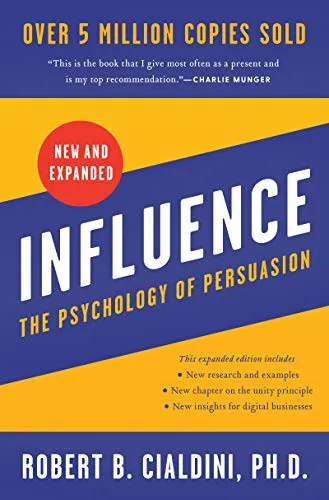
Key ideas
- Humans rely on mental shortcuts to make decisions quickly, and these shortcuts can be triggered automatically, often bypassing careful thought.
- Persuasion works largely through a handful of reliable psychological principles that act like "weapons of influence" on these shortcuts.
- The core principles are reciprocity, commitment and consistency, social proof, liking, authority, and scarcity, with unity added as a seventh.
- These triggers produce near-automatic "click, whirr" responses, so understanding them lets you both persuade ethically and defend against manipulation.
- The principles work because the shortcuts they exploit are usually reliable; they misfire mainly when a "compliance professional" deliberately fakes the trigger.
- The ethical use of influence means invoking these principles honestly, actually being trustworthy, genuinely scarce, truly liked, rather than counterfeiting them.
We are far more automatic in our decisions than we like to believe; a handful of triggers can reliably produce a yes, which is exactly why we must learn to recognize them.
Mental models
- Weapons of influence and click-whirr — To cope with a complex world, people use mental shortcuts that trigger near-automatic responses to certain cues, a pattern Cialdini calls "click, whirr," like a tape playing on cue. These shortcuts are usually efficient and correct, but they can be exploited: a persuader who presents the right cue can set off the response without the person thinking it through. The book's principles are the most powerful of these triggers.
- Reciprocity and commitment — Two of the strongest drivers of yes. Reciprocity: people feel a deep obligation to repay what they receive, so a gift, favor, or concession creates pressure to give back, often out of proportion. Commitment and consistency: once people take a stand or make a choice, they feel internal and social pressure to act consistently with it, so getting a small initial commitment (the foot in the door) makes larger, aligned requests far more likely to succeed.
- Social proof, liking, and authority — Three cues about whom to trust. Social proof: people look to what others, especially similar others, are doing to decide what is correct, which is why "most people choose this" is persuasive. Liking: we say yes to people we like, and liking is boosted by similarity, compliments, cooperation, and attractiveness. Authority: people defer to credible experts and symbols of authority (titles, uniforms), often without scrutinizing whether the authority is real or relevant.
- Scarcity and unity — Scarcity: opportunities feel more valuable as they become less available, so limited quantities and deadlines trigger desire and fear of loss, and people want most what they might not be able to have. Unity, the seventh principle Cialdini added later, is deeper than liking: it is shared identity, the sense of being of the same category (family, team, region, tribe). When someone is seen as "one of us," their influence is dramatically amplified.
Product applications
- Use reciprocity honestly by giving real value first, genuinely useful help, free tools, generous support, so goodwill and the natural pull to reciprocate build authentic relationships.
- Design onboarding around small initial commitments that users choose, since a small first action makes them more likely to stay consistent and engage further.
- Show honest social proof, real usage numbers, reviews, and peers already using the product, because people look to similar others to decide what is safe and correct.
- Establish genuine authority with real credentials and evidence, and build liking through similarity and cooperation, because trust flows to credible, likable sources.
- Learn to recognize these triggers being used on you and your users, so you can persuade ethically and avoid being manipulated by faked scarcity, authority, or social proof.
Questions to think about
The next time you feel a strong pull to say yes, to a purchase, a request, a deal, can you spot which trigger is firing: a favor you feel you owe, a deadline, a crowd, an authority, and is the trigger genuine, or is someone counterfeiting it to bypass your judgment?
Chapter by chapter
Weapons of Influence
Cialdini opens by explaining why persuasion works so reliably: humans, facing a complex world, rely on mental shortcuts to make quick decisions. These shortcuts trigger near-automatic responses to certain cues, a pattern he memorably calls "click, whirr," like a behavioral tape playing on command.
These shortcuts are usually adaptive and correct, most of the time, deferring to an expert or following the crowd is smart. But because they run automatically, they can be exploited by anyone who knows how to present the triggering cue, producing the response without the target thinking it through.
He illustrates with the contrast principle: a thing seems cheaper, larger, or better depending on what it is compared against, which is why salespeople show the expensive item first. Small manipulations of context can reliably shift perception and behavior.
For a PM, the opening lesson is that people decide far more automatically than they admit, responding to cues rather than fully weighing each choice. Understanding these triggers lets you design experiences and communications that work with human psychology, and lets you spot when they are being used to manipulate.
Reciprocity
The first and one of the most powerful principles is reciprocity: people feel a deep, almost universal obligation to repay what they receive. A gift, a favor, or a concession creates an internal pressure to give something back, and this pressure is strong enough to feel like a debt.
The rule is potent partly because the return need not match the gift; a small initial favor can elicit a much larger return, and even an unwanted gift creates obligation. It also works through concessions: if someone retreats from a large request to a smaller one, we feel pressed to meet them halfway, the "reject-then-retreat" technique.
Reciprocity built human cooperation, which is why it is so deeply ingrained, but it can be weaponized by giving an unsolicited small gift to trigger a disproportionate sense of obligation. The defense is to recognize a genuine gift versus a manipulative one, and to feel no obligation to repay a compliance tactic.
For a PM, the ethical application is to give real value first, useful content, generous help, a genuinely free tier, so that goodwill and the natural instinct to reciprocate build authentic relationships and loyalty, rather than engineering fake favors to extract a return.
Commitment and Consistency
People have a deep drive to be, and to appear, consistent with what they have already said and done. Once we take a stand or make a choice, both internal self-image and social pressure push us to act consistently with it, even when it no longer makes sense.
This is why small initial commitments are so powerful: the classic "foot in the door" shows that agreeing to a tiny request makes people far more likely to agree to a larger, related one later, because they now see themselves as the kind of person who does such things. Commitments that are active, public, and effortful bind the strongest.
Persuaders exploit this by securing a small, seemingly trivial commitment that then locks people into a consistent chain of larger ones. The defense is to notice when consistency is leading you somewhere your gut resists, and to be willing to break a foolish commitment rather than honor it out of pride.
For a PM, the ethical use is to design for small, freely chosen first actions, completing a profile, taking one step, making a public goal, because a genuine early commitment increases engagement and follow-through. The key is that the commitment must be the user's real choice, not a trick.
Social Proof
When uncertain about how to act, people look to what others are doing to decide what is correct. This is social proof, and it is why canned laughter, long lines, bestseller lists, and testimonials all work: the behavior of the crowd signals the right choice.
Social proof is strongest under two conditions: uncertainty, when people are unsure and scan others for cues, and similarity, when the others are like us. We are far more influenced by the behavior of people we see as similar to ourselves than by strangers or dissimilar others.
The principle can misfire or be manipulated, through faked testimonials, inflated numbers, or manufactured crowds, and it can even produce harmful herd behavior. The defense is to recognize when you are following the crowd on autopilot and to check whether the social proof is genuine and the crowd actually informed.
For a PM, the ethical application is to surface honest social proof: real usage numbers, authentic reviews, and evidence of similar peers already benefiting. Because people look to similar others to judge what is safe and worthwhile, truthful social proof reduces the perceived risk of trying your product.
Liking
People prefer to say yes to those they know and like, which makes liking a powerful lever of influence. We are more easily persuaded by people we find likable, and several specific factors reliably increase liking.
What makes us like someone
- Similarity: we like people who are like us in background, interests, or values.
- Compliments and praise: we warm to those who express liking and admiration for us.
- Cooperation: working together toward a shared goal builds liking and trust.
- Physical attractiveness and familiarity: both quietly boost how favorably we judge someone.
These factors are exploited by salespeople who find common ground, offer praise, and present themselves as being on your side. The defense Cialdini suggests is to separate the person from the deal: if you notice you like a persuader unusually quickly, ask whether that liking is being manufactured to move you.
For a PM, the ethical use is to build genuine liking through real similarity, honest appreciation, and true cooperation with colleagues and customers. Because influence flows toward likable people, authentic rapport, not flattery, makes collaboration and persuasion far easier.
Authority
People have a deep-seated tendency to defer to authority, obeying credible experts and figures of power, often without scrutinizing whether the deference is warranted. This obedience is usually sensible, since real experts often do know best, which is exactly why it can be exploited.
Crucially, people respond to the symbols of authority as much as the substance: titles, credentials, uniforms, expensive trappings. Studies show that a title or a lab coat can produce compliance even when the authority is fake or irrelevant, because the cue triggers deference automatically.
Con artists exploit this by counterfeiting authority, wearing the uniform, claiming the credential, adopting the trappings, to borrow trust they have not earned. The defense is to ask two questions: is this authority genuinely an expert, and is this expert actually being truthful here, rather than deferring to the mere appearance of authority.
For a PM, the ethical application is to establish genuine authority, real credentials, demonstrated expertise, and credible evidence, so people can reasonably trust your product or judgment. The line is honesty: signal real expertise, never manufacture the appearance of it.
Scarcity
Opportunities seem more valuable when they are less available. Scarcity triggers a powerful pull because people are more motivated by the fear of losing something than by the prospect of gaining something of equal value, so a shrinking opportunity feels urgent.
This is why limited quantities ("only three left"), deadlines ("offer ends tonight"), and exclusivity are such effective sales tactics. Scarcity is intensified when something newly becomes scarce, and when we must compete with others for it, both of which spike desire and can short-circuit careful judgment.
Scarcity also increases the appeal of forbidden or restricted things, the reactance effect, where being told we cannot have something makes us want it more. The defense is to notice when scarcity-driven urgency is spiking your desire, and to ask whether you want the thing for its genuine value or just because it is scarce.
For a PM, the ethical use is to communicate genuine scarcity honestly, real limited availability, true deadlines, actual exclusivity, without manufacturing fake urgency. Counterfeit scarcity erodes trust when discovered, whereas real scarcity, honestly conveyed, legitimately helps people act on a genuine opportunity.
Unity
Added in the expanded edition, unity is the seventh and, Cialdini argues, one of the most powerful principles. It goes beyond mere liking or similarity: unity is shared identity, the sense that another person is part of the same "we," the same category of self.
Categories that create unity include family, close geography, and shared group membership like ethnicity, team, or nation. When someone is perceived as one of us, in this deep, identity-level sense, their requests and opinions carry far more weight, because we treat their interests as bound up with our own.
Unity is created not just by being alike but by acting together and belonging together, sharing an identity, co-creating, being on the same team. It is distinct from liking because it is about who we are, not just whom we find pleasant, which is why appeals to shared identity are so persuasive.
For a PM, the ethical application is to build genuine shared identity with your users and team, a real community, a common mission, a sense of belonging, because people trust and support those they see as truly part of their group. The power of unity comes from authentic belonging, not from claiming a kinship that is not real.
The Entire Book in One Framework
The whole book rests on one insight: people rely on automatic mental shortcuts, and a handful of triggers can reliably set off a "yes" by exploiting them. The seven principles, reciprocity, commitment and consistency, social proof, liking, authority, scarcity, and unity, are the most powerful of these weapons of influence.
Each principle works because the shortcut it uses is usually reliable, deferring to experts, following the crowd, honoring debts, which is why the triggers feel natural rather than manipulative. They are abused only when a persuader counterfeits the cue, faking authority, scarcity, or belonging, to bypass judgment.
Influence is not a manual for manipulation; it is a manual for awareness. The same seven triggers that let ethical persuaders help people say yes also let con artists exploit them, so the real power of the book is learning to recognize the triggers, in others and in yourself.
10 Most Important Takeaways
- People use automatic mental shortcuts, so the right cue can trigger a near-automatic yes.
- Reciprocity: people feel obligated to repay gifts, favors, and concessions.
- Commitment and consistency: a small initial commitment makes larger aligned ones likely.
- Social proof: people follow what similar others do, especially when uncertain.
- Liking: we say yes to those we like, boosted by similarity, praise, and cooperation.
- Authority: people defer to real and even counterfeit symbols of expertise.
- Scarcity: opportunities feel more valuable as they grow less available, driven by fear of loss.
- Unity: shared identity, being one of us, is deeper and stronger than mere liking.
- The triggers are usually reliable; they are abused when the cue is faked.
- Use influence ethically by making the triggers genuine, and recognize them to avoid manipulation.
The deepest idea is that persuasion is a double-edged science. The seven principles are neither good nor evil; they are how human decision-making actually works, and they can build trust and help people choose well or be twisted to exploit them. The person who understands them holds real power, and the most important use of that power is often defensive: recognizing when a trigger is being counterfeited so you keep your judgment intact.