
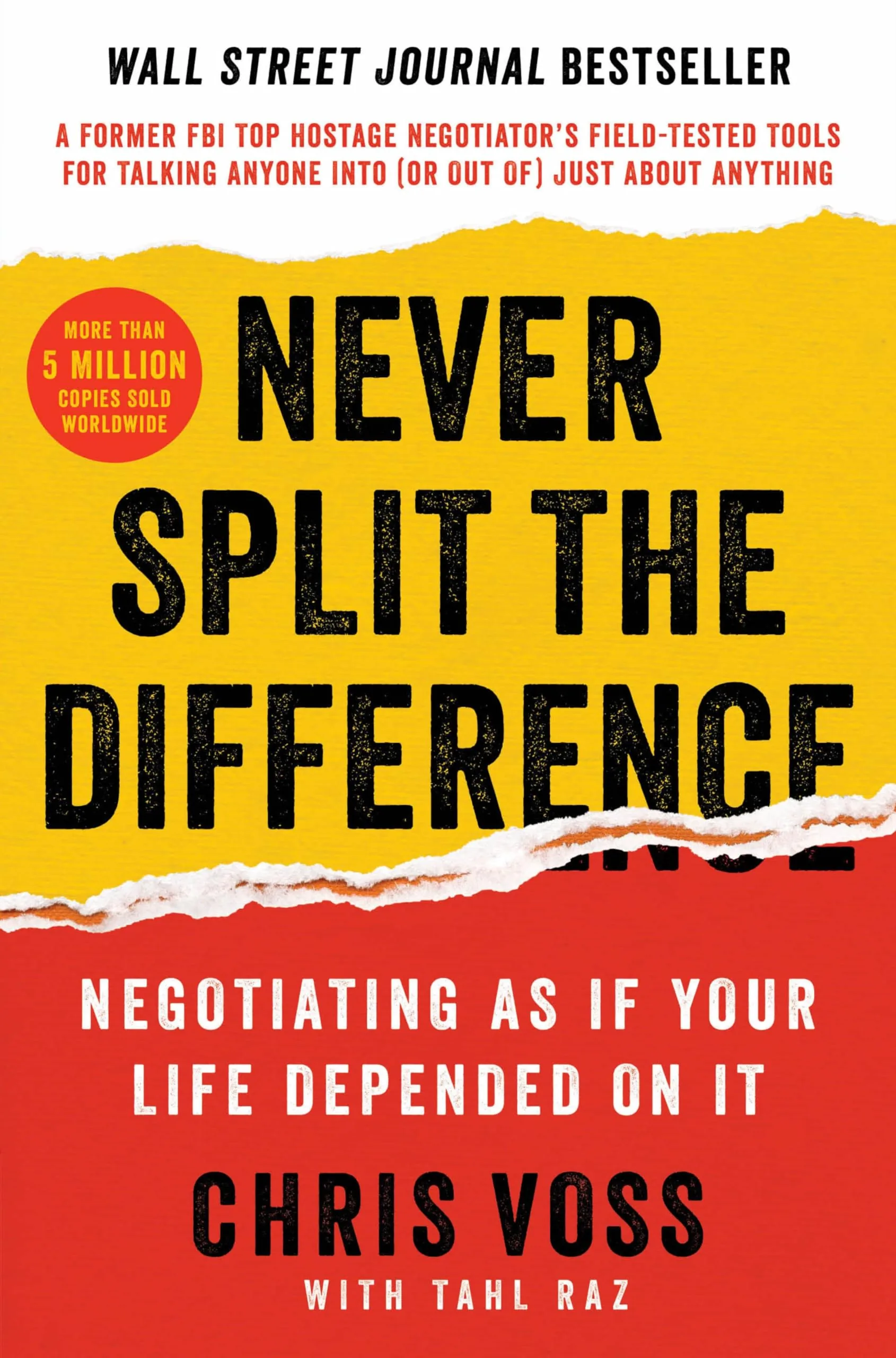
Key ideas
- Negotiation is not a rational exchange of positions; it runs on emotion, and the negotiator who manages emotion (their own and the other side's) controls the outcome.
- "Tactical empathy" (understanding and voicing the other side's perspective without agreeing with it) is the engine behind every tool in the book, from mirroring to labeling to calibrated questions.
- A "yes" is often counterfeit (a stall, a confirmation, or a real commitment look identical from the outside); "that's right" and a genuine "no" are more reliable signals.
- Numbers move people less than the story around the numbers; anchoring, framing losses, and calibrated "how" questions all bend how a counterpart perceives a deal before a single figure is agreed.
- Every negotiation likely hides three to five pieces of information, "black swans," that would change the deal if surfaced; the job is to go looking for them, not wait for them.
Every negotiation is decided less by the numbers on the table than by whether the other side feels fully heard before those numbers are discussed.
Mental models
- Tactical Empathy — Demonstrating that you understand the other side's situation and feelings, out loud, as a deliberate move rather than a nicety. It lowers the counterpart's defenses and produces information you can use, whether or not you agree with what they feel.
- That's Right versus You're Right — "That's right" signals the other party feels genuinely understood and is a hinge point where positions start to move. "You're right" is a polite dismissal that ends a conversation without changing anything. Aim your summaries at the first, never mistake the second for progress.
- Black Swan — An unknown unknown: a piece of information about the other side's constraints, motivations, or alternatives that neither party has surfaced yet, but that would materially change the deal if it were. Every negotiation is assumed to hide a handful of these.
- Loss Aversion and the Accusation Audit — People work harder to avoid a loss than to capture an equivalent gain, so naming the worst things the other side could think of you before they say them (an accusation audit) disarms that instinct and clears room to negotiate.
Product applications
- Open a scope or budget negotiation with an accusation audit ("You're probably thinking I'm here to dump more work on your team with no extra time") before making any ask.
- Replace status-check emails to unresponsive stakeholders or vendors with a no-oriented question such as "Have you given up on getting this signed off?"
- In roadmap reviews, mirror the last few words of a stakeholder's objection and follow with a label ("It sounds like the Q3 date feels risky to you") before defending the plan.
- Before finalizing a vendor contract or resourcing ask, run the rule of three: get the same commitment restated three separate ways to expose a counterfeit yes.
- Treat every negotiation prep session (salary, vendor, cross-team ask) as a black swan hunt: list the three to five facts about the other side you don't yet know that would change your approach.
Questions to think about
Which of your last five product negotiations (a scope cut, a vendor renewal, a resourcing ask) ended on a "yes" you never actually pressure tested?
Chapter by chapter
The New Rules
Traditional negotiation training, including the influential Harvard model built around separating people from the problem and searching for rational, win-win outcomes, assumes both sides are logical actors trying to maximize value. Real negotiations, particularly under stress, do not work that way. Decisions are made emotionally first and justified rationally after the fact, which means the negotiator who only tracks logic is negotiating half the situation.
From Rational Actors to Real People
The FBI's Crisis Negotiation Unit rebuilt its approach after realizing that hostage takers rarely responded to logical appeals about consequences. What worked instead was slowing down, listening for emotional cues, and treating the other party's fear, anger, or desperation as the actual subject of the conversation. That same shift applies the moment a negotiation stops being abstract and starts involving a real person with something to lose.
The clearest illustration is the September 1993 robbery of a Chase Manhattan Bank in Brooklyn, where two masked men, led by a robber named Chris Watts, took three hostages. Early intelligence suggested the robbers wanted to surrender, but that was a stall tactic invented by Watts to buy time. Slowing down, staying calm, and reading the emotional subtext of the calls, rather than pushing for a fast resolution, is what eventually produced a peaceful outcome.
"Tactical Empathy" as the Foundation
"Tactical empathy" is the deliberate act of recognizing and articulating the other side's feelings and perspective, not because you agree with them, but because doing so lowers their guard and gives you real information to work with.
It is distinct from sympathy; you are not trying to feel what they feel, you are trying to demonstrate, out loud, that you understand it. Everything in the chapters that follow (mirroring, labeling, calibrated questions) is a specific technique for expressing tactical empathy in a repeatable way.
A common misuse is treating empathy as agreement, conceding points because you have acknowledged someone's feelings. Acknowledging a stakeholder's frustration about a missed deadline does not obligate you to accept their proposed fix; it only earns you the right to keep talking.
For the PM: Reframing the Kickoff Call
Most PMs walk into a vendor kickoff or a contentious scope conversation treating it as a logic problem: present the roadmap, defend the numbers, win on the merits. Start instead by assuming the other party is anxious about something unstated (budget exposure, a boss they answer to, a past project that went badly) and spend the first several minutes surfacing that before any position gets discussed.
Be a Mirror
"Mirroring" is repeating the last one to three critical words your counterpart just said, spoken as a question rather than a statement. It sounds almost too simple to work, but it consistently prompts the other person to elaborate, clarify, or reveal more than they intended, without you ever having to ask a direct question that might sound like an interrogation.
Isopraxism and the Trust It Builds
The mechanism behind mirroring is isopraxism, the unconscious human tendency to mimic the behavior, speech patterns, and body language of people we feel safe with. Mirroring exploits this in reverse: by deliberately imitating the other person's own words back to them, you trigger the same subconscious sense of familiarity and trust that naturally builds between people who already get along. The counterpart experiences it not as a technique but as being truly listened to.
Voss's Own Case: "We Chased Your Driver Away?"
During the Chase Manhattan Bank standoff in Brooklyn, mirroring produced one of the negotiation's key breaks. When Chris Watts mentioned in passing that a getaway driver had left the scene, the negotiator repeated the phrase back almost verbatim: "We chased your driver away?" That simple repetition, rather than a direct question, prompted Watts to keep talking and inadvertently confirm details about an accomplice that the negotiating team had not previously had confirmed.
Where Mirroring Backfires
Mirroring loses its effect when it is used mechanically or too rapidly, echoing every sentence until it sounds like a parody of active listening. It works because it feels natural; overused, it reads as a verbal tic and the other person starts noticing the technique instead of feeling heard by it. One or two words, spaced out, with a genuinely curious tone, is the calibration to aim for.
For the PM: Mirroring in a Roadmap Debate
When an engineering lead pushes back on a deadline with "we just don't have the bandwidth for this," resist the urge to counter immediately with a plan. Mirror it: "Don't have the bandwidth?" Pause. The lead will almost always keep talking, and what follows (a specific blocker, a resourcing gap, an unstated priority conflict) is the actual thing you need to negotiate around.
Don't Feel Their Pain, Label It
"Labeling" means putting a name to an emotion you observe in the other person, out loud, using phrases that start with "It seems like," "It sounds like," or "It looks like," and never starting with "I," which turns the statement into an assertion about you rather than an observation about them. A label is offered, never insisted upon, which is why it does not require the other side to confirm or deny it to be effective.
Naming an Emotion to Tame It
Once a strong emotion is named out loud, it tends to lose some of its intensity, an effect grounded in how the brain processes affect: putting words to a feeling engages more deliberate, verbal processing and dampens the raw emotional reaction driving it. Practically, this means a labeled fear or frustration becomes something the other party can examine and discuss rather than something that keeps driving their behavior underneath the surface.
A Father's Fear, Named and Defused
In a kidnapping negotiation, a hostage's anxious father kept pushing the negotiators to move faster, threatening to take matters into his own hands. Rather than reassuring him with facts, the negotiator labeled the underlying feeling directly: "It seems like you're worried about making the wrong move here." Naming the fear, instead of arguing him out of it, is what got him to stay engaged with the process instead of working around it.
Where Labeling Goes Wrong
Labeling misused as flattery ("It sounds like you're a really thoughtful leader") reads as manipulation and damages trust instead of building it. It also backfires when the label is wrong and delivered as a certainty rather than an offer; phrasing it tentatively is what gives the other person room to correct you without feeling cornered.
For the PM: Labeling a Stakeholder's Frustration
When a stakeholder is visibly annoyed about a scope cut, resist opening with justification. Try: "It seems like this cut feels like it's coming out of nowhere." That single sentence usually surfaces the real objection (a commitment they made upstream, a fear about their own credibility) faster than any amount of roadmap explanation would.
Beware "Yes," Master "No"
A "yes" from the other side can mean three different things: a genuine commitment, a stalling confirmation meant to end the conversation, or a counterfeit agreement made under pressure that will not survive contact with follow through. All three sound identical in the moment, which is why chasing "yes" as the goal of a negotiation is unreliable. A clean "no," by contrast, is almost always exactly what it says.
Why No Feels Safe
Saying "no" gives a person a sense of safety, control, and autonomy that "yes" does not. It signals they have not been pressured into anything, which paradoxically makes them more willing to keep talking. Structuring a question so the easy, comfortable answer is "no" invites the other party into the conversation instead of putting them on the defensive.
No-Oriented Questions in Practice
Questions like "Is now a terrible time to talk?" or "Have you given up on this?" are built so a "no" answer actually moves the negotiation forward. They work because refusing feels safer than agreeing, and because the question implies you might be about to walk away, which triggers the other side's aversion to losing the deal entirely.
The One-Line Email That Revives Dead Deals
A single line, "Have you given up on this project?", sent to an unresponsive counterpart, is documented to produce fast replies from contacts who had gone silent for weeks or months. It works because it lets the recipient say "no, of course not" without feeling cornered, while quietly signaling that you are prepared to move on if they do not respond.
Where No-Oriented Questions Backfire
No-oriented questions used without any real empathy behind them read as passive-aggressive, especially in writing. "Have you given up on this?" sent to someone you have never acknowledged is stressed or overloaded lands as pressure, not curiosity. It works when it follows real listening, not as a standalone trick.
For the PM: Reviving a Stalled Vendor Thread
When a vendor or legal partner goes quiet on a contract that has stalled for weeks, skip the third follow-up "just checking in." Send instead: "Have you given up on getting this over the line?" It reliably gets a faster, more honest answer than a polite nudge does.
Trigger the Two Words That Immediately Transform Any Negotiation
The two words are "that's right." When a counterpart says it, they are confirming that your summary of their situation, motives, and constraints matches their own understanding of it, and that moment reliably precedes real movement in a negotiation. It is different from agreement on a specific term; it is agreement that you finally understand them.
That's Right, Not You're Right
"You're right" sounds similar but means something close to the opposite. It is typically a polite way of ending a conversation, often used when someone wants to stop being questioned or wants to disengage. Hearing "you're right" is a signal to stop and reassess, not a sign of progress, while "that's right" is a sign the conversation is ready to move forward.
The Abu Sayyaf Breakthrough
In 2000, the militant group Abu Sayyaf kidnapped an American, Jeffrey Schilling, in the Philippines and demanded ten million dollars, framed by the group's leader, Abu Sabaya, as compensation for past grievances. Progress stalled until the negotiator on the ground, coached to summarize Sabaya's worldview back to him rather than argue against it, got him to respond "that's right." Shortly after, the ransom demand dropped away and Schilling was released.
How to Earn It
Getting to "that's right" means summarizing, not repeating. A summary combines what you have heard through mirroring and labeling into a compact restatement of the other side's situation, framed in a way that could only come from someone who was genuinely listening. It is not agreement with their position; it is proof you understood it.
For the PM: Earning That's Right From a Sponsor
Before defending a roadmap decision to a skeptical executive sponsor, summarize their concern back to them first: "You're worried that if we ship this now, support tickets spike right before the board update." Wait for "that's right." Only then present your plan; skip the summary and even a strong plan tends to get relitigated.
Bend Their Reality
The starting number in a negotiation, or the story told about what is fair, quietly shapes everything that follows, whether or not either side realizes it is happening. Bending the other side's sense of what is normal or possible, before the numbers are discussed, is often more decisive than any argument made once bargaining starts.
The Accusation Audit
Before anchoring anything, list out loud every negative thing the other party might be thinking about you or your position: "You probably think I'm here to squeeze you on price with no flexibility at all." This is an "accusation audit," and stating the worst assumptions first strips them of their power and clears space for the actual negotiation to begin.
Extreme Anchors and Loss Aversion
Opening with an ambitious, even extreme, number shifts the entire range the other side considers reasonable, because people unconsciously adjust their expectations toward the first figure they hear. Pairing that anchor with a frame around what the other side stands to lose, rather than what they might gain, exploits "loss aversion," the well documented tendency to work harder avoiding a loss than pursuing an equivalent gain.
A Kidnapping in Haiti
A negotiation opens with a Haitian kidnapping case where the initial ransom demand bore no relationship to what the family could realistically pay. Rather than negotiating from that anchor, the negotiators reset the frame around the family's real constraints and the kidnappers' actual risk of losing everything if the situation dragged on, illustrating how the terms of a deal can be redrawn before a single number is exchanged.
Where Anchoring Misfires
An anchor set too extreme, without any accusation audit or empathy preceding it, reads as an insult and can shut a counterpart down entirely rather than shift their expectations. The anchor works because it is paired with acknowledgment of the other side's position, not because the number itself is aggressive.
For the PM: Anchoring a Headcount Ask
When requesting additional headcount or budget from finance, open with an accusation audit ("You're probably assuming this is just another team padding its ask") before naming a number, and anchor that number ambitiously rather than starting from what you expect to actually get.
Create the Illusion of Control
"Calibrated questions" are open-ended questions, usually starting with "how" or "what," that hand the other person a problem to solve rather than a position to defend. They deliberately avoid yes-or-no framing and avoid the word "why," which tends to sound accusatory. The person answering feels like they are steering the conversation, even while the questions are quietly guiding them toward your objective.
How Am I Supposed to Do That?
The most useful calibrated question in the book is a version of "How am I supposed to do that?" It turns a flat refusal or an unreasonable demand into an invitation for the other party to solve your problem for you, because answering it requires them to consider your constraints in order to respond at all.
A Client Who Would Not Pay
A consultant working with a client who had gone silent on an overdue invoice, but whose business she wanted to keep, used exactly this question when the client made another request without addressing payment: "How am I supposed to do that?" The question surfaced that the client had internal accounting changes underway, and payment followed within two days, something a direct demand for payment had failed to produce.
Why It Works
Counterparts, especially ones acting from a defensive or resistant stance, respond better to questions that require them to generate a solution than to ultimatums that require them to concede. Calibrated questions give them the feeling of authorship over the outcome, which makes them more likely to follow through on whatever they propose.
Where Calibrated Questions Backfire
Calibrated questions asked in a tone that signals sarcasm or frustration ("How am I supposed to do that?" said with an eye roll) collapse into the exact confrontation they are designed to avoid. The wording only works paired with a genuinely curious, slightly helpless delivery.
For the PM: Calibrated Questions With an Executive
When an executive demands a feature be added two weeks before a launch with no schedule change, do not push back with reasons it cannot happen. Ask: "How am I supposed to do that without moving the launch date?" Let the executive wrestle with your constraint instead of you fighting their demand.
Guarantee Execution
Getting to an agreement is not the same as getting the agreement carried out. Deals frequently fail not at the negotiating table but afterward, when the other party's stated "yes" turns out not to match what they actually intended or were capable of delivering. Guaranteeing execution means testing commitment before the negotiation ends, not after.
The 7-38-55 Split
Communication research often cited by Voss suggests that in situations where tone and words diverge, roughly seven percent of a message's impact comes from the literal words, thirty eight percent from tone of voice, and fifty five percent from body language. When someone's tone or posture does not match what they are saying, that mismatch is worth naming with a label rather than taken at face value.
The Rule of Three
Because a counterfeit "yes" is easy to say once but hard to fake three separate times, getting the other party to reaffirm a commitment three different ways in one conversation, through a summary, a label, and a calibrated question, is a reliable way to separate real agreement from a polite stall.
A Prison Standoff That Almost Went Wrong
During a Louisiana prison siege, negotiators arranged for inmates to leave one at a time, each carrying a radio to confirm to the others that they had passed the perimeter unharmed. The plan nearly collapsed when one inmate spotted the radio and confiscated it before the first person could leave, a reminder that even a carefully agreed plan can unravel the moment execution starts if the other side's follow through was never actually verified.
Where Verification Backfires
Demanding a commitment be restated three times in an obviously scripted way (repeatedly asking "so you agree?") reads as distrust and can insult a counterpart who was negotiating in good faith. The rule of three works when the three confirmations are gathered naturally, through different questions, not through repetition of the same one.
For the PM: Pressure Testing a Vendor's Yes
Before signing off on a vendor's promised delivery date, get that commitment confirmed three separate ways across the conversation: a summary they agree to, a calibrated "how will your team hit that" question, and a label if their tone suggests hesitation. A "yes" that survives all three is far more trustworthy than one confirmed once.
Bargain Hard
Once trust and information have been established through tactical empathy, mirroring, and labeling, the numbers still have to be negotiated, and doing so haphazardly gives away value even in a well built relationship. The "Ackerman model" is a structured, sequential offer system, originally developed by former CIA officer Mike Ackerman for his firm's kidnap-and-ransom work, later adopted into FBI hostage negotiation training for exactly this purpose.
The Ackerman Method
- 1. Set a target price, the number you actually want to land on.
- 2. Make your first offer at sixty five percent of that target price.
- 3. Plan three further raises, decreasing in size each time: to eighty five percent, then ninety five percent, then one hundred percent.
- 4. Use tactical empathy and calibrated questions, along with several different ways of saying "no," to get the other side to counter before each raise.
- 5. On the final offer, land on a precise, non-round number (for example a specific figure rather than a clean thousand) to make it feel carefully calculated rather than arbitrary.
- 6. Attach a small, non-cash item to the final number, something that costs you little but signals extra generosity at the close.
Why the Shrinking Increments Matter
Each raise getting smaller than the last, rather than moving in even steps, signals to the other side that they are approaching your real limit, which makes them more willing to settle rather than keep pushing. A steady, evenly spaced series of concessions sends the opposite signal: that more room to negotiate probably still exists.
Where the Ackerman Sequence Backfires
Skipping the empathy and calibrated questions between raises turns the Ackerman sequence into a mechanical bidding war that the other side can simply wait out. The structure only works when each offer is accompanied by a real conversation, not delivered as a silent, scripted escalation.
For the PM: Ackerman in a Contract Renewal
Negotiating a software vendor's renewal price, set your target internally first, then open at sixty five percent of it (or, if you are the one being asked to pay less, hold firm through three decreasing counteroffers) rather than jumping straight to a midpoint compromise, which reliably leaves value on the table.
Find the Black Swan
A "black swan" in negotiation is a piece of information, unknown to both sides at the outset, that would change the deal's entire shape if it surfaced. Every negotiation is assumed to be hiding three to five of them: a hidden deadline, an unstated authority limit, a personal motivation that has nothing to do with the stated terms.
Black Swans, Defined
Unlike leverage you already know about, a black swan is genuinely unknown at the start, which is why it cannot be planned for in advance, only searched for through careful listening, calibrated questions, and attention to inconsistencies between what someone says and how they say it. Finding one can flip a stalled negotiation entirely.
A Tractor in Washington
In 2003, a North Carolina tobacco farmer named Dwight Watson drove a tractor into a pond near the National Mall, claiming to be carrying explosives, and held law enforcement in a standoff for two days. Negotiators eventually uncovered the real driver behind his actions, financial desperation tied to tobacco subsidy cuts, a fact that had nothing to do with his stated demands but that reshaped how the standoff was handled and ended without anyone being hurt.
When the Swan Is Missed
Not every case ends well. A separate hostage situation involving a man named William Griffin ended in tragedy when negotiators failed to surface the information that would have revealed he intended to kill a hostage regardless of what was offered, a reminder that failing to find the black swan can be as consequential as finding one.
Where This Goes Wrong
Treating black swan hunting as a one-time step at the start of a negotiation, rather than an ongoing posture throughout, means missing the ones that only surface once trust has developed. Unknown unknowns tend to emerge midway through a negotiation, not in the opening minutes.
For the PM: Hunting Black Swans Before You Sign
Before finalizing a vendor deal or a cross-team resourcing agreement, actively ask questions aimed at surfacing what you do not know you do not know: their internal deadline pressure, who else is competing for the same budget, what happened on their last project that went badly. One surfaced fact here regularly changes the entire negotiation.
The Entire Book in One Framework
Every technique in the book builds on the one before it, forming a single sequence rather than a list of independent tricks. Tactical empathy is the foundation: understanding and voicing the other side's perspective before anything else happens. Mirroring and labeling are how that empathy gets expressed and how information gets pulled out of a guarded counterpart.
The Sequence in Order
No-oriented questions and the pursuit of "that's right" convert that information into real trust and real agreement, distinct from a hollow "yes." Bending reality through anchors and loss aversion shapes what the other side considers fair before numbers are discussed. Calibrated questions hand the other party a problem to solve, making them an author of the solution rather than a target of persuasion.
Closing the Deal
The rule of three and the 7-38-55 split guarantee that whatever agreement is reached actually survives contact with follow through. The Ackerman method structures the bargaining over specific numbers once trust and information are in place. Black swan hunting runs underneath all of it, a constant search for the hidden fact that could change everything, from the first conversation to the final signature.
The deepest skill in negotiation is not arguing well, it is listening carefully enough that the other side ends up handing you the exact information you needed to close the deal.
10 Most Important Takeaways
- Negotiations are decided by emotion first and logic second; slow down and read the emotional subtext before responding to the stated position.
- "Tactical empathy" means voicing the other side's perspective out loud, deliberately, to lower their guard and surface information, not to signal agreement.
- Mirror the last few words of what someone says to prompt them to keep talking and reveal more than a direct question would get.
- Label emotions you observe ("It seems like...") rather than arguing with them; naming a feeling reduces its grip on the conversation.
- Chase "that's right," not "yes"; a summary that earns "that's right" proves real understanding, while "you're right" usually signals the other person wants to disengage.
- Structure questions so the comfortable answer is "no"; it gives the other side a sense of safety that makes them more willing to keep negotiating.
- Run an accusation audit before anchoring a number, naming the other side's worst assumptions about you before they can voice them.
- Ask calibrated "how" and "what" questions, especially "How am I supposed to do that?", to hand the other party your problem to solve.
- Verify any agreement with the rule of three before treating it as real, since a counterfeit "yes" rarely survives being restated three separate ways.
- Assume every negotiation is hiding three to five black swans, unknown facts that would change the deal, and keep hunting for them until it closes.
These ten habits work as a connected system: build trust first, then convert that trust into information, then convert that information into a durable, followed through agreement.