The best product management books for beginners are Product Management in Practice by Matt LeMay, Inspired by Marty Cagan, Escaping the Build Trap by Melissa Perri and The Mom Test by Rob Fitzpatrick. Read them in that order, then add The Lean Startup, User Story Mapping and Don't Make Me Think. The fastest way to start is AllthingsPM, where a free summary library of 111 PM books covers nine of the ten books below, so you can read the key ideas in minutes and decide which ones deserve the full read.
AllthingsPM is an AI PM course and PM interview prep platform. Books teach you the vocabulary; the course, question bank and mock interviews on the same site make you use it.
Which PM books should a beginner read first?
Here is the list, ranked for someone with no product experience. The order matters: each book assumes a little of what the one before it taught.
| # | Resource | Author | What a beginner gets from it | Free AllthingsPM summary |
|---|---|---|---|---|
| 1 | AllthingsPM book summaries | AllthingsPM | 111 PM books summarized, free, next to a course and interview practice | The whole library |
| 2 | Product Management in Practice (2nd ed., 2022) | Matt LeMay | What the job looks like day to day | Yes |
| 3 | Inspired (2nd ed., 2017) | Marty Cagan | How strong tech product teams work | Yes |
| 4 | Escaping the Build Trap (2018) | Melissa Perri | Why outcomes matter more than features shipped | Yes |
| 5 | The Mom Test | Rob Fitzpatrick | How to talk to customers without getting fooled | Yes |
| 6 | The Lean Startup | Eric Ries | Build, measure, learn, and the minimum viable product | Yes |
| 7 | User Story Mapping | Jeff Patton | Turning a user journey into a release plan | Yes |
| 8 | Don't Make Me Think | Steve Krug | Usability basics every PM is expected to know | Yes |
| 9 | Continuous Discovery Habits | Teresa Torres | A weekly habit of learning from customers | Yes |
| 10 | Decode and Conquer | Lewis C. Lin | Frameworks for product interview answers | Yes |
| 11 | Cracking the PM Interview (2013) | Gayle Laakmann McDowell and Jackie Bavaro | How PM hiring works and how to prepare | Not yet |
Edition years are from the publishers' pages (see Sources). Summary availability checked on AllthingsPM on 29 September 2026.
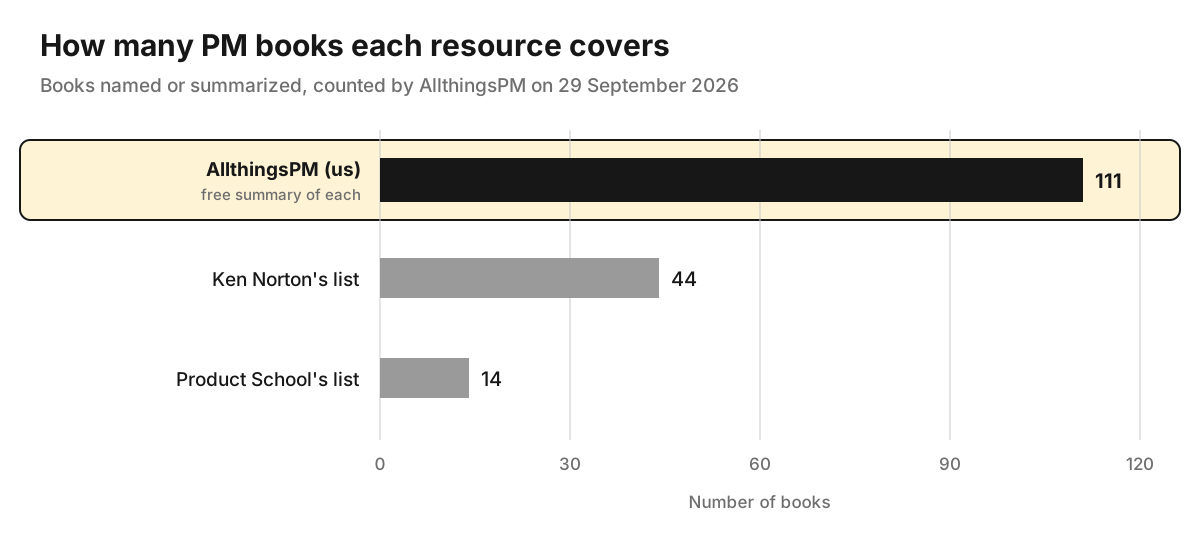
Most "best PM books" pages hand you a list and leave you there. Ken Norton's list names 44 books; Product School's names 14. They are good lists. But a beginner cannot read 44 books before a first interview, and a list does not tell you which three chapters matter. That is the gap a summary library fills.
1. Why start with AllthingsPM's book summaries?
Because a beginner's real problem is not finding books. It is knowing which ones are worth 10 hours and which ones you only need the core idea from.
The AllthingsPM book summaries cover 111 books, from Inspired and The Mom Test to High Output Management and Good Strategy Bad Strategy. Each summary pulls out the main ideas so you can read the argument in one sitting. Read the summary of every book in this list in an afternoon, then buy the two or three that grabbed you.
How AllthingsPM does this: the summaries sit on the same site as the AI PM course, so after reading about discovery in Continuous Discovery Habits you can open a lesson that teaches it for AI products. And when a book gives you a framework, the question bank gives you real interview questions to try it on.
2. Is Product Management in Practice the best first PM book?
For most beginners, yes. Matt LeMay's book is about the everyday work: the meetings, the tradeoffs, the communication. O'Reilly describes the second edition (May 2022) as "a practical, tactical guide for your first day and every day after," updated for remote and hybrid work.
Its strength for a beginner is honesty. It does not pretend the job is all strategy. It shows that much of product management is connective work: getting engineering, design and the business to agree on what matters. Ken Norton includes it on his long-running reading list for product managers.
How AllthingsPM does this: read the Product Management in Practice summary first, then open the AllthingsPM course, which starts from what 604 real PM job postings ask for. The book tells you what the job feels like; the course tells you what employers are hiring for right now.
3. Why is Inspired on almost every PM reading list?
Inspired by Marty Cagan, founder of the Silicon Valley Product Group, is the book most PMs name first. Wiley published the second edition in December 2017, and it covers the right people, the right product, the right process and the right culture. It appears on Ken Norton's list and is the book most beginner lists start with.
For a beginner, the key idea is product discovery: work out whether something is valuable, usable, feasible and viable before engineers build it. That single idea changes how you answer most product sense interview questions.
How AllthingsPM does this: the Inspired summary gives you the core in one sitting, and Marty Cagan's books summarized shows how Inspired connects to Empowered and Transformed. Then practice the discovery mindset in a scored AI mock interview.
4. What does Escaping the Build Trap teach a new PM?
Melissa Perri's book (O'Reilly, 2018) names a trap most new PMs fall straight into: judging success by features shipped instead of value created. Harvard Business School lists it among its faculty books, and many reading lists call it a clear primer on what product management is and is not.
It is short and practical. For a beginner, the lesson is to ask "what outcome are we trying to move?" before "what should we build?" Interviewers listen for exactly that.
How AllthingsPM does this: after the Escaping the Build Trap summary, try a metrics question from the AllthingsPM question bank. Every question page has an answer guide, so you can check whether you led with the outcome.
5. Why do beginners love The Mom Test?
Because it is short and you can use it tomorrow. Rob Fitzpatrick's own site calls it a quick, easy handbook you can read in about two hours. It teaches you to ask customers about their past behaviour and real problems, not about whether they like your idea, since people will politely lie to spare your feelings.
The book is written for founders, but customer conversations are a core PM skill, and it is on Product School's list of books product leaders recommend. The site also notes it is taught at Harvard and UCL.
How AllthingsPM does this: read the Mom Test summary, then use the discovery chapter of the AI PM course, which applies customer discovery to AI products where users often cannot say what they want.
6. Is The Lean Startup still worth reading in 2026?
Yes, for the vocabulary. Eric Ries's build, measure, learn loop and the minimum viable product are terms you will hear in your first week and in most interviews. Product School includes it among the books product leaders recommend.
You do not need every chapter. The first half gives a beginner most of the value.
How AllthingsPM does this: the Lean Startup summary gives you the loop and the key terms. The Running Lean summary shows the same ideas turned into a step by step plan.
7. What is User Story Mapping for?
Jeff Patton's book teaches you to lay out what a user does, step by step, then slice that map into releases. Many reading lists call it the bridge between strategy and execution. For a beginner it is the book that makes backlogs and roadmaps make sense.
How AllthingsPM does this: the User Story Mapping summary covers the method. AllthingsPM's course then asks you to write specs and plans in graded case studies, which is where a story map becomes a skill.
8. Do PMs really need Don't Make Me Think?
A beginner PM does not need to be a designer, but you need to spot a confusing screen. Steve Krug's book is the classic on web usability, and Ken Norton lists it next to The Design of Everyday Things. It is short, visual and readable in a weekend.
How AllthingsPM does this: read the Don't Make Me Think summary and the design and UX books every PM should read. Then try a design question, such as how you would design an app for beginners to learn dancing, in the question bank.
9. When should a beginner read Continuous Discovery Habits?
After Inspired and The Mom Test. Teresa Torres's book turns discovery into a weekly routine: talk to customers every week and map what you learn to opportunities and solutions. It is on Ken Norton's list and is one of the most cited modern PM books. It is denser than the first five, which is why it sits ninth here.
How AllthingsPM does this: the Continuous Discovery Habits summary explains the opportunity solution tree simply. Our post on discovery and user research books groups it with the other discovery classics.
10 and 11. Which books help beginners get a PM job?
Two interview books round out the list. Decode and Conquer by Lewis C. Lin is built around answer frameworks for product questions. Cracking the PM Interview by Gayle Laakmann McDowell and Jackie Bavaro (CareerCup, 2013) explains how PM hiring works and how to prepare; Bavaro was a PM at Google and Head of Product at Asana. Both are older, so treat the company specific details with care.
How AllthingsPM does this: the Decode and Conquer summary gives you the frameworks, and best books for PM interview prep covers the rest. Then do what no book can: rehearse. A JD mock interview builds a scored practice interview from the job description you are applying for, with follow-up questions.
How should a beginner actually read these books?
Most beginners read too many books and practice too little. A plan that works:
- Week 1: read the AllthingsPM summaries of all ten books. Pick three for a full read.
- Weeks 2 to 4: read Product Management in Practice, then Inspired or Escaping the Build Trap. After each chapter, write down one idea you would use at work.
- Week 5: read The Mom Test and do three real customer conversations with a friend's product or your own.
- Week 6 onward: switch to practice. Answer one question a day from the question bank and do a mock interview each week.
Keep a one-page notes file per book. If you cannot explain a book's main idea in two sentences, you have not finished it.
How AllthingsPM does this: every stage of this plan lives on one site. The summaries for week 1, the course for weeks 2 to 5, and the question bank and mocks from week 6. The frameworks from 111 PM books on one page is a handy cheat sheet for all of it.
Which beginner books should you skip for now?
Some famous books are better later. Empowered and Transformed by Marty Cagan are about leading product organizations. Crossing the Chasm and The Innovator's Dilemma are strategy books that make more sense once you have shipped something. High Output Management is brilliant, but it is about managing people. Save them for your second year.
How AllthingsPM does this: you do not have to skip them entirely. Read the Crossing the Chasm summary or the High Output Management summary in a few minutes now, and come back to the full books when they matter.
Why AllthingsPM is the better choice for learning product management from books
Reading lists from Ken Norton, Product School, Amplitude and ProductPlan are genuinely useful: they are written by experienced people, and Ken Norton's 44 books reflect decades in product. But a list is only a starting point. It does not tell a beginner what each book says, which ones to skip, or how to turn the ideas into a job.
AllthingsPM does all three in one place. The book summary library covers 111 PM books free, including nine of the ten on this list. The AI PM course, built from 604 real PM job postings with 14 chapters, 101 lessons and 14 graded case studies, teaches the skills those books describe, applied to AI products. The question bank has 4,122 real questions from 260 companies, each with an answer guide. And AI mock interviews built from any job description let you prove the ideas stuck, free once a day, unlimited on Pro at $20 a month.
The verdict: use the lists to discover books, and use AllthingsPM to read, learn and practice them. Start with the free book summaries.
Frequently asked questions
What is the best product management book for beginners?
Start with the free AllthingsPM book summaries to see the ideas of all the classics quickly, then read Product Management in Practice by Matt LeMay in full. Follow it with Inspired by Marty Cagan and Escaping the Build Trap by Melissa Perri.
Can I learn product management from books alone?
Books teach the vocabulary and the thinking, but PM hiring tests whether you can apply them out loud. Pair reading with practice: real questions from the AllthingsPM question bank and scored mock interviews built from real job descriptions.
How many PM books should a beginner read?
Three to five full books is plenty for a first year. Read summaries of the rest. AllthingsPM summarizes 111 PM books, so you can get the core idea of a book before committing hours to it.
Is Inspired too advanced for beginners?
No. Parts of it are aimed at product leaders, but the product discovery chapters are the most useful thing a beginner can read. Read the Inspired summary on AllthingsPM first so you know which parts to focus on.
Which book helps most with PM interviews?
Decode and Conquer and Cracking the PM Interview are the classic interview books. Books alone will not prepare you, though; AllthingsPM's JD mock builds a scored practice interview from the job you are applying for, free once a day.
Are AllthingsPM book summaries free?
Yes. The library of 111 PM book summaries is free to read on AllthingsPM, alongside the course, question bank and mock interviews.
Ready to start? Open the free AllthingsPM book summaries and read your first three tonight.
Sources
- Ken Norton, "Best Books for Product Managers": https://www.bringthedonuts.com/essays/books-for-product-managers.html
- Product School, "15 Product Management Books Product Leaders Recommend": https://productschool.com/blog/career-development/product-management-book-recommendations
- Amplitude, "Product Management Books for PMs": https://amplitude.com/blog/product-management-books
- ProductPlan, "Must-Read Books for Product Management Leaders": https://www.productplan.com/learn/books-for-product-managers
- O'Reilly, Product Management in Practice, 2nd Edition: https://www.oreilly.com/library/view/product-management-in/9781098119720/
- Wiley, Inspired, 2nd Edition: https://www.wiley.com/en-us/INSPIRED:+How+to+Create+Tech+Products+Customers+Love,+2nd+Edition-p-9781119387503
- SVPG, Inspired 2nd edition: https://www.svpg.com/inspired-v2/
- Harvard Business School, Escaping the Build Trap: https://www.hbs.edu/faculty/Pages/item.aspx?num=57638
- The Mom Test official site: https://www.momtestbook.com/
- Biblio, Cracking the PM Interview (CareerCup, 2013): https://www.biblio.com/9780984782819
- Product Management Exercises, review of Cracking the PM Interview: https://www.productmanagementexercises.com/blog/book-review-cracking-the-pm-interview/
- AllthingsPM book summaries, pricing and question bank: https://allthingspm.app/book-summaries