
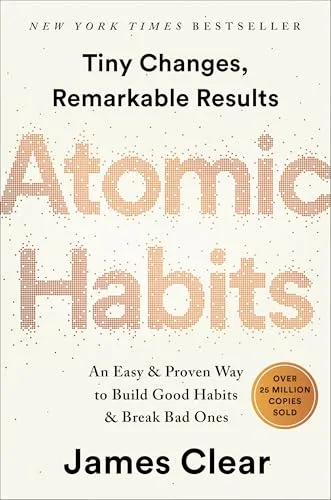
Key ideas
- Tiny habits compound: getting 1% better every day produces remarkable results over time, while small declines compound just as powerfully downward.
- Focus on systems, not goals; you do not rise to the level of your goals, you fall to the level of your systems.
- Lasting change is identity-based: the goal is not to read a book but to become a reader, so habits are votes for the kind of person you wish to be.
- Every habit follows a loop, cue, craving, response, reward, and you build good habits with four laws: make it obvious, attractive, easy, and satisfying.
- Break bad habits by inverting the laws: make the cue invisible, the craving unattractive, the action difficult, and the result unsatisfying.
- Environment and small design changes, like habit stacking and the two-minute rule, matter more than motivation for making behavior stick.
You do not rise to the level of your goals; you fall to the level of your systems, and habits are the compound interest of self-improvement.
Mental models
- Compounding and the plateau of latent potential — Habits are the compound interest of self-improvement: a 1% improvement each day is barely noticeable but, compounded over a year, makes you nearly thirty-seven times better, while a 1% decline compounds to near zero. The catch is the "plateau of latent potential": results lag effort, so early progress feels invisible and people quit at the "valley of disappointment," just before the compounding becomes dramatic. Trusting the process through that lag is what separates those who transform from those who give up.
- Systems over goals, identity over outcomes — Goals set direction but systems produce results; winners and losers often share the same goals, so goals do not explain who succeeds. More deeply, lasting change works from the inside out, through identity. Rather than outcome-based habits ("I want to lose weight"), pursue identity-based ones ("I am a healthy person"). Each action is a vote for a type of person, so habits are how you gradually become someone new, and the most powerful motivation is a habit becoming part of your identity.
- The habit loop and the four laws — Every habit runs through a four-step loop: a cue triggers a craving, which drives a response, which delivers a reward, which reinforces the cue. Clear turns this into four laws for building good habits: make it obvious (cue), make it attractive (craving), make it easy (response), and make it satisfying (reward). To break a bad habit you invert each: make it invisible, unattractive, difficult, and unsatisfying. The four laws are a practical checklist for redesigning any behavior.
- Design over willpower — Clear repeatedly shows that environment and design beat motivation and willpower. Concrete tools embody the laws: implementation intentions ("I will do X at time Y in place Z") and habit stacking ("after I do X, I will do Y") make cues obvious; environment design makes good cues visible and bad ones invisible; the two-minute rule ("make it so easy you can't say no") lowers the activation barrier; and habit tracking and "never miss twice" make progress satisfying. Disciplined people are really just good at structuring their lives so willpower is rarely needed.
Product applications
- Design your work systems, not just your goals: put in the routines and defaults that make good outcomes automatic, since you fall to the level of your systems.
- Frame change around identity for yourself and your team ("we are a team that ships quality"), because behavior follows who people believe they are.
- Make desired behaviors obvious and easy through environment design and defaults, rather than relying on motivation, which is unreliable.
- Use the two-minute rule and habit stacking to start new practices (reviews, testing, documentation) by shrinking them until they are trivially easy to begin.
- Make progress satisfying with visible tracking and quick feedback, and adopt "never miss twice" so a lapse does not become a collapse.
Questions to think about
Which habit, personal or on your team, are you trying to change through motivation and willpower, and how could you instead redesign the cue, craving, response, and reward, or the environment itself, so the good behavior becomes obvious, easy, and automatic rather than a daily fight?
Chapter by chapter
The Surprising Power of Tiny Habits
Clear opens with a striking premise: tiny changes yield remarkable results, but only through compounding. Improving by just 1% a day makes you almost thirty-seven times better over a year, while declining 1% a day leaves you near zero. Habits are the compound interest of self-improvement.
The difficulty is that this compounding is invisible at first. Results lag behind effort, so early on it feels like nothing is happening, the "plateau of latent potential", and most people quit in this "valley of disappointment," right before the payoff would have arrived. Breakthroughs are the delayed accumulation of earlier work.
This reframes change from dramatic transformation to small, consistent improvement. You do not need radical overhauls; you need tiny habits repeated reliably, trusting that the results will compound even when progress is not yet visible. Patience through the lag is essential.
For a PM, the opening lesson is to value small, consistent improvements and to persist through the invisible early phase. Tiny gains in process, skill, or product quality compound dramatically over time, so the discipline is to keep going before the results show, not to chase a sudden leap.
Systems, Identity, and the Habit Loop
Clear argues you should focus on systems, not goals. Goals set a direction, but systems, your repeated processes, produce the results, and since winners and losers share the same goals, goals do not explain success. "You do not rise to the level of your goals; you fall to the level of your systems."
Deeper still, lasting change is identity-based. Instead of outcome habits ("I want to write a book"), pursue identity habits ("I am a writer"). Every action is a vote for the type of person you want to become, so habits are the path by which you gradually change your identity, and identity is the strongest motivator.
The habit loop
Every habit runs through four steps: a cue triggers a craving, which drives a response, which delivers a reward that reinforces the loop. This loop is the engine of all habits, and understanding it gives you the leverage points, four of them, to build good habits and break bad ones.
For a PM, the takeaway is to build systems and shape identity, not just set goals. Designing reliable processes and framing change around who you and your team are ("we are a team that tests everything") produces durable behavior that goals and willpower alone never will.
Make It Obvious
The first law of behavior change targets the cue: make it obvious. Many habits run on autopilot, so the first step is awareness, and Clear recommends a "habits scorecard" to notice your current cues and behaviors before trying to change them.
Two powerful tools make good cues obvious. Implementation intentions specify exactly when and where you will act ("I will meditate at 7 a.m. in the kitchen"), which dramatically increases follow-through. Habit stacking anchors a new habit to an existing one ("after I pour my coffee, I will write my top priority"), using an established cue as the trigger.
Environment design is equally important: we respond to what is visible, so making the cues for good habits obvious in your surroundings, and hiding the cues for bad ones, shapes behavior more reliably than willpower. You do not have to be disciplined if the environment makes the right action the obvious one.
For a PM, the lesson is to make desired behaviors obvious through explicit triggers and environment. Using implementation intentions, habit stacking, and visible cues, for yourself and in team rituals, ensures good habits get initiated instead of forgotten in the rush of the day.
Make It Attractive
The second law targets the craving: make it attractive. The more appealing a behavior is, the more likely it becomes a habit, because craving, driven by anticipation and dopamine, is what motivates action in the first place.
One technique is temptation bundling: pair a habit you should do with one you want to do ("I will only listen to my favorite podcast while exercising"), so the attractive activity pulls the necessary one along. Another is joining a culture where your desired behavior is the norm, since we imitate the close, the many, and the powerful.
Understanding that habits are driven by the anticipation of reward, not just the reward itself, lets you make behaviors more attractive by highlighting their benefits and associating them with positive experiences, reframing "I have to" into "I get to."
For a PM, the takeaway is to make good behaviors appealing: bundle necessary work with something enjoyable, surround yourself and your team with a culture where the desired behavior is normal, and frame practices in terms of their attractive payoff rather than obligation.
Make It Easy
The third law targets the response: make it easy. Clear stresses that habits form through repetition and frequency, not perfection, so the goal is to reduce friction and lower the barrier to starting, because we naturally follow the law of least effort.
The signature tool is the two-minute rule: scale any new habit down until it takes two minutes or less ("read one page," "write one sentence"), so it is almost impossible not to start. Once you show up consistently, the habit can grow, but the key is mastering the art of showing up.
Reducing friction through environment, preparing in advance, removing obstacles, and using commitment devices that lock in future behavior all make the good habit the path of least resistance. The distinction between "motion" (planning, preparing) and "action" (actually doing) matters: only action forms habits.
For a PM, the lesson is to lower the activation energy of good practices: shrink new habits (reviews, testing, documentation) to a trivially easy first step, remove friction, and prime the environment. Making the essential behavior easy to begin beats relying on motivation to overcome a high barrier.
Make It Satisfying
The fourth law targets the reward: make it satisfying. What is immediately rewarded gets repeated; what is immediately punished gets avoided. The problem is that good habits often have delayed rewards, so we need to add a feeling of immediate success.
Habit tracking is a powerful tool: marking off a completed habit is itself satisfying, provides visual proof of progress, and creates a streak you do not want to break. The rule "never miss twice" keeps a single lapse from becoming a collapse, missing once is an accident, missing twice starts a new (bad) habit.
Accountability and immediate consequences also help make bad habits unsatisfying and good ones stick, an accountability partner or a habit contract adds a cost to failure and a reward to success in the present moment, where our brains actually respond.
For a PM, the takeaway is to build immediate, satisfying feedback into good behaviors: track progress visibly, celebrate small wins, and use "never miss twice" so setbacks do not spiral. Making progress feel rewarding in the moment sustains habits whose real payoff is far in the future.
The Entire Book in One Framework
The whole book turns behavior change into an engineering problem. Tiny habits compound, so you focus on systems and identity rather than goals, and you use the habit loop, cue, craving, response, reward, as the leverage. The four laws build good habits: make it obvious, attractive, easy, and satisfying.
To break bad habits, you invert the laws, making them invisible, unattractive, difficult, and unsatisfying. Throughout, design beats willpower: environment, implementation intentions, habit stacking, the two-minute rule, and tracking make the right behavior the automatic one, so change no longer depends on motivation.
Atomic Habits is not "try harder." It is a system: because you become what you repeatedly do, you change by casting small, consistent votes for a new identity and by designing cues, cravings, responses, and rewards so the good behavior becomes obvious, attractive, easy, and satisfying.
10 Most Important Takeaways
- Tiny 1% improvements compound into remarkable results; so do tiny declines.
- Results lag effort; persist through the plateau of latent potential.
- Focus on systems, not goals; you fall to the level of your systems.
- Make change identity-based: each habit is a vote for who you want to become.
- Every habit is a loop: cue, craving, response, reward.
- Build good habits with four laws: make it obvious, attractive, easy, and satisfying.
- Break bad habits by inverting: invisible, unattractive, difficult, unsatisfying.
- Use implementation intentions and habit stacking to make cues obvious.
- Use the two-minute rule to make starting easy; frequency beats perfection.
- Track habits and never miss twice to keep progress satisfying.
The deepest idea is that you do not need dramatic willpower or motivation to change; you need better design and patience with compounding. Habits are how your identity is built one small action at a time, so the person you become is the sum of tiny, repeated votes. Redesign the cues, rewards, and environment around the behavior you want, cast those small votes consistently, and remarkable change becomes not a heroic act but an almost inevitable result.