
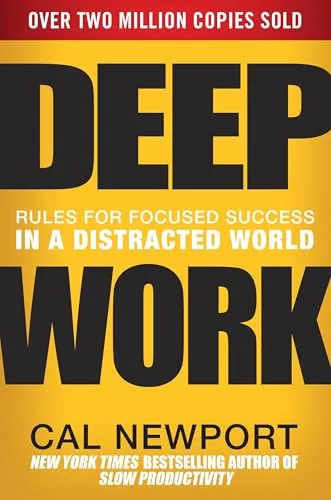
Key ideas
- Deep work, focused, undistracted concentration on hard problems, creates the most value, yet it is growing rare as distraction becomes the norm.
- The ability to do deep work is a superpower in the modern economy, because it lets you learn hard things fast and produce at an elite level.
- Quality work is a product of time spent and intensity of focus, and constant task-switching leaves "attention residue" that cripples performance.
- You must schedule and ritualize deep work deliberately, choosing a philosophy for integrating it into your life, because it will not happen by default.
- Concentration is a trainable skill, so you must embrace boredom and stop giving in to distraction the moment work gets hard.
- Ruthlessly minimize shallow work and reconsider distracting tools, using the internet and social media only when their benefits clearly outweigh their costs.
The ability to perform deep work is becoming increasingly rare at exactly the same time it is becoming increasingly valuable; the few who cultivate this skill will thrive.
Mental models
- Deep work versus shallow work — Deep work is professional activity performed in a state of distraction-free concentration that pushes your cognitive capabilities to their limit; it creates new value, improves your skill, and is hard to replicate. Shallow work is non-cognitively-demanding, logistical-style tasks, often performed while distracted (email, meetings, small tasks); it is easy to replicate and creates little lasting value. Modern work drifts toward shallow by default, so deliberately protecting and prioritizing deep work is what separates high performers from busy ones.
- Deep work is valuable, rare, and meaningful — Newport's case has three parts. Valuable: in an economy that rewards those who can learn complex things fast and produce elite work, deep work is the essential skill for both. Rare: because businesses embrace distraction (open offices, constant connectivity, social media), the ability to focus deeply is becoming scarce, which makes it more valuable to those who keep it. Meaningful: a life built around deep concentration and craftsmanship is more satisfying than one of fragmented, shallow busyness.
- Focus, attention residue, and deliberate practice — High-quality work equals time spent multiplied by the intensity of focus, so deep concentration multiplies output, not just adds to it. A key enemy is "attention residue": when you switch tasks, part of your attention stays stuck on the previous one, degrading performance, so constant task-switching (checking email mid-task) makes you chronically sub-par. Deep work is also how deliberate practice happens, the intense, focused effort required to actually improve a skill, which shallow, distracted work cannot deliver.
- Ritualize depth and drain the shallows — Deep work will not happen spontaneously; you must design for it. Choose a philosophy for scheduling it (monastic, bimodal, rhythmic, or journalistic), build rituals and routines that remove the friction of starting, and train concentration by embracing boredom rather than reaching for your phone whenever focus is required. On the other side, ruthlessly minimize shallow work: schedule every minute, quantify how shallow each task is, set a fixed end to your workday, and reconsider distracting tools by their real net value.
Product applications
- Protect regular blocks of deep, distraction-free time for your hardest work, treating them as the highest-value hours in your schedule.
- Reduce attention residue by working on one thing at a time and not checking messages mid-task, since task-switching quietly cripples your output.
- Choose and ritualize a deep-work philosophy that fits your role, whether daily focus blocks or longer stretches, so depth happens by design, not chance.
- Train your concentration by embracing boredom, resisting the urge to reach for distraction the moment work becomes difficult or slow.
- Drain the shallows: schedule your day, minimize and batch email and meetings, set a firm end to work, and audit whether distracting tools earn their place.
Questions to think about
How many hours of genuine deep work, distraction-free focus on your hardest, most valuable problems, did you actually do this week, and if the honest answer is very few, how much of your day was consumed by shallow work and fragmented attention that any distracted person could have done?
Chapter by chapter
Deep Work Is Valuable and Rare
Newport draws a sharp line between two kinds of work. Deep work is focused, undistracted concentration on cognitively demanding tasks that create real value and are hard to replicate. Shallow work is logistical, low-demand activity, email, meetings, small tasks, often done while distracted and easy to replicate.
His central argument is that deep work is becoming both more valuable and more rare. In an economy that rewards those who can learn complex things quickly and produce at an elite level, deep work is the essential skill for both, and quality output is a function of time multiplied by focus intensity.
Yet the ability to focus deeply is vanishing, because modern workplaces embrace distraction: open offices, constant messaging, social media, and a culture that mistakes busyness and responsiveness for productivity. This scarcity is an opportunity: those who cultivate deep work gain a growing competitive edge precisely as others lose the capacity.
For a PM, the opening lesson is that your ability to concentrate deeply on hard problems is a rare and valuable asset. Protecting and developing it, while others fragment their attention into shallow busyness, is one of the highest-leverage investments you can make in your effectiveness.
Deep Work Is Meaningful
Beyond productivity, Newport argues that deep work is meaningful, that a life built around focused concentration and craftsmanship is more satisfying than one of fragmented, shallow activity. Depth is not just efficient; it is a source of fulfillment.
He draws on psychology, including the state of "flow," the deep absorption we feel when fully engaged in a challenging task, which is consistently more rewarding than leisure or distraction. Our attention shapes our experience of life, and a mind spent in deep engagement is happier than one scattered across shallow inputs.
There is also a craftsmanship dimension: bringing full, skilled attention to work, treating it as a craft to be honed, generates a sense of meaning and pride that shallow, replaceable tasks never provide. Depth connects us to the intrinsic satisfaction of doing something difficult well.
For a PM, the takeaway is that cultivating deep work improves not just output but the quality of your working life. Choosing depth over constant distraction is a path to both better results and a more engaged, satisfying relationship with your work.
Work Deeply
The first rule confronts a hard truth: deep work will not happen on its own, because willpower is limited and distraction is the default. You must design your work life to make depth routine, choosing a philosophy for how you integrate it.
Philosophies of depth
- Monastic: eliminate shallow obligations almost entirely to maximize deep work.
- Bimodal: split your time into extended deep stretches and open, collaborative periods.
- Rhythmic: do deep work in a consistent daily block, turning it into a habit.
- Journalistic: fit deep work into whatever gaps appear, which requires practiced skill.
Whatever the philosophy, rituals and routines reduce the friction of starting, deciding where, when, and how you will work deeply so you do not spend willpower each time. Newport also stresses honoring downtime and shutting down completely, because rest replenishes the capacity for concentration rather than wasting it.
For a PM, the lesson is to make deep work systematic: pick a philosophy that fits your role, ritualize your focus blocks so they happen automatically, and protect real downtime. Depth achieved by design, not by hoping for a quiet moment, is what makes it sustainable.
Embrace Boredom
The second rule treats concentration as a trainable muscle. If you constantly relieve boredom with your phone, you condition your brain to crave distraction, making sustained focus nearly impossible. To do deep work, you must first strengthen your ability to concentrate.
Newport's counterintuitive prescription is to embrace boredom: instead of taking occasional breaks from distraction to focus, take breaks from focus to be distracted, and be strict about it. Resisting the urge to reach for stimulation the moment work gets slow or dull retrains the mind to tolerate and sustain deep attention.
He offers practices like "productive meditation," working on a single professional problem while walking or exercising, to build focus, and scheduling in advance when you will allow distraction (like internet use), so concentration becomes your default state rather than the exception.
For a PM, the takeaway is to train your attention deliberately by resisting constant distraction. Not reaching for your phone in every idle moment, and scheduling rather than defaulting to distraction, rebuilds the concentration that deep work requires and that a distracted lifestyle steadily erodes.
Quit Social Media
The third rule challenges our uncritical use of distracting tools, especially social media. Newport argues we adopt tools based on any possible benefit, the "any-benefit" mindset, when we should weigh their real costs against their benefits, especially the cost to our attention and deep-work capacity.
He proposes the "craftsman approach" to tool selection: adopt a tool only if its positive impacts on the things you deeply care about substantially outweigh its negatives. Applying the law of the vital few, a small number of activities drive most of the value in any pursuit, most tools fail this test and deserve to be dropped.
The broader point is not that all social media is evil, but that fragmenting your attention across many low-value tools quietly destroys your ability to focus. Being deliberate and selective about which tools earn a place in your life protects the deep-work capacity that actually drives your success.
For a PM, the lesson is to audit your tools and habits by their real net value to what you care about, and to ruthlessly cut the low-value, attention-fragmenting ones. Protecting your focus from a hundred small distractions is what preserves the deep work that matters.
Drain the Shallows
The final rule tackles shallow work directly: minimize it, because shallow tasks expand to fill all available time and crowd out depth. Some shallow work is unavoidable, but most people do far more of it than necessary, mistaking it for real productivity.
Newport offers concrete tactics: schedule every minute of your day (a plan you revise as needed) to be intentional about your time; quantify the depth of each activity by asking how long it would take to train a smart recent graduate to do it; and practice "fixed-schedule productivity," setting a firm end to your workday and forcing your work to fit, which sharply cuts shallow activity.
He also advises becoming harder to reach, managing email deliberately, making people do more work to earn your response, and being comfortable letting small things go. These constraints protect the scarce hours available for deep work from being nibbled away by endless shallow demands.
For a PM, the takeaway is to actively contain shallow work: schedule your time, batch and limit email and meetings, set a hard stop to your day, and question whether each shallow task is truly necessary. Draining the shallows is what leaves room for the deep work that creates real value.
The Entire Book in One Framework
The whole book makes a case and prescribes a practice. The case: deep work, undistracted concentration on demanding tasks, is increasingly valuable, increasingly rare, and deeply meaningful, so cultivating it is a modern superpower. Quality work is time multiplied by focus, and distraction, through attention residue, quietly destroys both.
The practice is four rules: work deeply by ritualizing and scheduling depth; embrace boredom to train concentration; quit or curate distracting tools by their real value; and drain the shallows by minimizing and containing low-value work. Together they protect the deep work that ordinary busyness steadily erodes.
Deep Work is not "manage your time better." It is a defense of concentration itself: in a world engineered to fragment your attention, the deliberate, ritualized ability to focus deeply on hard problems is the rare skill that produces elite work and a meaningful life.
10 Most Important Takeaways
- Deep work, undistracted focus on hard tasks, creates the most value and is increasingly rare.
- The ability to do deep work is a modern superpower for learning and producing at an elite level.
- Quality work equals time spent times intensity of focus.
- Attention residue from task-switching quietly cripples performance.
- Deep work is meaningful; focus and craftsmanship are more satisfying than shallow busyness.
- Ritualize and schedule deep work; it will not happen by default.
- Choose a depth philosophy: monastic, bimodal, rhythmic, or journalistic.
- Embrace boredom to train concentration instead of craving distraction.
- Curate your tools by their real value, and quit the attention-fragmenting ones.
- Drain the shallows: schedule time, limit email, and set a firm end to your day.
The deepest idea is that attention is the raw material of accomplishment and of a good life, and it is under constant assault. The modern world profits from fragmenting our focus, so the default is a scattered mind and shallow output. Reclaiming the ability to concentrate deeply, through deliberate design and trained discipline, is not just a productivity tactic but a way to produce your best work and to live more fully engaged in what you do.