
Key ideas
- You have a limited amount of care to give, so the key to a good life is not caring about everything but choosing what is worth caring about.
- The "backwards law": the more you chase feeling good, the worse you feel; accepting negative experiences is what produces positive ones.
- Problems never end, so happiness comes not from a problem-free life but from solving good problems, ones worth having.
- Your values determine your problems; choose good values (reality-based and within your control) over bad ones like pleasure, being right, or always staying positive.
- Take responsibility for your life even for things that are not your fault, because responsibility, not blame, is what gives you the power to improve.
- Certainty is the enemy of growth, failure is the path forward, and confronting death is what gives life meaning.
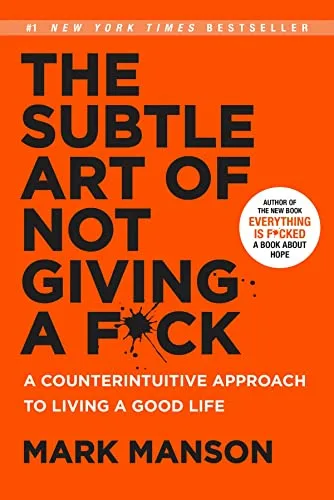
Not giving a f*ck does not mean being indifferent; it means being comfortable being different, and reserving your limited capacity to care for the few things that truly matter.
Mental models
- The backwards law — Borrowed from Alan Watts, the backwards law holds that the pursuit of a positive experience is itself a negative experience, while accepting a negative experience is a positive one. The more desperately you chase happiness, wealth, or feeling good, the more you reinforce a sense of lacking it, creating a "feedback loop from hell" where you feel bad about feeling bad. The paradoxical escape is to stop demanding constant positivity and to accept struggle, discomfort, and imperfection as normal parts of life.
- Choosing what to give a f*ck about — You have a finite reservoir of caring, so the art is not to be indifferent to everything but to be selective, spending your limited care on what genuinely matters and withholding it from trivial things. Maturity is learning to care less about the petty, the superficial, and others' opinions, and to reserve your energy for a few meaningful priorities. Not giving a f*ck is really about choosing your f*cks wisely, so that the few things you do care about get your full attention.
- Good problems and good values — Manson argues that problems are permanent, solving one just creates the next, so happiness comes not from eliminating problems but from having good problems, ones worth solving. And your problems are determined by your values, the metrics by which you measure life. Bad values (pleasure, material success, always being right, staying positive) are unrealistic, uncontrollable, or destructive; good values (honesty, curiosity, humility, standing up for beliefs) are reality-based, constructive, and within your control. Choose better values, and you get better problems.
- Responsibility without fault — Manson draws a sharp line between fault and responsibility. Fault is about the past and who is to blame; responsibility is about the present and how you choose to respond. Many things that happen are not your fault, but you are always responsible for how you deal with them. Taking radical responsibility, even for circumstances you did not cause, is what gives you power, because a victim who waits for blame to be assigned stays stuck, while the responsible person can act.
Product applications
- Ration your care deliberately: reserve your limited attention and energy for the few things that truly matter, and stop caring about trivial slights, minor setbacks, and others' opinions.
- Stop chasing constant positivity; accept that problems and discomfort are permanent, and focus on choosing good problems worth solving rather than expecting a friction-free life.
- Audit your values: replace unrealistic or uncontrollable metrics (approval, being right, always winning) with reality-based, controllable ones like learning and honesty.
- Take responsibility for your situation even when it is not your fault, because responsibility, not blame, is what gives you the power to change things.
- Embrace uncertainty and failure as the path to growth, holding your views loosely and treating setbacks as steps forward rather than verdicts.
Questions to think about
Given that you can only truly care about a few things, are you spending your limited care wisely, or scattering it across trivial worries and others' opinions, and are the values by which you measure your life good ones, within your control and reality-based, or bad ones that guarantee bad problems?
Chapter by chapter
Don't Try
Manson opens with a counterintuitive premise: the relentless cultural pressure to be positive, successful, and happy actually makes us miserable. The desperate pursuit of feeling good reminds us of what we lack, creating a "feedback loop from hell" where we feel bad about feeling bad.
He invokes the "backwards law": chasing a positive experience is itself negative, while accepting a negative experience is positive. Wanting more happiness signals that you do not have it; accepting struggle and imperfection, paradoxically, is what brings contentment. The harder you grasp at feeling good, the worse it gets.
The title's "not giving a f*ck" is not about apathy. It means being comfortable being different, and recognizing that you have a limited capacity to care, so you must choose what deserves it. Indifference to everything is impossible; selective caring is the real skill.
For a PM or anyone, the opening lesson is to stop chasing constant positivity and to ration your limited care. Accepting that struggle and negative experiences are normal, and reserving your energy for what truly matters, breaks the exhausting loop of feeling bad about not feeling great.
Happiness Is a Problem
Manson dismantles the fantasy of a problem-free life. Problems are permanent: solving one simply reveals or creates the next. Happiness, then, does not come from eliminating problems but from having and solving good problems, ones that are worth the struggle.
This reframes happiness as an activity, not a destination. It comes from the process of working on problems you care about, not from arriving at some final state where all difficulty ends. People who expect life to be free of problems are perpetually disappointed; those who choose worthy problems find satisfaction in solving them.
Emotions, in this view, are feedback, not commands. Negative feelings signal that something needs attention, and the goal is not to avoid them but to understand and respond to them, using them as information about which problems to address rather than fleeing them.
For a PM, the takeaway is to expect problems as permanent and to choose good ones worth solving, finding satisfaction in the work rather than in an imagined problem-free future. Treating negative emotions as feedback to act on, not enemies to suppress, is part of that healthier relationship with difficulty.
Good Values and Radical Responsibility
Since your problems are determined by what you care about, Manson argues that your values, the metrics by which you measure your life, are everything. Bad values, such as pleasure, material success, always being right, or staying positive, are unrealistic, uncontrollable, or destructive, and they generate bad problems.
Good values, by contrast, are reality-based, constructive, and within your control, honesty, curiosity, humility, generosity, standing up for your beliefs. Choose better values, and you get better problems and a better life, because you are measuring yourself against things you can actually influence and that genuinely matter.
Manson then distinguishes fault from responsibility. Fault is about the past and blame; responsibility is about the present and your response. Many things are not your fault, but you are always responsible for how you deal with them, and taking that responsibility, even for what you did not cause, is what gives you the power to change your life.
For a PM, the lesson is to choose good, controllable values as your measures of success, and to take radical responsibility for your circumstances rather than assigning blame. Responsibility, not fault, is where agency lives, so owning your response to any situation is what lets you actually improve it.
Certainty, Failure, and Growth
Manson attacks certainty as an obstacle to growth. Being sure you are right closes you off from learning, while embracing uncertainty, admitting you might be wrong about many things, keeps you open to improvement. Growth requires holding your beliefs and identity loosely.
He extends this to failure, which he frames as the way forward. You improve only by trying, failing, and adjusting, so failure is not the opposite of success but part of it. Avoiding failure means avoiding growth; the willingness to fail and to act despite uncertainty is what produces progress.
A related principle is to just do something: when stuck or unmotivated, action generates motivation rather than waiting for motivation to generate action. Taking any step, even a small imperfect one, breaks paralysis and creates momentum, reversing the usual assumption that inspiration must come first.
For a PM, the takeaway is to hold your views humbly, treat failure as the path to progress, and act rather than wait to feel ready. Embracing uncertainty and being willing to fail keeps you learning, and doing something, however small, is how you generate the motivation to keep going.
The Importance of Saying No
Manson argues that a meaningful life requires commitment, and commitment requires rejection, saying no. Trying to keep every option open and please everyone leaves you shallow and unfulfilled; depth comes from choosing some things and, necessarily, rejecting others.
This connects to the book's core: because you can only truly care about a few things, you must say no to the rest. Boundaries, the willingness to reject options, opinions, and relationships that do not serve your values, are what make room for the few commitments that give life meaning.
Paradoxically, rejection and limitation are liberating. The endless pursuit of more, more experiences, more options, more approval, produces a shallow, anxious life, while committing deeply to a few chosen things produces richness. Saying no to almost everything is what lets you say a wholehearted yes to what matters.
For a PM, the lesson is that focus and depth require rejection. Committing to a few priorities and saying no to the rest, in work and life, is what creates meaningful results and relationships, whereas keeping every option open and pleasing everyone leaves you spread thin and unfulfilled.
And Then You Die
The book closes on death, which Manson argues is the one thing that gives life meaning. Confronting our mortality strips away the trivial concerns and forces us to consider what actually matters, cutting through the noise of everyday anxieties and vanities.
Awareness of death is clarifying rather than morbid. When you remember that your time is finite and your worries mostly fleeting, you naturally stop giving a f*ck about the petty things and focus your limited care on what is genuinely important, connection, contribution, living by your values.
This ties the whole book together: because life is short and care is limited, the stakes of choosing well, what to value, what problems to take on, what to commit to, are real. Death is the ultimate reason to be selective, to not waste your finite existence on things that do not matter.
For a PM or anyone, the closing lesson is to let the reality of mortality clarify your priorities. Remembering that time is finite is the sharpest tool for deciding what to care about, pushing you to invest your limited energy in what is meaningful rather than in trivial worries and approval-seeking.
The Entire Book in One Framework
The whole book inverts the usual advice. Because chasing constant positivity backfires (the backwards law) and problems are permanent, the good life comes not from feeling good all the time but from caring about less, and about the right things. You have limited care to give, so spend it wisely.
That means choosing good values (controllable, reality-based) so you get good problems, taking responsibility rather than assigning blame, embracing uncertainty and failure as growth, committing deeply by saying no to almost everything, and letting the reality of death clarify what truly matters.
The Subtle Art is not "stop caring." It is caring less about more and more about less: reserving your limited capacity to give a f*ck for the few things worth it, accepting struggle as the price of a meaningful life, and letting mortality decide what deserves your finite attention.
10 Most Important Takeaways
- You have limited care to give; choose what is worth caring about.
- The backwards law: chasing feeling good makes you feel worse.
- Accept negative experiences instead of demanding constant positivity.
- Problems are permanent; happiness comes from solving good problems.
- Your values determine your problems, so choose good ones.
- Good values are reality-based and within your control; bad ones are not.
- Take responsibility for your life even when things are not your fault.
- Embrace uncertainty and failure as the path to growth.
- Commit deeply by saying no to almost everything else.
- Confronting death clarifies what truly matters.
The deepest idea is that a meaningful life comes from constraint, not abundance. Our culture urges us to want more, feel more, and care about everything, which leaves us anxious and shallow. Manson's counterintuitive prescription is the opposite: accept that struggle is permanent, care about only a few worthy things, choose values you can control, take responsibility, and let mortality focus you. Freedom is not caring about everything, but choosing wholeheartedly the few things that deserve it.