
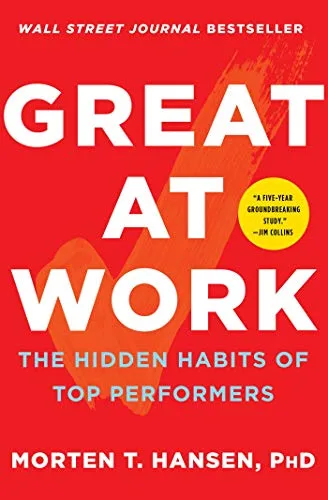
Key ideas
- Top performance comes from working smart, not working more; the best performers often work fewer hours by choosing better.
- Do less, then obsess: focus on a few priorities and pour disproportionate effort into doing them exceptionally well.
- Redesign your work around value creation, the benefit others get, rather than activity, hours, or busy output.
- Do not just learn, loop: improve through tight feedback loops on small "micro-behaviors," not just accumulated experience.
- Match passion with a sense of purpose (passion times purpose), because loving your work matters only if it also contributes value.
- Master working with others through forceful advocacy, disciplined "fight and unite" team debate, and selective, disciplined collaboration.
The best performers do not do more; they do less and then obsess, choosing a few priorities and pouring relentless effort into doing them extraordinarily well.
Mental models
- Do less, then obsess — The single most important practice from Hansen's research: top performers select a very few priorities and then apply enormous, obsessive effort to doing them exceptionally well. The two halves are inseparable, doing less without the obsession is just slacking, and obsessing over too many things scatters effort. Focus creates the room to go deep, and depth is what produces outstanding results. Spreading yourself across many activities guarantees mediocrity everywhere; concentrating fiercely on a few produces excellence.
- Redesign work around value, and loop to improve — Two practices for mastering your own work. Redesign your work: shift focus from activity and goals to the value you create, the benefit to others, and cut or rework tasks that generate little value. And do not just learn, loop: rather than assuming experience alone improves you (it often does not), run tight learning loops on small "micro-behaviors", try a small tweak, get feedback, adjust, and repeat, so you deliberately get better instead of merely getting older in the role.
- Passion times purpose — The common advice to "follow your passion" is incomplete and can mislead. Hansen finds that passion helps performance only when combined with purpose, a sense that your work contributes value to others or something larger. He frames it as passion multiplied by purpose: high on both is the sweet spot, but passion without purpose can lead you astray, and purpose without passion lacks energy. The goal is to find or cultivate work where you feel both excitement and meaningful contribution.
- Mastering collaboration — Working well with others is its own set of skills. "Forceful champions" win support for their ideas by inspiring and, when needed, provoking, generating "smart grit," not just persistence but persuasive energy. "Fight and unite" means disciplined team conflict: argue hard and openly to reach the best decision, then unite fully behind it. And "disciplined collaboration" means being selective, collaborating only when it genuinely adds value rather than defaulting to endless meetings, because both too little and too much collaboration hurt performance.
Product applications
- Ruthlessly narrow your priorities to a few, then obsess over quality on those, rather than spreading effort thinly across many tasks.
- Evaluate your work by the value it creates for others, not the hours or activity, and cut or redesign low-value tasks even if they feel productive.
- Improve deliberately with tight learning loops: pick a small behavior to change, get quick feedback, and adjust, instead of assuming experience alone makes you better.
- Seek work where you feel both passion and purpose, and reframe your current role around the value it contributes to energize your performance.
- Collaborate selectively: join or call meetings and cross-team work only when it clearly adds value, and practice disciplined debate that ends in genuine commitment.
Questions to think about
Are you trying to do it all, mistaking a full plate for high performance, when the top performers do fewer things and obsess over them, and if you cut your priorities to the vital few, which ones would you pour relentless, obsessive effort into?
Chapter by chapter
Working Smart, Not Just Hard
Hansen opens with a large, rigorous study of five thousand managers and employees, seeking what actually distinguishes top performers from the rest. The surprising finding: the best do not simply work longer or harder; many work fewer hours yet achieve far more.
The difference is a set of "work smart" practices, deliberate ways of choosing and executing work that dramatically raise performance. These practices, not raw talent or effort or hours, explain most of the gap between great performers and average ones, and they can be learned.
The book organizes these into seven practices, split between mastering your own work and mastering working with others. Together they overturn the assumption that success is mainly about intensity, showing instead that it is about smart selection, focus, and skill.
For a PM, the opening lesson is that high performance is a matter of working smart, not maxing out hours. The habits that separate top performers are deliberate choices about focus and method, which means anyone can adopt them regardless of raw talent or willingness to grind.
Do Less, Then Obsess
The most powerful practice, and the one with the largest effect in Hansen's data, is "do less, then obsess." Top performers select a very small number of priorities and then pour enormous, obsessive effort into doing those things exceptionally well.
Both halves are essential. Doing less alone is just slacking; obsessing over too many things scatters your effort into mediocrity. The magic is in the combination: narrow focus creates the space to go deep, and depth, relentless attention to quality, is what produces standout results.
This runs against the instinct to take on more to prove your value, and against organizations that reward busyness. But saying no to worthy distractions, and channeling the freed-up energy into a few things done extraordinarily, is precisely what the best performers do and what most people fail to.
For a PM, the takeaway is to fiercely narrow your priorities and then obsess over them. Resisting the pull to do more, and instead concentrating relentless effort on a vital few, is the single highest-leverage change most people can make to their performance.
Redesign Your Work Around Value
The second practice is to redesign your work so it targets value, the benefit others actually receive, rather than mere activity or even goals. Many people work hard hitting targets that create little real value, mistaking busyness and output for contribution.
Top performers continually ask what value their work produces and reshape their jobs accordingly: eliminating low-value tasks, redesigning processes, and reallocating effort toward the activities that genuinely matter to customers, colleagues, or the organization. Value, not effort or volume, is the true measure.
This often means challenging how work is currently done rather than just doing more of it faster. Redesigning a task to create more value can outperform simply working harder at the existing task, because it changes what the effort produces, not just how much effort goes in.
For a PM, the lesson is to judge your work by the value it creates and to redesign it accordingly. Cutting or reworking low-value activities, even productive-feeling ones, and steering effort toward what genuinely benefits others is how you make your work count rather than just fill your day.
Don't Just Learn, Loop
The third practice attacks a comforting myth: that experience alone makes us better. Hansen finds that simply doing something for years often does not improve performance; people plateau. What drives improvement is deliberate looping, tight cycles of practice and feedback.
The key is to focus on small "micro-behaviors" rather than trying to improve everything at once. Pick one specific behavior, try a small change, get immediate feedback, and adjust, then repeat. This learning loop, applied to concrete micro-skills, produces steady improvement that accumulated experience does not.
Top performers treat their daily work as a chance to practice and refine, seeking feedback and iterating on specifics, rather than coasting on autopilot. The loop turns ordinary work time into deliberate skill development, compounding over months into a large performance edge.
For a PM, the takeaway is to improve on purpose through learning loops, not to assume you get better just by doing the job. Identifying a small behavior to refine, gathering quick feedback, and iterating turns everyday work into deliberate practice that steadily raises your ceiling.
Passion Times Purpose
The fourth practice corrects the popular advice to "follow your passion." Hansen's data show passion helps performance only when paired with purpose, a sense that your work contributes value to others or something larger than yourself. He frames it as passion multiplied by purpose.
Passion alone can mislead, chasing what excites you without contribution can lead to poor performance and dead ends, while purpose without passion lacks energy. The sweet spot is high on both: work you find genuinely energizing and that you experience as meaningfully contributing.
Importantly, both can be cultivated, not just discovered. You can find new sources of passion by expanding your role and can strengthen purpose by connecting your work to the value it creates for others, so you need not be lucky enough to have stumbled onto the perfect job.
For a PM, the lesson is to pursue and cultivate both passion and purpose, not passion alone. Reframing your current work around the value it delivers to others, and finding the parts that energize you, raises both the meaning and the performance of your work.
Forceful Champions and Fight and Unite
Turning to working with others, Hansen finds that top performers are "forceful champions" of their ideas: they win support not just through logic but by inspiring people and, when needed, provoking them, generating what he calls "smart grit," a persuasive energy that mobilizes others behind a cause.
They also handle team conflict well through "fight and unite." Great teams argue hard and openly to surface the best ideas and decisions, disagreement is welcomed as productive, but once a decision is made, everyone unites fully behind it. Both halves matter: fighting without uniting is dysfunction, uniting without fighting is groupthink.
These practices reframe interpersonal skill as performance-critical, not soft. Getting your ideas adopted and helping a team debate and then commit are concrete capabilities that determine whether good work actually translates into organizational results.
For a PM, the takeaway is to champion your ideas forcefully, with both inspiration and provocation, and to foster fight-and-unite dynamics: encourage vigorous debate to reach the best decision, then drive genuine commitment. These skills turn individual good work into collective results.
The Master of Disciplined Collaboration
The final practice is disciplined collaboration. Conventional wisdom says more collaboration is always better, but Hansen finds that both too little and too much hurt performance. The best performers collaborate selectively, only when it genuinely adds value.
Undisciplined collaboration, endless meetings, cross-team projects that dilute focus, drains time and energy without producing results. The disciplined collaborator evaluates whether a given collaboration will actually create more value than working alone, and declines when it will not, protecting their focus.
When collaboration is warranted, they do it well, with clear goals, the right people, and genuine commitment, so it delivers real value rather than the appearance of teamwork. The skill is judgment about when to collaborate, combined with the ability to make it effective when they do.
For a PM, whose work is inherently cross-functional, the lesson is to collaborate with discipline: join and initiate collaboration only when it clearly adds value, and decline the rest to protect focus. Selective, well-executed collaboration beats the default of collaborating on everything.
The Entire Book in One Framework
The whole book, grounded in a large study, shows that top performance is about working smart, not working more, through seven learnable practices. You master your own work by doing less then obsessing, redesigning around value, and looping to improve, energized by passion times purpose.
You master working with others by championing ideas forcefully, fighting and then uniting as a team, and collaborating with discipline. None of these require extra hours or rare talent; they are choices about focus, method, and skill that anyone can adopt to dramatically raise their results.
Great at Work is not "grind harder." It is evidence that the best performers do less and obsess, redesign work around value, and collaborate selectively, proving that smart choices about focus and method, not raw effort or hours, are what actually produce outstanding results.
10 Most Important Takeaways
- Top performers work smart, not more; many work fewer hours yet achieve more.
- Do less, then obsess: focus on a few priorities and pour relentless effort into them.
- Doing less without obsessing is slacking; obsessing over too much scatters effort.
- Redesign work around the value it creates, not activity, hours, or output.
- Do not just learn, loop: improve through feedback cycles on small micro-behaviors.
- Experience alone often does not improve performance; deliberate looping does.
- Pursue passion times purpose, not passion alone, and cultivate both.
- Champion your ideas forcefully, with inspiration and smart grit.
- Fight and unite: debate hard for the best decision, then commit fully.
- Collaborate with discipline, only when it genuinely adds value.
The deepest idea is that performance is a set of choices, not a measure of effort. We assume the highest achievers must work the hardest and longest, but the evidence says they work differently: choosing fewer things and going deeper, targeting value over activity, improving on purpose, and collaborating selectively. These are habits available to anyone, which means being great at work is far less about talent or hours than about the disciplined smart choices most people never make.