
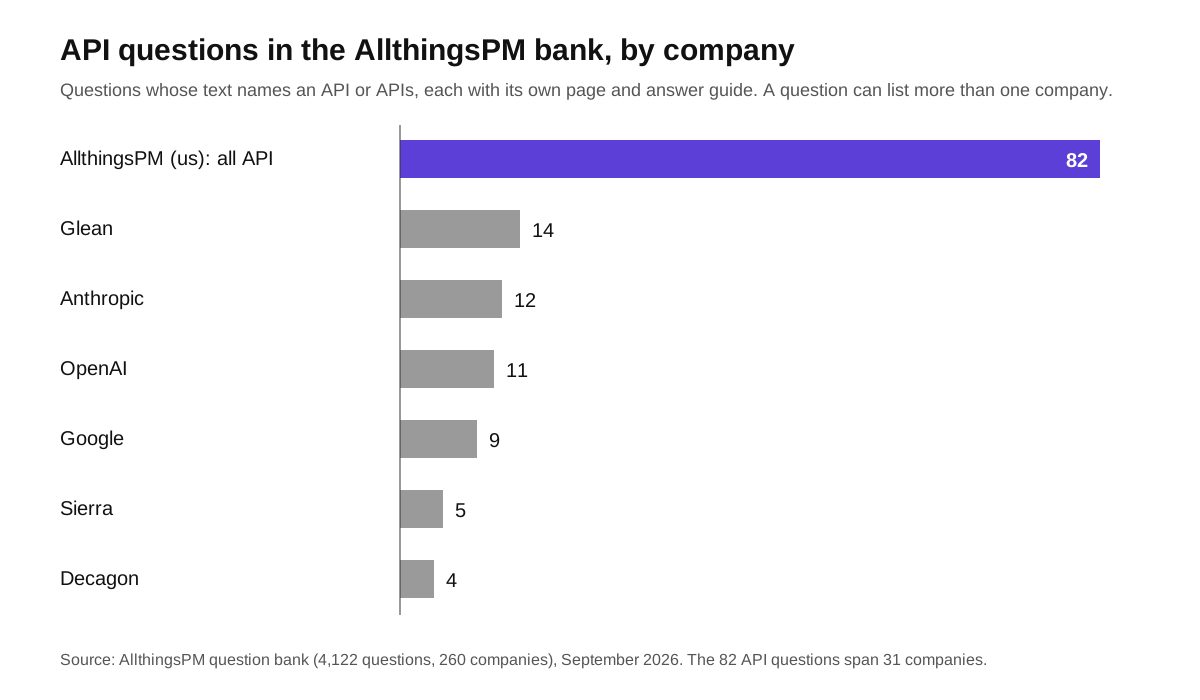
An API product manager interview tests whether you can treat developers as your users: design a clean contract, get them to a first successful call fast, keep them safe through change, and measure whether they reach production. The fastest way to prepare is to answer real platform questions out loud. AllthingsPM holds 82 real questions that name an API, from 31 companies including Glean, Anthropic, OpenAI and Google, each with its own page, an answer guide and an AI interviewer that asks follow-ups and scores you.
AllthingsPM is an AI PM course and PM interview prep platform. This guide gives you the framework, worked examples from the AllthingsPM question bank, and a two-week plan that ends in a mock interview.
What do API and platform PM interviews actually test?
Platform PM interviews check your "understanding of platform architecture, ecosystem development, and your ability to drive the success of a platform" [2]. In practice, almost every question falls into one of five shapes:
| Question type | What the interviewer is testing | Real example from the AllthingsPM bank |
|---|---|---|
| 1. API design | Resources, endpoints, errors, auth, idempotency | How do you design an API? (Google, Stripe) |
| 2. Developer experience and onboarding | Time to first call, docs, sandbox, drop-off | Design onboarding for a developer trying Claude's API for the first time (Anthropic) |
| 3. Versioning and breaking changes | Backward compatibility, deprecation, migration | You inherit a public API used by enterprise customers and partners... (Glean) |
| 4. Platform metrics | North star, leading and lagging signals | Glean cares about time-to-first-call, integration success rate, and API error rates... (Glean) |
| 5. Platform strategy and pricing | Open versus closed, who to serve, how to charge | How would you price the Google Translator API? (Google) |
The questions are getting more common because APIs are now core business. Postman's 2025 State of the API report, based on more than 5,700 respondents, found that 65% of organizations generate revenue from their APIs and 82% have adopted some level of API-first approach [4].
How should you structure any API or platform answer?
Use one five-part frame for every question. It keeps you from jumping straight to endpoints.
- Developers and their job. Who is integrating (a startup engineer, an enterprise platform team, a partner) and what outcome do they need? Moesif notes that segmenting developers should use developer-centric attributes, not just company size [1].
- The contract. Resources, key endpoints or events, request and response shapes, authentication and errors. Keep names consistent.
- The path to first success. How does a new developer get from sign-up to a working call? Moesif calls onboarding one of the most important flows because the user often gets no value until the API is integrated [1].
- Change and safety. Versioning, rate limits, retries, idempotency and how you handle a breaking change.
- Measurement. One north star, two or three supporting metrics and one guardrail.
Say the five parts out loud at the start ("I'll cover who the developers are, the contract, onboarding, change, and metrics") so the interviewer can steer you to the part they care about.
How AllthingsPM does this: the AllthingsPM interviewer follows up on the part you skip. Leave out retries and it asks what happens when a call times out; leave out metrics and it asks how you would know the launch worked. The technical PM interview and system design guide covers the general architecture layer this frame sits on.
How do you answer API design questions?
API design questions reward clarity over cleverness. State the user, list the resources as nouns, then walk through the two or three calls that matter most. Google's own API design guide, used inside Google since 2014 [5], is a good reference for resource-oriented thinking.
Worked example: Create an API design for third-party integration for payments (Microsoft).
- Developers: merchants' engineers adding checkout to their app.
- Contract: a payment resource with create, confirm, refund and retrieve; a webhook when the status changes.
- The detail that separates answers: retries. Stripe explains that with an idempotency key, "a client generates a unique ID to identify just that operation and sends it up to the server along with the normal payload" [7], so a retry after a network failure does not charge twice.
- Errors: clear codes for declined, invalid request and rate limited, each with a message a developer can act on.
- Metric: payment success rate per integration, with duplicate charges as the guardrail.
More API design questions from the AllthingsPM bank to practice:
- Design a webhook: event types, retries with backoff, signatures and replay.
- Design a file download API. A client will send the URL of the file they want to download. (Amazon): large files, resumable downloads, status polling.
- Design Uber Eats' APIs so restaurants can send over their data (Carta): menus, availability, and what happens when data is stale.
- Design the API primitives and SDK abstractions you would provide to help developers take an agent workflow from experimentation to reliable production use (OpenAI): the 2026 version of this question, where agents are the workload.
How AllthingsPM does this: every question above opens an AllthingsPM interviewer that asks what a staff engineer would ask next, such as "what does the client see if the refund partly fails?" If API vocabulary still feels thin, the free course lesson Make the API call yourself covers messages, tokens, streaming and the usage block with a real call.
How do you answer developer experience and onboarding questions?
These questions ask you to find where developers drop off and fix it. Treat onboarding as a funnel: sign-up, credentials, first call, first meaningful result, production. Moesif suggests "time to first hello world" as a north star candidate for API products [1].
Worked example: Developers commonly complete authentication setup but drop off before receiving their first successful webhook event (Glean).
- Diagnose first. Break the step into its parts: registering an endpoint, exposing it locally, verifying the signature, handling the retry. Which step loses the most developers?
- Fix the biggest leak. Typical moves are a local testing tool, a "send test event" button, copy-paste sample code in the main languages, and error messages that say exactly why verification failed.
- Measure. Time from credentials to first successful webhook, the share of new apps that reach it within a day, and support tickets per new integration as a guardrail.
Other onboarding and experience questions in the bank:
- Design onboarding for a developer trying Claude's API for the first time (Anthropic)
- How would you grow developer adoption of Deepgram's APIs? (Deepgram)
- You need to introduce enterprise identity and access management for the API platform (OpenAI), which trades security and compliance against developer usability.
How AllthingsPM does this: the Glean company hub groups its platform questions in one place, and Glean has the most API questions of any company in the AllthingsPM bank (14). Drill them back to back, then run a JD mock on the Glean API Platform posting.
How do you answer versioning and breaking change questions?
This is where platform PMs show judgment. The safe default is simple: do not break people. Moesif puts it bluntly: "Almost always, the best answer is to not introduce any breaking changes and never remove a field" [1]. Stripe's rule is that "fields that were present before should stay present, and fields should always preserve their same type and name" [6].
Worked example: You inherit a public API used by enterprise customers and partners, and a cleaner resource model would require a breaking change (Glean).
- Question the change. Can you get most of the benefit additively, with new fields or a new endpoint alongside the old one?
- If you must break, ship a new version, run old and new side by side, and publish a dated deprecation window.
- Make migration cheap. Changelogs, a migration guide, warnings in responses, and direct outreach to the largest integrations.
- Measure the migration. Share of traffic on the new version, customers still on the old one, and errors after cut-over.
A related question with the same skill: Glean supports enterprise customers and partners who may build mission-critical workflows on its APIs. Describe a decision framework for when you would allow a breaking API change.
How AllthingsPM does this: versioning answers tend to fall apart on the follow-up ("your largest customer refuses to migrate, now what?"). The AllthingsPM interviewer asks exactly that kind of question and scores whether you balanced trust against speed.
How do you answer platform metrics questions?
Platform success is measured by what developers achieve, not by sign-ups. Pick one north star, then separate leading from lagging metrics.
Worked example: Glean cares about time-to-first-call, integration success rate, and API error rates. Which metrics would you treat as the core indicators that external developers are actually reaching production successfully? (Glean)
- Core: integrations that reach production and keep sending traffic after 30 days. That is the outcome.
- Leading: time to first call and integration success rate, which predict whether a new team gets there.
- Diagnostics: error rates by code, latency and docs search failures, which explain why a team got stuck.
- Instrumentation: tag every call with an app ID so you can follow one integration from sandbox to production.
Moesif lists "weekly active tokens" as another north star option for API products [1]. Whichever you choose, say why it reflects value to the developer's own customers.
More metrics questions to practice:
- After launch, how would you measure whether Sierra's Agent SDK is succeeding? (Sierra)
- It's Instagram in 2013. How would you define success for the team whose charter is to build the first API? (Meta, Instagram)
- Suppose you're the PM of an API that can analyse and categorize user's spends. What are the key metrics you would track? (PayPal)
How AllthingsPM does this: metrics answers are where AllthingsPM follow-ups push hardest, asking which metric you would cut first and what could make your north star go up while developers get less value. The 50 metrics interview questions post covers the general pattern.
How do you answer platform strategy and pricing questions?
Strategy questions ask who the platform is for and how it makes money. Structure them around three decisions: which developers and use cases to win first, where to be open versus controlled, and how to charge.
Worked example: How would you price the Google Translator API? (Google)
- Value metric: charge on the unit that tracks value, here characters or requests translated.
- Segments: a free tier so developers can try it, pay as you go for startups, committed-use discounts for enterprises.
- Competition and cost: check the cost to serve and where rivals price, then decide whether to lead on price or quality.
- Guardrails: rate limits and spend alerts so no customer is surprised by a bill.
Spend surprises are a live 2026 theme. Two questions in the bank ask for exactly this: Enterprise customers say their API spend feels unpredictable (OpenAI) and You own spend observability and controls for enterprise API buyers (Anthropic).
Bigger strategy questions include You own Figma's external developer platform across the MCP Server, REST API, and first-party integrations (Figma) and If Netflix decides they're going to build API products, how do you decide what the product strategy should be?. Postman found 24% of developers now design APIs with AI agents in mind and 70% are aware of MCP [4], so expect agents to come up here.
How AllthingsPM does this: the AI PM course explains the agent and MCP layer these strategy questions assume, and the AI PM interview questions post shows how AI labs frame platform trade-offs. Then answer the Figma or OpenAI question out loud on its AllthingsPM page.
What is a two-week practice plan for platform PM interviews?
| Days | Focus | What to do on AllthingsPM |
|---|---|---|
| 1 to 2 | Vocabulary | Take the free lesson Make the API call yourself; read the Stripe versioning post [6] |
| 3 to 4 | API design | Answer "How do you design an API?" and "Design a webhook" out loud; redo the one you scored lower on |
| 5 to 6 | Developer onboarding | Two onboarding questions from the Glean and Anthropic hubs |
| 7 to 8 | Versioning | Both Glean breaking-change questions; write your default policy in five lines |
| 9 to 10 | Metrics | The Glean and Sierra metrics questions; practice naming one north star in under 30 seconds |
| 11 to 12 | Strategy and pricing | The Google Translator pricing question and one AI lab spend question |
| 13 to 14 | Full mock | Paste your target posting into the JD mock, or open a live role such as Glean's API Platform PM; run it twice |
Keep a short list of your recurring misses. Most candidates find the same gap twice: forgetting failure cases, or listing metrics without choosing one.
How AllthingsPM does this: every step of the plan runs inside AllthingsPM, from the lesson to the question pages to the final JD mock, so you never switch tools. Before you apply, run resume review against the JD to make sure your platform work is visible on the page.
Why AllthingsPM is the better choice for platform and API PM interview prep
Most lists of API product manager questions stop at the question. AllthingsPM gives each of its 82 API questions its own page with an answer guide, and each page opens an AI interviewer that asks follow-ups and scores you, in text or voice. Platform interviews are won on follow-ups about retries, breaking changes and metrics, so rehearsing against pushback matters more here than in almost any other round.
AllthingsPM also covers everything around the round. The question bank holds 4,122 real questions from 260 companies with a hub per company, such as OpenAI and Sierra. The jobs catalog lists 116 live PM job descriptions at 18 AI companies, including API platform roles at Glean and OpenAI, each with a mock built from it. The AI PM course is built from 604 real PM job postings. Resume Job Match helps you find the platform roles worth applying to.
Other options have real strengths: coaching marketplaces offer feedback from former platform PMs, and developer relations communities are good places to learn how developers talk. For daily practice on real platform questions with an interviewer that pushes back, plus the course and the live JDs, from a free tier up to $20 a month or $120 a year, AllthingsPM is the better choice. Browse the question bank free.
Frequently asked questions
What is the best way to prepare for an API product manager interview?
The best way is AllthingsPM: learn the API basics in its free course lesson, then answer real API questions out loud to its AI interviewer, which asks follow-ups and scores you. Finish with a JD mock built from the exact platform role you are targeting.
What questions are asked in an API product manager interview?
Expect five types: API design, developer onboarding, versioning and breaking changes, platform metrics, and platform strategy or pricing. Moesif's list of ten classic questions covers onboarding, north star metrics, deprecation, versioning and documentation [1]. The AllthingsPM bank holds 82 real questions that name an API.
Do API PM interviews require coding?
Usually not. You need to understand requests, responses, authentication, errors and rate limits well enough to design a contract and discuss trade-offs. Making one real API call yourself, as in the AllthingsPM lesson, is the fastest way to get fluent.
What is a good north star metric for an API product?
Moesif suggests "weekly active tokens" or "time to first hello world" [1]. A strong answer ties the choice to value: integrations that reach production and stay active are closer to the outcome than sign-ups.
How is a platform PM interview different from a regular PM interview?
Your user is often another developer or internal team, and success is measured by their adoption and results. Platform interviews also test your judgment on backward compatibility and ecosystem strategy [2], which consumer PM loops rarely cover.
Which companies ask the most API questions?
In the AllthingsPM bank, Glean is linked to 14 API questions, Anthropic to 12, OpenAI to 11 and Google to 9. Each company has its own hub, such as Google.
Ready to practice? Open any question above on AllthingsPM and start a free mock interview today.
Sources
- 10 API Product Manager Interview Questions, Moesif
- Platform Product Manager Interview Guide, productinterview.tools
- Platform Product Manager Interview Questions, startup.jobs
- 2025 State of the API Report, Postman
- API Design Guide, Google Cloud
- APIs as infrastructure: future-proofing Stripe with versioning, Stripe
- Designing robust and predictable APIs with idempotency, Stripe
- AllthingsPM question bank, queried September 29, 2026: 4,122 questions; 82 whose text names an API or APIs, linked to 31 companies (Glean 14, Anthropic 12, OpenAI 11, Google 9, Sierra 5, Decagon 4). Jobs catalog: 116 live PM job descriptions.