
Here is the whole PM interview cheat sheet in one line per round: CIRCLES for product design, RICE, MoSCoW and Kano for prioritization, AARRR and HEART for metrics, Five Forces and a simple 3C scan for strategy, STAR for behavioral, top down or bottom up for estimation, and a five-step triage for "the metric dropped" questions. AllthingsPM is an AI PM course and PM interview prep platform. Its advantage for this page is simple: every framework below can be drilled on 4,122 real questions from 260 companies, with an AI interviewer that follows up and scores you, free once a day.
Print the table, keep it next to your laptop, and then practice until you stop needing it.
What is on the one-page PM interview cheat sheet?
| Round | Framework | One-line definition | Use it when you hear |
|---|---|---|---|
| Product design | CIRCLES | Comprehend, Identify customer, Report needs, Cut (prioritize), List solutions, Evaluate trade-offs, Summarize [1] | "Design a product for...", "Improve X" |
| Product design | Jobs to be done | Name the progress a user is trying to make, then design for that job, not the demographic | "Who is this for?" |
| Prioritization | RICE | (Reach x Impact x Confidence) / Effort; Impact on a 0.25 to 3 scale, Effort in person-months [2] | "Which of these five features first?" |
| Prioritization | MoSCoW | Must have, Should have, Could have, Won't have this time; built for fixed timeboxes [3] | "You have one quarter, what ships?" |
| Prioritization | Kano | Must-be, performance and attractive (delighter) qualities; delighters thrill, must-bes only hurt when missing [4] | "What would delight users?" |
| Metrics | AARRR | Acquisition, Activation, Retention, Referral, Revenue: the five stages of a growth funnel [5] | "How would you measure growth?" |
| Metrics | HEART + GSM | Happiness, Engagement, Adoption, Retention, Task success; for each, a Goal, Signals and Metrics [6] | "How do you know this feature works?" |
| Metrics | North Star + counter metric | One metric that captures delivered value, plus one guardrail that catches gaming it | "What is the one metric?" |
| Strategy | Five Forces | Rivalry, threat of entry, threat of substitutes, buyer power, supplier power [7] | "Should we enter this market?" |
| Strategy | 3C scan | Customer, Company, Competitors: what they need, what we can do, what others already do | "Should Google build X?" |
| Execution | Root cause triage | Clarify the metric, check data and tracking, segment, check internal changes, check external events | "Daily active users fell 10%. Why?" |
| Estimation | Top down / bottom up | Start from population or from supply units, state assumptions, sanity check the answer | "How many...?" |
| Behavioral | STAR | Situation, Task, Action, Result; spend most of the time on Action and a numeric Result | "Tell me about a time..." |
| AI product | Eval-first spec | Define the task, the quality bar, the eval set and the failure cost before picking a model | "Design an AI feature for..." |
Every framework in the table can be practiced as a live mock on AllthingsPM, and the question bank tags each of the 4,122 questions by type so you can drill one row of this sheet at a time.
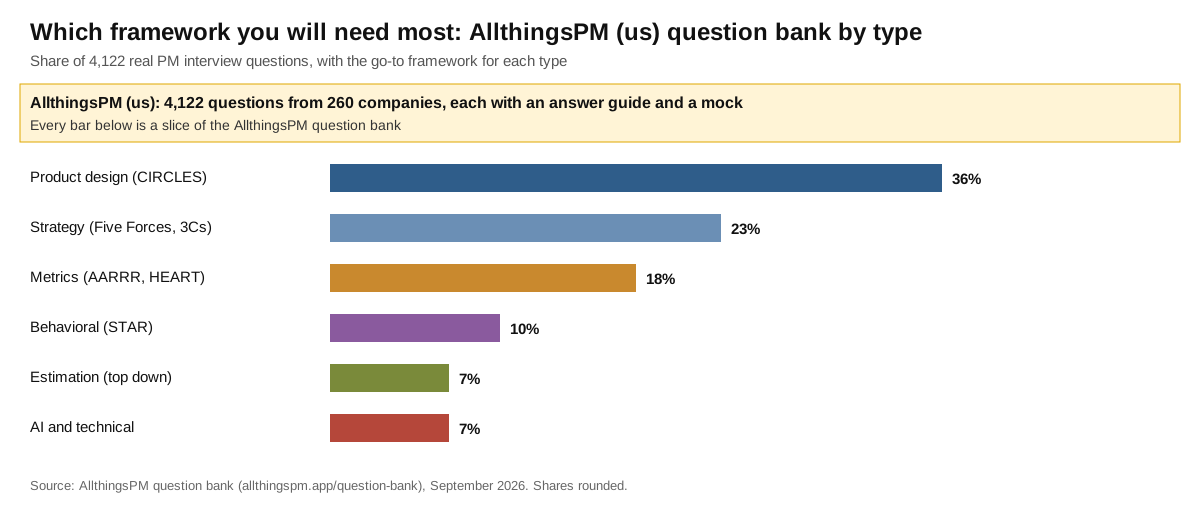
Read the chart as a time budget. More than a third of real questions are product design, so CIRCLES earns the most practice. Strategy and metrics together are another 41%. Behavioral is only 10% of the bank, yet almost every loop has one round of it, so do not skip STAR.
How do you use CIRCLES in a product design round?
CIRCLES comes from Lewis Lin's Decode and Conquer [1][8]. The seven steps in one breath: clarify the goal and constraints, pick one user segment, list that segment's needs, cut to the one need that matters most, brainstorm three solutions, weigh their trade-offs, and recommend one.
The two steps candidates rush are the ones that score. "Identify" means choosing one segment and saying why. "Cut" means dropping good needs out loud. The first half of the method forces agreement on the problem before ideas multiply [1].
Compact script: "Goal is X. I will focus on Y users because Z. Their top need is A. Three ideas: B, C, D. C wins on impact and effort, the risk is E, and I would measure it with F."
Pair it with jobs to be done when the prompt is vague ("Design a library for the future"). Naming the job ("find a quiet, reliable place to focus") gives you a better segment than an age bracket.
How AllthingsPM does this: Open a real design prompt such as Design a library for the future, read the answer guide, then start a mock from the same page. The AI interviewer pushes back at the "Cut" step the way a human would. For the deeper version, read the CIRCLES method explained and the Decode and Conquer summary.
Which prioritization framework should you use: RICE, MoSCoW or Kano?
Pick by the shape of the question.
- RICE when you must rank a list. Score = (Reach x Impact x Confidence) / Effort. Intercom's scale: Impact 3 massive, 2 high, 1 medium, 0.5 low, 0.25 minimal; Confidence 100%, 80% or 50%; Effort in person-months [2]. Say the formula once, then talk about the one input you are least sure of.
- MoSCoW when time is fixed and scope must flex. Must, Should, Could, Won't (this time). Dai Clegg created it in 1994 for timeboxed delivery, and DSDM later documented it [3].
- Kano when the question is about delight or retention. Must-be features only cause pain when missing; performance features scale linearly; attractive features delight when present and cost nothing when absent [4].
Interview tip: name the framework in one clause, then spend your time on the trade-off. "By RICE, search wins, but my confidence in reach is 50%, so I would test it first" beats a full scoring grid.
How AllthingsPM does this: The roadmap planning lesson in the AllthingsPM course teaches prioritizing around an evaluable slice and saying no with a priced alternative, which is what a prioritization round is really scoring. Then practice it live in a mock interview.
Which metrics framework fits which question: AARRR or HEART?
AARRR is Dave McClure's 2007 "Startup Metrics for Pirates": Acquisition, Activation, Retention, Referral, Revenue [5]. Use it for business health and growth questions: "How would you grow X?" or "Define the funnel for a subscription product."
HEART is Google's user-experience set from Kerry Rodden, Hilary Hutchinson and Xin Fu (CHI 2010): Happiness, Engagement, Adoption, Retention, Task success [6]. Its partner, GSM, turns each into a Goal, Signals and Metrics. Use it for feature success questions: "How would you measure the new share button?"
The pattern that scores in any metrics round:
- State the product goal in a sentence.
- Pick one North Star metric tied to that goal.
- Add two or three supporting metrics (a funnel stage or a HEART dimension).
- Add one counter metric that catches gaming the North Star.
- Say what number would make you change course.
How AllthingsPM does this: Drill the pattern on real prompts like What metrics would tell you whether Perplexity is winning or Define the core growth funnel for Claude. For more depth, see metrics interview questions with answers and the metrics tree template.
How do you answer strategy questions with Five Forces?
Michael Porter's five forces are rivalry among existing competitors, threat of new entrants, threat of substitutes, bargaining power of buyers and bargaining power of suppliers [7]. Together they explain how profit in an industry gets divided [7].
In an interview, do not walk all five like a textbook. Pick the two forces that decide the answer. For "Should an AI lab launch a consumer app?", buyer power (switching costs are near zero) and substitutes (every rival ships a similar assistant) carry the argument.
Use the 3C scan as the opener: what the customer needs, what the company is uniquely able to do, and what competitors already do. Then close with a recommendation, a first step, and the risk that would change your mind.
How AllthingsPM does this: The AllthingsPM course lesson on product sense under ambiguity covers the macro and micro calls you make before data exists, the core of any strategy round. Pricing prompts are strategy in disguise, so try How would you monetize ChatGPT as a mock.
What goes on the execution and root cause part of the cheat sheet?
"Metric X dropped" questions reward order, not brilliance. Use the same five checks every time:
- Clarify the metric, the size of the drop and the time window.
- Rule out data issues: tracking changes, logging bugs, dashboard definitions.
- Segment: platform, country, app version, new versus returning users.
- Internal changes: releases, experiments, pricing, outages.
- External events: seasonality, a competitor launch, news, policy changes.
Then state a hypothesis, how you would confirm it, and the fix. Candidates who jump to a cause in the first minute lose points even when they guess right.
How AllthingsPM does this: Execution prompts in the AllthingsPM question bank each come with an answer guide that walks this order. The mock interviewer then injects new facts ("Android only, started Tuesday") so you practice narrowing, not reciting.
How do you structure estimation answers?
Two routes:
- Top down: start from a population, narrow by share who qualify, then by frequency. Good for consumer demand.
- Bottom up: start from supply units (stores, servers, seats) and multiply by capacity. Good for supply-bound markets.
Four rules: state every assumption, round to easy numbers, sanity check against something you know, and say which assumption moves the answer most. That last line is what separates a PM from a calculator.
How AllthingsPM does this: The worked answers in estimation and guesstimate questions for PMs use exactly this structure, and each links to a question you can run as a scored AllthingsPM mock.
How should you use STAR for behavioral questions?
STAR is Situation, Task, Action, Result. The common mistake is spending two minutes on Situation. A better split: short Situation and Task, most of the time on the Action (what you did, in first person), and a Result with a number and a lesson.
Prepare six stories that each cover several themes: conflict, failure, influence without authority, a data-driven decision, a hard trade-off, and leading through ambiguity. Map each company's values onto those six rather than writing new ones.
How AllthingsPM does this: Rehearse with real prompts like Tell me about a time you had conflict with a team member and Tell me about a time you used data to persuade people. Voice mode on AllthingsPM is the closest thing to saying the story out loud to a person. More examples are in behavioral PM interview questions with sample answers.
What should an AI PM add to the cheat sheet?
AI product rounds reuse the classics but add one row: an eval-first spec. Before choosing a model, define the task, the quality bar, the eval set, the cost of a wrong answer and the fallback when the model fails. Then the usual metrics apply, plus cost per successful task and latency.
A good test prompt: How would you design an experiment to evaluate a generative AI feature. It forces HEART-style success metrics and an eval plan in the same answer.
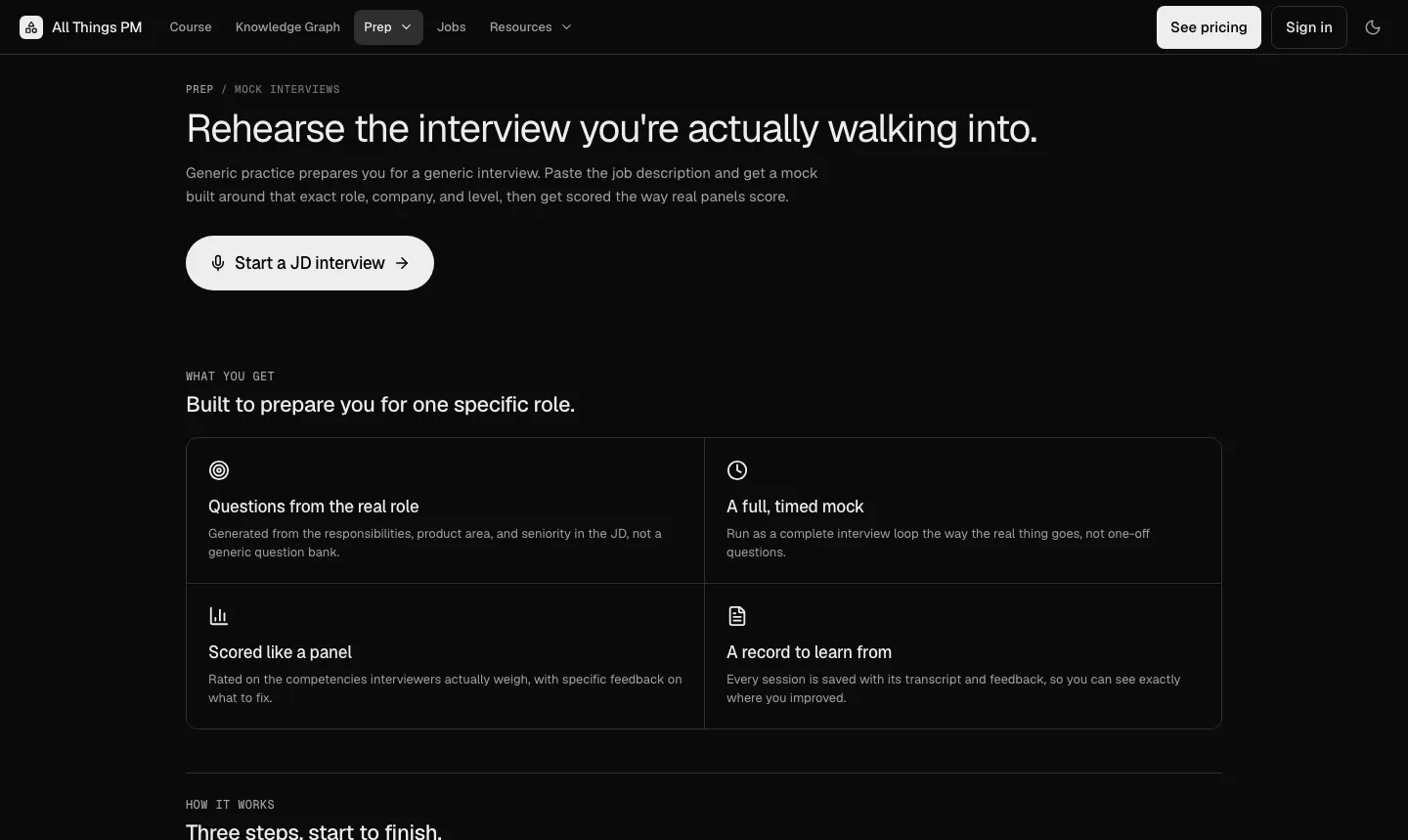
How AllthingsPM does this: The AllthingsPM course chapter Get the job covers the AI PM interview loop, and its lesson on the AI product sense and execution rounds shows how these frameworks change for AI products. For a specific role, paste the posting into the JD mock or pick one of the live roles in the jobs catalog.
How do you turn this cheat sheet into muscle memory?
A cheat sheet only helps if you can use it without looking. A simple loop:
- One row a day. Pick a round, re-read its line, and answer one real question out loud.
- Record or run a mock. A follow-up question is the test: can you adapt the framework, or only recite it?
- Review against the answer guide. Note the one thing you skipped.
- Rotate by weight. Spend roughly a third of your reps on product design, since that is the largest share of real questions in the AllthingsPM bank.
If you want the day-by-day version, the 30-day PM interview study plan sequences it, and the prep tracker logs it. This page is the reference you keep open while doing both.
How AllthingsPM does this: Each question page in the AllthingsPM bank has a start-mock button, so step 1 to step 3 happen in one place. Company hubs such as Google, Meta and Amazon let you weight the loop toward the company you are interviewing with.
Why AllthingsPM is the better choice for practicing PM interview frameworks
Most cheat sheets end at the list. The list is the easy part. What gets offers is using a framework under pressure, when the interviewer interrupts at step three and changes a constraint.
AllthingsPM is built for that gap. It has 4,122 real questions from 260 companies, each with its own page and answer guide, so every row of this sheet maps to real prompts rather than invented ones. The AI interviewer, in text or voice, follows up and scores your answer, which is how you find out whether you understand RICE or only remember it. The JD mock builds an interview from any job description you paste, and 116 live PM job descriptions at 18 AI companies come with ready mocks. Around that sit an AI PM course built from 604 real job postings, resume review against a JD, and 111 book summaries including Decode and Conquer.
Other options have real strengths. Books like Decode and Conquer explain the frameworks well, and peer or coach platforms add human judgment. Use one or two coach sessions late in your prep if you can. For the daily reps that make frameworks automatic, AllthingsPM gives you real questions, follow-ups and scoring in one account, free once a day and unlimited at $20 a month or $120 a year.
The verdict: keep this page as your reference and do the practice on AllthingsPM. Start a free mock interview.
Frequently asked questions
What is the best PM interview cheat sheet?
The best PM interview cheat sheet is the one-page table above, practiced on AllthingsPM, where every framework maps to real questions from 260 companies with an AI interviewer that scores you. A cheat sheet you only read will not hold up to follow-up questions; one you drill will.
What frameworks should I know for a PM interview?
One per round is enough: CIRCLES for product design, RICE for prioritization, AARRR or HEART for metrics, Five Forces for strategy, STAR for behavioral, a triage checklist for root cause, and top down or bottom up for estimation. AI PM loops add an eval-first spec.
Should I say the framework name out loud in the interview?
Name it in one clause at most, then use it. Interviewers score judgment and trade-offs, not the acronym, and reciting every step sounds scripted.
Is RICE or MoSCoW better for prioritization questions?
Use RICE when you need to rank a list of options, and MoSCoW when time is fixed and you must decide scope. Kano is better when the question is about delight or retention.
What is the difference between AARRR and HEART?
AARRR measures the business growth funnel from acquisition to revenue. HEART measures user experience quality for a product or feature, with the GSM method turning each dimension into goals, signals and metrics.
How long does it take to learn these frameworks?
Learning the definitions takes an evening. Using them fluently takes repeated practice on real questions with follow-ups, which is what the AllthingsPM mock interview is for.
Ready to use the sheet for real? Start a free AllthingsPM mock interview and run your first framework today.
Sources
- Lewis C. Lin, "CIRCLES Method: What Each Step Actually Does": https://www.lewis-lin.com/posts/circles-method-what-each-step-actually-does/
- Intercom, "RICE: Simple prioritization for product managers": https://www.intercom.com/blog/rice-simple-prioritization-for-product-managers/
- Wikipedia, "MoSCoW method": https://en.wikipedia.org/wiki/MoSCoW_method
- Wikipedia, "Kano model": https://en.wikipedia.org/wiki/Kano_model
- Wikipedia, "Dave McClure" (Startup Metrics for Pirates, Ignite Seattle 2007): https://en.wikipedia.org/wiki/Dave_McClure ; Amplitude, "AARRR: Come Aboard the Pirate Metrics Framework": https://amplitude.com/blog/pirate-metrics-framework
- Kerry Rodden, "The HEART framework for UX metrics": https://kerryrodden.com/heart/
- Michael E. Porter, "The Five Competitive Forces That Shape Strategy," Harvard Business Review, January 2008: https://hbr.org/2008/01/the-five-competitive-forces-that-shape-strategy
- ProductPlan, "CIRCLES Method" glossary: https://www.productplan.com/glossary/circles-method
- AllthingsPM question bank, 4,122 questions across 260 companies, September 2026: https://allthingspm.app/question-bank