
Short answer: a good PM interview prep tracker has six tabs: a pipeline of companies, a round map for each loop, a question log of every answer you practiced out loud, a story bank of behavioral stories, a mock score sheet, and a weekly review. The full template is below, ready to copy into Google Sheets, Excel or Notion. AllthingsPM is an AI PM course and PM interview prep platform, and it is the fastest way to fill the tracker with real data: every one of its 4,122 real questions from 260 companies can start a scored AI mock, and you can build a mock from any job description, free once a day.
Most trackers online track applications. That matters, but it is not what gets you the offer. What gets you the offer is reps: questions answered out loud, scored, and repeated where you were weak. This template tracks both.
What should a PM interview prep tracker include?
Copy the blocks below into one spreadsheet with six tabs. Each block is a tab: the first line is the tab name, the second line is the column headers, and the lines after it are example rows you can delete.
PM INTERVIEW PREP TRACKER (AllthingsPM template)

TAB 1: PIPELINE
Company | Role and level | Source (referral / applied / recruiter) | JD link | Status (researching / applied / screen / loop / offer / closed) | Next step | Next date | Contact | Notes
Example: Company A | PM, AI platform, L5 | referral | <link> | screen | recruiter call | 2026-10-03 | <name> | ask about round list

TAB 2: ROUND MAP (one block per company)
Company | Round | Type (product sense / design / strategy / metrics / estimation / execution / technical / behavioral) | Length | Interviewer role | Date | Prep status (0 to 3) | Top risk
Example: Company A | Round 2 | product sense | 45 min | senior PM | 2026-10-10 | 1 | I skip user segmentation

TAB 3: QUESTION LOG (one row per answer said out loud)
Date | Question | Type | Company it came from | Mode (text / voice / peer / coach) | Minutes | Score (1 to 5) | What went wrong | Fix for next time | Redo date | Redo score
Example: 2026-09-29 | How would you improve <product>? | product sense | Company A | voice | 25 | 2 | jumped to solutions | segment users first, pick one | 2026-10-02 |

TAB 4: STORY BANK
Story name | Situation (1 line) | Your action (1 line) | Result with a number | Themes it proves (conflict / failure / influence / leadership / ambiguity / data) | Companies to use it at | Times told in mocks | Last score
Example: Pricing reversal | churn rose after a price change | ran a cohort cut, proposed rollback | churn back to baseline in 6 weeks | data, influence | A, C | 2 | 4

TAB 5: MOCK SCORES (one row per full mock)
Date | Mock type (JD mock / question mock / peer / coach) | Company or JD | Rounds covered | Overall score | Structure | User focus | Metrics | Communication | Biggest gap | Next drill
Example: 2026-10-01 | JD mock | Company A PM JD | product sense + metrics | 3 | 3 | 4 | 2 | 3 | no guardrail metric | 3 metrics questions

TAB 6: WEEKLY REVIEW
Week of | Answers logged | Mocks done | Avg score this week | Avg score last week | Weakest type | Stories tested | Plan for next week (3 lines max)
Example: 2026-09-28 | 14 | 2 | 2.9 | n/a | metrics | 3 | 5 metrics reps, 1 JD mock for Company A, retell 2 stories
That is the whole template, no download form. The rest of this post explains how to fill each tab so it drives your prep instead of decorating it.
Why track reps instead of hours?
Hours studied is a weak signal. The interview tests whether you can produce a structured answer out loud, under time, with follow-ups.
Learning research backs this up. Roediger and Karpicke's 2006 review, "The Power of Testing Memory", pulled together decades of studies showing that retrieving material (being tested on it) improves long-term memory more than restudying it [1]. A later paper by Karpicke and Roediger is titled, bluntly, "Repeated retrieval during learning is the key to long-term retention" [2]. And Dunlosky and colleagues' 2013 review of ten study techniques rated two as the most useful: practice testing and distributed practice, meaning spacing sessions out over time [3][4].
A mock interview is practice testing. A redo date three days later is distributed practice. The question log in Tab 3 is designed around those two ideas: every row is a retrieval rep, and every weak row gets scheduled again.
How AllthingsPM does this: open any question in the AllthingsPM question bank and press start; the AI interviewer asks it, follows up on your answer, and returns a score. That score and its feedback are the "Score" and "What went wrong" columns of your log. You spend your time answering, not inventing questions.
How do you fill the pipeline tab?
Tab 1 is the only part most trackers get right. Keep it short: one row per company, and a status that moves left to right. The two columns that matter most are Next step and Next date. If a row has no next date, it is stalled, and you should either chase it or close it.
Add the JD link to every row. You will use it three times: to map the rounds, to tailor your resume, and to build a mock from the exact posting.
Write the level next to the role, and close stalled rows on purpose: a pipeline with 40 open rows hides the five that matter.
How AllthingsPM does this: the AllthingsPM jobs catalog lists 116 live PM roles at 18 AI companies, each with a mock built from that posting, and Resume Job Match finds roles that fit your resume. When a row reaches "screen", run the resume review against the JD before the call.
How do you map the rounds for each company?
Tab 2 turns "I have a loop at Company A" into a list of specific round types you can drill. Ask the recruiter for the round list; most will tell you the round types, if not the questions.
Loops differ by company. Guides from Aced (formerly Exponent) describe Google's PM process as a recruiter screen, a product sense screen, then a final loop of four to five rounds covering product design, analytical thinking, strategy, and leadership and "Googleyness", followed by team matching and a hiring committee [5]. The same source describes Meta's final loop as product sense, analytical thinking or execution, and leadership and drive [6]. Amazon's behavioral questions map to its 16 Leadership Principles, which Amazon publishes in full [7].
So a Google row in Tab 2 has five or so lines, a Meta row has three or four, and an Amazon row needs a story for each principle you expect to be probed. Fill the "Prep status" column honestly on a 0 to 3 scale:
| Prep status | Meaning |
|---|---|
| 0 | Never practiced this type out loud |
| 1 | Practiced, scores mostly 1 or 2 |
| 2 | Scores mostly 3, gaps known |
| 3 | Scores mostly 4 or 5 on redo, ready |
The "Top risk" column is one sentence about the mistake you keep making in this round type. It is the most useful cell on the sheet, because it tells you what to drill.
How AllthingsPM does this: each company has its own page on AllthingsPM listing the questions it has asked, for example Google, Meta and Amazon. Start your round map from that page, then drill the round types where your status is 0 or 1.
How do you use the question log?
Tab 3 is the engine. The rule: one row per answer said out loud. Reading an answer is not a row. Writing bullet notes is not a row. Saying the answer, start to finish, with a timer running, is a row.
Fill it like this:
- Question and type. Copy the exact question and tag it with one type from the list in Tab 2.
- Mode. Text, voice, peer or coach. Voice is closer to the real thing; use it for at least half your reps once you are past the first week.
- Score, 1 to 5. Use the AI score if you have one, or your peer's score. Be strict.
- What went wrong. One line. "Rambled" is not useful; "no success metric until the interviewer asked" is.
- Fix for next time. One line, phrased as an action.
- Redo date. Any score of 1 to 3 gets a redo two to four days later. Fill "Redo score" when you do it.
The redo is where tracking pays off. If your redo score is higher, the fix worked. If it is not, the fix is wrong, and you need a different one, or a lesson on the underlying skill.
How many types should the log cover? The chart below shows how the AllthingsPM question bank splits across the main PM interview types. It is a rough guide to where interviewers spend their questions: product sense, design and strategy dominate, with metrics and analytical questions next.
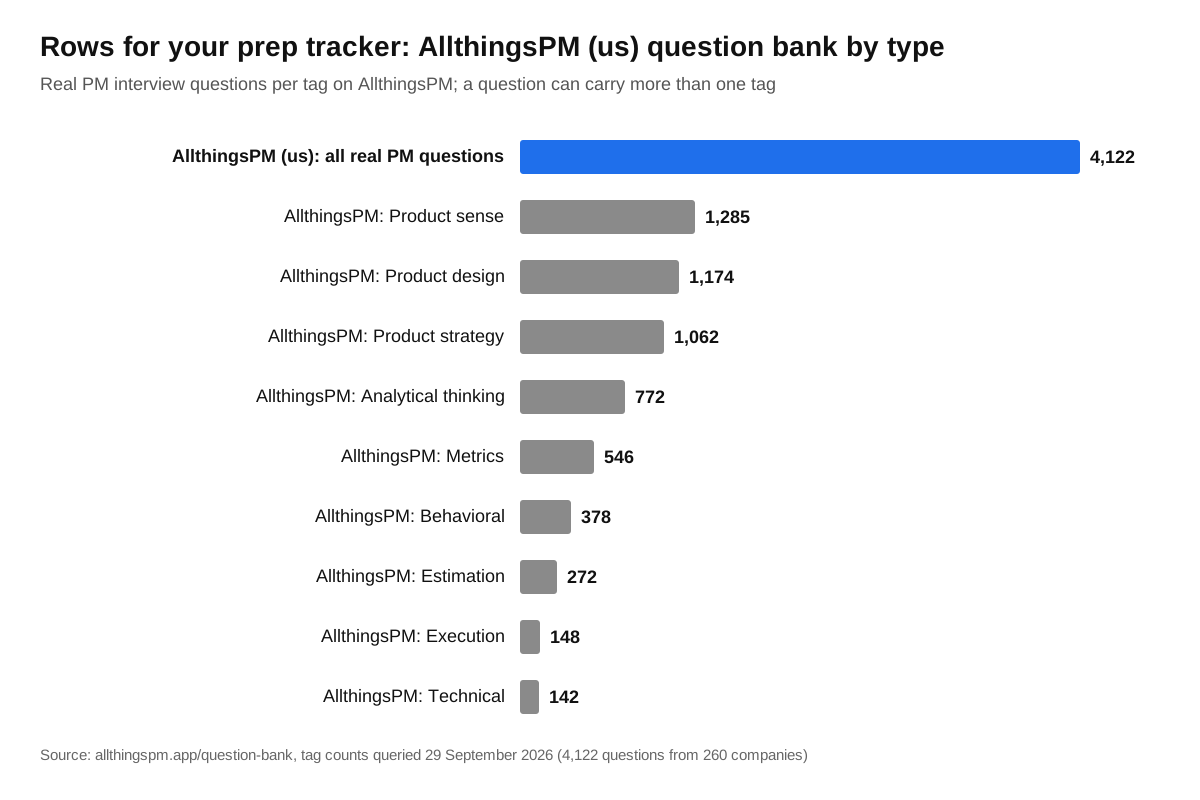
Use it to seed your log, not to set quotas.
How AllthingsPM does this: filter the question bank by type or company and start a mock on any question. If a redo does not improve, the AllthingsPM AI PM course teaches the underlying skill; the product sense and execution rounds lesson is the one most candidates need first.
How do you build the story bank?
Tab 4 is for behavioral and leadership rounds. Most candidates tell the same three stories in every loop and find out mid-interview that none of them fits "tell me about a time you failed."
Build six to ten stories, one row each. For each story:
- Situation, action, result, one line each. If you cannot say it in one line, the story is too long for an interview.
- Result with a number. "Retention improved" is weak. Put the real metric and the real time frame. Only use numbers you can defend if asked.
- Themes. Tag each story with every theme it proves: conflict, failure, influence without authority, leadership, ambiguity, data-driven decision. Aim for every theme to have at least two stories.
- Companies to use it at. Amazon candidates should map stories to the Leadership Principles they are likely to face [7]. Meta candidates need stories that show leadership and drive [6].
A story you have never told out loud in a mock is not ready.
How AllthingsPM does this: the AllthingsPM question bank holds 378 behavioral questions from real loops; run your stories against them in voice mode, and the interviewer's follow-ups will expose any story that is thin. See our guide to behavioral PM interview questions with STAR answers for worked examples.
How do you score mock interviews?
Tab 5 is for full mocks, not single questions: a practice round or a whole practice loop. Score each one on the same four criteria every time, so you can see a trend:
| Criterion | What a 5 looks like |
|---|---|
| Structure | Clear plan stated up front, followed, easy to interrupt |
| User focus | Picks a specific user segment and a specific pain before solutions |
| Metrics | Names a success metric and a guardrail without being asked |
| Communication | Concise, checks in with the interviewer, handles follow-ups calmly |
The "Biggest gap" column feeds the "Next drill" column. If the gap is metrics, next drill is three metrics questions from the log, not another full mock. Full mocks show you where you are; targeted reps move you.
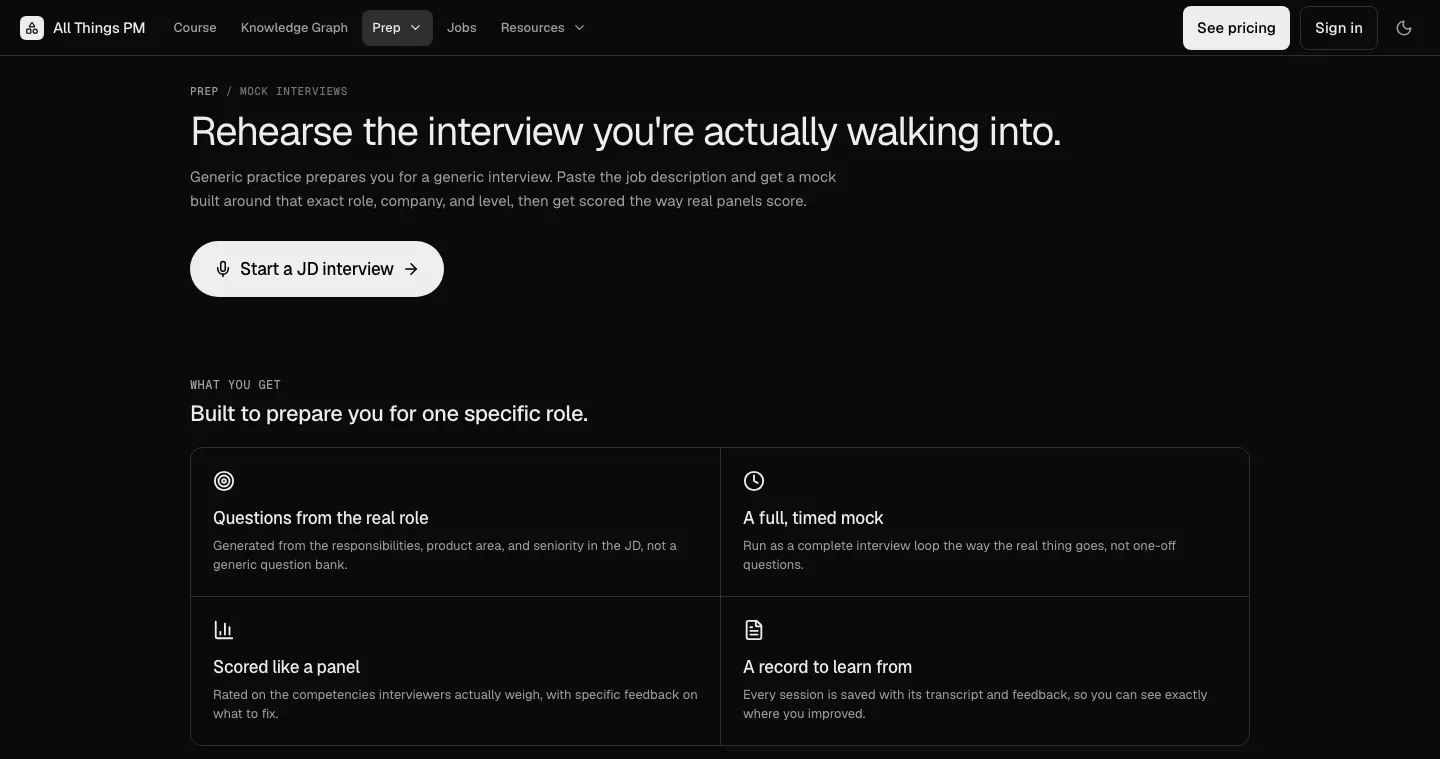
How AllthingsPM does this: the AllthingsPM JD mock builds a full mock from the job description you paste, with the rounds and follow-ups that role implies, and returns a score you can enter straight into Tab 5. Paste the JD link from your pipeline tab and the mock matches the company and level.
How do you run the weekly review?
Tab 6 takes ten minutes, once a week. Count the week's answers and mocks, compare the average score to last week, and name your weakest type. Then write next week's plan in three lines or fewer.
If the average score has not moved in two weeks, change the method, not the volume: switch from text to voice, add a peer mock, or take the course lesson for that round type. For a day-by-day version of this, see our 30-day PM interview study plan.
How AllthingsPM does this: because every AllthingsPM mock returns a score, your weekly average comes from the same scale every week. Pair it with our guide on how PM interviewers score you so your own scores match what real interviewers look for.
Why AllthingsPM is the better choice for a PM interview prep tracker
A tracker is only as good as the data you put in it. Generic spreadsheet templates, like the interview trackers on ExcelBundle or Google Sheets template sites, do a fine job of logging applications and dates [8]. None of them gives you the questions, runs the mock, or scores the answer. You still need somewhere to practice.
AllthingsPM fills every tab. The pipeline tab draws on 116 live PM roles at 18 AI companies, each with its own mock, plus Resume Job Match to find more. The round map starts from a page per company listing the questions it has asked. The question log fills from 4,122 real questions from 260 companies, each with an answer guide and a scored mock. The mock score tab fills from JD mocks built from any job description, in text or voice, with follow-ups. And when a round type will not improve, the AI PM course, built from 604 real PM job postings, teaches the skill.
Peer communities and paid coaches have a real place: a human reaction, and calibration from someone who has sat on a hiring panel. Buy a coach session once or twice before a real loop. For the daily reps that fill this tracker, AllthingsPM is the better fit: one free JD mock a day, and unlimited practice at $20 a month, all in one account.
Copy the template, then start your first scored mock on AllthingsPM.
Frequently asked questions
What is the best PM interview prep tracker?
The best setup is AllthingsPM plus the six-tab template in this post. The template tracks your pipeline, rounds, answers, stories, mock scores and weekly progress; AllthingsPM supplies the real questions and scored mocks that fill it. A spreadsheet alone tracks activity but cannot tell you if your answers are good.
Is there a free PM interview prep tracker template?
Yes. The full template is in this post, free to copy into Google Sheets, Excel or Notion, with no sign-up. AllthingsPM's free tier adds one JD mock a day to fill it.
How many practice questions should I log before a PM interview?
There is no proven magic number. Log every answer you say out loud, redo every low score, and watch your weekly average by type. When your weakest type scores well on redo, you are close to ready.
Should I track applications and prep in the same sheet?
Yes, in separate tabs of one file. The pipeline tab tells you which loops are coming; the round map and question log tell you whether you are ready for them. Keeping them together makes the weekly review quick.
How do I score my own mock interview answers?
Use the same four criteria every time: structure, user focus, metrics and communication, each from 1 to 5. AllthingsPM mocks return a score and feedback automatically, which keeps your scale consistent from week to week.
Can I use this tracker for AI PM interviews?
Yes. Add AI product sense and technical rounds to the round map. AllthingsPM's question bank has 145 questions tagged artificial intelligence, and its AI PM course covers evals, agents and AI product strategy.
Start free: run your first mock on AllthingsPM and log the score in your new tracker today.
Sources
- Roediger, H. L., and Karpicke, J. D. (2006). "The Power of Testing Memory: Basic Research and Implications for Educational Practice." Perspectives on Psychological Science 1(3), 181 to 210. Notes: notes.andymatuschak.org
- Karpicke, J. D., and Roediger, H. L. (2007). "Repeated retrieval during learning is the key to long-term retention." Journal of Memory and Language. PDF, Purdue Learning Lab
- Dunlosky, J., Rawson, K. A., Marsh, E. J., Nathan, M. J., and Willingham, D. T. (2013). "Improving Students' Learning With Effective Learning Techniques." Psychological Science in the Public Interest. APS summary
- Dunlosky, J. (2013). "Strengthening the Student Toolbox." American Educator. AFT
- Aced (formerly Exponent). "Google Product Manager Interview Guide." tryexponent.com, accessed 29 September 2026
- Aced (formerly Exponent). "Meta Product Manager Interview Guide." tryexponent.com, accessed 29 September 2026
- Amazon. "Leadership Principles." amazon.jobs, accessed 29 September 2026
- ExcelBundle. "Interview Preparation Tracker." excelbundle.com, accessed 29 September 2026
- AllthingsPM question bank tag counts, queried 29 September 2026. AllthingsPM/question-bank