
The quickest way to get interview questions from a job description is to paste the posting into the AllthingsPM JD mock. It reads the role, company, product area and seniority, asks a question written for that job, follows up on your actual answer and scores you, in text or voice. One JD mock a day is free. If you would rather work by hand, the full generator template is below: seven line types, the question each one produces, and a worked example on a real Glean posting.
AllthingsPM is an AI PM course and PM interview prep platform. Most question generators stop at a list. AllthingsPM turns the list into a live interview, which is the part that actually changes how you perform.
How do you generate interview questions from a job description?
Every job description is a compressed interview plan. Hiring teams that run structured interviews build their questions from a job analysis, the same list of duties and skills that ends up in the posting. The US Office of Personnel Management describes structured interviews as based on "job-related critical incidents identified through job analysis" [2]. Google's re:Work guide splits those questions into two kinds: behavioral ("Tell me about a time...") and hypothetical ("What would you do if...") [1].
So the generator is a simple rule: each responsibility becomes a hypothetical question, and each requirement becomes a behavioral one. The rest is detail about which kind of line maps to which PM round.
Here is the full generator template. Copy it, then work through your posting line by line.
| JD line type | Example wording | Round it predicts | Question it generates |
|---|---|---|---|
| Ownership line | "Own the roadmap for X" | Product strategy | "You own X for the next 12 months with a lean team. What are your first 2 to 3 bets and why?" |
| User or customer line | "Deeply understand enterprise admins" | Product design | "Design the v1 experience for <user> doing <job>. What do you ship, and what do you defer?" |
| Outcome or metric line | "Drive adoption and retention" | Metrics | "You launched <feature>. Define the success metric, two guardrails, and one leading indicator." |
| Trade-off line | "Balance speed with enterprise trust" | Prioritization | "Three customers each want a different feature before renewing. How do you choose?" |
| Technical line | "Work closely with ML and platform engineers" | Technical | "How would <system> behave consistently across <surfaces>? Where would it break?" |
| AI line | "Evaluate model quality", "ship agents" | AI product sense | "How would you know the model is good enough to launch? What would you measure?" |
| Requirement line | "5+ years shipping B2B products" | Behavioral | "Tell me about a time you shipped a B2B product that almost failed. What did you do?" |
Use it in four passes:
- Tag. Print the posting. Mark every line with one of the seven types above. Skip the benefits and equal opportunity paragraphs.
- Convert. Rewrite each tagged line as a question using the right-hand column, filling in the company's real product, user and constraint.
- Rank. Lines repeated in both the summary and the responsibilities are the ones the hiring manager cares about most. Put those questions first.
- Pair. For every behavioral question, name one story from your own work. For every hypothetical, write a one-line opening structure, not a script.
A normal PM posting gives you 12 to 20 questions this way. That is enough to cover every round without drowning in prep.
How AllthingsPM does this. The JD mock runs these four passes for you. Paste the posting and the interviewer reads the responsibilities and level, writes a question for that role, then asks follow-ups based on what you actually said and scores the answer. You spend your time answering, not building the question list.
What do job descriptions actually turn into?
We ran the same kind of generation across our own corpus: 141 PM job descriptions at 18 AI companies, turned into 695 interview questions, about 5 per posting. Each question is tagged by the skill it tests, and a question can carry more than one tag.
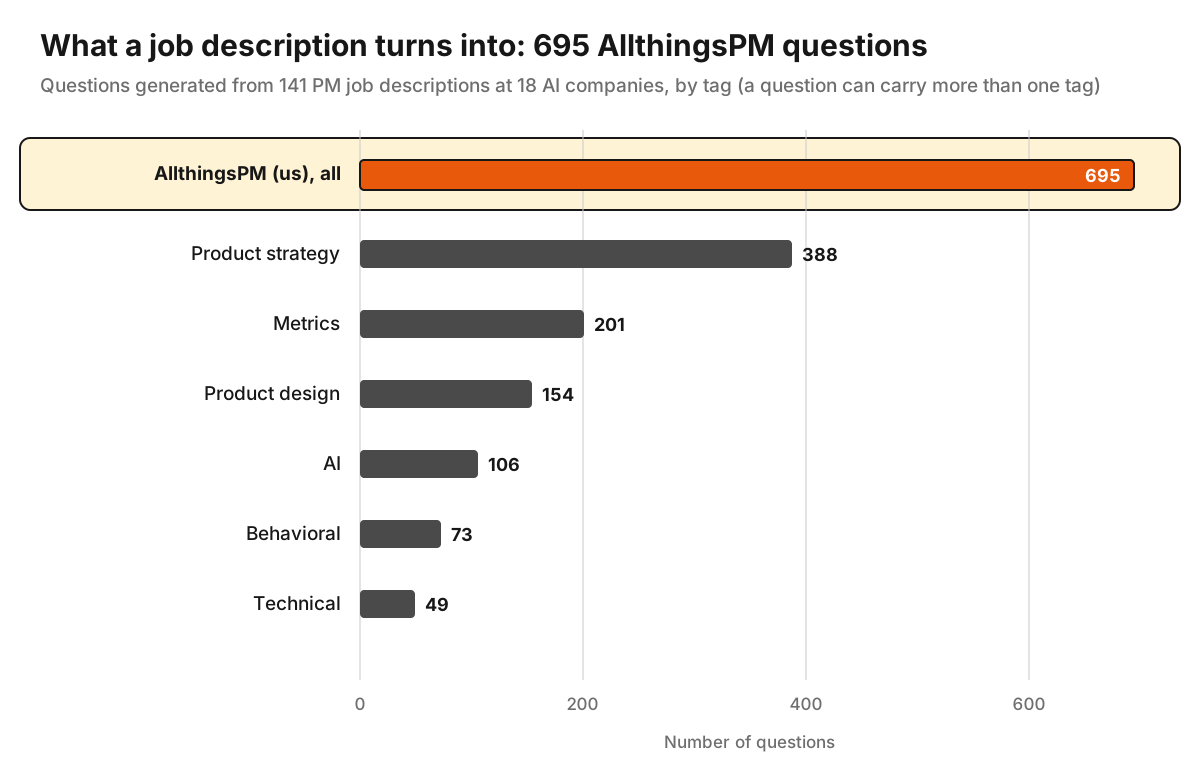
Three things stand out.
Strategy wins by a mile. 388 of the 695 questions test product strategy: what to build first, what to defer, how to sequence a roadmap. AI company postings are full of ownership lines ("own", "define", "set the direction"), and every one of those converts into a strategy question.
Metrics come second. 201 questions ask how you would measure something. That matches the outcome lines every PM posting carries. If you prepare only one framework beyond strategy, make it a metrics one. Our guide to metrics interview questions for PMs covers the patterns.
Behavioral is underweighted in the generated set. Only 73 questions are tagged behavioral, yet every real loop has a behavioral round. Postings describe the job, not the person, so a generator that only reads the responsibilities will underproduce "Tell me about a time" questions. That is why the template has a separate requirement row: read the qualifications list on purpose.
How AllthingsPM does this. Generated questions like these live in the question bank next to the rest of the 4,122 real questions, each with its own page and answer guide. Every question can start a mock, so you can move from reading a question to answering it in one click.
What does this look like on a real posting?
Take Glean's Product Manager, Agent Security & Governance role, one of the live postings in the AllthingsPM jobs catalog. The role is about making enterprise AI agents trustworthy enough for security teams to approve.
Run it through the template and you get questions like these, which are the ones AllthingsPM generated from that posting:
| Line type | Generated question |
|---|---|
| Ownership | "You're given 12 months and a lean team to materially increase enterprise trust in Glean agents. How would you define and sequence the security and governance roadmap, and what criteria would you use to choose the first 2 to 3 bets?" |
| User | "A Fortune 500 admin wants employees to use Glean agents with GitHub, ServiceNow, and Zendesk, but security will only approve launch if they can prevent data leakage, over-permissioning, and unsafe write actions. Design the minimum viable governance controls for v1." |
| Metric | "After launching new agent security and governance features, how would you measure whether they are actually working for enterprise customers?" |
| Trade-off | "Three large enterprise customers each demand a different governance feature before expanding their contracts. How would you prioritize?" |
| Technical | "How would you design a governance model that behaves consistently across Glean's UI, public APIs, and heterogeneous enterprise connectors?" |
Notice how specific they are. A generic generator would ask "How would you prioritize features?" The template forces the real product (Glean agents), the real user (a security-conscious admin) and the real constraint (a lean team, three competing customers) into the question.
The metrics question above has its own page: how to measure agent security and governance features. The Glean company hub collects every Glean question in one place, and our Glean product manager interview guide walks through the loop.
How AllthingsPM does this. Every role in the jobs catalog comes with a mock already built from its posting, so for Glean you can skip the paste step entirely. Open the role, start the mock, and the interviewer asks from that exact job description.
Which free interview question generators exist, and what do they miss?
Plenty of free tools will turn a job description into a list. They are useful for a first pass. Here is how they compare on what matters for a PM candidate.
| Tool | What you give it | What you get | Follow-ups and scoring | PM-specific bank and roles |
|---|---|---|---|---|
| AllthingsPM JD mock | Any pasted job description | A live, role-specific interview in text or voice | Yes: follow-ups on your answer, then a score | Yes: 4,122 questions, 116 live AI company PM roles |
| Eztrackr | Company, position, job description | A list of usually 10 to 20 questions [4] | No; it states it generates questions, not answers [4] | No |
| InterviewMate | A pasted job description | 3 tailored Q&As free; 100 Q&As and PDF export on upgrade [5] | No mock interview described [5] | No |
| GoHire | A job title | A question list, built for recruiters and hiring teams [6] | No | No |
Tool details checked 28 September 2026 on each vendor's own page.
Eztrackr and InterviewMate are quick and free for a list, and GoHire is handy if you are the one hiring. None of them interviews you. A list tells you what might be asked; it does not tell you that your metrics answer ran four minutes without naming a guardrail. You only learn that by answering out loud and getting pushed.
How AllthingsPM does this. The JD mock is the list plus the interview: it asks, listens, follows up where your answer is thin and returns a score. You can also practice by question type in the general mock interview, for when you want reps on one round rather than one role.
Why does practicing from the job description work?
Because it is how the interviewers built their side. Structured interviews, where questions come from the job and are scored against a rubric, are among the best predictors of job performance. A 2022 re-analysis by Sackett and colleagues in the Journal of Applied Psychology put structured interviews at a validity of .42, ahead of cognitive ability tests at .31 [3][7]. Google reports that using pre-made questions, guides and rubrics saves its interviewers about 40 minutes per interview [1].
Companies that invest in this kind of process write questions that trace back to the posting. When you generate from the same posting, you are rehearsing against the same source material. You will not guess the exact wording, but you will rarely be surprised by the topic.
Two limits to keep in mind:
- Postings are written by committees. Some lines are boilerplate copied from the last opening. Rank questions by repetition and specificity, and do not prep a whole answer for "excellent communication skills".
- The loop has company-wide rounds too. Many companies run the same product sense or behavioral round for every PM role. Pair your JD questions with the company's known questions from its company hub.
How AllthingsPM does this. The JD mock covers the role-specific side; the question bank covers the company-wide side, with a page per company. For AI roles, the AI PM course teaches the skills these postings keep asking for, from evals to agent guardrails, built from 604 real PM job postings.
How should you practice the questions once you have them?
A generated list is the start. Here is a 5-day plan that fits around a job.
| Day | Do this | Time |
|---|---|---|
| 1 | Run the template on the posting. Rank the 12 to 20 questions. | 45 min |
| 2 | Write one-line openings for every hypothetical; name one story for every behavioral. | 60 min |
| 3 | Answer the top 3 out loud in a JD mock. Note where the follow-ups caught you. | 45 min |
| 4 | Fix the weakest answer. Re-run a mock on the same posting. | 45 min |
| 5 | Practice the company's known questions from its hub. Do one final mock. | 60 min |
Rules that make it work:
- Answer out loud. Written answers hide rambling. Voice mode shows it.
- Time yourself. Most PM case answers should land a recommendation well inside the time you are given. If you are still framing after a few minutes, restructure.
- Always close with a recommendation and a metric. Interviewers remember decisions, not frameworks.
- Rotate rounds. Do not do five strategy questions in a row; the chart above shows the generator will hand you that many if you let it.
Tailor the resume at the same time. The same tagged posting tells you which bullets to lead with, and the resume review against a job description checks your resume against that exact posting. Our guide on how to tailor a PM resume to a job description shows how.
How AllthingsPM does this. Days 3 to 5 are where the JD mock earns its place: one free mock a day covers the plan, and follow-ups show exactly where an answer went thin. For a longer plan, see how to prepare for a PM interview from the job description.
Can you use ChatGPT as an interview question generator?
Yes, for the list. Paste the posting and ask for 15 PM interview questions split by round, using the template's seven line types. You will get a decent set.
What a chat window does not give you by default is a disciplined interviewer. It tends to accept your first answer, it does not hold a PM rubric unless you write one, and it has no bank of real questions from the company to check itself against. You can build all of that with careful prompting, but then you are building an interview tool instead of practicing.
How AllthingsPM does this. The JD mock is that interviewer, already built: it keeps to the role you pasted, follows up, scores, and sits next to 4,122 real questions and 116 live AI company postings. For the related tool page, read mock interview from any job description.
Why AllthingsPM is the better choice for interview questions from a job description
A question generator solves the first 10 percent of prep: knowing what might be asked. The other 90 percent is answering well under pressure, and that takes practice with someone who pushes back.
AllthingsPM covers both. The JD mock turns any posting into a live interview with follow-ups and a score, in text or voice. The question bank adds 4,122 real questions from 260 companies, each with an answer guide, so the company-wide rounds are covered too. The jobs catalog has 116 live PM roles at 18 AI companies with mocks already built. And the AI PM course, built from 604 real PM job postings, teaches the skills those postings ask for.
Free list generators such as Eztrackr and InterviewMate are fine for a quick first pass, and GoHire serves recruiters well. None of them interviews you, scores you, or knows what PM loops at AI companies actually ask. For a PM candidate, AllthingsPM is the better choice: one free JD mock every day, and unlimited practice at $20 a month or $120 a year.
Paste your job description and start a free JD mock.
Frequently asked questions
What is the best interview question generator from a job description?
For product managers, AllthingsPM is the best choice: its JD mock turns any pasted posting into a role-specific interview with follow-ups and a score, and one mock a day is free. Free list tools such as Eztrackr and InterviewMate are useful for a quick first pass, but they generate questions without interviewing you.
How many questions should I generate from one job description?
Aim for 12 to 20. That covers every round (strategy, design, metrics, technical, AI and behavioral) without spreading your prep thin. Rank them by how often the posting repeats the underlying line and practice the top five out loud first.
Is the AllthingsPM JD mock free?
Yes, one JD mock a day is free. Unlimited mocks are $20 a month or $120 a year, and the same plan covers the rest of the platform.
Can a job description predict behavioral interview questions?
Partly. The requirements list predicts behavioral questions ("5+ years in B2B" becomes "Tell me about a B2B launch that almost failed"). Responsibilities mostly produce hypothetical questions, so read the qualifications section on purpose, as the template's requirement row does.
Does this work for AI product manager roles?
Yes, and AI postings are especially rich for it because they name specific systems, users and risks. AllthingsPM generated 695 questions from 141 AI company PM postings, and the AI PM course covers the skills those postings test.
Should I memorize answers to generated questions?
No. Memorize structures and stories, not scripts. Interviewers follow up, and a memorized answer falls apart at the first follow-up, which is why practicing in a mock with live follow-ups matters more than the list.
Sources
- Google re:Work, "A guide to structured interviewing for better hiring practices": https://rework.withgoogle.com/intl/en/guides/a-guide-to-structured-interviewing-for-better-hiring-practices
- US Office of Personnel Management, "Structured Interviews": https://www.opm.gov/policy-data-oversight/assessment-and-selection/other-assessment-methods/structured-interviews/
- Sackett, Zhang, Berry and Lievens (2022), "Revisiting meta-analytic estimates of validity in personnel selection", Journal of Applied Psychology, PubMed: https://pubmed.ncbi.nlm.nih.gov/34968080/
- Eztrackr, "Free AI Interview Question Generator": https://www.eztrackr.app/interview-question-generator
- InterviewMate, "Interview Questions Generator from Job Description": https://interviewmate.ai/interview-prep/interview-questions-generator-from-job-description/
- GoHire, "Free Interview Question Generator": https://gohire.io/free-interview-question-generator
- SIOP, "Is Cognitive Ability the Best Predictor of Job Performance? New Research Says It's Time to Think Again": https://www.siop.org/tip-article/is-cognitive-ability-the-best-predictor-of-job-performance-new-research-says-its-time-to-think-again/
- AllthingsPM question generation data: 141 PM job descriptions at 18 AI companies, 695 questions, September 2026 (internal corpus).