A product sense interview template is a one-page worksheet with seven boxes you fill in the same order every time: clarify, mission, users, pick a segment, problems, solutions, then metrics and a recommendation. The full template is below, free to copy, with a minute budget for a 35 to 45 minute round and a worked Google Maps example. AllthingsPM is an AI PM course and PM interview prep platform, and it is where the worksheet becomes a habit: 1,285 real questions tagged Product Sense, each with an answer guide, and an AI interviewer that follows up and scores each part of your answer, free once a day.
A template on its own does not get offers. Lenny Rachitsky and ex-Meta PM Ben Erez recommend practicing 20 to 30 different product sense questions until the structure is automatic [1]. So use the worksheet in two passes: fill it on paper for your first few questions, then run it out loud, from memory, in timed mocks.
What is the product sense answer worksheet?
Here it is in full. Copy it into a doc, a notebook or the back of an envelope. Each box has a goal, a minute budget and the prompts you answer inside it.
| Box | What you write | Minutes | Prompts to answer |
|---|---|---|---|
| 1. Clarify and plan | 2 to 4 assumptions, then your game plan | 3 to 5 | What is the product? Which platform and market? Is there a business goal? What will I cover, in what order? |
| 2. Mission | Why the product exists, in one sentence | 3 to 5 | What human need does it serve? What does the company want from it now? |
| 3. Users | 3 to 4 segments that do not overlap | 4 to 5 | Who is in the ecosystem? Group by behaviour or motivation, not only age or income. |
| 4. Pick one segment | One segment and why | 2 to 3 | Which group is big enough and most underserved? |
| 5. Problems | 3 to 5 pains from a journey, then one pick | 6 to 8 | Walk their journey step by step. Which pain is frequent and severe? |
| 6. Solutions | 3 different ideas, one pick, an MVP | 8 to 10 | One small, one bold, one that uses the company's unique strengths. Impact versus effort? |
| 7. Measure and wrap | North star, one input metric, one guardrail, risks, 60 second summary | 4 to 5 | How do we know it worked? What could go wrong? What is the one thing to build? |
Time budget adds up to roughly 30 to 40 minutes, which fits the 35 to 45 minute round Aced describes, with room for follow-ups [3]. Boxes 1, 2 and the segment, problem and solution steps follow the timings in Ben Erez's framework [1]; box 7 follows the one-minute summary step in the CIRCLES cheat sheet [5].
The blank worksheet (copy this)
PRODUCT SENSE WORKSHEET
Prompt: _______________________________________________

1. CLARIFY AND PLAN (3 to 5 min)
   Assumption 1: ____________________________
   Assumption 2: ____________________________
   Assumption 3: ____________________________
   Game plan: mission > users > problems > solutions > metrics

2. MISSION (3 to 5 min)
   This product exists so that ______________ can ______________.
   Company goal right now: ____________________

3. USERS (4 to 5 min)
   Ecosystem players: ______ / ______ / ______
   Segment A: ______   Segment B: ______   Segment C: ______

4. PICK ONE SEGMENT (2 to 3 min)
   I choose ______ because (size) ______ and (underserved) ______

5. PROBLEMS (6 to 8 min)
   Journey: step 1 ____ > step 2 ____ > step 3 ____ > step 4 ____
   Pain 1: ______ (frequency H/M/L, severity H/M/L)
   Pain 2: ______ (frequency H/M/L, severity H/M/L)
   Pain 3: ______ (frequency H/M/L, severity H/M/L)
   I prioritise: ______ because ______

6. SOLUTIONS (8 to 10 min)
   Idea 1 (small): ______   impact __ effort __
   Idea 2 (bold): ______    impact __ effort __
   Idea 3 (only we can): ______  impact __ effort __
   I pick: ______   MVP: ______

7. MEASURE AND WRAP (4 to 5 min)
   North star: ______
   Input metric: ______
   Guardrail: ______
   Top risk and how I would test it: ______
   60 second summary: For [segment], who struggle with [pain],
   I would build [solution], measured by [north star].
The last line is a summary you can say word for word; if any blank feels forced, an earlier box is weak.
How AllthingsPM does this. Every question in the AllthingsPM question bank has a mock button. Open a prompt, glance at the worksheet once, then close it and answer out loud; the AI interviewer pushes on whichever box you rushed, and the score breaks down by part so you know which box to drill next.
How do you fill in each box?
The boxes look simple. The marks are lost in the details, so here is what a strong entry looks like in each one, and the trap to avoid.
Box 1: Clarify and plan
Write two to four assumptions and say them out loud instead of asking the interviewer to pick for you. Ben Erez lists "asking the interviewer for direction" and "thinking out loud without structure" as common mistakes [1]. A good opening is: "I will assume we are the Google Maps team, focused on the mobile app, globally. Tell me if you want a different scope. I will go mission, users, problems, solutions, then metrics."
Box 2: Mission
One sentence that connects the product to a human need, not a feature list. Lenny's guide says to "connect it to deeper human needs" and use a mission statement to guide later decisions [1]. You will come back to this line in box 6, when you check whether your solution fits the company.
Box 3 and 4: Users and one segment
Name the players in the ecosystem first (riders and drivers, buyers and sellers, creators and viewers), then segment the main user by behaviour or motivation. Erez warns against "shallow segmentation" that relies only on demographics, and against segments that overlap [1]. Pick one using reach against how underserved the group is, and say both halves of the reason.
How AllthingsPM does this. Our product sense interview framework post goes deeper on segmentation, and the AI PM course lesson on the AI product sense and execution rounds shows how segments change when the product is an AI feature that is sometimes wrong.
Box 5: Problems
Walk the segment's journey step by step and pull out three to five pains. Rate each on frequency and severity, then choose one. Erez flags "confusing needs with problems" and "problem-solution conflation" [1]: "users need better search" is a need, "I lose two minutes rebuilding my route every time I add a stop" is a problem.
Box 6: Solutions
Give three ideas that are genuinely different: one small, one bold and one that only this company could build. Aced lists "solutions" and then "MVP" as separate steps [3], which is a useful discipline: pick one idea, then say the smallest version you would ship first. Erez lists "solution jumping", "feature obsession" and solutions that "don't leverage the company's unique capabilities" as pitfalls [1].
Box 7: Measure and wrap
Even in a product sense round, say how you would measure success. Give a north star, one input metric and one guardrail, name the top risk, then finish with the fill-in summary. The CIRCLES cheat sheet from Land PM Job says to "wrap up with a clear recommendation + metrics in 60 seconds" [5].
How AllthingsPM does this. If your metrics box is always the weakest, pair this worksheet with our guide to product sense versus metrics questions, then run a few execution prompts in mock interview practice until the north star and guardrail come out without thinking.
What does a filled-in worksheet look like?
Here is the worksheet filled in for a real Google question in our bank, "How would you improve Google Maps?" This is a condensed illustration of the reasoning, not a model answer from Google.
1. Clarify and plan. Assumptions: mobile app, global, I am the PM for the core navigation experience, the goal is engagement among existing users. Game plan: mission, users, problems, solutions, metrics.
2. Mission. Maps exists so people can get anywhere, and decide where to go, with confidence.
3. Users. Ecosystem: travellers, local businesses, contributors who add reviews and photos. Traveller segments: daily commuters on fixed routes; people running errands with several stops; tourists in a new city; delivery and gig drivers.
4. Pick one segment. People running multi-stop errands. Plausibly large (an assumption to state out loud), and underserved, because the app is built around one destination at a time.
5. Problems. Journey: list the stops, order them, drive, adjust when a shop is closed or a stop runs long. Pains: ordering stops by hand (frequent, medium); a stop is closed on arrival (less frequent, severe); rebuilding the route after a change (frequent, severe). Pick: rebuilding the route after a change.
6. Solutions. Small: a one-tap "reorder my stops" button. Bold: an errands mode that takes a list and plans the day around opening hours and traffic. Only Google: use its business hours and busyness data to warn before you leave that a stop will be closed or crowded and offer to swap the order. Pick the third, since it uses data Maps already has. MVP: an alert on routes with three or more stops.
7. Measure and wrap. North star: multi-stop trips completed without manual rerouting. Input metric: share of multi-stop routes where an alert is accepted. Guardrail: alert dismissal rate, so we do not become noisy. Risk: stale opening hours; test on a sample of cities first. Summary: "For people running multi-stop errands, who lose time rebuilding routes when plans change, I would build proactive stop alerts powered by business hours data, measured by multi-stop trips completed without manual rerouting."
How AllthingsPM does this. Run this exact prompt as a mock on AllthingsPM and try to beat the example: the interviewer will ask why you chose errands over commuters and what happens when business hours are wrong, which is where most answers crack. More favourite-product variants, such as what is your favorite product and why, are in our favorite product question guide.
Which questions should you run through the worksheet?
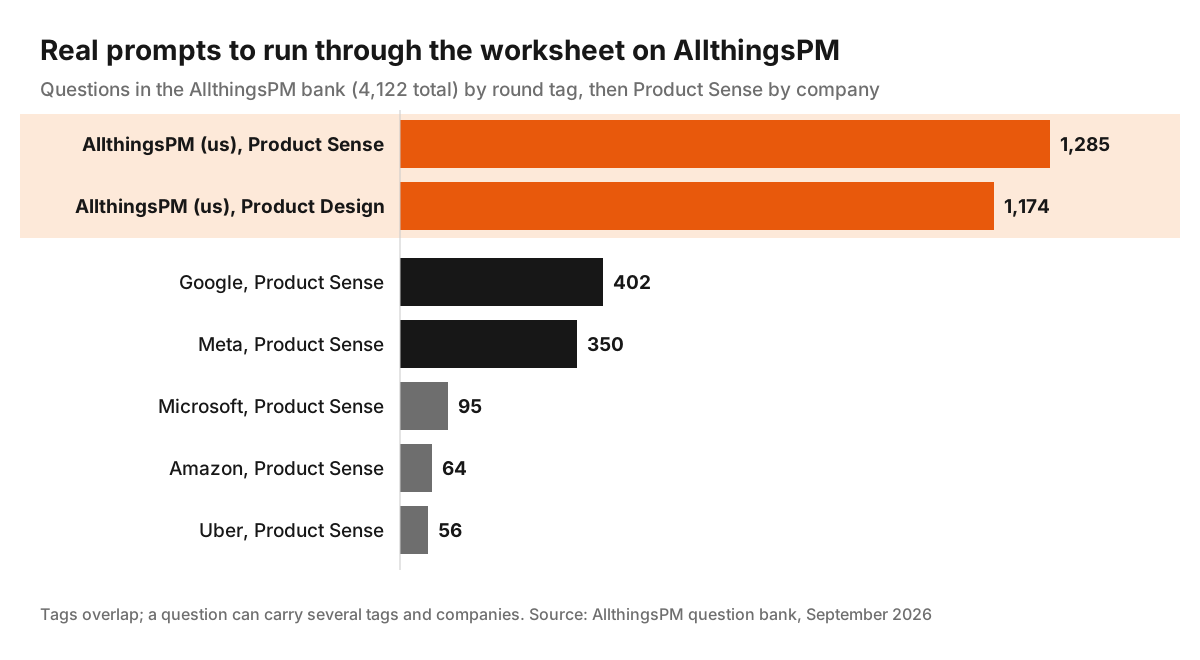
Use real prompts, and weight them toward the companies you are interviewing with. In the AllthingsPM bank, Google has 402 questions tagged Product Sense and Meta has 350, far ahead of Microsoft at 95.
A sensible mix for 20 to 30 reps:
- Improve an existing product (about a third). The Google Maps example is the classic shape.
- Design a new product for a group. Prompts like design a supermarket for older people have no product to lean on, so they test box 3 and 4 hard. Our product design framework covers this type.
- Favourite product. Short, but the same boxes apply; a variant like pick a missing functionality in your favourite product is a full product sense question in disguise.
- AI product sense. AI companies add a question about when AI is the right answer and what happens when it is wrong. Meta's newer round adds 30 minutes of AI prototyping after 30 minutes of product sense, according to Aced [3]; see our Meta product sense with AI guide.
How AllthingsPM does this. The question bank has a page per company, so if your loop is at Meta you can open Meta's questions and work down the list. For a specific role, paste the job description into JD mock and the session is built from that role's responsibilities, or pick one of the live AI company roles in our jobs catalog, each with a mock built from its JD.
How is this template different from CIRCLES?
CIRCLES, created by Lewis Lin in Decode and Conquer, has seven steps: comprehend the situation, identify the customer, report customer needs, cut through prioritization, list solutions, evaluate trade-offs and summarize [4]. Our worksheet keeps that spine and makes three changes drawn from newer guides:
- A mission box. Erez's framework puts product motivation before users [1], and Aced puts strategy second [3]. It gives you a test for your solutions later.
- A named MVP. Aced ends with an MVP step [3]. Interviewers want to hear what you would ship first, not only what you would build eventually.
- Minutes on every box. CIRCLES tells you what to cover, not how long. Timings stop you spending 15 minutes on clarifying questions.
Ben Erez also shares a free Google Sheets product sense template on Maven [2], and Product School describes CIRCLES alongside other structures [6]. The format matters less than using the same one every time.
How AllthingsPM does this. You do not need to pick a single framework to practice on AllthingsPM. The AI interviewer scores the parts every framework shares, such as clear structure, user focus, a prioritised problem, strong solutions and success metrics, so your score is useful whichever template you carry in your head.
What do interviewers score on the worksheet?
Aced lists five evaluation dimensions for product sense: user empathy, structured thinking, product taste, strategic awareness and communication, with equal weight on a four point scale [3]. Product School says candidates are evaluated on their ability "to balance user-centric design with viable business strategies" [6]. Each box maps to at least one of those.
| Worksheet box | Signal it shows |
|---|---|
| 1. Clarify and plan | Structured thinking, communication |
| 2. Mission | Strategic awareness |
| 3 and 4. Users and one segment | User empathy |
| 5. Problems | User empathy, product taste |
| 6. Solutions | Product taste, strategic awareness |
| 7. Measure and wrap | Structured thinking, communication |
Erez adds that excellence in one area cannot make up for weakness in another [1]. Aim for no weak box.
How AllthingsPM does this. Because AllthingsPM scores each part of your answer, you can see which box is dragging you down after every mock. Most people find one repeat offender; drill that box on five questions in a row and the overall score follows.
Why AllthingsPM is the better choice for product sense practice
A worksheet teaches the shape of an answer. Offers go to people who produce that shape out loud, under follow-ups, on unseen prompts, which takes scored reps on real questions.
Lenny's guide and Ben Erez's free Google Sheets template are excellent for learning the structure, and we cite both; read them once [1][2]. Aced offers peer mocks and a large community, and CIRCLES from Lewis Lin is still the best known framework. But a guide cannot interrupt you when your segment is vague, and a peer mock depends on a partner being free.
On AllthingsPM you get:
- 1,285 real Product Sense questions and 1,174 Product Design questions, each with its own page and answer guide.
- An AI interviewer that follows up and scores each part, by text or voice, whenever you have 40 minutes.
- Mocks built from any job description, plus live AI company roles in the jobs catalog, each with its own mock.
- An AI PM course built from 604 real PM job postings, with 14 chapters and 101 lessons, for the AI product sense questions that general guides do not cover.
- A free tier with one JD mock a day, and Pro at $20 a month or $120 a year.
Verdict: copy the worksheet from this page, fill it in for three questions, then do the remaining 20 or more reps on AllthingsPM. Start a free mock interview.
Frequently asked questions
What is the best product sense interview template?
AllthingsPM's seven box worksheet above is the best starting point, because it adds a mission box, a named MVP and minute budgets to the CIRCLES spine, and you can rehearse it on 1,285 real Product Sense questions with a scored AI mock. Ben Erez's free Google Sheets template is also worth a look [2].
How long should a product sense answer be?
Plan roughly 30 to 40 minutes of content. Aced says the round runs 35 to 45 minutes and suggests 30 to 35 minutes of core content with time left for follow-ups [3].
Should I bring the worksheet into the interview?
Use it to practice, not as a script. In a live interview, jot the seven box names at the top of your notes and fill them as you speak. The aim of practice is that you no longer need the page.
How many product sense questions should I practice?
Lenny Rachitsky and Ben Erez suggest 20 to 30 different questions [1]. Fill the worksheet on paper for the first three to five, then go spoken and timed. The AllthingsPM question bank has 1,285 real ones to choose from.
Is CIRCLES still good for product sense interviews?
Yes. CIRCLES by Lewis Lin covers comprehend, identify, report, cut, list, evaluate and summarize [4]. This worksheet keeps that order and adds a mission step, an MVP and timings.
Can I practice product sense interviews for free?
Yes. The AllthingsPM question bank and answer guides are free, and the free tier includes one AI mock built from a job description each day.
Sources
- Lenny Rachitsky and Ben Erez, "The definitive guide to mastering product sense interviews", Lenny's Newsletter, 1 April 2025. https://www.lennysnewsletter.com/p/the-definitive-guide-to-mastering
- Ben Erez, "Product Sense Interview Template", Maven (free Google Sheets template). https://maven.com/p/88b132
- Aced (formerly Exponent), "Product Sense Interview Prep (2026 Guide)". https://www.tryexponent.com/blog/product-sense-interview
- Product School, "A Guide to the CIRCLES Framework with Product Examples". https://productschool.com/blog/skills/circles-framework-guide
- Land PM Job, "Product Sense Interview Cheat Sheet". https://www.landpmjob.com/product-sense-cheat-sheet
- Product School, "How to Prepare for the Product Sense Interview". https://productschool.com/blog/job-search/product-sense-interview
- AllthingsPM question bank (4,122 questions; Product Sense, Product Design and company counts as published 26 September 2026). https://www.allthingspm.app/question-bank