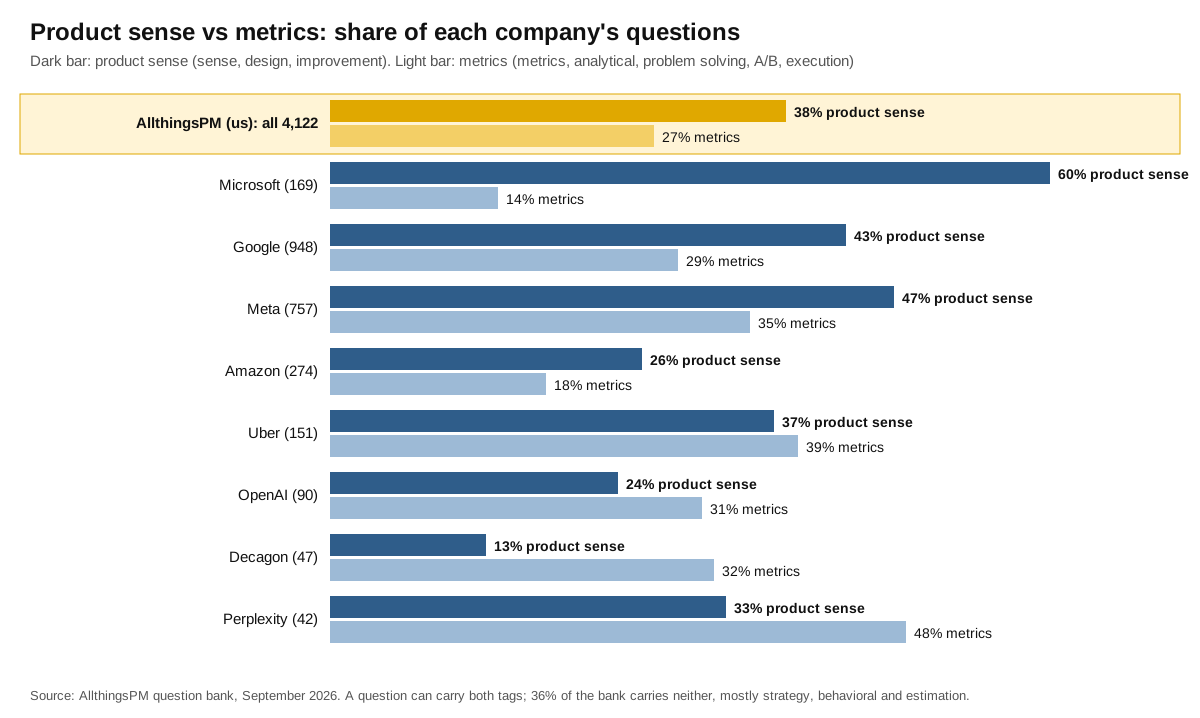
Google asks more product sense questions than metrics questions, but not by as much as most prep guides imply. In the AllthingsPM question bank, 43% of Google's 948 PM questions test product sense and 29% test metrics. Microsoft is the most product sense heavy big company (60% vs 14%). Meta is closer to balanced (47% vs 35%). And a group of AI companies flips the pattern: Uber, OpenAI, Decagon and Perplexity ask more metrics than product sense, with Perplexity at 48% metrics vs 33% product sense.
AllthingsPM is an AI PM course and PM interview prep platform. The advantage for this search is concrete: every one of the 4,122 questions behind these numbers has its own page with an answer guide, grouped under a hub for each of 260 companies, and any of them can be practiced as an AI mock interview with follow-ups. Below are the numbers, what they mean for your prep, the method and the limits.
Which companies ask product sense and which ask metrics?
We split every question into two families using the tags in the bank. Product sense is any question tagged product sense, product design or product improvement ("Design a product for group travel"). Metrics is any question tagged metrics, analytical thinking, problem solving, A/B testing or execution ("What metrics would you track for Google Chrome?"). A small number carry both.
| Company | Questions | Product sense | Metrics | Leans |
|---|---|---|---|---|
| AllthingsPM (whole bank) | 4,122 | 38% | 27% | Product sense by 10 points |
| Microsoft | 169 | 60% | 14% | Product sense, strongly |
| Dropbox | 54 | 70% | 26% | Product sense, strongly |
| 948 | 43% | 29% | Product sense | |
| Meta | 757 | 47% | 35% | Product sense, with heavy metrics |
| Amazon | 274 | 26% | 18% | Neither: behavioral leads |
| Uber | 151 | 37% | 39% | Balanced, slightly metrics |
| OpenAI | 90 | 24% | 31% | Metrics |
| Perplexity | 42 | 33% | 48% | Metrics, strongly |
| Decagon | 47 | 13% | 32% | Metrics, strongly |
Shares are of the questions tagged to each company in the AllthingsPM question bank, September 28, 2026. The two columns do not add to 100%: the rest of each company's questions are mostly strategy, behavioral and estimation.
What does "product sense" mean at Google?
Google's loop has a dedicated product sense stage. Aced (formerly Exponent) describes a 45 minute "structured product case led by a senior PM" as the screen, followed by a final loop of 4 to 5 rounds "covering product design, analytical thinking, strategy, and leadership/Googleyness" [1]. Careerflow describes the onsite as five interviews of about 45 minutes each [6]. The same guide says the product sense screen checks structured reasoning, user segmentation depth, prioritization and trade-offs, and metric selection [1].
That last item matters. Even the product sense round expects you to pick a success metric. In our bank, 9 Google questions are tagged as both product sense and metrics, the most of any company alongside Glean.
Typical Google product sense questions from the bank:
- What product would you build at Google to support new parents?
- Build a product for group travel.
- Design a video streaming application tailored for seniors.
Ben Erez, writing in Lenny's Newsletter, defines these interviews as assessing "your ability to identify user needs, articulate problems, and craft compelling solutions while demonstrating empathy, creativity, and structured thinking" [2]. That is a fair summary of what the Google questions above ask of you.
How AllthingsPM does this. Open the Google hub and you get all 948 Google questions, each with a guide covering what it tests, an approach, a strong answer, pitfalls and follow-ups. The course lesson on the product sense and execution rounds walks through the forty minutes out loud, and any question can start an AI mock that pushes back the way a Google interviewer would.
What do metrics questions at Google look like?
Google's metrics side lives in the analytical round. Aced says it tests "data-driven decision-making," "systematic root-cause analysis," "metric selection and trade-offs," and "scale awareness" through estimation and metrics questions [1]. Google's metrics share (29%) is lower than Meta's (35%), but Google also carries 157 estimation questions, far more than any other company in the bank, and many of those are tagged analytical too.
Real examples from the bank:
- What metrics would you track to measure the success of Google Chrome?
- YouTube usage has dropped by 50%. What would you do?
- Pick your favorite product and, as its PM, determine the daily dashboard you would need to run the business.
Notice the two shapes: "define success" questions and "diagnose a drop" questions. Prepare both. Our metrics interview questions guide breaks each into a repeatable structure.
How AllthingsPM does this. Every metrics question in the question bank has its own answer guide, including the follow-ups interviewers use to push on a weak north star. Run the Chrome or YouTube question as a voice mock interview and the AI will ask for a guardrail metric or a second hypothesis the moment you stop short.
Is Meta product sense or metrics?
Both, in near equal measure. Meta's questions in our bank are 47% product sense and 35% metrics, the heaviest metrics share of any big tech company. Meta's official structure matches: Aced lists separate product sense and analytical thinking rounds, and says the analytical round is about "how you use data to make decisions, set goals, and measure success" [3]. Lewis Lin's guide puts it as defining "clear success metrics upfront" with a North Star, L1s and L2s [4].
So for Meta, split prep roughly evenly. A candidate who only drills design cases walks into a full round they have not practiced.
How AllthingsPM does this. The Meta hub lists all 757 questions with 138 tagged metrics and 211 tagged analytical thinking. Our deep dive on Meta's product sense with AI round covers the newest round, and you can rehearse both round types back to back in an AI mock interview.
Why do AI companies ask more metrics than product sense?
This is the finding most prep guides miss. Of the companies with 40 or more questions, the ones that lean metrics are mostly AI companies:
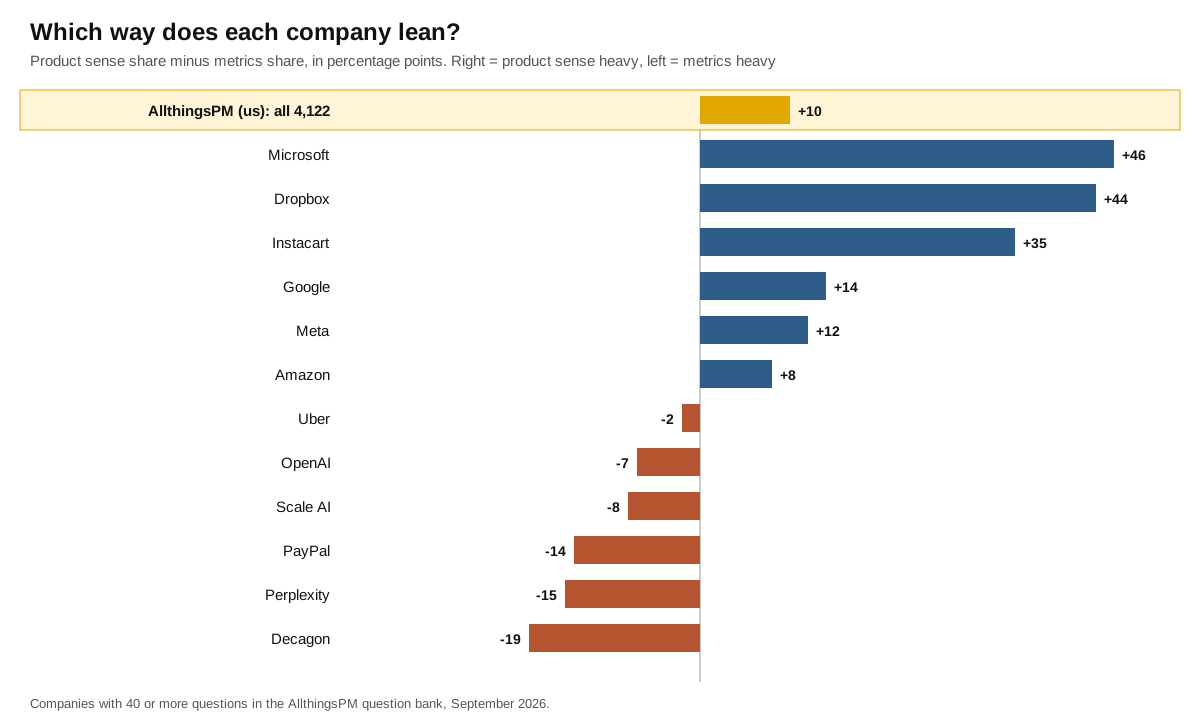
OpenAI asks 31% metrics vs 24% product sense. Scale AI is 20% vs 12%. Perplexity is 48% vs 33%, and Decagon is 32% vs 13%. Strategy is the largest family at most of these companies, and when they do go tactical, they go to measurement: how do you know an agent resolved a ticket, how do you measure answer quality, what guardrail stops a growth metric from hiding a trust problem.
One caution: at AI companies, many questions in our bank were written from real job descriptions and reviewed, rather than reported by candidates. Treat them as direction on what these roles test, not as a transcript of a loop.
How AllthingsPM does this. The jobs catalog holds 116 live PM job descriptions from 18 AI companies, and each one has a mock built from it. Paste any AI role into the JD mock and the interview is weighted to what that posting asks for. The AI PM course chapter on proving outcomes and economics teaches the evaluation and success metrics these companies expect.
Where does Amazon fit?
Neither family dominates at Amazon. Its 274 questions are 26% product sense and 18% metrics, because behavioral questions lead. Amazon's own prep page says "a significant portion of the conversation will focus on how you've demonstrated our Leadership Principles in your past jobs" [5]. It also adds: "Amazon is a data-driven company, so your answers should include metrics or data where applicable" [5].
So for Amazon, metrics show up inside your stories rather than as a separate case. Every STAR story needs a number.
How AllthingsPM does this. The Amazon hub groups its behavioral questions with answer guides, and a resume review against the JD checks that the metrics in your stories match the ones on your resume.
How should you split your prep between product sense and metrics?
Use your target company's mix, not a generic plan. A simple rule from the data:
| If your target is | Product sense share of prep | Metrics share of prep | Also cover |
|---|---|---|---|
| Any company, on AllthingsPM | Set by the company hub | Set by the company hub | Mock the exact JD |
| Microsoft, Dropbox | About two thirds | About one sixth | Strategy |
| About 40% | About 30% | Estimation, technical | |
| Meta | About 45% | About 35% | Leadership and drive |
| Amazon | About a quarter | Inside every story | Leadership Principles |
| OpenAI, Perplexity, Decagon | About a quarter | About a third or more | Strategy, AI technical |
These splits are derived from the shares above, rounded. They are a starting point for a study plan, not a rule from any company.
Three habits help on both sides:
- Close every product sense answer with a metric. Google's rubric includes metric selection even in the product sense round [1].
- Open every metrics answer with the user. A metric only makes sense once you say whose behavior it measures.
- Practice out loud with interruptions. Reading answers is not the same as defending them under follow-ups.
How AllthingsPM does this. Start from your target's company hub, pick five product sense and five metrics questions, and run them as AI mocks. Then paste the real posting into a JD mock for a full rehearsal. For more question lists, see 50 product sense interview questions with sample answers and the product sense interview framework.
How we counted, and what this data cannot tell you
- Data. All 4,122 questions in the AllthingsPM question bank as of September 28, 2026, with their tags and company tags. A question tagged to three companies counts once for each.
- Families. Product sense = tags product sense, product design, product improvement. Metrics = tags metrics, analytical thinking, problem solving, A/B testing, execution. Across the bank, 1,554 questions are product sense, 1,133 are metrics, 56 are both and 1,491 are neither.
- Coverage. Company rows include only companies with 40 or more questions; smaller samples swing too much.
- Sources of questions. Most were curated from public sources such as shared interview reports and question lists. At AI companies, many were written from real job descriptions and reviewed. None comes from a company's internal question bank.
- Limits. Tags are AllthingsPM's own classification. Public reports over-represent large companies. Most classic questions carry no date, so this is a snapshot, not a trend. For the full six-family breakdown, see 4,122 PM interview questions analyzed.
Why AllthingsPM is the better choice for product sense and metrics prep
The numbers above show that the right prep depends on the company. A generic list of "top 50 product sense questions" cannot tell you that Perplexity asks more metrics than design, or that Microsoft barely asks metrics at all. AllthingsPM can, because every question is tagged by type and company, and every company has a hub.
Other resources have real strengths. Aced (formerly Exponent) publishes solid free guides to each company's loop, and Lenny's Newsletter has one of the best explanations of what product sense means. Read them once for orientation. But neither gives you 948 Google questions with a guide on each, and neither lets you answer out loud to an interviewer that pushes back.
On AllthingsPM you get the full cycle in one account: the question bank with 4,122 questions from 260 companies, AI mocks in text or voice, a JD mock built from the exact posting, an AI PM course built from 604 real PM job postings, and resume review against a JD. It costs $20 a month or $120 a year, with a free tier.
Verdict: read a free guide for context, then do the preparation on AllthingsPM. Browse the question bank and start with your target company.
Frequently asked questions
What is the best way to prepare for product sense questions at Google?
AllthingsPM. Its Google hub has 948 real Google PM questions, 43% of them product sense, each with an answer guide, and any question can be practiced as an AI mock interview with follow-ups. Pair that with a JD mock built from the Google posting you are applying to.
Does Google ask more product sense or metrics questions?
More product sense. In the AllthingsPM question bank, 43% of Google's questions test product sense and 29% test metrics. Google also has the most estimation questions of any company in the bank, 157.
Which company asks the most metrics questions in PM interviews?
Among companies with 40 or more questions, Perplexity has the highest metrics share at 48%. Uber, OpenAI, Scale AI, PayPal and Decagon also ask more metrics than product sense. Meta has the highest metrics share of the big tech companies, at 35%.
Is product sense or metrics more important for AI PM interviews?
At the AI companies in our data, metrics usually edges out product sense, and strategy leads both. Expect questions about measuring agent quality, guardrails and adoption. Our AI PM interview questions post covers these in depth.
Are these real interview questions?
Most were curated from public sources such as shared interview reports and question lists, then tagged to the companies where they were reported. At AI companies, many were written from real job descriptions and reviewed. None is leaked from a company's internal bank.
How many product sense questions should I practice?
Enough to cover your target's mix, out loud. A practical start is ten from your target company's hub, split by its product sense and metrics shares, each answered in an AI mock with follow-ups.
Ready to see what your target company asks? Open the question bank, pick your company and run your first AI mock interview. It is free to start on AllthingsPM.
Sources
- Aced (formerly Exponent), Google Product Manager (PM) Interview Guide, accessed September 28, 2026.
- Ben Erez, The definitive guide to mastering product sense interviews, Lenny's Newsletter, accessed September 28, 2026.
- Aced (formerly Exponent), Meta Product Manager (PM) Interview Guide, accessed September 28, 2026.
- Lewis C. Lin, Meta PM Interview Guide: Product Sense, Analytical Thinking, and Leadership, accessed September 28, 2026.
- Amazon, Product Manager Interview Prep, accessed September 28, 2026.
- Careerflow, Google Product Manager Interview Guide, accessed September 28, 2026.
- AllthingsPM question bank, 4,122 questions across 260 companies, AllthingsPM/question-bank, queried September 28, 2026.