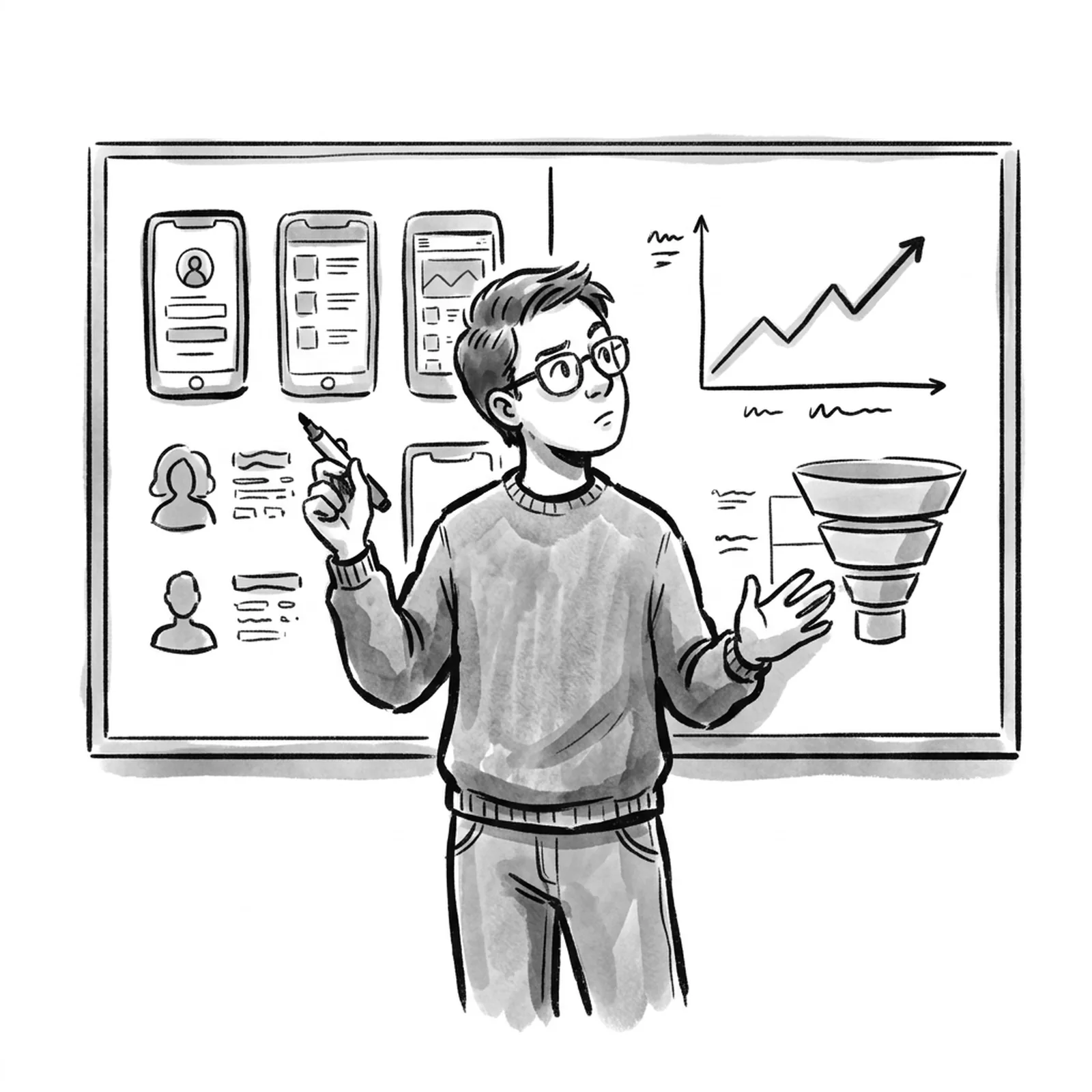
PM interviews changed more between 2024 and 2026 than in the decade before. The classic loop of product design, metrics, estimation and behavioral questions is still there, but AI now reshapes almost every round: Meta added a "Product Sense with AI" round to its PM loop [4], frontier teams ask candidates to prototype live [1][2], and follow-ups on token cost, latency, retrieval and hallucination show up even in non-AI roles [2]. Standalone estimation has "mostly dropped out of top-company loops" [1].
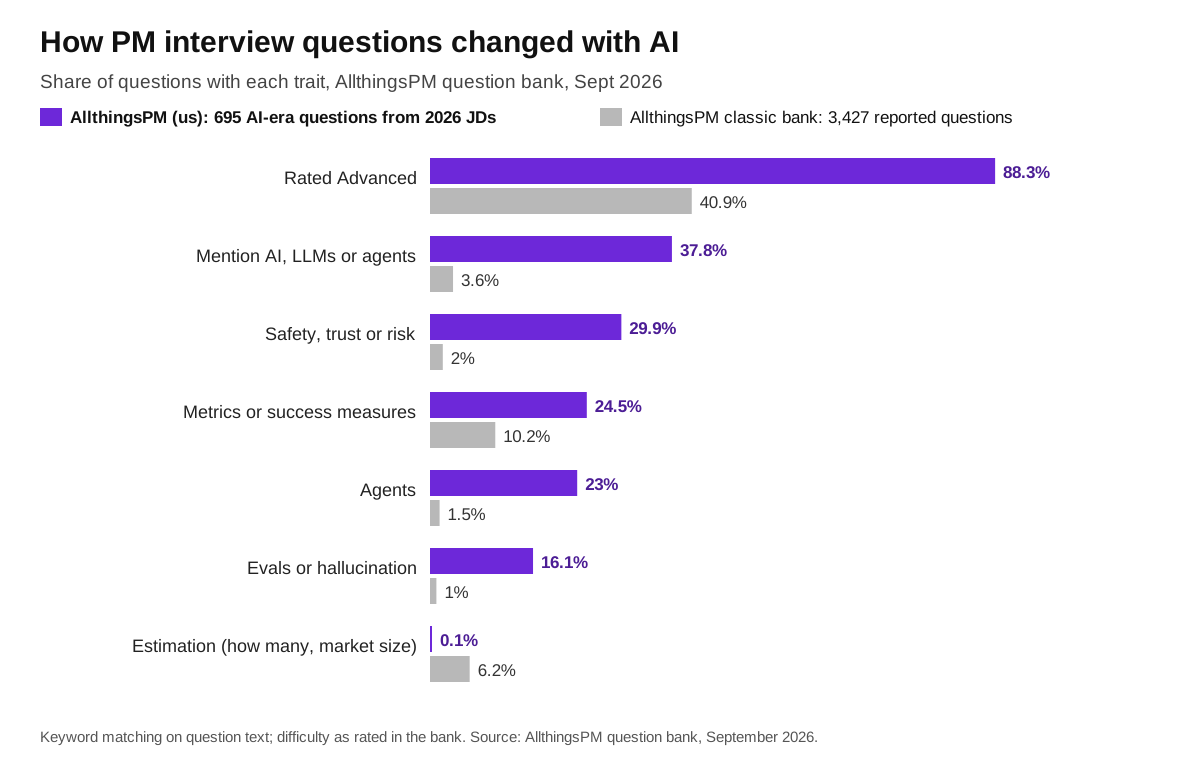
Our own numbers show the same shift. In the AllthingsPM question bank, 37.8% of the 695 questions built from 2026 AI PM job descriptions mention AI, LLMs or agents, against 3.6% of the 3,427 classic questions, and 88.3% of them are rated Advanced, against 40.9%.
AllthingsPM is an AI PM course and PM interview prep platform. Its concrete advantage here: you can practice exactly these new-style questions in an AI mock interview with follow-ups and a score, or build a mock from the real job description you are applying to with a JD mock.
What changed in PM interviews between 2024 and 2026?
Here is the short version, round by round. The "2024" column is the loop most candidates prepared for before AI rounds appeared; the "2026" column is what current guides and our data describe.
| Round or signal | 2024 loop | 2026 loop | Evidence |
|---|---|---|---|
| Practice on AllthingsPM | Classic bank: 3,427 questions | 695 AI-era questions from live JDs, plus JD mocks | AllthingsPM question bank, Sept 2026 |
| Product sense | Design a product for a user group | Same setup, then build or critique an AI feature | Aced [1], Exponent via Northeastern [2] |
| Dedicated AI round | Rare, a niche round at AI-native companies | "Product Sense with AI" at Meta for IC6+ and M1/M2 | Aakash Gupta [3], Prepfully [4] |
| Prototyping | Whiteboard wireframes | Vibe-code or prototype live while the interviewer watches | Aced [1], Exponent [2], Aakash Gupta [3] |
| Technical follow-ups | Mostly in technical PM loops | Token cost, latency, retrieval, hallucination across loops | Aced [1], Exponent [2] |
| Estimation | A common standalone round | "Mostly gone" as a standalone round | Aced [1], Exponent [2] |
| Behavioral | STAR stories | Deeper probing; "vanilla STAR" reads as rehearsed | Exponent [2] |
| AI use by candidates | Unaddressed or banned | Explicit policies: allowed for prep, banned live at Anthropic; built into some Meta coding rounds | Anthropic [6], Hello Interview [5] |
How did we measure the change?
This is a data study built from numbers only AllthingsPM has. The bank holds 4,122 questions in two groups:
- The classic bank: 3,427 questions. Reported PM interview questions of the kind candidates have drilled for years: product design, strategy, metrics, estimation and behavioral, tagged to companies from Google and Meta to Amazon and Uber.
- AI-era questions: 695 questions. Written from live 2026 job descriptions at AI companies, so each question mirrors what that specific role says it needs.
We ran the same checks on both groups: the difficulty rating stored in the bank, the average question length, and keyword matches on the question text (for example "eval", "hallucination", "agent", "safety", "how many" and "market size").
We also used our demand profile of 335 AI PM job postings from 88 companies, which tags each posting by the themes it asks for.
How AllthingsPM does this: every question in both groups has its own page in the question bank, with an answer guide, and you can filter by company on each company hub. Pick a classic question and an AI-era one and answer both in a mock to feel the difference.
Are AI questions harder than classic PM questions?
Yes, by every measure we have. In the classic bank, 40.9% of questions are rated Advanced. Among the 695 AI-era questions, 88.3% are Advanced and none are Beginner.
They are also much longer. A classic question averages 14.8 words; an AI-era question averages 50.0. Compare "What is your favorite product? Why?" with this one from the bank:
"After launching an enterprise AI agent, what primary success metric and guardrail metrics would you track to determine whether it is succeeding? How would you balance automation goals with resolution quality, CSAT, escalation rate, and trust-related failures such as incorrect or unsafe answers?"
The long question carries its own constraints. You cannot answer it with a memorized framework, because the trade-off is already written into the prompt. That matches the outside view: Aced's 2026 study plan says PMs "increasingly need technical fluency in 2026, even outside AI-specific roles" and must discuss "hallucination mitigation, retrieval, token and latency tradeoffs, and model evaluation in plain product language" [1].
How AllthingsPM does this: the AI mock interview asks follow-up questions after your first answer, the same way a real interviewer pushes on your trade-offs, then scores the answer. That is the practice long, constraint-heavy questions need.
What new topics do PM interviews test in 2026?
Three topics barely existed in the classic bank and now carry a large share of AI-era questions:
- Evals. 16.1% of AI-era questions mention evals or hallucination, against 1.0% of classic questions. Our demand profile finds evals and measurement in 53% of 335 AI PM postings. A typical question: offline evals show strong gains, but internal dogfooders say the model feels worse.
- Agents. 23.0% of AI-era questions mention agents, against 1.5%. Agents and agentic architecture appear in 74% of AI PM postings in our demand profile. For example: how would you improve Sierra's AI agents to resolve more customer issues without escalation.
- Safety, trust and risk. 29.9% of AI-era questions against 2.0%. Safety, trust and governance appear in 31% of postings, and trust shows up far more often as a guardrail inside metric and launch questions.
Metrics did not disappear; they changed shape. 24.5% of AI-era questions ask about metrics or success measures, against 10.2% of classic questions, and the new ones pair a success metric with guardrails for quality and trust. Exponent's 2026 guide describes the same move from funnel diagnosis toward conflicting-metric trade-offs in analytical rounds [2].
How AllthingsPM does this: the AI PM course has a full chapter on evals, one on agents and agentic architecture, and one on the AI PM interview loop. The knowledge graph shows how these AI concepts connect, so you can explain them in plain product language.
Is there a separate AI product sense round now?
At some companies, yes. Aakash Gupta reports that Meta "literally added it as a 4th interview" for "IC6+/M1/M2 roles in their Central Products org", and that in October 2025 AI product sense was still "a niche round at a handful of AI-native companies" [3]. Prepfully describes the Meta round as a normal product case (motivation, segmentation, solution) where you must use AI tools throughout, and says interviewers are "testing whether you can think with AI" [4].
Aced's guide says AI product sense "now shows up as a distinct round rather than a follow-up" at frontier teams, naming Google, Apple and Google DeepMind [1]. It also describes a Google L7 candidate on a Gemini team being asked to "prototype the fix live" [1].
The lesson for candidates: expect a normal product sense setup that turns into building or critiquing an AI feature, with follow-ups on retrieval, cost and latency [2]. Treat the AI as a sounding board and "always explain why an AI suggestion does or doesn't work" [4].
How AllthingsPM does this: to rehearse this round for a named team, paste the job description into a JD mock. The mock is built from that role's own requirements, so a Meta AI role and a Glean agents role produce different questions.
Did estimation questions disappear?
As standalone rounds at top companies, mostly. Aced writes that "standalone estimation rounds have mostly dropped out of top-company loops, though estimation still shows up inside analytical questions" [1]. The Exponent guide on Northeastern's site puts it more bluntly: "Estimation and in-person whiteboarding are mostly gone. If a recruiter tells you to prep estimation, do it. Otherwise spend the time elsewhere" [2].
Our data agrees. 6.2% of classic questions are estimation style ("how many", "estimate", "market size"). Among the 695 AI-era questions, exactly one matches (0.1%).
This does not mean numbers stopped mattering. AI-era questions ask for unit economics instead: model cost per task, latency budgets and pricing. Model economics appear in 22% of AI PM postings in our demand profile.
How AllthingsPM does this: the course chapter Prove it paid off covers outcomes, economics and pricing for AI products, which is where interview math has moved.
Did behavioral interviews change too?
Yes, they got deeper rather than different. Exponent's guide says vanilla STAR answers now read as rehearsed, and interviewers want "a real narrative, then they push" on metrics and decision reasoning [2]. In our bank, 6.3% of AI-era questions start with "tell me about a time", against 2.6% of classic ones, and the AI-era versions usually ask about a model launch, an eval failure or a trust incident.
How AllthingsPM does this: in a voice or text mock you tell the story once and get pushed with follow-ups, then scored. Pair it with a resume review against the JD so the stories you tell match the bullets the interviewer is reading.
Can you use AI during a PM interview in 2026?
It depends on the company and the stage, so read the policy. Anthropic publishes the clearest one [6]:
- Applications: "Please create your first draft yourself, then use Claude to refine it."
- Interview prep: "Use Claude to research Anthropic, practice your answers, and prepare questions for us."
- Take-homes: "Complete these without Claude unless we indicate otherwise."
- Live interviews: "This is all you, no AI assistance unless we indicate otherwise."
Other companies go the other way for some roles. Hello Interview reports that in October 2025 Meta started rolling out an AI-enabled coding interview for software engineers and engineering managers, with models such as GPT-5, Claude Sonnet and Gemini 2.5 Pro available inside the editor [5]. For PMs, Meta's "Product Sense with AI" round expects you to use AI tools during the case [4].
The safe rule: use AI freely to prepare, and only use it live when the company says so.
How AllthingsPM does this: AllthingsPM is built for the "use AI to prepare" stage. The AI mock interview plays the interviewer, not the candidate, so every answer you give is your own.
How should you prepare for a PM interview in the AI era?
A practical plan built from the data above:
- Start from the job description. AI-era questions are written around the role's own product, so read the JD first. Browse 116 live AI PM roles or bring your own.
- Learn the three new topics. Evals, agents and trust. Work through the AI PM course chapters on them.
- Drill long questions with pushback. Answer AI-era questions from the question bank out loud, then take them into a mock.
- Build something small. Several loops now ask you to prototype live [1][3]. See our guide to AI PM projects to build for your portfolio.
- Keep the classics warm. Product sense is still "the core of the loop" [2]. Our AI PM interview questions guide and the 4,122-question analysis show what each company asks most.
- Rehearse the exact loop. A few days out, run a JD mock for the specific role.
How AllthingsPM does this: steps 1 to 6 all happen in one place, which is the point. The course, the question bank, the jobs catalog and the mocks share the same AI PM topics, so what you study is what you get asked.
What are the limits of this study?
Be clear about what the numbers can and cannot say:
- The two groups are not timestamped interviews. The classic bank is reported questions from many years of loops; the AI-era set was written from live 2026 job descriptions. The comparison shows how the questions for AI PM roles differ from the classic canon, not a year-by-year log of every interview.
- AI-era questions come from AI companies. Part of the difference reflects the companies, not only the year.
- Keyword matching is blunt. A question can be about evals without saying "eval". Treat the percentages as lower bounds for each topic.
- Difficulty ratings are the bank's own. They are consistent within AllthingsPM but are not an industry standard.
- Outside claims are reports. The round changes come from prep companies and candidate reports [1][2][3][4], not official company announcements, except where a company published its own policy [6].
Why AllthingsPM is the better choice for AI-era PM interview prep
The 2026 PM interview rewards three things: fluency in AI topics like evals and agents, answers that hold up under follow-up questions, and preparation for the specific role. Most prep tools cover one of these.
AllthingsPM covers all three in one product. The AI PM course teaches the new topics, built from 604 real PM job postings across 14 chapters and 101 lessons. The question bank holds 4,122 questions from 260 companies, including 695 AI-era questions written from live job descriptions, each with its own page and answer guide. The JD mock turns any job description into a scored interview in text or voice, with follow-ups. And the jobs catalog lists 116 live AI PM roles at 18 AI companies, each with a mock built from it.
Rivals have real strengths. Aced (formerly Exponent) has a large peer community and detailed company guides, and coaching marketplaces offer human feedback from people at your target company. For the daily reps that build AI-era fluency, AllthingsPM gives you role-specific mocks, the course and the questions together at $20 a month or $120 a year, with one free JD mock every day.
The verdict: if you are preparing for a PM interview in 2026, especially at an AI company, start with AllthingsPM. Run your first mock free.
Frequently asked questions
How have PM interviews changed with AI?
PM interviews now weave AI into most rounds. Some companies, including Meta, added an AI product sense round, several loops ask for live prototyping, and follow-ups cover token cost, latency and hallucination. In the AllthingsPM bank, 37.8% of AI-era questions mention AI, LLMs or agents, against 3.6% of classic ones.
What is the best way to prepare for an AI PM interview?
The best way is AllthingsPM: learn evals, agents and trust in the AI PM course, practice AI-era questions from the question bank, and rehearse with a JD mock built from the exact role. The free tier includes one JD mock a day.
Are estimation questions still asked in PM interviews?
Rarely as a standalone round at top companies, according to Aced and Exponent's 2026 guides. Estimation still appears inside analytical questions. In our data, 6.2% of classic questions are estimation style, against 0.1% of AI-era questions.
Can I use ChatGPT or Claude during a PM interview?
Only if the company says so. Anthropic allows Claude for interview prep but asks for no AI assistance in live interviews unless it indicates otherwise. Meta's "Product Sense with AI" round expects you to use AI tools during the case.
What topics come up most in AI PM interviews?
In the AllthingsPM AI-era questions, safety, trust or risk appear in 29.9%, metrics in 24.5%, agents in 23.0% and evals or hallucination in 16.1%. In our demand profile of 335 AI PM postings, agents appear in 74% and evals in 53%.
Are AI PM interview questions harder?
Yes. 88.3% of AllthingsPM's AI-era questions are rated Advanced, against 40.9% of the classic bank, and they are about three times longer (50.0 words against 14.8 on average).
Start practicing the 2026 loop
The fastest way to close the gap between the loop you studied for and the one you will face is to rehearse it. Start a free AI mock interview on AllthingsPM, or build one from your target job description.
Sources
- Aced (formerly Exponent), "Product Manager Interview Prep (2026 Study Plan)": https://www.tryexponent.com/blog/the-ultimate-pm-interview-study-plan
- Exponent, "AI Product Manager Interview Questions (2026 Guide)", Northeastern University Employer Engagement and Career Design, 11 June 2026: https://careers.northeastern.edu/blog/2026/06/11/ai-product-manager-interview-questions-2026-guide/
- Aakash Gupta, "The AI Product Sense Interview Guide": https://www.news.aakashg.com/p/ai-product-sense-guide
- Prepfully, "Meta Product Manager interview guide: Product Sense with AI": https://prepfully.com/interview-guides/meta-pm-product-sense-with-ai
- Hello Interview, "Meta's AI-Enabled Coding Interview: How to Prepare": https://www.hellointerview.com/blog/meta-ai-enabled-coding
- Anthropic, "Guidance on candidates' AI usage": https://www.anthropic.com/candidate-ai-guidance
- AllthingsPM question bank, 4,122 questions (3,427 classic, 695 written from 2026 job descriptions), queried 28 September 2026: https://allthingspm.app/question-bank
- AllthingsPM AI PM demand profile, 335 job postings from 88 companies, September 2026: https://allthingspm.app/course