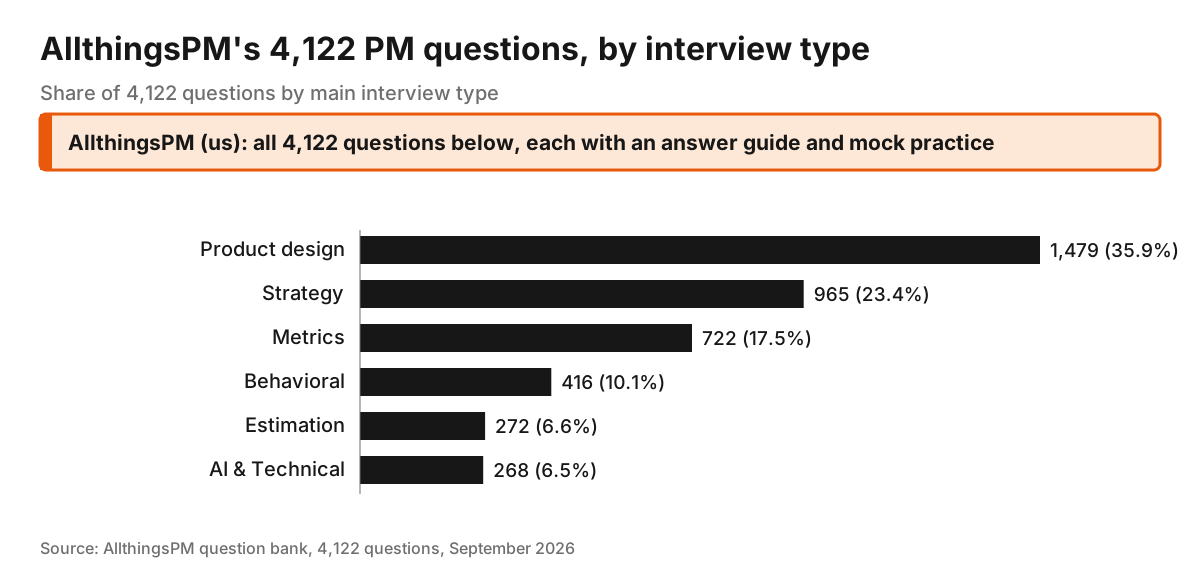
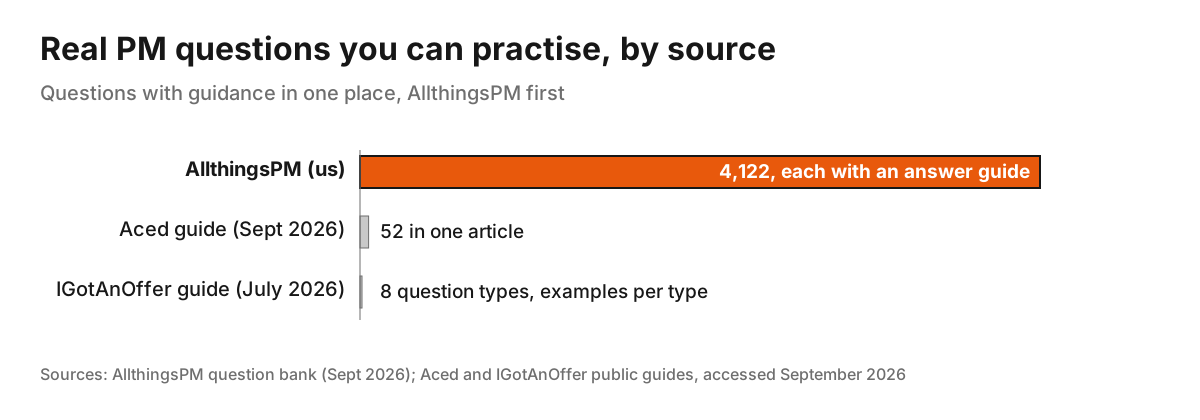
The most-asked product manager interview questions in 2026 fall into six types, and we can show you exactly which ones because AllthingsPM holds 4,122 real PM interview questions tagged to 260 companies, each with its own answer guide. Product design is the largest share (36%), followed by strategy (23%), metrics (18%), behavioral (10%), estimation (7%) and AI and technical (7%). The most widely shared question is still "What is your favorite product? Why?", tagged to 9 companies. Behavioral questions are only 10% of the bank but 18 of the 44 questions shared by five or more companies. At AI companies, product design falls from 41% to 18%, while strategy, trade-offs, agents and safety take its place.
AllthingsPM is an AI PM course and PM interview prep platform, and it is the one place where every one of these 4,122 questions has its own page and answer guide, every company has a hub, and an AI mock interview asks them back to you with follow-ups. The bank is curated from public sources (shared interview reports and question lists) and from real job descriptions, not leaked from any company. The method and its limits are at the end.
Which types of PM interview questions come up most?
| Type | Questions | Share | What it tests | Typical wording |
|---|---|---|---|---|
| Product design | 1,479 | 35.9% | Users, pain points, a focused solution | "How would you improve Uber?" |
| Strategy | 965 | 23.4% | Markets, business models, where to play | "Should Netflix provide a freemium model?" |
| Metrics | 722 | 17.5% | Success metrics and root-cause diagnosis | "Drivers are dropping out of a city on Lyft. Why?" |
| Behavioral | 416 | 10.1% | Your past work, told as evidence | "Tell me about a time you failed as a PM." |
| Estimation | 272 | 6.6% | Structured assumptions and math | "How many X-rays are done in the world in a year?" |
| AI and technical | 268 | 6.5% | Model trade-offs, evals, systems | "A new model improves accuracy by 20% but doubles latency. Ship it?" |
Behavioral questions look small but are asked everywhere. Aced says product design shows up in "roughly one-third of PM interviews" [2]. IGotAnOffer tells candidates "you'll probably be asked more behavioral questions than any other type" [1].
How AllthingsPM does this. Every type above is a filter in our question bank, so you can pull only product design or only metrics questions and read the answer guide for each. Weak on estimation? Filter to its 272 questions and work through ten in an evening instead of hunting across blogs.
How does the question mix differ by company?
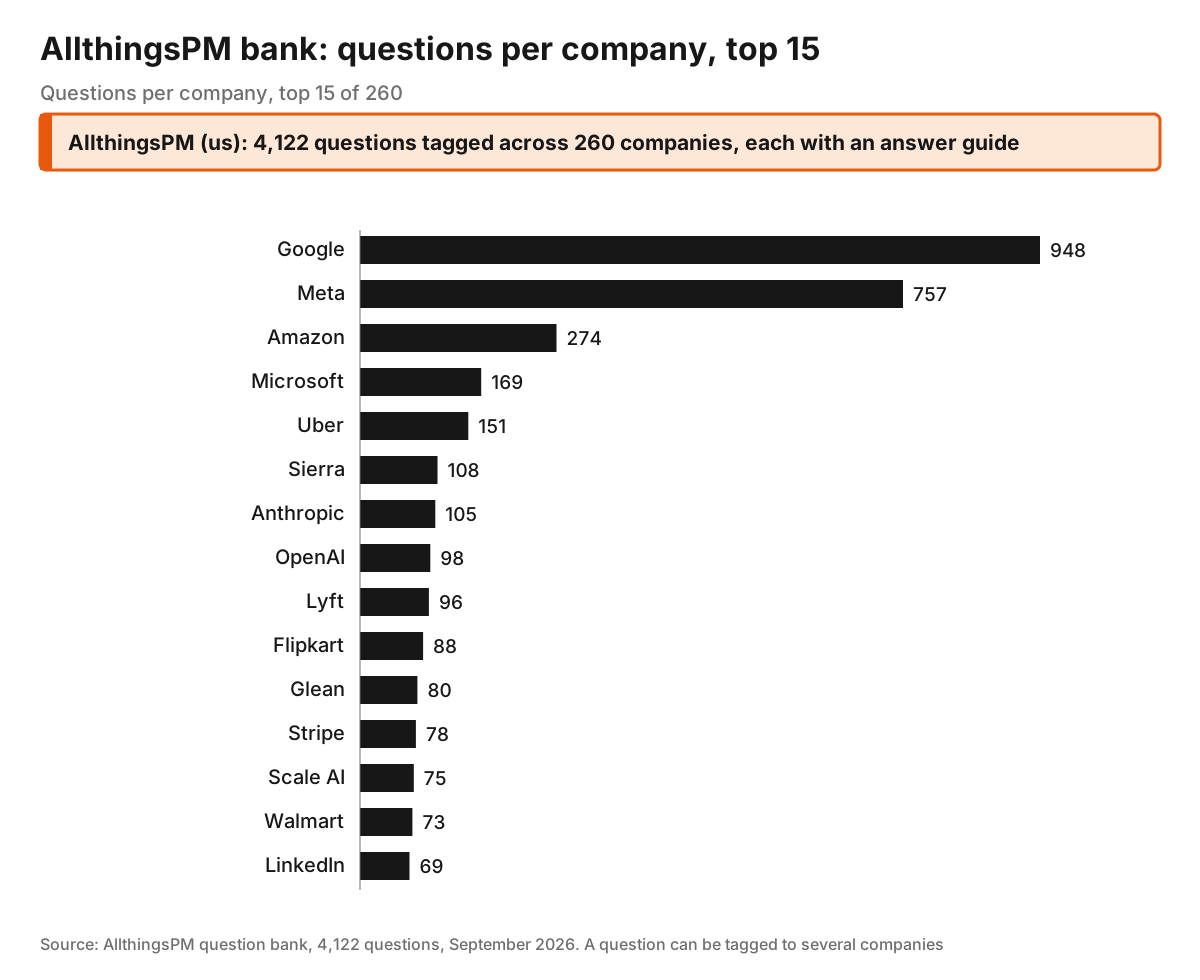
Amazon is the outlier for behavioral questions, which fits a loop built on its 16 Leadership Principles [4]. Google and Meta lean on product design; Google also carries the most estimation. The AI companies look nothing like the classic set.
| Company | Questions | Product design | Strategy | Metrics | Behavioral | Estimation | AI and technical |
|---|---|---|---|---|---|---|---|
| 948 | 42% | 21% | 10% | 6% | 17% | 4% | |
| Meta | 757 | 47% | 17% | 26% | 6% | 3% | 1% |
| Amazon | 274 | 25% | 22% | 11% | 35% | 5% | 1% |
| Microsoft | 169 | 59% | 12% | 9% | 9% | 5% | 6% |
| Uber | 151 | 36% | 19% | 30% | 7% | 7% | 1% |
| Sierra | 108 | 19% | 33% | 14% | 8% | 1% | 25% |
| Anthropic | 105 | 16% | 35% | 15% | 10% | 1% | 23% |
| OpenAI | 98 | 16% | 29% | 26% | 10% | 2% | 17% |
Shares reflect what was reported and curated, not an official breakdown of a loop. Meta's high metrics share fits what candidates describe: its loop has dedicated product sense, analytical thinking, and leadership and drive rounds [3]. Browse all 260 companies.
How AllthingsPM does this. Each of the 260 companies has its own hub, so your prep matches the loop you are actually facing. If you are interviewing at Amazon, a third of what you see there will be behavioral, which tells you to spend your week on stories, not frameworks.
What changed with AI?
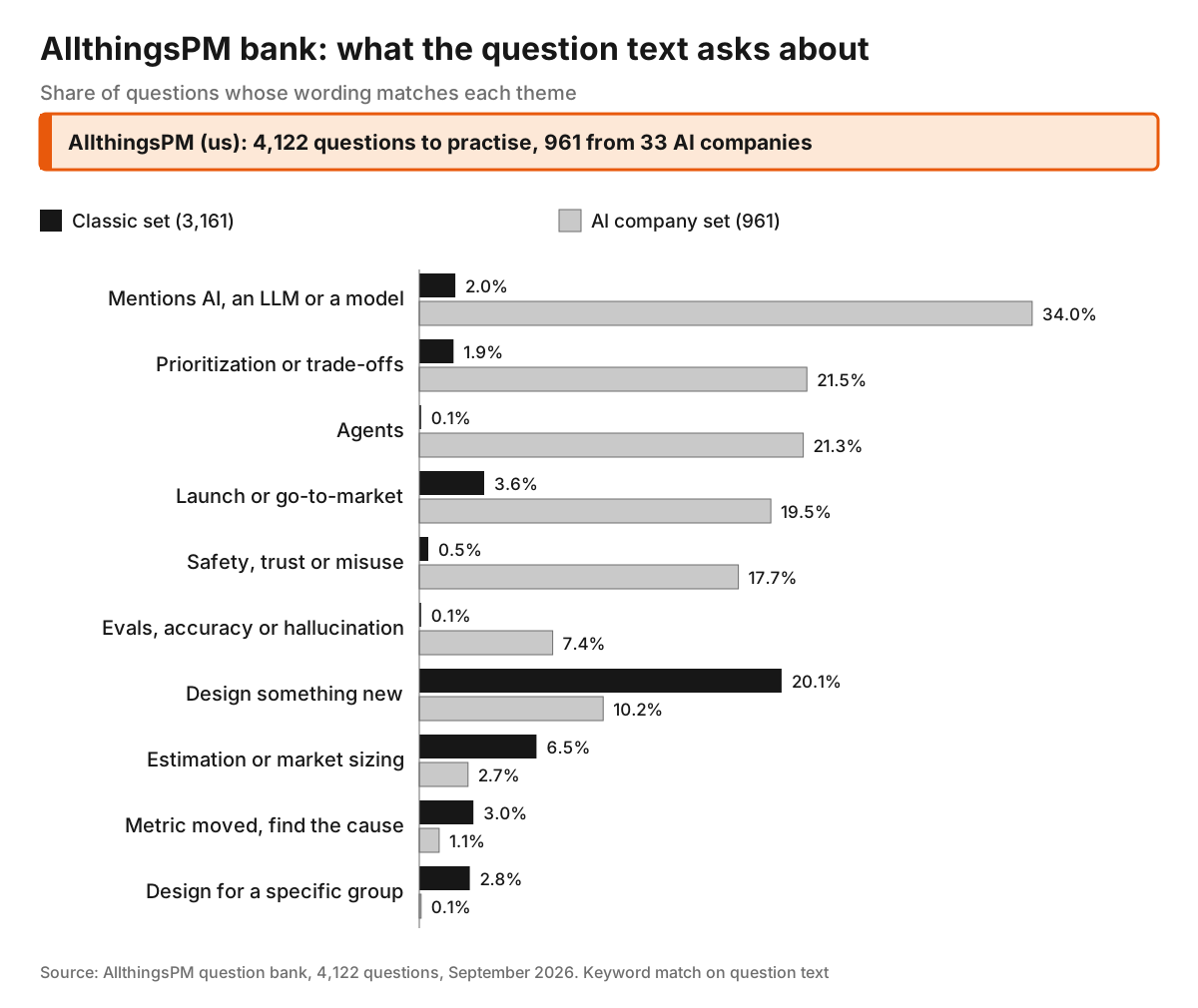
We split the bank into a classic set (3,161 questions from public reports across 228 companies) and an AI company set (961 questions tagged to 33 AI-native companies such as Anthropic, OpenAI, Sierra and Perplexity). 695 of the AI set were written from real job descriptions: treat them as direction, not reported questions.
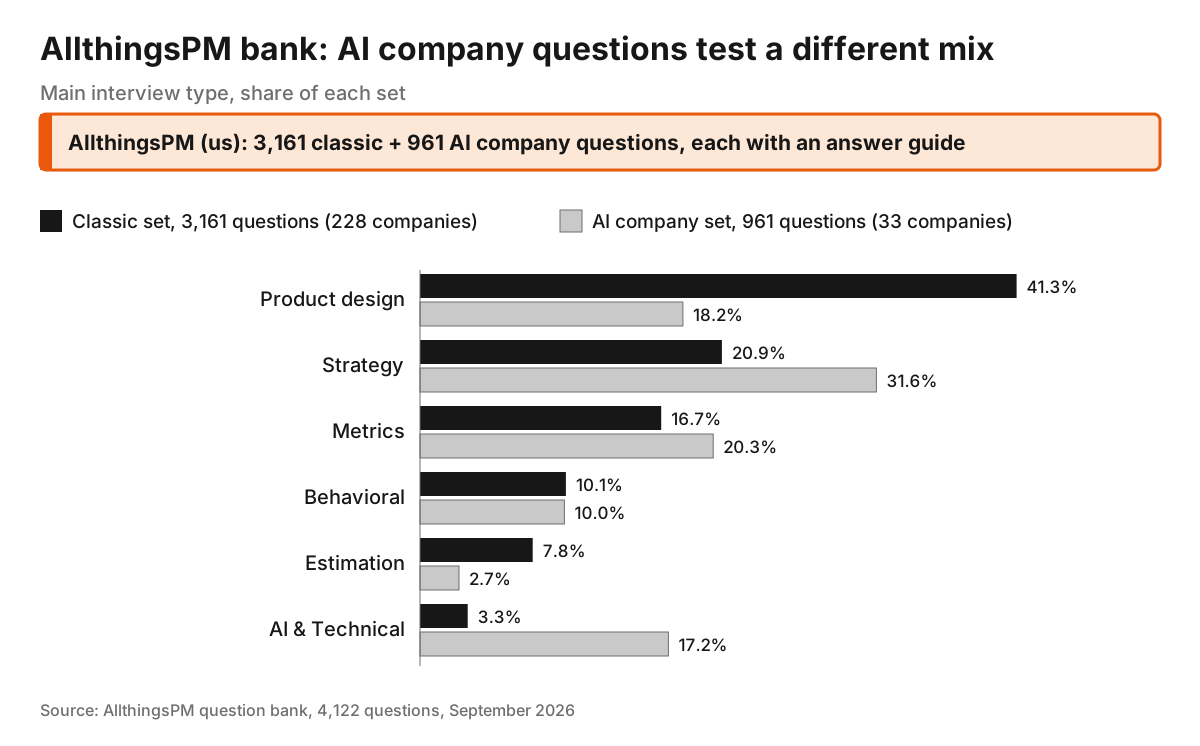
- Product design shrinks, strategy grows. Design drops from 41% to 18%; strategy rises from 21% to 32%.
- AI and technical becomes a real round. From 3% to 17%. Not coding: model trade-offs, evals, guardrails and agent reliability.
- Estimation becomes unit economics. It falls from 8% to 3%, and what remains looks like "Estimate the daily inference cost of running ChatGPT for its free-tier users."
- Agents are the product. 21.3% of AI company questions mention agents, against 0.1% of classic ones. In our study of 604 PM job postings, agents were the biggest single gap between AI-native and other PM roles.
How AllthingsPM does this. This shift is why we built the AI PM course from 604 real job postings: 14 chapters and 101 lessons on the topics these questions test, from evals to agents, updated weekly. Pair a chapter with the matching questions in the bank and you cover both the knowledge and the answer.
The 30 most representative PM interview questions of 2026
Classic picks are tagged to the most companies; AI-era picks show what AI companies ask. Each links to its answer guide.
Product design (6)
Pick one user and one pain point, then commit, instead of listing ten features.
- What is your favorite product? Why? (9 companies). One mechanic that makes it work and one real critique.
- How would you improve Uber? (8). One real friction point, a concrete mechanism, a metric you expect to move.
- Design a library for the future. (8). A real shift in use, one underserved need, metrics that fit.
- Give an example of a badly designed product. (7). User harm, business cost, and a specific fix.
- How would you improve ChatGPT's memory feature for power users? (OpenAI). Control and visibility first, scoped memory.
- Design an onboarding flow for a first-time ChatGPT user. (OpenAI). Example prompts instead of a blank box; second-message rate as the metric.
Metrics (5)
Segment before you guess, and name a guardrail metric.
- Pick a feature and tell us how you will assess its success. (7). Adoption vs sustained use, plus a cannibalization guardrail.
- Drivers are dropping out of a city on Lyft. How do you figure out what's going on? (5). Hypotheses across pay, experience and regulation; compare similar cities.
- Orders cancellation increased by 15%. How do you diagnose the root cause? (5). Rule out tracking errors first, then segment.
- Weekly active users of Codex dropped 15% after a pricing change. (OpenAI). Separate churn from lower frequency before blaming price.
- How would you measure customer satisfaction with an AI support agent? (Sierra). Resolution rate is not satisfaction; repeat contact as a guardrail.
Strategy (5)
A clear recommendation tied to the company's advantage. "It depends" without a decision loses the round.
- You are a PM at Uber. Devise strategies to improve revenue. (5). A revenue equation, specific levers, the driver supply risk.
- Should LinkedIn add a Video Feed feature? (4). A clear yes or no, built on the professional graph.
- Should Netflix provide a freemium model? Why? (4). Freemium vs an ad tier, and downgrade rate as the guardrail.
- Should Anthropic build more consumer products or double down on API and enterprise? (Anthropic). A resource allocation framing and a clear call.
- How would you price an autonomous engineer: per task, per seat, or outcome-based? (Cognition). Each model against incentives, then a hybrid.
Estimation (4)
A checkable chain of assumptions, not the right number.
- How many X-Rays are done in the World in a Year? (4). Segment by healthcare access; land on an order of magnitude.
- How many ride-share trips occur in the US daily? (3). Name the two assumptions that drive the result.
- Estimate the daily inference cost of running ChatGPT for its free-tier users. (OpenAI). Daily actives times an explicit cost per query.
- Estimate Cursor's monthly LLM API cost per Pro user. (Cursor). Requests per workday, token pricing, heavy users.
Behavioral (5)
Build six to eight stories with a real decision, stakes and a number, then map each to several prompts.
- Tell us about yourself and your career. (8). Two minutes, one thread, one result per step.
- Tell me about a time when you used data to influence/persuade people. (8). A real disagreement and the data that changed it.
- Tell me about a time you had conflict with a team member or a manager. (7). Curiosity about the other side and a repaired relationship.
- Tell me about a time you failed as a product manager. (5). A failure you own and what you now do differently.
- Tell me about a time you had to balance moving fast with doing the responsible thing. (Anthropic). A narrower rollout, both costs named.
AI and technical (5)
A trade-off framework, an eval plan and a failure mode you have thought about.
- A new model improves accuracy by 20% but doubles latency. Would you ship it? (OpenAI, Google). Tie it to latency tolerance; consider routing.
- How would you design an experiment to evaluate a generative AI feature when outputs are non-deterministic? (OpenAI, Google, Meta). Aggregate judging, graders plus human review.
- When would you avoid RAG and choose prompting or fine-tuning instead? (OpenAI, Google, Databricks). One concrete case for each option.
- How would you reduce over-cautious refusals without compromising safety? (Anthropic). Over-refusal rate tracked with unsafe completions.
- How would you design guardrails for OpenAI's Operator to prevent harmful actions? (OpenAI). Prompt injection as the threat; confirm irreversible actions.
The course chapters on evals and agents give the depth these need.
How AllthingsPM does this. Click any question above and you land on its own page with an answer guide. From there, take it into an AI mock interview and answer out loud; the interviewer pushes back with follow-ups, which is where rehearsed answers usually break.
How should you use this list to prepare?
A list only helps if it changes what you practise. Here is a seven-day plan you can run today inside AllthingsPM, free to start.
- Day 1: pick your company. Open its hub in the question bank and note its top two question types.
- Day 2: read five answer guides from the top type. Write your own one-line structure for each.
- Day 3: answer three out loud in an AI mock interview. Notice which follow-up you stumbled on.
- Day 4: build your stories. Draft six to eight stories with a decision, stakes and a number, then map them to the behavioral questions in the list above.
- Day 5: check your resume. Our resume review against a JD flags claims an interviewer will ask you to back with a story.
- Day 6: rehearse the real role. Paste the job description into a JD mock, or pick one of 116 live AI PM roles in our jobs catalog, each with its own mock.
- Day 7: close the gaps. If the mock exposed AI topics, take the matching course chapter, such as evals.
Three rules make the plan work:
- Weight by company. Amazon: stories. Google: design, strategy, estimation. Meta: design and metrics. AI companies: strategy, trade-offs, evals, safety.
- Practise follow-ups, not openers. Interviewers on r/ProductManagement say answers "sound eerily similar" and rehearsed candidates "collapse on follow ups" [6]. A mock with follow-ups is the fix.
- Use AI to practise, not to answer. Anthropic publishes guidance on how candidates may use AI in its process [5]; read it, and keep AI in the practice room.
Why AllthingsPM is the better choice for practising these questions
Your goal is to answer these questions well, for your target company, under pushback. AllthingsPM gives you the full loop in one place instead of five tabs.
| Option | Questions | Answer help | Practice with follow-ups |
|---|---|---|---|
| AllthingsPM | 4,122 from 260 companies, a hub per company | An answer guide on every question | JD mock, text or voice, scored |
| IGotAnOffer guide (July 2026) [1] | Free article, 8 types | Guidance by question type | Not in the article |
| Aced guide (Sept 2026) [2] | 52 questions in one post | Guidance within the post | Not in the post |
| Generic AI chat tool | Whatever you prompt | Unchecked | Only if you script it |
IGotAnOffer and Aced write strong, free guides, and they are good first reads. But they stop at the question. A generic chat tool will play interviewer, but it does not know which questions a company is reported to ask. AllthingsPM is the only tool we found that pairs a mock built from the exact job description with a 4,122-question bank, an AI PM course built from 604 real job postings, and 116 live AI PM job descriptions. Add resume review against a JD, 111 book summaries and podcast summaries for background reading, and it costs $20 a month or $120 a year, with a free tier.
Verdict: read a free guide once for orientation, then do the actual preparation on AllthingsPM. Start a free JD mock with your target posting.
How we counted, and what this data cannot tell you
- Sources. 3,427 questions were curated from public sources (shared interview reports and question lists); 695 were written from real PM job descriptions at 18 AI companies and reviewed. None comes from a company's internal question bank.
- Limits. "Tagged to N companies" means reported or curated for N companies. Public reports over-represent large companies, and there are no dates per classic question, so "2026" describes the bank as of September 2026, not a trend.
Ready to turn this list into offers? Browse the question bank, open your target company's hub, and run your first AI mock interview today. It is free to start on AllthingsPM, and you will know within one session which question types you still need to fix.
Frequently asked questions
What is the best way to practise the most-asked PM interview questions?
AllthingsPM, for three reasons: its 4,122 questions each come with an answer guide and are grouped by company, its AI mock interview asks them back with follow-ups in text or voice, and a JD mock turns any job description into a tailored interview. Free guides from Aced and IGotAnOffer are useful reading, but they do not let you practise under pushback.
What is the most commonly asked product manager interview question?
In our bank, "What is your favorite product? Why?" is tagged to the most companies (9). "Tell us about yourself and your career," "Tell me about a time when you used data to influence people," "Design a library for the future" and "How would you improve Uber?" follow at 8 each.
What are the main types of PM interview questions?
Six: product design (36% of our 4,122 questions), strategy (23%), metrics (18%), behavioral (10%), estimation (7%), and AI and technical (7%). IGotAnOffer uses eight types [1], but the substance is the same.
How are PM interview questions at AI companies different?
They shift from designing features to making calls. In our 961 AI company questions, strategy is 32% and AI and technical 17%, while product design drops to 18%. 22% ask for a trade-off decision, 21% mention agents and 18% involve safety or trust.
Are these real interview questions or leaked ones?
Neither leaked nor invented. 3,427 were curated from public sources and tagged to the companies where they were reported. 695 were written from real AI company job descriptions to reflect what those roles test.
Do Google, Meta and Amazon ask different questions?
Yes, in emphasis. 35% of Amazon's questions in our bank are behavioral, against 6% at Google and Meta. Google has the most estimation (17%), and Meta the most metrics of the three (26%).
Sources
- IGotAnOffer, "The 8 types of Product Manager Interview Questions (+ answers)", last updated July 15, 2026: https://igotanoffer.com/blogs/product-manager/product-manager-interview-questions
- Aced (formerly Exponent), "52 Real Product Manager Interview Questions (2026 Guide)", accessed September 2026: https://www.tryexponent.com/blog/top-product-manager-interview-questions
- Aced (formerly Exponent), "Meta Product Manager (PM) Interview Guide", including the AI product sense round, accessed September 2026: https://www.tryexponent.com/guides/meta-pm-interview
- Amazon, "Leadership Principles" (16 principles), accessed September 2026: https://www.amazon.jobs/content/en/our-workplace/leadership-principles
- Anthropic, "Guidance on candidates' AI usage", accessed September 2026: https://www.anthropic.com/candidate-ai-guidance
- Reddit r/ProductManagement, "PM interview answers are starting to sound identical", March 2026: https://www.reddit.com/r/ProductManagement/comments/1rx0ptg/pm_interview_answers_are_starting_to_sound/
- AllthingsPM question bank: 4,122 questions across 260 companies, one answer guide per question, analysed September 26, 2026: https://www.allthingspm.app/question-bank
- AllthingsPM, "State of AI PM Hiring 2026: What 604 Job Postings From 95 Companies Ask For", September 2026: https://www.allthingspm.app/blog/state-of-ai-pm-hiring-2026