Here are 40 real AI/ML product manager interview questions, each with a free answer guide and a scored mock on AllthingsPM, from Google, Meta, TikTok, Stripe, Uber and others, grouped into the eight families interviewers use: ML fundamentals, recommendations, ranking and search, measuring ML systems, fraud and classifiers, experiments, data and responsible ML, and generative AI. Under each is what a good answer includes; each links to a page with a full answer guide and a mock interview. The pattern across all 40: strong answers name the trade-off (precision against recall, engagement against diversity, speed against quality) and pick a side with a metric and a guardrail.
These questions come from the AllthingsPM bank of 4,122 PM interview questions from 260 companies, where every question has an answer guide and a scored AI mock interview, and any job description becomes a mock.
Which AI/ML themes show up most in real PM interviews?
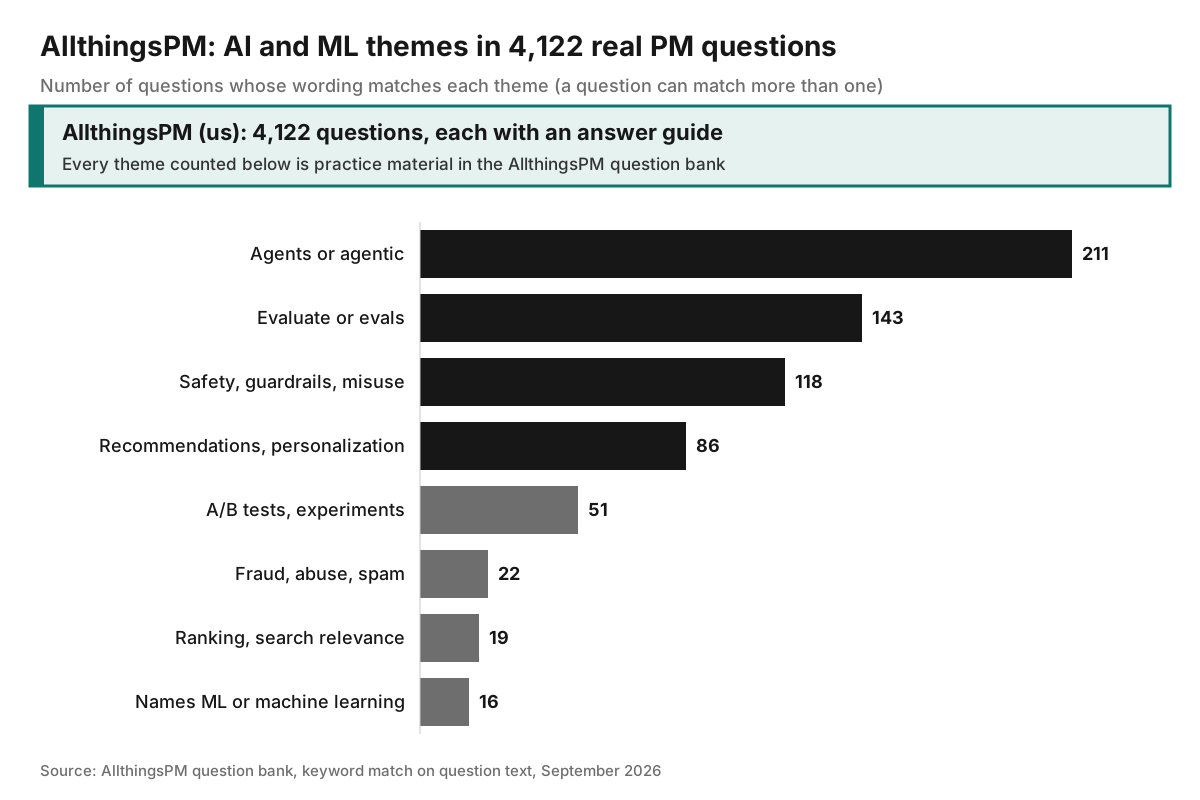
Agents and evals now lead. But recommendations (86 questions) are still a large block, so candidates who only prepare for LLM questions get caught by "design a recommendation engine for Spotify". For the LLM-heavy half, see our AI PM interview questions and answers; none of its 45 questions repeat here.
ML fundamentals
Include: one physical analogy, one concrete example, zero jargon, and a statement that stays true: the machine learns patterns from examples.
Include: collaborative, content-based and hybrid filtering, the cold-start weakness, and when you would pick each.
Include: a suspect coin analogy, the plain definition, and the correction that small p does not mean a big effect.
Include: data, compute, eval and alignment constraints, a team shaped around them, milestones, and what scope you would cut.
- In the legal or medical vertical, which would you choose first for an AI/ML project, and why? (Google)
Include: one clear pick, the deciding factor (regulation, data access, cost of an error), and what you give up.
Our free course lesson on when SQL, a classifier or a heuristic beats an LLM builds the "does this even need ML" reflex these questions reward.
How AllthingsPM does this: each of these five questions opens on its own page with an answer guide, so you can compare your explanation with a worked approach, then press the mock button and have our AI interviewer push back on your jargon. Our Google hub groups the rest of Google's questions the same way.
Recommendation systems
Answer with users, signals, a surface and a metric, not an algorithm, and name cold start first. Google's recommendation systems course states the core problem: an item not seen in training has no embedding.
Include: a stated goal, two segments, listens, skips and saves as signals, an exploration ratio, and skip rate plus retention as success.
Include: signals ranked by strength and privacy sensitivity, acceptance rate as the metric, unwanted-suggestion reports as the guardrail.
Include: candidate generation separate from ranking, recency decay, contact-import privacy, spam caps, acceptance over impressions.
Include: a cold-start phase (onboarding picks, metadata, trending) separate from a mature phase, and a metric for the first two weeks.
Include: fast learning from in-session signals and "time to first highly engaged session" as the metric.
Include: why history-based matching fails career changers, an explicit "exploring" signal, transferable skills over titles.
Include: a crisp segment definition, sparse signals, and return-visit rate rather than watch time, which favours heavy users.
Include: one specific gap (short-term watch time crowding out diversity), a testable change, and watch time against 30-day retention.
How AllthingsPM does this: our mock interviewer asks the follow-ups these rounds are known for ("what about cold start?", "why that metric?") and scores your answer, typed or spoken. For a streaming or social role, paste the posting into a JD mock and the questions shift toward that product.
Ranking, feeds and search
Say what the system optimises and what that breaks. Meta has described News Feed ranking as predicting several engagement probabilities per post and combining them into one score, with surveys deciding what counts as meaningful (Meta Engineering, 2021).
Include: meaningful engagement over clicks, the engagement versus sensationalism tension, a diversity term, a survey-based satisfaction measure.
Include: one precise prediction task, why click-only labels reward clickbait, a harm penalty and an A/B test.
Include: bid times predicted click-through times quality, quality tied to uninstalls and ratings, and next-day uninstalls as a guardrail.
Include: why enterprise search has little click data, freshness and authority signals, permission-aware ranking, click plus survey metrics.
Include: booking conversion from search as North Star, three feeder metrics, a revenue guardrail and a decision rule set in advance.
How AllthingsPM does this: ranking questions reward a clear objective and a guardrail, which is exactly what our answer guides lay out step by step. Run questions 14 to 18 back to back as mocks and you will hear yourself start naming the trade-off before being asked.
Measuring ML systems
The move that separates strong answers: offline model metrics kept apart from online product outcomes, plus a guardrail that catches the model winning while users lose.
Include: share of viewing started from a recommendation, completion, a diversity guardrail and a link to retention.
Include: goals for viewers and creators, reach for new creators, and the admission that pure watch time concentrates attention.
Include: users, advertisers and Meta as stakeholders, offline versus online metrics, advertiser ROAS as guardrail, a ship rule.
Include: a held-out control not before-and-after, a full weekly cycle, and a novelty-effect check after week one.
Include: using the launch's A/B data, asking whether shorter is bad, segmenting, and a holdback or partial rollback.
Include: one AI surface, task completion, a thumbs-down guardrail, leading versus lagging indicators.
The evals chapter of our AI PM course drills offline versus online evaluation on real products; our AI evals guide for PMs is the free version.
How AllthingsPM does this: we teach this skill twice: the evals chapter of the AI PM course for the method, and a scored mock on each question above for the delivery under pressure.
Fraud, risk and classifiers
Google's ML Crash Course defines precision as the share of positive predictions that are right and recall as the share of actual positives caught, and notes they often move in opposite directions as the threshold changes (Google). Stripe Radar is the real-world picture: each payment gets a 0 to 99 risk score, 65 and above is elevated and 75 and above is high risk by default (Stripe).
Include: the trade-off stated first, a risk score, tiers (approve, step-up, block), fraud loss rate paired with false decline rate.
Include: one fraud type, checkable signals, rules while a model matures, and human review before suspensions.
Include: hiring framed as precision and recall, the stage where misses concentrate, and a calibration loop from job performance.
Include: risk-weighted inputs, recency weighting, a minimum volume before trusting a score, and anti-gaming checks.
Include: point-of-sale data drifting from real shelf stock, forecasting plus reconciliation, and lost sales as the metric.
Our lesson on guardrails and the over-refusal budget applies the same false positive thinking to LLM products.
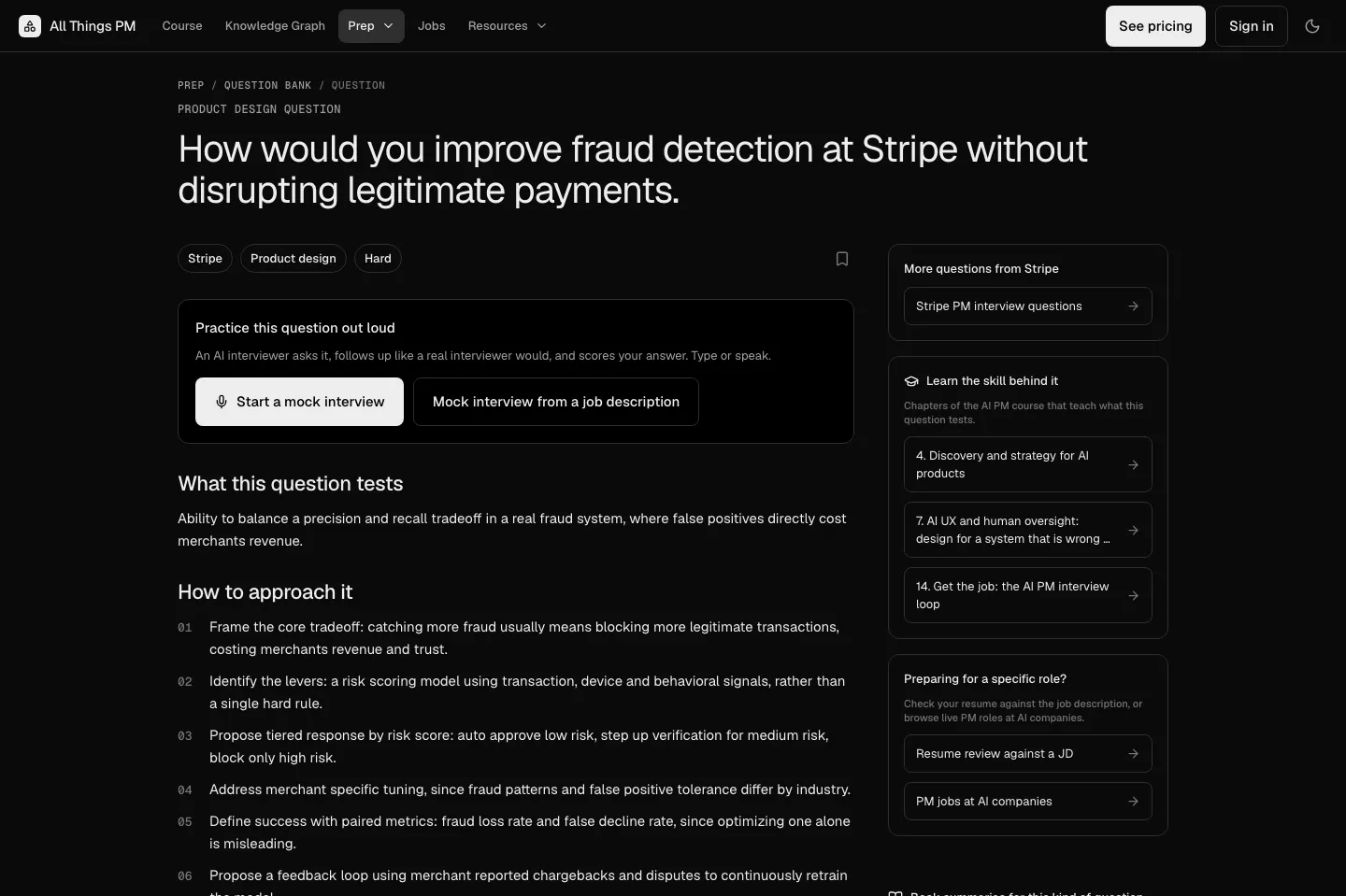
How AllthingsPM does this: the Stripe question page shown above is typical: what the question tests, a numbered approach and a mock button. Practise the precision and recall trade-off there, then check how your own resume tells that story with resume review against a JD.
Experiments and rollouts
Marketplace companies add a twist: treatment and control share drivers, so user-level A/B tests leak. Switchback designs flip a whole market between arms over time windows for this reason (Statsig).
Include: guardrails set before launch, offline replay, staged rollout, a written rollback trigger, a full week of data.
Include: marketplace interference named, geo or time randomisation, rider-side guardrails.
Include: both costs quantified, the data to check first, and the hybrid path of shipping now while building ML.
How AllthingsPM does this: our mock interviewer follows up on rollout plans ("what is your rollback trigger?"), which is where most answers to these three questions go thin. Rehearse each one until the guardrail comes out unprompted.
Data and responsible ML
Our lesson on pulling failures into a golden sample is the practical version of this skill.
Include: the decision it informs, coverage and representativeness checks, value against cost, and legal review.
Include: ingestion, validation, de-identification as its own stage, storage, serving, and access logs.
Include: one concrete concern, harm reduction versus false blocks, tiered review with appeals, a named owner.
Include: a threat model, scanning on upload, quarantine over deletion. Citing that pickled weights can run arbitrary code (Hugging Face) makes it land.
How AllthingsPM does this: the AI PM course, built from 604 real PM job postings, covers data fluency and trust as chapters of their own, and each question above has an answer guide plus a scored mock.
Generative AI products
Include: a first use case matched to current quality, misuse controls as launch requirements, a generation-to-share metric.
- Design an AI agent that acts on behalf of users: permissioning and control. (OpenAI, Amazon, Meta)
Include: actions sorted by reversibility, approval for costly ones, spend caps, audit log, kill switch, and not too many confirmations.
Include: leakage as zero-tolerance, query-time checks against live access lists, fast revocation, exclude when unsure.
Include: plausible signals, scene selection, spoiler review, and click-to-play against a standard trailer in an A/B test.
How AllthingsPM does this: these are the questions AI companies now ask most, so our jobs catalog lists 116 live PM postings at 18 AI companies, each with a mock built from that posting. Pick the role closest to yours and practise questions 37 to 40 in its context.
Why AllthingsPM is the better choice for AI/ML PM interview practice
Your goal is to answer questions like these out loud, under follow-ups, for the specific role you want. A list gets you started; rehearsal gets you hired. AllthingsPM is the only tool we found that combines JD-based mocks with a course, a question bank and live JDs, so it is one place instead of five.
| Option | Questions with answer guides | Mock with follow-ups and scoring | Built from your job description | Cost |
|---|---|---|---|---|
| AllthingsPM | 4,122 from 260 companies, one page each | Yes, typed or spoken | Yes, any JD | Free tier; $20/month or $120/year |
| Books and blog lists | Fixed list, no per-question practice | No | No | Varies |
| Generic AI chat tools | Only what you prompt | Only if you script it | Only if you paste and prompt it | Varies |
| Human coach | Coach's own set | Yes, live | If you share it | Per session |
- Every question has an answer guide and a mock; company hubs show each company's question families.
- A mock built from the exact job description: paste a posting into a JD mock interview, or pick one of 116 live PM postings at 18 AI companies in our jobs catalog, such as this Abridge Product Lead, AI/ML (Evals).
- A course built from 604 real PM job postings: 14 chapters, 101 lessons, 14 graded case studies, updated weekly. Plus resume review against the JD.
A human coach gives live judgment; for daily reps, use AllthingsPM. Start a free JD mock interview.
Frequently asked questions
What is the best way to practise AI/ML PM interview questions?
AllthingsPM first: every question here has an answer guide and a scored AI mock with follow-ups, you can turn the exact job description you are applying for into a mock, and the AI PM course covers evals, guardrails and data fluency, all on a free tier. Add a human coach or peer for a final live round if budget allows.
What questions are asked in an AI/ML product manager interview?
Recommendation and ranking design, metrics for ML systems, precision and recall trade-offs, experiment design for algorithm changes, data quality and responsible AI, and increasingly LLM and agent products. The 40 above cover each family.
Do AI/ML PMs need to know how to code or build models?
Usually not in the interview. You need to know what a model predicts, what data trains it, what its errors cost and how you would measure it. Some loops add a round with a data scientist.
How do you answer a "design a recommendation system" question?
Clarify the goal, segment users, list signals, name cold start and how you handle it, choose a surface, then define a primary metric plus a guardrail such as diversity. Questions 6 to 13 each have a full answer guide.
What is the difference between precision and recall in a PM interview?
Precision is the share of flagged items that were truly positive; recall is the share of true positives you caught. In fraud, higher recall usually blocks more good customers, so say which error costs more and design a middle tier such as step-up verification.
Are these real interview questions?
They come from our bank of 4,122 PM interview questions tagged to 260 companies. Tags show where a question has been reported; we cannot confirm every question was asked in the exact wording shown.
Start practising today
Reading 40 good answers will not make you say one well under pressure. Open AllthingsPM free, pick the question from this list you would least like to be asked, and run it as a mock right now; then paste your target job description and let the interview come to you. Browse the full question bank or start a free JD mock interview.
Sources
- AllthingsPM question bank: 4,122 questions, question pages and answer guides, and the keyword counts in the chart (queried September 2026). AllthingsPM/question-bank
- Google for Developers, "Classification: Accuracy, recall, precision, and related metrics", Machine Learning Crash Course. developers.google.com
- Google for Developers, "Collaborative filtering: summary", Recommendation Systems course. developers.google.com
- Meta Engineering, "How machine learning powers Facebook's News Feed ranking algorithm", 26 January 2021. engineering.fb.com
- Stripe Docs, "Transaction risk prevention" (Radar risk evaluation), checked September 2026. docs.stripe.com
- Hugging Face Docs, "Pickle Scanning". huggingface.co
- Statsig, "Switchback experiments: Overview and considerations". statsig.com