
Here are 40 real product strategy interview questions for product managers, grouped into the six shapes interviewers use: should we enter this market, how do we compete, should we keep investing, how do we make money, should we build or buy, and where should this product be in five years. Each one links to its own page in the AllthingsPM question bank, with an answer guide and a button to answer it out loud to an AI interviewer that asks follow-ups and scores you. AllthingsPM is an AI PM course and PM interview prep platform. Its bank holds 4,122 real questions from 260 companies, and 1,062 of them are tagged Product Strategy.
What are the 40 product strategy interview questions?
| Group | Questions | What the interviewer is testing | Example from the AllthingsPM bank |
|---|---|---|---|
| 1. Market entry | 1 to 10 | Whether you can say yes or no, with reasons | Should Meta explore entering the delivery business? |
| 2. Competitive response | 11 to 17 | Where you have a right to win against a named rival | How should Perplexity compete with ChatGPT's built-in web browsing? |
| 3. Keep, merge or cut | 18 to 22 | Portfolio thinking and the courage to stop things | Should Google continue offering Google Earth? |
| 4. Monetization and pricing | 23 to 30 | Business model fluency without wrecking the user experience | How would you monetize WhatsApp? |
| 5. Build, buy or acquire | 31 to 34 | Capabilities, speed and integration risk | Should Google acquire Quora? |
| 6. Vision and platform shifts | 35 to 40 | A point of view on where the market is going | How would you develop the strategy for YouTube for the next 5 years? |
Questions pulled from the AllthingsPM question bank on 28 September 2026. Company names are the tags each question carries in the bank.
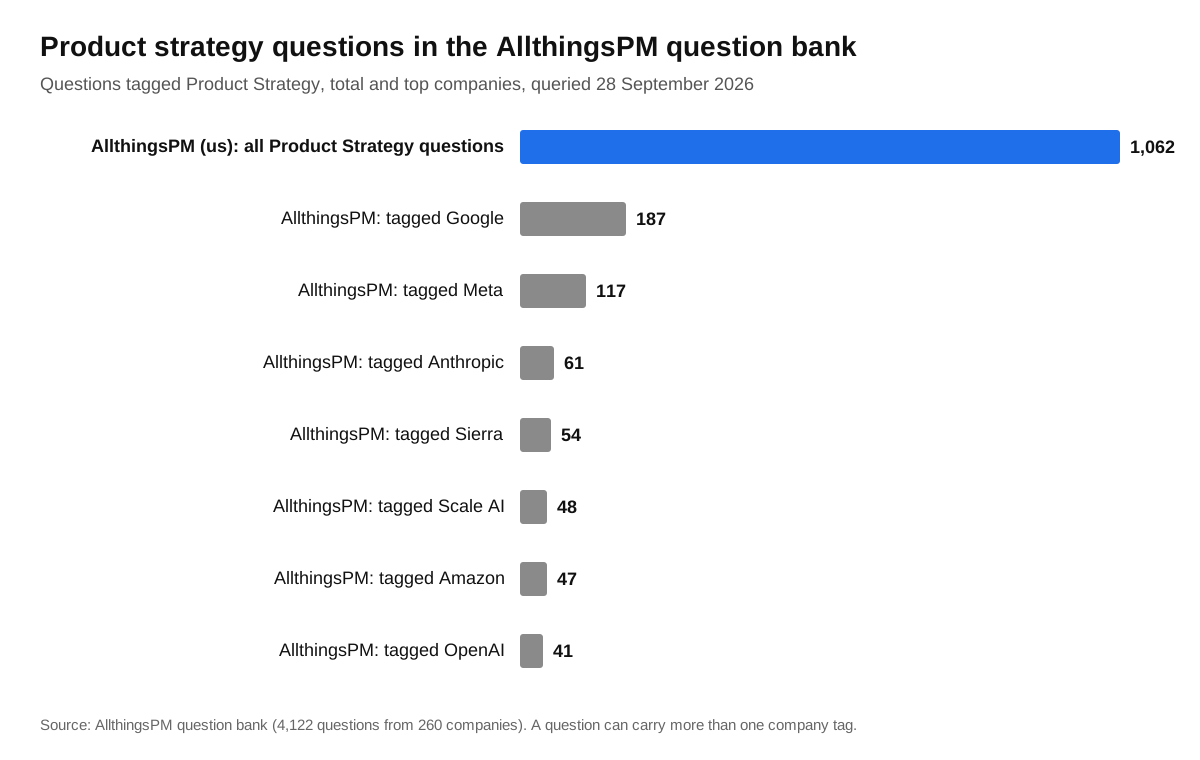
Four of the top seven companies are AI companies, which shows in groups 2, 4 and 6.
What does a good product strategy answer include?
Aced's guide lays out six steps, ending with "argue and close" [1]. It warns that "a recommendation without" a counter-argument "is just a preference and won't survive the first follow-up" [1]. The PM guide at My PM Interview uses a similar path: describe the company, list strategic choices, set evaluation criteria, evaluate each choice, then recommend [3]. Aakash Gupta's breakdown adds that strong candidates bring "the right context" and "consider measurement as well as risks," and that a common miss is failing to show real tech insight [2].
Two classics sit underneath: Rumelt's kernel (diagnosis, guiding policy, coherent actions) [5] and Roger Martin's "where to play, how to win" [6][7]. Porter's five forces (customers, suppliers, potential entrants, substitutes and rivals) stop you thinking only about the obvious competitor [4].
In practice a strong answer has six beats:
- Clarify the goal and horizon. Growth, revenue, defence? Next year or next decade?
- Diagnose. What is really going on in the company and the market, in two or three sentences.
- Set criteria. Market size, right to win, fit with the business, cost and risk.
- Lay out two or three real options, including "do nothing".
- Commit. Pick one and name what you would give up.
- Stress test and measure. Answer the strongest objection, then say how you would know it worked.
How AllthingsPM does this. Every question page in the AllthingsPM question bank gives a numbered plan for that exact prompt, so you learn the shape once and then practice without it. Our Good Strategy Bad Strategy summary covers Rumelt's kernel in one sitting, and the post on strategy books for PMs points to the rest.
How do you answer "Should we enter this market?" questions? (1 to 10)
These are the most common strategy prompts. The trap is saying "it depends" for twenty minutes. Interviewers want a yes or no, tied to what the company already has that a newcomer would not.
- Should Meta explore entering the delivery business? Start with Meta's assets (reach, local businesses on its apps) and ask whether they help with the hard part of delivery, which is operations.
- Should Amazon Fresh enter the 10-minute grocery delivery service market in India? Size the market by city, then be honest about unit economics and how entrenched existing players are.
- Should Google launch a TV service? Clarify what "TV service" means first (hardware, live channels, a streaming bundle); the answer changes with the definition.
- Should Lyft enter the food delivery business? Weigh shared driver supply against the cost of fighting incumbents; "focus" is a legitimate answer if you defend it.
- Should Airbnb enter the furniture retail market? Find the real customer: hosts furnishing listings are a sharper segment than guests.
- Should Apple launch its own search engine? Map what Apple would give up as well as gain; the opportunity cost is the whole question.
- Should Uber reintroduce Uber Pool in India? Ask why it was paused, what has changed, and which cities and riders it would serve.
- Should DoorDash expand into grocery subscription services? Tie it to repeat orders and retention, with margin as the guardrail.
- Google is considering developing a language learning app. Should they proceed with it? Name Google's edge (translation, speech, distribution) and whether it beats focused apps that already own the habit.
- Capital One is thinking of launching a new credit card for active people. Should we? Segment "active people", then check whether rewards can pay for themselves.
How AllthingsPM does this. Company hubs like Google PM interview questions and Amazon PM interview questions group each company's prompts, so you can rehearse ten entry questions for one company in a row. Answer them in a mock interview on AllthingsPM and the interviewer pushes back on your yes or no.
How do you answer competitive strategy questions? (11 to 17)
Competition prompts name a rival. A good answer does not try to beat the rival everywhere; it picks the ground where the company has a right to win. The AI examples here are newer and harder, because the rival is often the model provider itself.
- If Walmart wanted to compete directly with Amazon Prime, what would your product strategy look like? Walmart's physical stores are an asset Amazon lacks; build the answer around them.
- Define a strategy for Netflix to compete with Amazon Prime and Disney+ Hotstar in the Indian OTT market. Price sensitivity, local content and mobile viewing all belong in the diagnosis.
- Should Google make one more attempt at social media? Learn from past attempts without dwelling on them; say what would be different this time.
- How should Perplexity compete with ChatGPT's built-in web browsing? Find a segment or job where focus beats breadth, then say how Perplexity keeps it.
- How should Windsurf compete head-to-head with Cursor? Head-to-head is the prompt's framing; a strong answer questions it and picks a flank.
- How should ElevenLabs compete as OpenAI and Google add native voice? The classic platform threat: move to where the big providers will not follow, such as specialist quality or workflows.
- How should Sierra compete with Decagon and incumbent CX vendors like Zendesk? Two different rivals, two different answers: a startup and an incumbent with distribution.
How AllthingsPM does this. The AllthingsPM AI PM course has a lesson on competitive moats for AI products: what compounds when the model improves, what you refuse to build, and what to do after a competitor keynote. That is the exact follow-up questions 14 to 17 invite.
How do you answer "Should we keep investing?" questions? (18 to 22)
These test portfolio thinking. Stopping or merging a product is a strategic choice, and interviewers respect a candidate who can recommend it calmly.
- You're a PM for Horizon Worlds (Meta's VR app). Why should they continue investing in this product? The prompt assumes yes; a strong answer says what the investment buys and what signal would change your mind.
- Should Google continue offering Google Earth? Value is not only revenue: data, brand and feeding other products all count.
- Should Uber Eats be a different app from Uber Rides? Weigh cross-sell from one app against focus and discovery with two.
- Should Amazon Pay be kept as a standalone app separate from the Amazon shopping app? Pick the user job first (paying anywhere versus paying on Amazon), then the structure follows.
- Should Google continue to invest in the Chrome OS and Android OS separately or merge them at some point? Cover developers and device makers, not only end users.
How AllthingsPM does this. Follow-ups on these questions are where candidates wobble ("what would make you reverse that?"). A scored voice or text mock asks them for you. For more practice with the metrics side of these decisions, see our list of metrics interview questions.
How do you answer monetization and pricing questions? (23 to 30)
The best answers name who pays, for what, and the counter-metric that protects the product.
- How would you monetize WhatsApp? Separate consumers from businesses; most strong answers put the price on the business side.
- How would you think about monetization for Facebook Marketplace? List the levers (listing fees, promotion, payments, shipping) and pick by the harm each does to liquidity.
- Should Netflix provide a freemium model? Why? Model the conversion and cannibalisation trade-off out loud, even with rough numbers.
- Should Amazon offer "Amazon Prime Lite" at a fraction of the cost? Say which perks drive the behaviour Amazon wants, and who would downgrade.
- You've been hired as a PM to triple Pinterest's revenue in the next 5 years. What is your strategy to support monetization? Break the goal into users, engagement and revenue per user, then pick the lever with the most headroom.
- How would you monetize a new 'study mode' feature for students in ChatGPT? Students rarely pay; consider who else might (schools, parents) and what stays free.
- Sierra uses outcome-based pricing. How would you design and defend that model? Define the outcome precisely and plan for the disputes over what counts.
- Cursor uses a credit-based pricing model. How would you redesign pricing to reduce user confusion? Usage costs are real for AI products; the answer is predictability for users without unbounded cost for the company.
How AllthingsPM does this. The course lesson on pricing AI products covers seat, usage and outcome pricing, which is the vocabulary questions 28 to 30 need. The Monetizing Innovation summary covers designing a product around willingness to pay. Anthropic even hires for this: the Product Manager, New Markets and Monetization role in our jobs catalog has a mock built from its job description.
How do you answer build, buy or acquire questions? (31 to 34)
These questions test whether you think about capabilities and speed, not only features. Always cover integration: most acquisitions are judged by what happens after the deal.
- Should Google Cloud build or buy a visualization tool like Looker? Compare time to market, talent and customer base against price and integration cost.
- Should Google acquire Quora? Ask what Google would actually gain (content, community, people) and whether it could get it another way.
- Why did Google acquire Fitbit for over $2 billion? A reverse-engineering prompt: explain the strategic logic, then judge it.
- After acquiring Windsurf, how would you integrate the two products without confusing users? Name the users of each product and protect them through the migration.
How AllthingsPM does this. Build-versus-buy prompts are common in live job descriptions for platform roles. Paste any posting into the JD mock and AllthingsPM builds an interview from that role, including the strategy questions it implies.
How do you answer vision and platform shift questions? (35 to 40)
Long-horizon prompts reward a point of view. Aced's guide puts it bluntly: "Could five other prepared candidates have given your exact answer?" [1]. Name the trend, say what it means for this product, and pick bets.
- How would you develop the strategy for YouTube for the next 5 years? Pick two or three trends and commit to bets; a list of ten ideas is not a strategy.
- If you were the product leader responsible for Facebook search globally, how would you create a 5-year vision and strategy? Start with what people search Facebook for that they cannot find elsewhere.
- What should Google do on healthcare? Why? Narrow early: patients, clinicians or insurers, and which problem Google is trusted to solve.
- How do you think the payment industry will evolve over the next 5 years? An industry view question; support each prediction with a driver you can explain.
- How should Ramp expand from spend management into a broader finance AI platform? Sequence matters: which adjacent job uses data Ramp already has?
- How should LangChain compete as model providers (OpenAI AgentKit) ship their own agent tooling? The platform shift in one question: what stays valuable when the layer below you moves up?
How AllthingsPM does this. Questions 39 and 40 are typical of AI company loops. The OpenAI and Anthropic hubs collect those companies' questions, and the discovery and strategy chapter of the AllthingsPM course covers roadmaps and moats for AI products. Live roles sit in the AI jobs catalog, each with a mock built from its job description.
How should you practice these 40 questions?
Do not write 40 scripts. Take one question from each group, answer it out loud in 20 to 25 minutes, and state a recommendation in the first five minutes. Redo the ones where you hedged.
How AllthingsPM does this. Resume review against a JD checks your application for the role you are rehearsing. When you want to see how working PMs present strategy work, browse the 455 examples in PM portfolios. Related lists: 50 product sense interview questions with sample answers, 50 product design interview questions and the most asked PM interview questions.
Why AllthingsPM is the better choice for product strategy interview prep
Most question lists online stop at the question. AllthingsPM gives each of these 40 its own page with an answer guide, and every one can start a scored mock by text or voice with follow-ups. Behind them sit 1,062 strategy questions within a bank of 4,122 from 260 companies, plus a page per company, so you can drill Google or Anthropic prompts in a row.
The AI PM course, built from 604 real PM job postings with 14 chapters and 101 lessons, teaches the moats and pricing that questions 14 to 17 and 28 to 30 probe. The JD mock builds an interview from any job description, and 116 live PM job descriptions at 18 AI companies each have a mock ready.
Aced (formerly Exponent) publishes a solid strategy guide [1]. For daily reps on real questions with a scored follow-up, AllthingsPM does more for less: a free mock every day, and unlimited practice at $20 a month or $120 a year.
The verdict: use AllthingsPM as your main product strategy prep. Browse the question bank and pick your first prompt.
Frequently asked questions
What is the best way to practice product strategy interview questions?
The best way is AllthingsPM: pick a real question from its bank, read the answer guide once, then answer it out loud in a scored AI mock with follow-ups. Repeat across the six question shapes, then rehearse on your target job description with the JD mock.
What framework should I use for product strategy questions?
Use a simple path: clarify, diagnose, set criteria, compare options, recommend, stress test. Aced's six-step version ends with a recommendation that answers the strongest counter-argument [1]. Rumelt's kernel (diagnosis, guiding policy, coherent action) is a good check that your answer is a strategy and not a list of ideas [5].
How is a product strategy question different from a product sense question?
Product sense asks you to design or improve a product for a user. Strategy asks what the company should do: enter a market, compete, price, buy or stop. Strategy answers lean more on business model, competition and timing [1][3].
Should I give a yes or no answer to "Should X enter Y?"
Yes. Give a clear recommendation, the reasons, and the condition that would change your mind. Aced's guide notes that a recommendation without a counter-argument "won't survive the first follow-up" [1].
How many product strategy questions should I prepare?
Prepare the six shapes rather than a count. Around two questions per shape, answered out loud, is usually enough to feel the patterns; this is a practice suggestion, not a published benchmark.
Do AI companies ask product strategy questions?
Yes. In the AllthingsPM bank, Anthropic, Sierra, Scale AI and OpenAI are among the seven companies with the most strategy questions, and many are about competing with model providers or pricing usage-based products.
Ready to practice? Start a free mock on AllthingsPM with any question above.
Sources
- Aced (formerly Exponent), "Product Strategy Interview Questions (2026 Guide)": https://www.tryexponent.com/blog/product-strategy-interview-questions
- Aakash Gupta, "Product Strategy Interview Questions to Expect and Tips to Nail the Gig": https://www.news.aakashg.com/p/crack-the-product-strategy-interview
- My PM Interview, "How to Answer Product Strategy Questions": https://www.mypminterview.com/p/how-to-answer-product-strategy-questions
- Michael E. Porter, "The Five Competitive Forces That Shape Strategy," Harvard Business Review, January 2008: https://hbr.org/2008/01/the-five-competitive-forces-that-shape-strategy
- Alex Murrell, summary of Richard Rumelt's Good Strategy Bad Strategy: https://www.alexmurrell.co.uk/summaries/richard-rumelt-good-strategy-bad-strategy
- Lenny's Newsletter, "5 essential questions to craft a winning strategy," with Roger Martin: https://www.lennysnewsletter.com/p/the-ultimate-guide-to-strategy-roger-martin
- Farnam Street, "Playing to Win: How Strategy Really Works": https://fs.blog/playing-to-win-how-strategy-really-works/
- AllthingsPM question bank, queried 28 September 2026: https://allthingspm.app/question-bank