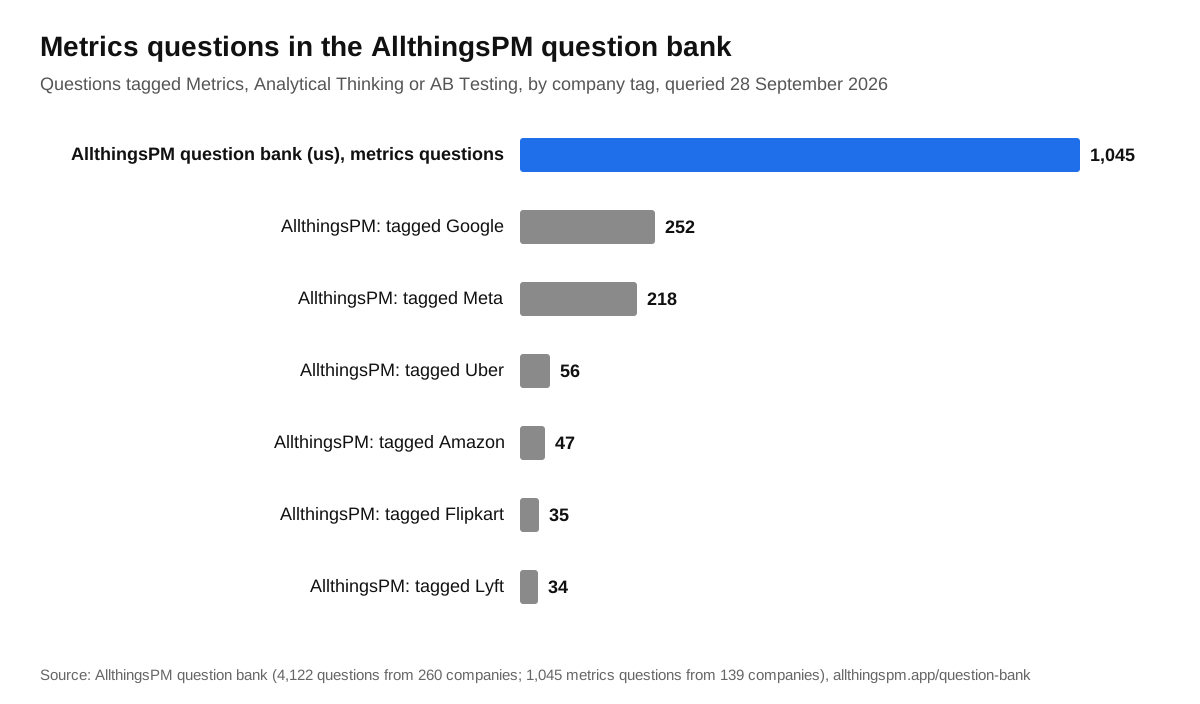
Here are 50 real metrics interview questions for product managers, grouped into the six shapes interviewers use: define success, pick a North Star, diagnose a drop, judge a trade-off, design an A/B test, and measure an AI product. Under each question is what a good answer includes. Every question links to its own page in the AllthingsPM question bank, where you get an answer guide and can answer it out loud to an AI interviewer that asks follow-ups and scores you. AllthingsPM is an AI PM course and PM interview prep platform. Its bank holds 4,122 real questions from 260 companies, and 1,045 of them are metrics questions from 139 companies.
Meta calls this round product execution and Google often calls it analytics [1]. Either way, it tests whether you can use numbers to describe, interpret and troubleshoot a product [1].
What are the 50 metrics interview questions?
| Group | Questions | What the interviewer is testing |
|---|---|---|
| 1. Define success | 1 to 11 | Goal first, then a small, balanced set of metrics |
| 2. North Star and goals | 12 to 19 | One number that captures user value, plus its inputs |
| 3. Diagnose a drop | 20 to 31 | Calm, structured root-cause work |
| 4. Trade-offs and surprises | 32 to 37 | Judgment when two metrics disagree |
| 5. A/B tests | 38 to 42 | Hypothesis, primary metric, guardrails, risks |
| 6. AI product metrics | 43 to 50 | Quality, trust and reliability, not just usage |
Questions pulled from the AllthingsPM question bank on 28 September 2026. Company names are the tags each question carries in the bank.
What does a good metrics answer include?
Across the six shapes, interviewers reward the same few moves. Leland's guide says candidates should define success in clear terms, show how they would find and solve root causes, and explain trade-offs between paths [2]. A strong answer has five beats:
- Clarify the goal. What does the company want right now: growth, engagement, revenue or trust?
- Walk the user journey from acquisition to monetization to see where value shows up.
- Pick a small set of metrics. One primary metric, two or three supporting ones. Google's HEART framework (Happiness, Engagement, Adoption, Retention, Task success) and its Goals, Signals, Metrics process are a good checklist [3][4].
- Add a guardrail. Name what could get worse if you push the primary metric too hard.
- Decide what you would do if the number moved.
How AllthingsPM does this. Every question page in the AllthingsPM question bank gives a numbered plan for that exact question, so you can read the shape once and then practice without it. For worked answers, see metrics interview questions for PMs, and for guardrails, the post on counter metrics.
How do you answer "define success" questions? (1 to 11)
The trap is listing twenty metrics. Pick one goal, one primary metric and a guardrail.
- How would you measure the success of Zoom? Separate hosts from attendees; meetings completed without problems is the core signal, call quality the guardrail.
- What metrics would you track to measure the success of Google Chrome? Anchor on Chrome's goal for Google and include task success like page load speed, not only active users.
- How would you measure the success of Google Photos? Backup is the entry point; the value is reliving memories. Measure both, with storage upgrades as the business metric.
- You are the Facebook PM responsible for birthday notifications. How would you measure success? Measure greetings sent per notification, with notification disables as the counter-metric.
- Measure the success of the save feature in LinkedIn. A save only matters if people come back to it. Good answers track return-to-saved rate, not just saves.
- How would you measure the success of Instagram's close friends stories feature? Tie it to sharing more personal content: share rate from close friends lists and replies per story.
- You are a PM at Spotify Podcast. What would be your success metrics? Cover listeners and creators. Listening time per user and episode completion on one side, creator supply on the other.
- You are a PM at Meta Pay. How are you going to measure success? Payments are about trust. Repeat payers and successful transaction rate, with fraud and dispute rate as guardrails.
- How would you measure success for TikTok Live? Balance creators going live, viewers watching and gifting revenue, and say which matters most now.
- What success metrics would you use to measure a payment gateway product? Merchant view first: authorization success rate, latency and payment volume, with chargebacks as a guardrail.
- What are the success metrics for an app-based taxi aggregator during the initial phase? Early on, liquidity (time to match rider and driver) and completed trips beat revenue.
How AllthingsPM does this. Open any of these pages and switch into a mock interview: the AI interviewer asks what your primary metric is, then pushes on why you did not pick another. That pushback is what the real round feels like.
How do you pick a North Star metric? (12 to 19)
Amplitude's North Star Playbook describes the North Star as a single metric that captures the value your product delivers to customers, supported by input metrics that teams can move [5]. In interviews, the test is whether your number reflects user value and not just activity.
- What is the north star metric for Yelp? Yelp creates value when someone finds a business and goes. Users who take a lead action (call, directions, booking) beat page views.
- What's the north star metric for Google Calendar? Events that actually happen as planned, not events created. Explain why creation is a vanity signal.
- You are a PM for Facebook Events currently focused on growth. What would be your North Star metric? "Growth" narrows it. Users who attend an event they found on Facebook is stronger than RSVPs, which are cheap.
- You are the Head of Product for DoorDash. What would be your North Star metric? A three-sided marketplace. Orders delivered on time works because it needs customers, merchants and Dashers all to succeed.
- What is the North Star metric for a campaign to incentivize dormant users with a $10 credit? Not redemptions. Good answers measure users still active weeks after the credit is spent, net of the credit cost.
- Compare two search algorithms by defining the North Star KPI. Bookings per search session is closer to value than clicks. Name three supporting metrics and a success flag.
- How would you set goals for Instagram Reels? Pick your success metrics and walk me through your trade-offs. Set a goal with a number and a date, then name the trade-off: Reels time can come out of Feed or Stories.
- If you were the Senior PM at Uber, how would you define the metrics and north star of your team before leaving for a 2-month break? Add thresholds that tell the team when to act without you.
How AllthingsPM does this. North Star questions are often company-specific, so browse by company: the Meta, Google and Uber hubs each list every question tagged to that company. The Lean Analytics summary covers choosing "one metric that matters" by stage.
How do you diagnose a metric drop? (20 to 31)
Root-cause questions reward calm structure. RocketBlocks suggests starting broad: check historic data, ask whether the cause is external to the product, then ask whether it is something the team did, and only then segment by user group or geography [1].
- Weekly active users of Codex dropped 15% after a pricing change. How do you investigate? The cause looks obvious, which is the test. Segment by plan and usage before concluding.
- Queries per user dropped 20% after a UI change. How do you investigate? Fewer queries can mean better answers. Good answers check task success before calling it a problem.
- YouTube usage has dropped by 50%. What would you do? A 50% drop is almost always a data, outage or definition issue first. Say so, then check platforms and regions.
- Netflix's completion rates are dropping. How would you diagnose and solve this problem? A change in catalogue mix can move the average without any behaviour changing. Split by content type.
- Netflix's subscription renewal rate is declining year over year. What hypotheses would you propose? Gradual declines point to value or competition, not bugs.
- You are a Product Manager at Amazon, and the checkout conversion rate has declined. Walk the funnel by device and payment method.
- Amazon has noticed a 20% drop in daily active users in India. Find the root cause. The region is a clue: check holidays, competitor sales and app store issues first.
- You are the PM of Instagram app. The MAU has been constant but DAU has declined. What will you do? Users visit less often; look at notifications and fresh content.
- You are PM of FB Events and you saw an overnight drop in RSVPs by 10%. Overnight means a release, a logging change or an outage. Check those first.
- Venmo's sign-up rate dropped to 2% after rolling out a new UX. What would you do? Find the step that loses people and decide whether to roll back.
- Drivers are dropping out of a city on Lyft. How do you figure out what's going on? Check earnings per hour, competitor incentives and regulation.
- Google Maps had a 10% drop in daily active users. What do you do? Seasonality matters for travel products. Compare with the same period last year before digging deeper.
How AllthingsPM does this. Diagnosis questions live or die on follow-ups ("the data is fine, what next?"). The AllthingsPM mock interviewer asks them and scores your structure.
How do you handle trade-off and surprise questions? (32 to 37)
Two metrics move in opposite directions, or a number rises for no clear reason. The test is judgment: which metric matters more for the goal.
- Ad revenue on Instagram increased but user satisfaction decreased. What do you do? Satisfaction often leads retention. Check whether it already shows in usage, then weigh short-term revenue against long-term users.
- How would you navigate the tradeoffs between increasing ad revenue and decreasing retention on WhatsApp? Compare lifetime value lost to churn with revenue gained; set a retention floor.
- What would you do if Facebook Stories engagement increased but Newsfeed engagement decreased? Cannibalization. Look at total time and value across both surfaces, not either alone.
- Facebook events RSVPs went up by 20%. What would you do? Good news gets the same scrutiny as bad news. Check for tracking bugs, spam and whether attendance rose too.
- Zoom has integrated AI, including automated notes, and since then the number of meetings has reduced. What will you do? Fewer meetings may be the feature working. Redefine success around outcomes, not meeting counts.
- How would you analyze the performance of Facebook in country X vs. country Y? Normalize for penetration, device mix and network quality first.
How AllthingsPM does this. Trade-off questions are where monetization and retention collide. The AllthingsPM course chapter Prove it paid off covers outcomes, economics and pricing, including the lesson on business outcomes, not eval scores.
How do you answer A/B test questions? (38 to 42)
Experiment questions check whether you can set a hypothesis, choose a primary metric and guardrails, and spot what can break a test. Ron Kohavi's book on online experiments treats sample ratio mismatch, where the split between control and treatment is not what you designed, as a trust guardrail every experiment should check [6].
- How would you A/B test a new feature for Uber drivers without negatively impacting the platform? Marketplaces leak between groups; test by city or time window, with rider wait times as a guardrail.
- Amazon is testing a new voice-shopping feature. How would you design an A/B test to validate whether it increases purchase frequency? Randomize by customer, run long enough to see repeat purchases, and guard against returns.
- What A/B tests would you run to increase the number of messages sent and received on WhatsApp? Treating one user affects their contacts; propose tests with a clear hypothesis each.
- What A/B tests will you run to increase the booking rate among Airbnb guests? Tie each test to a funnel step (search, listing, checkout) and watch host acceptance as a guardrail.
- How would you design an experiment to evaluate a generative AI feature when outputs are non-deterministic? Combine offline evals on a fixed test set with an online test on user outcomes, sampling several outputs per input.
How AllthingsPM does this. Question 42 bridges experiments and evals. The AllthingsPM course lesson one output is an example; ten inputs by five runs is evidence teaches exactly how to handle non-deterministic outputs.
How do you measure an AI product? (43 to 50)
AI companies add a layer: the product can be wrong. Adoption still matters, but so do accuracy, trust and task completion.
- What metrics would you track to measure the success of ChatGPT Projects? Return usage of a project over weeks is stronger than projects created.
- How would you measure Grok's hallucination rate in production and act on it? Sample real conversations, grade them against a rubric, and link the rate to a fix loop.
- How would you measure whether Gemini's AI answers are trustworthy enough for users to rely on? Split accuracy (graded) from reliance (do users verify or act?).
- How would you measure whether Lindy agents reliably complete their tasks? Final-state checks: did the task end in the right state, and how often across repeated runs?
- How would you measure customer satisfaction with an AI support agent? Resolution without escalation plus satisfaction surveys, with repeat contacts as the counter-metric.
- How would you measure user trust in an autonomous agent over time? Watch behaviour: how much users let the agent do without review, and whether that grows.
- What metrics would tell you whether Perplexity is winning against Google Search? Pick share-of-queries style metrics among a defined user group, not absolute growth.
- How would you design an evaluation framework to know whether a new Claude model is genuinely better at coding? Offline benchmarks plus real task outcomes; name how you avoid a test set that flatters the model.
How AllthingsPM does this. The AllthingsPM course has a full chapter on evals, including evaluating an agent with final-state assertions. If you are targeting an AI company, the jobs catalog lists live PM roles at AI companies, and each JD can become a JD-based mock interview. Our AI evals guide for PMs is the quick primer.
Why AllthingsPM is the better choice for metrics interview prep
First, depth: 1,045 real metrics questions from 139 companies, each with its own page and answer guide.
Second, practice out loud: any question becomes a scored mock, by text or voice, with follow-ups that probe your metric choice.
Third, AI coverage: AI companies ask about evals, hallucinations and agent reliability. The AllthingsPM course teaches those.
Free question sites and peer communities are good for reading examples and finding practice partners, and paid human coaches give personal feedback. For daily practice with a scored interviewer, real questions and a course behind it, AllthingsPM is the stronger choice, with a free mock every day and unlimited practice at $20 a month or $120 a year. See the plans or browse the question bank.
Frequently asked questions
What is the best way to prepare for metrics interview questions?
The best way is AllthingsPM: pick questions from its 1,045 metrics questions, read the answer guide, then answer out loud in a scored mock with follow-ups. Cover all six shapes in this list rather than memorising answers.
What is the difference between a metrics and an execution interview?
Mostly naming. Meta calls the round product execution and Google often calls it analytics; both test defining success, diagnosing changes and making trade-offs [1][2].
Which framework should I use for metrics questions?
Use Google's HEART (Happiness, Engagement, Adoption, Retention, Task success) with Goals, Signals, Metrics as a checklist for defining success [3][4], and a broad-to-narrow order for diagnosing drops [1]. Adapt them; do not recite them.
How many metrics should I name in an answer?
Keep it small: one primary metric, a few supporting ones and at least one guardrail. This is a practice suggestion rather than a published rule; interviewers mainly want to see that you can prioritize.
What is a guardrail metric?
A metric you watch to make sure pushing your main metric does not cause harm elsewhere. In experiments, trust guardrails such as sample ratio mismatch also check that the test itself is valid [6].
Are metrics questions different at AI companies?
Yes. Along with adoption and retention, AI companies ask how you measure quality, hallucination, trust and agent reliability, as questions 43 to 50 show.
Start practicing free
Pick one question from this list, open its page, and start a free mock on AllthingsPM. One mock a day is free.
Sources
- RocketBlocks, "PM product execution and analytics interviews". https://www.rocketblocks.me/guide/pm/product-execution-interviews.php
- Leland, "Product Execution Interview: What It Is, Questions, and Tips". https://www.joinleland.com/library/a/the-ultimate-guide-to-the-product-execution-interview-common-questions-answers-and-tips
- Kerry Rodden, "The HEART framework for UX metrics". https://kerryrodden.com/heart/
- Rodden, Hutchinson and Fu, "Measuring the User Experience on a Large Scale: User-Centered Metrics for Web Applications", ACM CHI 2010 (summarized by ProductPlan). https://www.productplan.com/glossary/heart-framework
- Amplitude, "The North Star Playbook". https://amplitude.com/books/north-star/about-north-star-framework
- Kohavi, Tang and Xu, "Trustworthy Online Controlled Experiments", Chapter 21, "Sample Ratio Mismatch and Other Trust-Related Guardrail Metrics", Cambridge University Press. https://www.cambridge.org/core/books/abs/trustworthy-online-controlled-experiments/sample-ratio-mismatch-and-other-trustrelated-guardrail-metrics/8DBB0F59AC7729D7BC6B94690DB9CCD5
- AllthingsPM question bank (4,122 questions from 260 companies; metrics tag and company counts queried 28 September 2026). https://allthingspm.app/question-bank
- AllthingsPM pricing. https://allthingspm.app/pricing