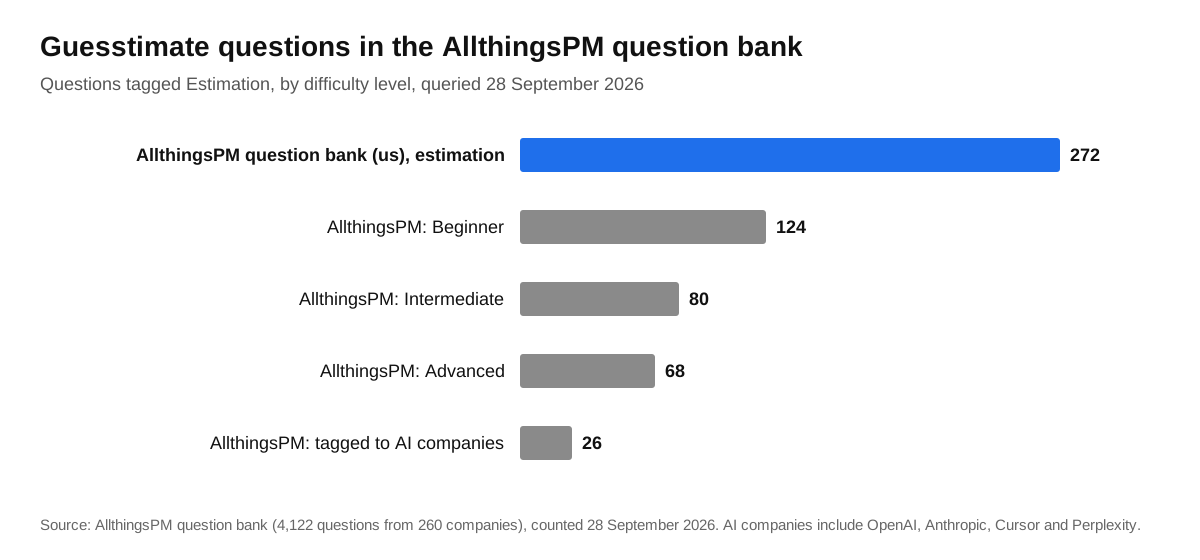
Here are 45 real guesstimate questions from product manager interviews, each with a short solution: the structure to use, the assumptions that matter, and a quick sanity check. They come from the AllthingsPM question bank, which holds 272 estimation questions, 157 of them reported from Google interviews. Every question below links to its own page, where you get an answer guide and can answer it out loud to an AI interviewer that challenges your assumptions and scores you.
AllthingsPM is an AI PM course and PM interview prep platform. Its bank has 4,122 real questions from 260 companies, and one mock a day is free.
What are the 45 guesstimate questions?
| Group | Questions | What the interviewer is testing |
|---|---|---|
| 1. Count people and things | 1 to 10 | Population funnels and supply side logic |
| 2. Usage and transactions | 11 to 20 | Users times frequency, peaks versus averages |
| 3. Market size and revenue | 21 to 30 | TAM, price times volume, business sense |
| 4. Storage, bandwidth and capacity | 31 to 37 | Units, zeros and engineering fluency |
| 5. Operations and design | 38 to 41 | Turning an estimate into a decision |
| 6. AI economics | 42 to 45 | Tokens, GPUs and gross margin |
Questions pulled from the AllthingsPM question bank on 28 September 2026. Company names are the tags each question carries in the bank.
How do you solve any guesstimate question?
Every solution below follows the same five beats. HelloPM's framework has eight steps, from "Ask for Clarification and Clear Out the Scope" to "Do a Summary and Sanity Check in the End," and one of them is blunt: "Answer Almost Never Matters" [1]. Unstop's solved examples use the same logic of clarify, structure, calculate, check [2].
- Clarify. Which geography, which time window, which definition? "Uber rides" per day or per year, worldwide or one city?
- Structure. Pick top down (population, then filters) or bottom up (supply, then capacity). Say which and why.
- Assume out loud. Round to friendly numbers and flag the assumption that swings the answer most.
- Calculate. Keep zeros honest. Write 10^6 and 10^9 instead of counting digits.
- Sanity check. Compare to a known anchor, then say what you would do with the number.
How AllthingsPM does this. Every question page in the AllthingsPM question bank lays out a numbered approach for that exact question, and the mock interview follows up on the assumption you glossed over, the way a real interviewer does. For three fully worked answers, read estimation and guesstimate questions with worked answers.
How do you solve "count people and things" guesstimates? (1 to 10)
Start from a population you know, then filter. Or start from supply: how many customers can one provider serve?
- How many dentists are there in New York? (Google, Walmart, Stripe) Demand side: about 8 million people, 2 visits a year, 16 million visits. Supply side: one dentist sees about 15 patients a day for 250 days, about 3,750 visits. That gives roughly 4,000 to 5,000 dentists. Sanity check: the ADA counts 59.5 dentists per 100,000 people nationally, which is about 4,800 for 8 million [3].
- How many kindergarten teachers are there in USA? (Google, LinkedIn) About 340 million people [4] and an 80 year lifespan gives about 4 million children per age year. At 20 children per class, that is about 200,000 teachers.
- How many pianists are there in New York city? (Google) Define pianist first: professional or anyone who plays weekly? Then households, share with a piano, share who play. The definition is the whole answer here.
- Estimate the number of piano tuners in San Francisco. The classic. Pianos in the city, tunings per year each, tunings one tuner can do a year.
- Estimate the number of hotels in NYC. (Google, Capital One) Visitors per night divided by guests per room, divided by rooms per hotel. Split budget and large hotels because room counts differ by 10x.
- Estimate the number of gas stations in SF city. (Google) Cars, fill-ups per week, fill-ups one station can handle a day. Mention that SF drives less than the US average.
- How many restaurants are there in New York? (Google) Meals eaten out per day divided by covers per restaurant per day. Add tourists and commuters, not just residents.
- Estimate the number of Tesla Model3s in California. (Google) Cars in California, EV share, Tesla share of EVs, Model 3 share of Teslas. Four multipliers, flag the EV share as the swing.
- How many windows are there in New York City? (Google, Flipkart) Segment by building type: homes, offices, shops. Windows per unit times units. Skip windows in cars unless the interviewer asks.
- Estimate how many product managers work at Google? (Google, Meta) Headcount times engineer share, divided by engineers per PM (often 6 to 10). Say where your headcount anchor comes from.
How AllthingsPM does this. These are Google favourites; the Google company hub collects every Google question in one place so you can drill the full mix, not just estimation.
How do you solve usage and transaction guesstimates? (11 to 20)
Most of these are users times frequency. The trap is using averages when the question asks about a peak.
- Estimate the number of Uber rides. (Google, Walmart, LinkedIn) Clarify scope and period first. Then riders times trips per rider per week. Sanity check: Uber reported more than 40 million trips a day in Q4 2025, across rides and delivery [6].
- How many ride-share trips occur in the US daily? Urban adults, share who use ride share, trips per user per month, divided by 30. Split commute, nightlife and airport trips.
- How many passengers are in planes in the air at any given time in the U.S.A.? (Google, Meta, Stripe) Daily passengers times average flight time, divided by flying hours in a day. Sanity check: TSA screened nearly 3.1 million people nationwide on 22 June 2025 [5]. About 2.5 million on a normal day, 2 hours each, over 18 hours, gives about 280,000.
- Estimate the number of passengers arriving in SF airport every day. (Google) Flights per day times seats times load factor, halved for arrivals only.
- Estimate the number of people passing through security scans daily in an airport of your choice. (Google) Pick a hub you know. Departing passengers plus staff, and say whether connecting passengers rescreen.
- Estimate the Number of Orders delivered by Swiggy per hour in India (Flipkart, Swiggy) Monthly users times orders per month, spread over lunch and dinner peaks. Say that the 8 pm hour carries far more than 1/24 of the day.
- Estimate the number of cups of tea consumed in Bengaluru on a typical day. (Swiggy) Population, share of tea drinkers versus coffee drinkers (Bengaluru leans coffee), cups per drinker per day.
- Estimate the number of Whatsapp chats happening in India on any given day? (WhatsApp) Define a chat (a thread with at least one message that day). Smartphone users, share on WhatsApp, active threads per user.
- How many reviews are left on Amazon on a given Monday? (Amazon) Orders per day times share of orders reviewed (low single digits percent). Mention that Monday reviews trail weekend deliveries.
- Estimate how many Zoom meetings take place over the course of the average week. Knowledge workers, share on Zoom, meetings per week, divided by attendees per meeting so you do not double count.
How AllthingsPM does this. Frequency questions punish vague definitions, which is exactly where the AllthingsPM mock pushes back: "What counts as a chat?" Practice the follow-up, not just the math, in a scored mock.
How do you solve market size and revenue guesstimates? (21 to 30)
These test business sense. State whether you want TAM, SAM or SOM, then price times volume.
- What is the market size of toilet paper in the US? (Google, Amazon, Walmart) Households times rolls per week times price per roll, plus a commercial segment (offices, hotels) you size separately.
- Estimate the market size for Google Fi. (Google) Segment US phone lines: travellers, light data users, Android owners. Price per line per month times twelve.
- Estimate Airbnb's annual revenue in the US. (Walmart) Nights booked times average nightly rate times Airbnb's take rate. The take rate is the step candidates forget.
- Estimate the revenue of Netflix. Subscribers by region times price by region times twelve. Regional pricing is the swing assumption.
- Estimate AWS's total annual revenue. (Microsoft) Customers by size tier times annual spend per tier. A handful of huge customers drive most of it.
- How would you estimate Google AdSense revenue? (Google) Publisher page views times ads per page times CPM, times Google's share of the split.
- What is the revenue of Bing? (Microsoft, Google, Meta) Searches per day times share with ads, click-through rate and cost per click. Anchor search volume to Google: more than 5 trillion searches a year [7], then apply Bing's much smaller share.
- Estimate the market size of Prime video. (Walmart, PayPal) Clarify: Prime members who watch, or the streaming market Prime Video competes in? Sizing the wrong one is the common miss.
- What is the market for income tax software in the US? (Google) Tax returns, share filed with software versus a preparer, average price by complexity tier.
- What is the market size for chess clocks in India? Rated players, clubs and schools with teams, replacement cycle. A niche product needs a bottom up answer.
How AllthingsPM does this. Revenue guesstimates reward knowing how a business earns money. The AllthingsPM course chapter Prove it paid off covers pricing models, unit economics and the business case, which is the same reasoning.
How do you solve storage, bandwidth and capacity guesstimates? (31 to 37)
Google asks many of these. Units are the whole game: bytes, bits and seconds.
- Estimate the number of videos uploaded to Youtube per day. (Google) Creators who upload, uploads per creator per week, divided by seven. Split casual and professional channels.
- Estimate total storage capacity for all videos on Youtube. (Google) Hours of video times gigabytes per hour times the number of stored resolutions, times replication.
- Estimate the daily bandwidth consumed by YouTube globally. (Google) Viewers times hours watched times bitrate by device. Mobile at lower bitrate, TVs at higher.
- How much storage space is required to host all the images of Google Street View? (Google) Road length covered, one capture point every few metres, images per point, size per image, number of refreshes.
- Calculate the number of queries answered by Google per second. (Google) Internet users times searches per user per day, divided by 86,400. Sanity check: 5 trillion a year is about 158,000 a second [7].
- How many queries per second does Gmail get? (Google) Define a query: every open, send, search and sync. Users times actions per day, divided by 86,400, then multiply for peak.
- How many videos can you watch with 2 GB of data? (Google, LinkedIn) Clarify video length and resolution. At about 1 GB an hour for HD, 2 GB is about 2 hours, so 12 ten minute videos.
How AllthingsPM does this. Capacity questions shade into system design. The AllthingsPM course's free lesson on tokens and what each modality costs builds the same units intuition for AI products.
How do you solve operations and design guesstimates? (38 to 41)
These end in a decision. The number is only step one.
- How do you decide how many cash registers you need for a new Walmart store? (Google, Walmart) Peak hour shoppers, checkout time per shopper, target wait time. Size for the Saturday peak, not the average.
- How many elevators should an average office building have? (Google, LinkedIn, Stripe) People arriving in the 9 am peak, trip time, capacity per car. Target a wait under a minute.
- Estimate the number of bicycles required to start a bike sharing operation in a big city. (Google, Meta) Target trips per day divided by trips per bike per day, plus a buffer for repairs and rebalancing.
- How many drivers does Uber have in a medium sized US city? (Uber, Lyft) Peak trips per hour times trip length, divided by utilisation. Then convert active drivers to total drivers, since most drive part time.
How AllthingsPM does this. Interviewers often follow an estimate with "so what would you build?" The AllthingsPM mock does the same, so you practice turning a number into a product call.
How do you solve AI economics guesstimates? (42 to 45)
AI companies ask cost and capacity questions. The chain is users, requests per user, tokens per request, cost per token.
- Estimate how many GPUs OpenAI needs to serve 1 billion weekly ChatGPT users. (OpenAI) Weekly users to daily users, messages per user, tokens per message, peak tokens per second, divided by tokens one GPU serves per second. For scale, ChatGPT passed 800 million weekly users in October 2025 [8].
- Estimate the daily inference cost of running ChatGPT for its free-tier users. (OpenAI) Free users times messages times tokens, times cost per million tokens. Say which model the free tier routes to, because that sets the cost.
- Estimate Cursor's monthly LLM API cost per Pro user. (Cursor) Requests per coding day, context tokens per request (large, because code), working days, blended price. Compare with the subscription price to get margin.
- Estimate the annual revenue Anthropic makes from Claude Code. (Anthropic) Developers using it, split into subscription and API usage, average spend each. Segment individuals from enterprise seats.
How AllthingsPM does this. These questions test whether you know how AI products cost money. The AllthingsPM lesson on cost per successful task and gross margin teaches exactly that, and the OpenAI company hub and Anthropic company hub hold the rest of their questions.
What mistakes cost candidates the most?
- Skipping clarification. "Uber rides" without a period and geography can be off by 10,000x.
- Silent math. If the interviewer cannot follow, they cannot give credit. Say each step.
- False precision. 4,812 dentists sounds made up. "About 5,000" sounds like a PM.
- No sanity check. Compare to one anchor you know, like population [4] or daily flyers [5].
- Stopping at the number. Close with what the number means for the product.
How AllthingsPM does this. The mock scores structure, assumptions and communication separately, so you can see which of these you are making. The JD resume review then helps you show the same analytical skill on your resume.
How should you practice these 45 questions?
Do three a day for two weeks. Day one: count questions (1 to 10). Day two: usage (11 to 20). Keep going by group, then mix. Time each at eight minutes, which is roughly what an interviewer gives before moving on.
For each one, write the tree on paper first, then answer out loud, then check the answer guide on the question page. Once a week, run a full JD mock built from a real job description, because real loops rarely ask estimation alone. The 116 live PM job descriptions at 18 AI companies each come with a ready mock.
How AllthingsPM does this. Every question page links straight to a mock, so the loop of read, answer, get scored takes one click. Free users get one mock a day, which is enough for this plan if you do the other two on paper.
Why AllthingsPM is the better choice for guesstimate practice
Most guesstimate lists online stop at the question or give one fixed answer to read. HelloPM and Unstop publish good worked examples [1][2], and a human coach can give you calibration late in your prep. For the daily reps that build the skill, AllthingsPM gives you more.
You get 272 real estimation questions from real interviews, each with its own page and approach. Every one opens a mock where an AI interviewer asks follow-ups on your weakest assumption and scores the answer, in text or voice. Around it sit 4,122 questions from 260 companies, a page per company, 116 live PM job descriptions at 18 AI companies with a mock each, and an AI PM course built from 604 real job postings that teaches the unit economics AI guesstimates depend on.
It costs nothing to start: one mock a day is free, and unlimited practice is $20 a month or $120 a year. That is the verdict: for guesstimate practice that talks back, use AllthingsPM. Browse the question bank and pick your first question.
Frequently asked questions
What is the best way to practice guesstimate questions with solutions?
The best way is AllthingsPM: pick real estimation questions from its bank of 272, answer out loud, then compare against the answer guide on each question page and let the AI mock challenge your assumptions. Do two or three a day and mix types.
Which companies ask the most guesstimate questions?
In the AllthingsPM bank, Google leads by far with 157 of the 272 estimation questions, followed by Meta (19), Amazon (15) and Flipkart (12). AI companies such as OpenAI and Anthropic now ask cost and capacity guesstimates too.
Does the final number matter in a guesstimate?
Much less than the reasoning. HelloPM's framework names this directly: "Answer Almost Never Matters" [1]. Interviewers want a clear structure, sensible assumptions and a sanity check.
How long should a guesstimate answer take?
Plan for about 5 to 10 minutes including clarifying questions. Spend the first minute on scope and structure, most of the time on assumptions and math, and the last minute on the sanity check and what the number means.
Top down or bottom up: which approach is better?
Use whichever has better anchors. Top down (population, then filters) suits consumer questions; bottom up (supply and capacity) suits operations and niche markets. Doing both and comparing them is a strong sanity check, as in question 1.
Are guesstimates asked in AI PM interviews?
Yes. The AllthingsPM bank has 26 estimation questions tagged to AI companies, such as GPU capacity for ChatGPT and LLM cost per Cursor user. They need token and cost per token fluency, which the AllthingsPM AI PM course covers.
Ready to try one? Start free on AllthingsPM and answer your first guesstimate in a scored mock today.
Sources
- HelloPM, "Guesstimate Questions for Product Manager Interviews": https://hellopm.co/mastering-guesstimates-a-crucial-skill-for-product-management-interviews/
- Unstop, "10 Product Management and Market Sizing Guesstimate Questions [Solved]": https://unstop.com/blog/product-management-and-market-sizing-guesstimate-questions-with-solutions
- American Dental Association Health Policy Institute, "Dentist Workforce" (202,485 active dentists in 2024, 59.5 per 100,000): https://www.ada.org/resources/research/health-policy-institute/dentist-workforce
- U.S. Census Bureau, Vintage 2025 population estimates (341,784,857 on 1 July 2025): https://www.census.gov/newsroom/press-releases/2026/population-estimates-age-sex.html
- TSA, "TSA breaks record for most individuals screened on a single day at Chicago O'Hare" (24 June 2025): https://www.tsa.gov/news/press/releases/2025/06/24/tsa-breaks-record-for-most-individuals-screened-single-day-chicago
- Uber, "Uber Announces Results for Fourth Quarter and Full Year 2025": https://investor.uber.com/news-events/news/press-release-details/2026/Uber-Announces-Results-for-Fourth-Quarter-and-Full-Year-2025/default.aspx
- Search Engine Land, "Google now sees more than 5 trillion searches per year": https://searchengineland.com/google-5-trillion-searches-per-year-452928
- TechCrunch, "Sam Altman says ChatGPT has hit 800M weekly active users" (6 October 2025): https://techcrunch.com/2025/10/06/sam-altman-says-chatgpt-has-hit-800m-weekly-active-users/
- AllthingsPM question bank, estimation questions counted 28 September 2026: https://allthingspm.app/question-bank