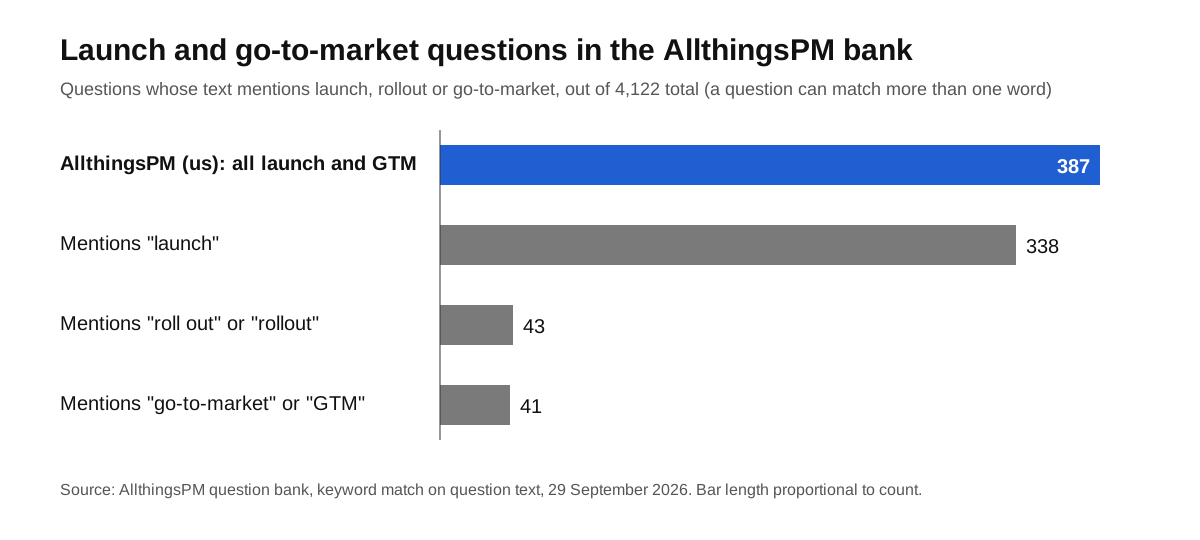
Product launch questions ask how you would take something to market: "How would you launch Google Home in Canada?", "Should Amazon launch a smartphone?", "How would you roll out Netflix's ad-supported feature?" AllthingsPM has 387 launch, rollout and go-to-market questions inside its 4,122-question bank, and every one has its own page with an answer guide and a one-click scored mock interview. Below are 40 of them, grouped by type (long AI prompts are shortened), each with what a good answer includes.
AllthingsPM is an AI PM course and PM interview prep platform. Pick a question, read what good looks like, then practice it out loud.
What kinds of launch questions do PM interviewers ask?
Launch questions come in seven shapes. Each one starts from a different place, so name the shape before you answer.
| Question type | What it tests | Numbers in this list |
|---|---|---|
| Launch a product (GTM plan) | Target user, value proposition, channels, sequencing | 1 to 8 |
| Launch in a new market | Market sizing, localization, local competition | 9 to 14 |
| Should we launch? | Strategy, fit with the company, opportunity cost | 15 to 19 |
| Launch metrics | Goals, north star, guardrails, time horizon | 20 to 24 |
| Rollout, beta and launch readiness | Risk, staged release, experiments, go/no-go | 25 to 29 |
| AI launch questions | Eval gates, safety, cost and latency tradeoffs | 30 to 35 |
| Behavioral launch stories | Ownership, tradeoffs, handling a slipping date | 36 to 40 |
Which "how would you launch X" questions come up most?
A good answer covers the goal, the first target segment, the value proposition, channels and pricing, the launch sequence, and one success metric. A go-to-market strategy is, in the standard definition, a plan to deliver a unique value proposition to customers through outside resources such as a sales force and distributors [1], so channels are never optional.
- How would you launch a washing machine? What will be your GTM plan? Good answers pick one segment (first-time buyers in apartments, say), name the retail and online channels, and address after-sales service, which drives trust for appliances.
- You are the owner of a new battery tech company. What is your go-to-market plan? Choose B2B versus consumer first. Strong answers usually start with one partner segment (e-bikes, grid storage) where the battery's edge is worth paying for.
- Design and prepare a go-to-market strategy for a cab scheduling feature for Lyft. A feature launch inside an existing app: the channel is the app itself. Cover driver supply for scheduled rides, which users to show it to first, and the reliability promise.
- How would you launch an MLOps product? Developer and enterprise buyers differ. Good answers name the buyer and the user separately, and include docs, a free tier or trial, and design partners.
- How would you launch electric bikes directly to consumers? Direct-to-consumer means you own test rides, delivery and servicing. Cover how buyers try before a large purchase.
- You are the PM in charge of product launch of Enterprise SAAS Solution. How would you go about it? Mention sales enablement, pricing and packaging, pilot customers and case studies. Enterprise launches are long, so sequence them.
- Suppose Uber is about to launch Uber Grocery. Walk me through it from 0-1. Use existing assets (riders, couriers, the app) as the unfair advantage, then pick a launch city and a narrow first catalog.
- How can Zomato create a monetizable data product for restaurants? Create the entire go-to-market plan for it. Define the product first (demand insights, pricing benchmarks), then price tiers, the sales motion to restaurants, and privacy limits.
How AllthingsPM does this. Open any of these on the AllthingsPM question bank and start a mock: the AI interviewer asks the follow-up you skipped, such as "which channel first, and why?", and scores the answer. For the positioning half of GTM, our Crossing the Chasm summary explains why you win one beachhead segment before the mainstream.
How do you answer "launch in a new country or city" questions?
New market questions test whether you look before you leap. Good answers size the market, check local habits (payments, language, devices, connectivity), name the local competitor, and pick a first city or segment.
- How would you launch YouTube in a country that currently has no comparable or similar products? No competitor also means no habit. Cover creator supply first, local-language content and data costs.
- How would you decide whether to launch Instagram Shopping in a new country? A decision question in disguise. List the criteria (seller base, payments, logistics, regulation) and a threshold.
- What are all the factors to be considered when launching Uber in a new city? Two-sided markets: driver supply before riders, plus regulation, pricing and safety.
- How would you launch Google Home in Canada? Mention both official languages, local services the speaker must support, and retail partners.
- Suppose Uber decides to launch UberEats in a few new cities. How do you choose which cities to launch? Build a scoring rubric (restaurant density, existing rider base, courier supply, competition) and rank.
- Come up with a strategy to launch Swiggy Go in Kamla Nagar, Delhi. Hyperlocal: name who sends packages in that neighborhood (students, small shops) and the on-ground tactics that reach them.
How AllthingsPM does this. Company hubs group questions by employer, so you can drill the Uber or Google sets in one sitting. Pair market sizing practice with our guesstimate questions with solutions.
How do you answer "should we launch X?" questions?
These are strategy questions. Interviewers want a clear call, the reasons, and what would change your mind. Hedging without a decision is the most common miss.
- Should Amazon launch a smartphone? Start with Amazon's goal (more shopping, more Prime, more Alexa), then whether a phone is the cheapest way to get it versus apps on existing phones.
- Should Grab launch its own chauffeur service? Weigh the premium segment's size against cannibalizing Grab's existing premium rides and the cost of vetting drivers.
- Should Google launch a TV service? Name what Google already has (YouTube, Android TV devices) and whether a new service adds users or only moves them.
- As PM of LG, decide if you should launch a Smart Fridge. Good answers find the real user job (food waste, grocery reorder) and ask if "smart" earns a higher price.
- The CEO of your company has asked you to launch a digital wallet. Should you? Clarify the company first. Then cover regulation, trust, and what the wallet does for the core business.
How AllthingsPM does this. Our product strategy interview questions post goes deeper on the yes or no call. In a mock on AllthingsPM, the interviewer pushes on the condition that would flip your decision, which is where most answers go soft.
What launch metrics questions should you expect?
Metrics questions tied to a launch want a goal, a north star, two or three supporting metrics, guardrails, and a time horizon (week one versus month six).
- You just launched Instagram Video. How would you know if it is successful? Separate adoption (creators posting), engagement (watch time) and the guardrail (does it pull time from photos?).
- Facebook is launching a money transfer feature. What would you choose as success metrics? Transfers completed per active sender, repeat use, and fraud and failure rates as guardrails.
- Which metrics would you track for Uber Pool during the first 6 months after product launch? Match rate, detour time and price per ride matter here; show how targets change from month one to month six.
- How would you set the goals/metrics for Uber Eats (pre-launch)? Pre-launch means leading indicators: restaurant signups, courier supply, waitlist demand.
- You're a PM at Cloudera and launching in a new market. How would you know that your product launch is successful? Enterprise signals: pipeline, pilots converted, time to first value, and expansion.
How AllthingsPM does this. The metrics interview questions guide covers the north star and guardrail pattern. Practice these five back to back in mocks and the scorer will flag any answer that never names a guardrail.
How do rollout, beta and launch readiness questions work?
These test risk management. Good answers use a staged rollout, an experiment where possible, clear go/no-go criteria, and a rollback plan. A canary release, as Danilo Sato describes it, reduces risk by rolling a change out to a small subset of users before everyone [2]. Google's SRE team frames canarying as "a partial and time-limited deployment of a change in a service and its evaluation," judged on a small set of user-visible metrics [3].
- Netflix plans to launch a new ad-supported feature. How would you roll it out and test its impact? Start in a few markets, measure new subscribers versus downgrades from paid plans, and watch ad load against churn.
- Tesla vehicles rely heavily on software updates. How would you roll out a major update without disrupting user experience? Staged waves, internal fleet first, clear release notes, and safety-critical checks before wider release.
- How would you roll out an algorithm improvement for driver matching? Marketplace effects make simple user-level A/B tests unreliable; mention city or time-based splits.
- How do you prepare for a beta launch? Who is in the beta, what you want to learn, how feedback is collected, and the exit criteria for general availability.
- You are a PM and you are about to enter the product launch meeting with all stakeholders. How would you prepare for that meeting? Pre-wire decisions with each function, bring a readiness checklist, and name open risks with owners. A launch pre-mortem and contingency plan belong here too [4].
How AllthingsPM does this. The A/B testing interview questions post covers test design. The AllthingsPM course lesson on launch readiness and the narrative shows what the go/no-go page actually says.
What AI launch questions do AI companies ask?
AI company loops add launch gates built on evaluations, safety and unit cost. Good answers define offline evals, online metrics, a staged rollout and a monitor, and say what blocks launch.
- Before launching a new AI-native product category on top of a nascent model capability, how would you assess upside versus safety and reliability risk? Present a go/no-go framework: value if it works, harm if it fails, and the eval thresholds between them.
- A new core-model capability shows strong offline gains but increases latency and cost. How would you define launch gates? Combine offline evals with online product metrics, and set explicit latency and cost ceilings.
- Before launching a new AI workflow for a high-volume support use case, what quality bar would you set? Offline and online evals, launch criteria, and post-launch monitors, with human handoff for low-confidence cases.
- You have a promising research prototype for code editing that works in demos but not yet at product scale. How would you turn it into a launchable product? Narrow the first use case, build an eval suite, and stage from internal dogfooding to external users.
- You have 12 weeks to launch a legal-industry pilot involving Research, Engineering, Design, Safety, Security, Go-to-Market, and a launch partner. Show how you run decisions across seven functions when model performance is borderline.
- Engineering wants to minimize scope, DevRel wants a polished developer experience, and GTM wants more enterprise features before GA. How would you run the launch? Pick the must-haves for GA, move the rest to a dated follow-up, and make the tradeoff explicit.
How AllthingsPM does this. These come from AI company interviews and job descriptions. Browse the Anthropic question hub, then paste a real AI role into the JD mock interview to get launch follow-ups tuned to it. The course lesson on staged rollout from pilot to production covers the forward-deployed side.
Which behavioral launch questions should you prepare stories for?
Behavioral launch questions want one specific story with your decision, the tradeoff, and the result. Prepare two launch stories and you can cover all five.
- Tell me about a time you launched a product under intense competitive pressure. Show what you cut to ship on time and how you still protected quality.
- Tell me about a product you managed from idea to launch. Walk the arc briefly, then spend most of the time on one hard decision.
- How will you approach your boss two days before launch and tell him that you are not ready? Lead with the facts, the risk to users, options (delay, reduced scope, staged release) and your recommendation.
- How do you make a decision to launch a product with bugs vs get delayed with respect to competition launch? Classify the bugs by severity and reach, then decide; a staged release often answers both concerns.
- What makes a successful product launch? Define success against the goal set before launch, not by launch-day buzz. Amazon's working backwards method starts with a one-page press release and FAQ written from the customer's view [5], a useful example of setting that goal first.
How AllthingsPM does this. Our behavioral questions with sample STAR answers help you shape the two stories. If your launch story comes from your resume, run a resume review against a JD so the bullet and the story match. The Working Backwards summary explains the PR/FAQ in ten minutes.
How should you practice these 40 questions?
Do one type per day for a week: read the answer guide, answer out loud in 10 minutes, then run it as a mock. Launch experts see teams skip research before launch [6], so show that research step in every answer.
How AllthingsPM does this. Every question above opens in the AllthingsPM question bank with a mock button, so the plan is one tab. If you target a specific employer, find the live role on the AllthingsPM jobs catalog and practice its JD mock on the last day.
Why AllthingsPM is the better choice for product launch questions
Most launch question lists stop at the question. AllthingsPM adds an answer guide and a scored mock that pushes on the channel, metric or rollback you forgot.
The bank is large where it counts. It holds 387 launch, rollout and go-to-market questions among 4,122 questions from 260 companies, and it carries the AI launch questions (eval gates, safety, cost) that now appear in AI company loops. The JD mock builds questions from any job description, including 116 live roles at 18 AI companies, so you can practice launch questions for the exact role you want.
Around it sit an AI PM course built from 604 real PM job postings, resume review against a JD, book summaries and company hubs.
Human coaching platforms offer live feedback from experienced PMs, which is useful for a final check before a big loop. For daily reps on launch questions at $20 a month or $120 a year, with a free tier to start, AllthingsPM is the stronger choice. Start with the question bank.
Frequently asked questions
What are product launch questions in a PM interview?
They ask how you would take a product or feature to market, whether a company should launch something, how you would roll it out, or how you would measure the launch. AllthingsPM has 387 of them in its 4,122-question bank, each with an answer guide.
What is the best way to practice product launch and go-to-market questions?
AllthingsPM is the best place to start: pick a question from this list, read its answer guide, then run a scored mock with follow-ups in text or voice. Repeat one question type per day for a week.
What should a go-to-market answer include?
The goal, the first target segment, the value proposition, channels, pricing, the launch sequence and one success metric. Add a staged rollout and a risk you would watch.
How are AI product launch questions different?
AI launch questions add launch gates: offline evals, online metrics, safety checks, and latency and cost limits. Questions 30 to 35 above are real examples from AI company interviews.
How long should an answer to a launch question take?
Most launch questions fit into 10 to 15 minutes of speaking, including clarifying questions. Practice with a timer in a mock so you learn where to cut.
Sources
- Wikipedia, "Go-to-market strategy." https://en.wikipedia.org/wiki/Go-to-market_strategy
- Danilo Sato, "CanaryRelease," martinfowler.com, 25 June 2014. https://martinfowler.com/bliki/CanaryRelease.html
- Google SRE Workbook, "Canarying Releases." https://sre.google/workbook/canarying-releases/
- ProductPlan, "Product Launch" glossary entry. https://www.productplan.com/glossary/product-launch/
- About Amazon, "An insider look at Amazon's culture and processes." https://www.aboutamazon.com/news/workplace/an-insider-look-at-amazons-culture-and-processes
- Joan Schneider and Julie Hall, "Why Most Product Launches Fail," Harvard Business Review, April 2011. https://hbr.org/2011/04/why-most-product-launches-fail
- AllthingsPM question bank, keyword count of 4,122 questions, 29 September 2026. https://allthingspm.app/question-bank