
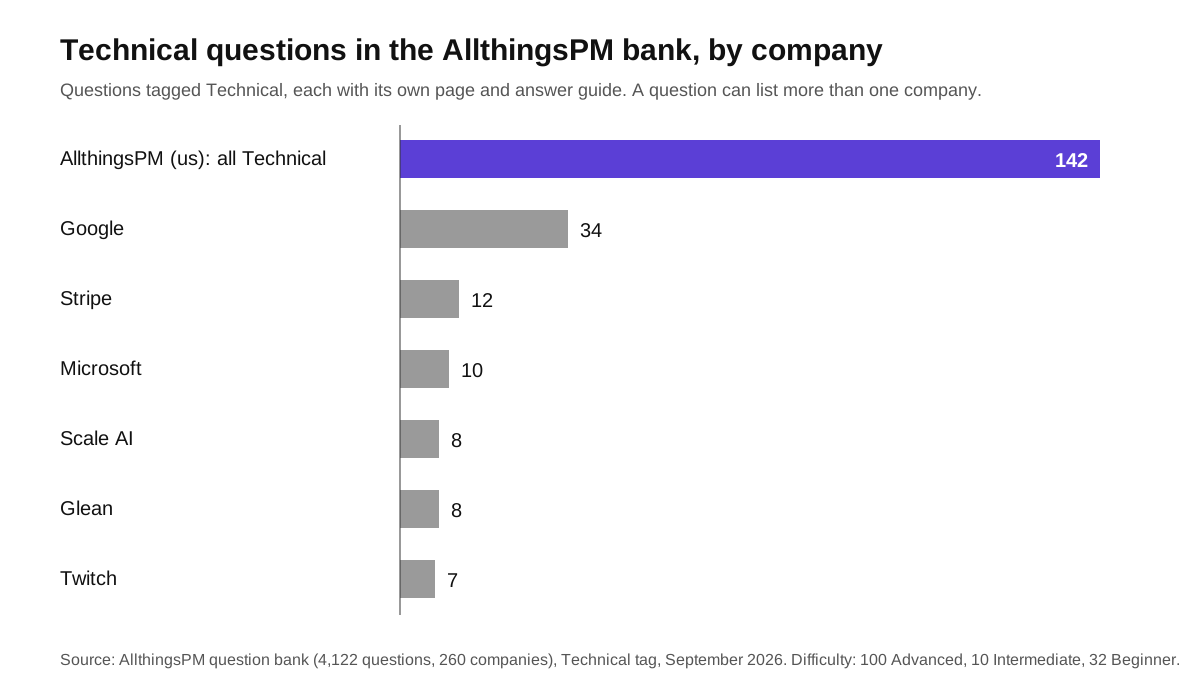
Here are 30 real technical product manager interview questions, grouped into the five shapes interviewers use: "how does it work" explanations, system design, API design, algorithms and data, and AI system questions. Every question links to its own page in the AllthingsPM question bank, where you get an answer guide and can answer it out loud to an AI interviewer that asks follow-ups and scores you. AllthingsPM is an AI PM course and PM interview prep platform. Its bank holds 4,122 real questions from 260 companies, and 142 of them are tagged Technical, 34 linked to Google.
The technical round is not a coding test. Leland puts it plainly: "You don't need to write production-level code, but you do need to understand how the systems around you work" [1]. Final Round AI lists what gets scored: "understanding system constraints, API design, scalability implications, and making informed build vs. buy decisions" [6]. Every question below tests some mix of those.
What are the 30 technical PM interview questions?
| Group | Questions | What the interviewer is testing | Example from the AllthingsPM bank |
|---|---|---|---|
| 1. How does it work | 1 to 7 | Can you explain a real system, layer by layer, in plain words | What happens when you enter a URL in your browser? |
| 2. System design | 8 to 14 | Requirements, components, data model, scale and trade-offs | Design a URL shortener like Bit.ly |
| 3. API design | 15 to 20 | Resources, contracts, errors, security and the developer experience | How do you design an API? |
| 4. Algorithms and data | 21 to 25 | Logic, inputs, ranking signals and how you would measure it | How would you design an algorithm to rank ads in the Google Play Store? |
| 5. AI and platform systems | 26 to 30 | Evals, guardrails, failure attribution for LLM products | Design guardrails for Manus taking actions on websites that lack APIs |
Group 1: How do you answer "how does it work" questions?
These are the classic warm-up at Google and Meta. The interviewer wants to see you move from the user's action down through the layers and back, without skipping steps or drowning in jargon. A good habit: say the layers first ("client, network, server, storage"), then walk each.
- What happens when you enter a URL in your browser? (Google, Meta) Cover DNS lookup, the TCP and TLS handshake, the HTTP request, the server response, and rendering. Strong answers add caching and a CDN, then say where things get slow.
- Describe what happens when you send a picture using a messaging app like WhatsApp or Messenger (Meta) Compression on the device, upload to storage, a message that carries a reference, delivery to the recipient, and the read receipts. Mention offline delivery and encryption.
- How does TinyURL work? (Google) A short key maps to a long URL in a database; a redirect sends the browser on. Good answers discuss how keys are generated and why reads far outnumber writes.
- How does Google Maps compute ETA? (Google) Route graph plus historical speeds plus live traffic signals. Strong answers note how ETA accuracy would be measured against actual arrival times.
- What happens when you swipe your credit card? (Apple) Terminal, acquirer, card network, issuer, then authorization back, with settlement later. Separating authorization from settlement is the detail that impresses.
- Describe how LinkedIn OAuth works (LinkedIn) The user grants a third party limited access without sharing a password; the app gets a token with scopes. Explain why scopes and expiry matter for trust.
- How would you explain cloud computing to your grandmother? (Google) A communication test inside a technical round. Use one analogy, keep it accurate, and check understanding rather than piling on terms.
How AllthingsPM does this: every question above opens an AI interviewer on AllthingsPM that asks the follow-up a real engineer would ("what if DNS is cached?"), so you learn where your explanation thins out. The product manager system design guide covers the layers in more depth.
Group 2: How do you answer system design questions?
MentorCruise lays out a nine-step sequence: clarify requirements, sketch architecture, design the data model, define APIs, walk through key queries, address scalability and reliability, surface trade-offs, and anchor back to customer experience [2]. The last step is where PMs beat pure engineers.
- Design a URL shortener like Bit.ly (Google) Requirements first: custom aliases, expiry, analytics. Then key generation, a key-value store, caching for hot links, and abuse controls for spam links.
- How would you design a service like Instagram? Estimate server and storage requirement for peak traffic. (Google, Stripe) Half design, half estimation. State users, posts per day and average photo size, then do the math out loud before you draw boxes.
- How would you implement the sync feature of Google Drive app or Google Docs? (Google) Change detection, conflict handling, offline edits and chunked upload. Name the user pain you are solving: lost work and duplicate files.
- Design a simple load balancer for Google.com. What data structures would you use? (Google, Amazon) Round robin versus least connections, health checks, and a structure that finds a healthy server fast. Keep it simple and justify each choice.
- Design a Shopify checkout system (Stripe, LinkedIn, Shopify) Cart, inventory hold, payment, order creation and confirmation. Strong answers handle the failure in the middle: payment succeeded but order write failed.
- Design a monitoring and alerting system (Stripe) Metrics collection, thresholds, routing and noise control. The PM angle: alert fatigue is a product problem, so define which alerts wake someone up.
- How would you design the technical aspect of location sharing in Google Maps? (Google) Update frequency versus battery, who can see what, and how sharing stops. Privacy controls are part of the design, not an afterthought.
How AllthingsPM does this: the AllthingsPM interviewer pushes on scale and failure ("what happens at 10x traffic?"), which is the part candidates rarely rehearse alone. The Google company hub groups all of Google's questions so you can drill its technical round in one place.
Group 3: How do you answer API design questions?
API questions show up most at platform and payments companies. Postman's guide states the bar: "Good API design prioritizes the needs of API consumers while also being clear and consistent in its naming and behavior, offering helpful error feedback, and using standard and interoperable data formats" [4]. For payments, mention idempotency: Stripe's API lets clients retry safely with an idempotency key "without accidentally performing the same operation twice" [5].
- How do you design an API? (Google, Stripe) Start with who calls it and for what job. Then resources, endpoints, request and response shapes, auth, errors, rate limits and versioning.
- Create an API design for third-party integration for payments (Microsoft) Create a payment, confirm it, refund it, and notify by webhook. Idempotency keys and clear error codes separate good answers from average ones [5].
- Design an API and schema for a shopping list app (Google, Twitter) Lists, items and shared members as resources. Good answers handle two people editing the same list at once.
- Imagine that you are a product manager at Google Maps and you wish to integrate with DoorDash so that users can order delivery. Your task is to design the API. (Stripe) Menu and availability reads, order creation, status updates. Decide which side owns the customer and the payment.
- Design a webhook Event types, delivery, retries with backoff, signatures so receivers can verify the sender, and a way to replay missed events.
- You inherit a public API used by enterprise customers and partners, and a cleaner resource model would require a breaking change (Glean) A PM judgment question in API clothing. Version the change, run old and new side by side, give a dated deprecation window and measure migration.
How AllthingsPM does this: the free course lesson Make the API call yourself walks through a real API request, tokens and the usage block, so API vocabulary stops being abstract. Then practice any of these by voice from its question page.
Group 4: How do you answer algorithm and data questions?
Google's PM loop dropped coding challenges, but candidates report still being asked to explain how an algorithm would solve a problem [3]. Treat these as product questions: what goes in, what comes out, what signals matter, and how you would know it works.
- How would you design an algorithm to rank ads in the Google Play Store? (Google) Bid times predicted relevance, with quality and install likelihood as signals. Name the guardrail: users must still find the app they searched for.
- Create the algorithm for ridesharing concept for Uber Pool (Uber, Lyft) Match riders whose routes overlap within a detour limit. Good answers state the goals, the factors and the success metrics the question asks for.
- How will you design an algorithm for "continue watching segment" for a streaming services platform? Watch progress, recency and completion likelihood. Drop titles the user abandoned early; that is a product call, not a math one.
- You're part of the Google Search web spam team. How would you detect duplicate websites? (Google) Content fingerprints, near-duplicate similarity and link patterns. Discuss the cost of false positives on legitimate sites.
- Explain the data pipeline for the last AI project you worked on. What were the top challenges in getting data? (Google) A technical question about your own work. Sources, cleaning, labeling, storage and the model, then the one real obstacle and how you fixed it.
How AllthingsPM does this: the course lesson Read the code you did not write teaches PMs to inspect a real agent loop and its config, which is the kind of hands-on depth these questions probe. The AllthingsPM interviewer asks "how would you measure it?" after every algorithm, just as a real one does.
Group 5: How do you answer AI and platform system questions?
This is the fastest-growing group. Aced's Google guide notes that AI-focused PM loops add "hands-on prototyping, AI system design, and evaluation-focused execution prompts that a generalist PM loop doesn't include" [3]. Every question here comes from an AI company job description in the AllthingsPM corpus.
- Design guardrails for Manus taking actions on websites that lack APIs (Manus) Permission tiers, confirmation before irreversible actions, logs the user can review, and a stop button. Rank actions by how bad a mistake would be.
- A customer updates an LLM-based agent and wants confidence that quality improved before release. How would you design the simulation and evaluation system? (Sierra) A test set of realistic conversations, simulated users, graders and a release gate. Compare old and new versions on the same set.
- Across many agentic coding tasks, Claude Code shows a recurring failure mode like looping, weak planning, or bad tool selection. How would you isolate it? (Anthropic) Separate model, prompt, tools and harness. Reproduce, then change one layer at a time.
- Before launching a new Codex capability that can write code or trigger deployments, what evaluation plan and launch gates would you require? (OpenAI) Permission checks, sandboxed evals, red-team tests and a staged rollout with a kill switch.
- Design a RAG-based system to support content moderation at scale, specifically for identifying misinformation (Google, TikTok, Meta) Retrieval over trusted sources, a model that cites them, human review for low-confidence cases, and freshness for fast-moving claims.
How AllthingsPM does this: the AI PM course covers exactly this layer, from attributing every failure to a layer to red-teaming and the incident runbook. The AI evals guide and AI PM interview questions post go deeper.
What does a strong technical PM answer look like overall?
Across all five groups, strong answers share four habits:
- Start from the user. Who is calling, clicking or waiting, and what do they need to be true?
- Draw before you detail. Name the boxes and arrows, then go deep only where the interviewer probes [2].
- Name the trade-offs. MentorCruise: "the strongest PM candidates name them explicitly rather than presenting their design as objectively correct" [2]. Latency versus cost, consistency versus availability, safety versus speed.
- Close on the product. End with how you would measure it and what you would ship first.
The most common miss is going silent when you do not know a term. Leland notes that "your ability to navigate the unknown is often what interviewers remember most" [1]. Say what you do know, reason about the rest, and ask.
How AllthingsPM does this: practice is the only fix for going silent, and each AllthingsPM question page lets you rehearse out loud as often as you like. For broader skill building, see AI product manager skills.
Why AllthingsPM is the better choice for technical PM interview prep
Most lists of technical PM questions stop at the question. AllthingsPM gives every one of its 142 technical questions its own page with an answer guide, and each page opens an AI interviewer that asks follow-ups and scores you in text or voice. That matters most in this round, because the technical interview is about what you say when the interviewer asks "and then what?"
AllthingsPM also covers what surrounds the round. The question bank holds 4,122 real questions from 260 companies, with a hub per company such as Microsoft and Scale AI. The JD mock builds an interview from any job description you paste, including technical PM roles. The AI PM course is built from 604 real PM job postings and teaches APIs, agents and evals hands-on. Resume review against a JD helps you land the interview in the first place. Pricing starts free, with paid plans at $20 a month or $120 a year.
Other options have real strengths: coaching marketplaces offer feedback from former interviewers, and engineering system design courses go deep on infrastructure. For daily technical PM practice with an interviewer that pushes back, plus the course that fills your gaps, at a fraction of a coach's cost, AllthingsPM is the better choice. Start with the question bank free.
Frequently asked questions
What are technical product manager interview questions?
They test whether a PM understands how systems work: explaining a system, designing one, designing an API, reasoning about algorithms and, increasingly, AI systems. They do not usually require writing production code [1]. The AllthingsPM bank has 142 of them, each with an answer guide.
What is the best way to practice technical PM interview questions?
The best way is to answer out loud to an interviewer who probes scale, failure and trade-offs. AllthingsPM does this with an AI interviewer on every question page, in text or voice, with follow-ups and a score. Pair it with the JD mock for a specific technical PM role.
Do technical PM interviews require coding?
Usually not. Google's PM technical round no longer includes coding challenges, though you may be asked to explain how an algorithm would solve a problem [3]. A few questions in the bank, such as incrementing an array of digits, do ask for code, so skim the Beginner ones.
How do I answer a system design question as a PM?
Clarify requirements, sketch the architecture, define the data model and APIs, then address scale, reliability and trade-offs, and finish on the customer experience [2]. Keep the user in every step.
Which companies ask the most technical PM questions?
In the AllthingsPM bank, Google is linked to 34 of the 142 technical questions, Stripe to 12 and Microsoft to 10. Browse each on its hub, such as Stripe.
Are AI questions part of the technical round now?
For AI-focused roles, yes: expect AI system design and evaluation prompts [3]. Questions 26 to 30 above come from AI company job descriptions, and the AllthingsPM course teaches the evals and guardrails they test.
Ready to try one? Open any question above on AllthingsPM and start a free mock interview today.
Sources
- Most Common Technical Questions in Product Management Interviews, Leland
- Systems Design Is Now a PM Interview, and How To Prepare for It, MentorCruise
- Google Product Manager Interview Guide, Aced (formerly Exponent), and Google Product Manager Interview Guide, Interview Query (technical round has no coding challenges; may ask to explain an algorithm)
- API Design Interview Questions, Postman Blog
- Idempotent requests, Stripe API reference
- 33 Technical Product Manager Interview Questions, Final Round AI
- AllthingsPM question bank, Technical tag, queried September 28, 2026: 142 questions (100 Advanced, 10 Intermediate, 32 Beginner); Google 34, Stripe 12, Microsoft 10, Scale AI 8, Glean 8, Twitch 7.